
Liquidity Mining Earnings Calculator
How Liquidity Mining Works
You earn two ways: 1) Trading fees (0.3% per swap) and 2) New tokens (like UNI, SUSHI). The calculator shows potential earnings based on your deposit.
Results
Imagine earning free cryptocurrency just by leaving your coins in a digital wallet - no trading, no guessing market swings, no late-night screen staring. That’s the real promise of liquidity mining. It’s not magic. It’s mechanics. And it’s changed how everyday people interact with decentralized finance.
Before liquidity mining, DeFi was stuck. New protocols couldn’t attract traders because there wasn’t enough money in the pools. No liquidity meant big price jumps on small trades. No one wanted to use them. Then came Uniswap’s 2020 UNI token drop. Suddenly, people weren’t just swapping tokens - they were getting paid to make it possible. Within months, DeFi’s total value locked jumped from $1 billion to over $100 billion. That wasn’t just growth. It was a system reboot.
More Liquidity, Smoother Trades
Think of a liquidity pool like a shared cash register. When you add $500 worth of ETH and $500 worth of USDC to a pool, you’re helping traders swap between those two coins. The more money in the pool, the less the price moves when someone buys or sells. That’s called low slippage. For big traders, that’s a game-changer. For regular users, it means your trade executes close to the price you see.
Without liquidity mining, these pools would stay empty. Why would anyone put up their crypto if they weren’t getting paid? Liquidity mining solves that. It turns idle assets into active market fuel. And the result? Markets that behave more like real financial systems - not guesswork.
Real Passive Income, No Job Required
You don’t need to be a trader to benefit. You just need to hold crypto. If you’ve got some LINK, DAI, or MATIC sitting around, you can put them into a liquidity pool and start earning. Rewards come two ways: trading fees and new tokens.
Every time someone swaps tokens in your pool, a tiny fee is charged. That fee gets split among all liquidity providers. If your pool handles $1 million in trades a day, you get a slice of that. Then there are the bonus tokens - often governance tokens like UNI, SUSHI, or CAKE. These aren’t just free money. They give you a say in where the protocol goes next.
It’s passive in the truest sense. Set it up. Walk away. Come back a week later and check your balance. No charts. No news alerts. Just crypto growing in the background.
Small Investors Get a Seat at the Table
In traditional finance, only banks and hedge funds get to be market makers. They have the capital, the tech, the teams. In DeFi? Anyone with $100 can join. Liquidity mining breaks down that wall.
Before, if you wanted to own a piece of a new DeFi project, you had to buy its token early - often at a huge premium, or through private sales you couldn’t even access. Now, you can earn it. By providing liquidity, you’re not just a user. You’re a contributor. And you get rewarded in the protocol’s own currency.
This isn’t just fair. It’s transformative. It means a college student in Manila and a retiree in Texas can both earn the same UNI tokens as a venture fund. The playing field is level.

Protocols Grow Faster - And You Benefit
Launching a new DeFi app is hard. No one uses it if no one can trade on it. Liquidity mining fixes that chicken-and-egg problem. A new project offers token rewards to anyone who adds liquidity. People show up. Trading volume spikes. More users come. The protocol gains traction. And you? You got paid to help make it happen.
This is why so many new projects start with liquidity mining. It’s the fastest way to bootstrap a market. And the early participants? They’re often the ones who end up holding the most valuable tokens when the project takes off.
Price Discovery Gets Real
When a token has low trading volume, its price is just a guess. One big buy order can spike it 30%. That’s not a market - that’s a lottery.
Liquidity mining changes that. More money in the pool means more buyers and sellers. Prices stabilize. The market starts reflecting real demand, not just hype. That’s good for everyone. If you’re holding a token, you want to know its price is accurate. If you’re trading, you want to know you’re not getting ripped off.
DeFi’s whole goal is to remove middlemen. Liquidity mining makes that possible by creating honest price signals - without banks, without brokers, without manipulation.
It’s Not All Free Money - Know the Risks
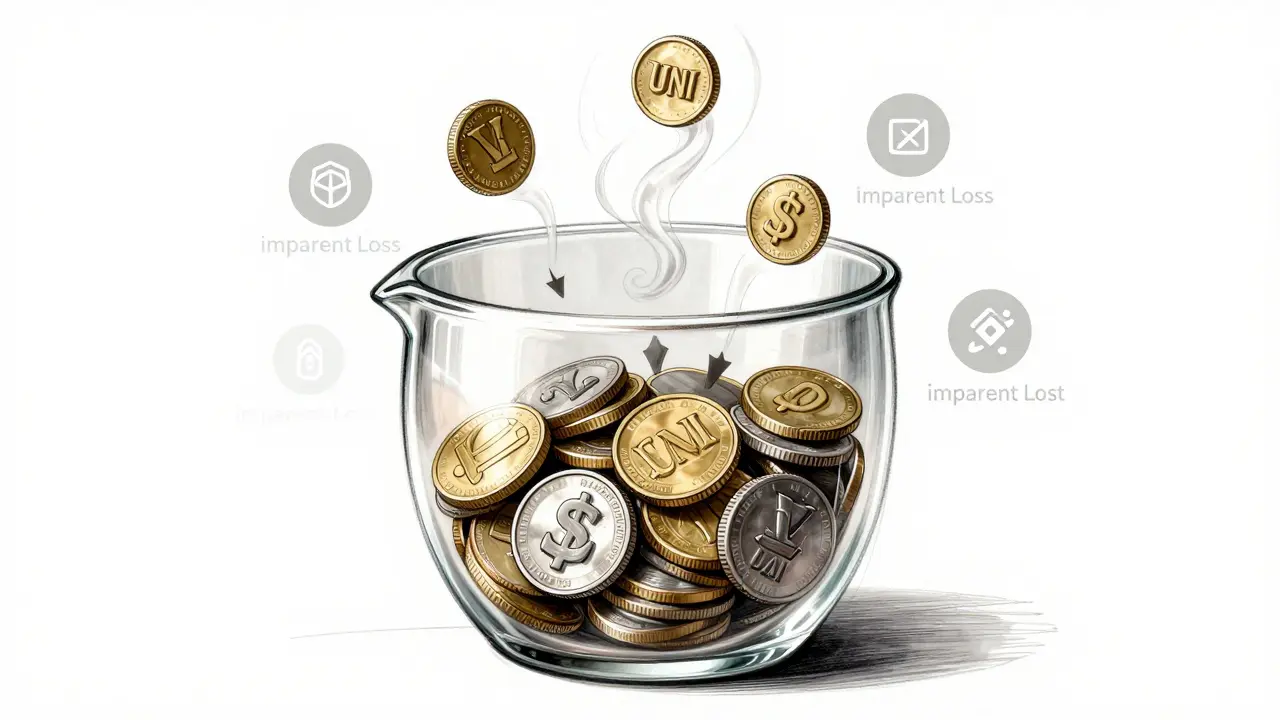
Don’t get fooled. Liquidity mining isn’t risk-free. The biggest one? Impermanent loss. It happens when the price of the two tokens in your pool changes after you deposit them. If ETH goes up and USDC stays flat, you’ll end up with less value than if you’d just held them in your wallet.
It’s called “impermanent” because if the prices go back to where they started, the loss disappears. But if they don’t? You lose money. And you still have to pay gas fees to enter and exit.
Also, some projects offer insane APYs - 100%, 500%, even 1000%. That’s not sustainable. Those are often scams or dying protocols trying to attract one last wave of users. Always check how long the rewards have been running. If it’s been 3 months and the APY is still sky-high, be skeptical.
And don’t forget: you’re not just earning tokens. You’re holding them. If the token’s price crashes, your rewards lose value. That’s why some people hedge by shorting their rewards or using stablecoin pairs like USDC/DAI.
Where to Start
Stick to well-known platforms if you’re new. Uniswap, SushiSwap, and PancakeSwap have been around for years. Their interfaces are clean. Their code is audited. Their liquidity pools are deep.
Start with stablecoin pairs. USDC/ETH or DAI/USDT. They’re less volatile. Less risk of impermanent loss. Once you understand how it works, you can try riskier pairs.
Use tools like DeFi Llama or Zapper to compare APYs across pools. Don’t just chase the highest number. Look at the total value locked. A pool with $50 million in it is safer than one with $500,000.
And never invest more than you’re willing to lose. This isn’t banking. It’s experimental finance.
Why This Isn’t Going Away
Liquidity mining isn’t a fad. It’s a solution to a real problem: how do you get people to fund a system that doesn’t have a bank behind it? The answer? Incentivize them.
As more institutions enter DeFi, they’ll need liquidity too. And they’ll use the same tools - just with bigger wallets. That means even more rewards, more stability, and more opportunities.
The future of finance isn’t centralized. It’s decentralized. And liquidity mining is the engine that makes it run.
What is liquidity mining?
Liquidity mining is when you deposit cryptocurrency into a decentralized exchange’s liquidity pool and earn rewards in return. These rewards usually come as trading fees and new tokens from the protocol. It’s how DeFi platforms attract users and keep markets active.
Is liquidity mining the same as yield farming?
Liquidity mining is a type of yield farming. Yield farming is the broad term for earning rewards by locking up crypto. Liquidity mining specifically refers to earning rewards by providing liquidity to decentralized exchanges. So all liquidity mining is yield farming, but not all yield farming is liquidity mining.
How do I earn from liquidity mining?
You earn two ways: 1) A share of the trading fees generated by your liquidity pool, and 2) New tokens issued by the protocol (often governance tokens). The more you contribute to the pool, the bigger your share. Rewards are automatically added to your wallet.
What is impermanent loss?
Impermanent loss happens when the price of the two tokens in your liquidity pool changes after you deposit them. You end up with less value than if you’d just held the tokens in your wallet. It’s called “impermanent” because if prices return to their original levels, the loss disappears. But if they don’t, it becomes permanent.
Are liquidity mining rewards taxable?
In most countries, the tokens you earn from liquidity mining are treated as income when you receive them. You may owe taxes based on their fair market value at that time. Selling or trading those tokens later could trigger capital gains taxes. Always consult a tax professional familiar with crypto regulations in your country.
Can I lose my principal in liquidity mining?
Yes. If the value of the tokens in your pool drops significantly, or if the protocol fails or gets hacked, you can lose part or all of your initial deposit. Even with stablecoin pairs, there’s risk from smart contract bugs or sudden market crashes. Never put in more than you can afford to lose.
What’s the safest way to start liquidity mining?
Start with a well-known platform like Uniswap or PancakeSwap. Use stablecoin pairs like USDC/DAI or USDT/USDC. These are less volatile and have lower risk of impermanent loss. Keep your initial deposit small. Learn how the interface works. Monitor your position for a few weeks. Only increase your stake once you understand the risks.
Do I need to stake my LP tokens to earn rewards?
Usually, yes. After you deposit tokens into a liquidity pool, you get LP tokens as proof of your share. You then need to stake those LP tokens in a farm or reward contract to start earning the protocol’s bonus tokens. Skipping this step means you’ll only earn trading fees - not the extra rewards.
Liquidity mining turned idle crypto into active capital. It gave ordinary people a real role in building the future of finance - not as customers, but as contributors. And that’s why it’s still growing, even as markets shift and trends fade.


Stanley Machuki
12 December, 2025 . 01:37 AM
This is the real deal. Set it and forget it. My DAI/USDC pool just made me more in a week than my side hustle.
Sue Gallaher
13 December, 2025 . 16:55 PM
Liquidity mining is why america still leads in innovation forget europe and china theyre just copying
Ike McMahon
15 December, 2025 . 13:51 PM
Start with stable pairs. Seriously. Dont chase 500% APYs. Youre not a trader youre a saver.
Ian Norton
16 December, 2025 . 05:47 AM
The math here is flawed. Youre ignoring the tax implications and the fact that 90% of these pools are rug pulls disguised as innovation. The APYs are bait. The gas fees are the real cost.
Rakesh Bhamu
17 December, 2025 . 15:12 PM
In India we call this "digital chai money". Small investors finally have a shot. I started with $50 in USDC/DAI. Now I have a few UNI tokens and I actually feel like part of the system. No broker needed.
Eunice Chook
18 December, 2025 . 06:10 AM
It's not passive income. It's risk arbitrage with emotional labor. You're not earning. You're gambling with your capital under the illusion of autonomy.
Scot Sorenson
19 December, 2025 . 00:02 AM
So you're telling me I should trust a smart contract written by anonymous devs in a Discord server with a 200% APY? Cool. I'll just send my life savings to a meme coin pool then
Candace Murangi
20 December, 2025 . 21:40 PM
I tried this last year. Lost half my ETH to impermanent loss. But then I learned. Now I only use top 5 pools. It's not magic. It's math. And math doesn't lie.
JoAnne Geigner
21 December, 2025 . 03:05 AM
I love how this gives people who were once excluded from finance a real seat at the table. Not just as customers but as co-builders. It's beautiful really.
Lois Glavin
22 December, 2025 . 11:45 AM
If you're new just stick to Uniswap and USDC/DAI. No drama. No panic. Just watch your balance grow slow and steady. You got this.
Nicholas Ethan
22 December, 2025 . 13:19 PM
The data shows that liquidity mining protocols with >$100M TVL and <6 month reward schedules have a 78% survival rate. Those with >500% APY and <10k in TVL have a 96% failure rate. Your risk profile should reflect this.
Kathy Wood
23 December, 2025 . 06:47 AM
This is the end of capitalism as we know it! People are getting rich without working! The elites are FURIOUS! This is the revolution! They're coming for your tokens next!
Tiffany M
25 December, 2025 . 06:13 AM
I tried it. Lost money. Got scammed. Then I did it again with research. Now I make more than my job. Stop being scared. Learn. Then do it.
Bridget Suhr
25 December, 2025 . 22:51 PM
i just started with 20 bucks in usdc/dai and its kinda wild how it just sits there and earns. like a plant but with crypto. also i spelled d a i wrong in my wallet once. oops.
Albert Chau
26 December, 2025 . 18:56 PM
You think this is smart? You're just feeding the machine. The real winners are the ones who created the protocols. You're the fuel.
Hari Sarasan
26 December, 2025 . 19:11 PM
The structural inefficiencies of liquidity mining are masked by tokenomics theater. The impermanent loss curve is non-linear and the gas fee arbitrage is fundamentally unsustainable under current economic models. You're not earning yield-you're subsidizing protocol growth at the expense of your principal.
Lynne Kuper
27 December, 2025 . 06:30 AM
Oh so now you're a financial guru because you put ETH in a pool? Congrats. You didn't invent anything. You just clicked 'approve' and 'stake'.
Abhishek Bansal
29 December, 2025 . 05:00 AM
Liquidity mining is a scam. All of it. The only ones winning are the devs who cash out early. You're just the sucker who holds the bag when the lights go out.
John Sebastian
30 December, 2025 . 12:40 PM
I read this whole thing. Still don't get it. But I'm not mad. Just confused.
Jeremy Eugene
31 December, 2025 . 18:04 PM
The author presents a compelling case. The risks are acknowledged, the mechanics are explained clearly, and the long-term implications are thoughtfully considered. A rare example of responsible crypto education.