Crypto Capital Gains Tax Calculator
Calculate Your Crypto Tax
Enter your crypto transaction details to calculate your Australian capital gains tax liability
How It Works
In Australia, crypto is treated as property and subject to Capital Gains Tax (CGT). This calculator shows how the 50% discount applies if you hold for over 12 months.
Calculation Results
Enter your transaction details to see your tax calculation
When you sell Bitcoin, trade Ethereum for Solana, or even use crypto to buy coffee in Australia, the tax man is watching. The Australian Taxation Office (ATO) doesn’t treat crypto like cash. It treats it like property. And that changes everything.
Why Crypto Is Taxed as Property, Not Currency
Australia’s approach to crypto taxation has been clear since 2014: digital assets are capital assets, not money. That means every time you sell, trade, spend, or gift crypto, you trigger a Capital Gains Tax (CGT) event. It doesn’t matter if you’re holding for years or flipping daily. The moment you part with your crypto, the tax rules kick in. This isn’t just bureaucracy. It’s a deliberate design. The ATO wants crypto to be treated like shares, property, or gold - assets you buy, hold, and sell for profit. Unlike countries like Portugal or Singapore, where crypto gains are tax-free, Australia applies its full CGT framework. That means you pay tax based on your income bracket, but you also get one big advantage: a 50% discount if you hold for over a year.The 50% CGT Discount: Your Biggest Tax Saving
If you hold your crypto for more than 12 months before selling, you only pay tax on half your profit. That’s the 50% CGT discount. It’s not a loophole. It’s a rule built into Australia’s tax code to reward long-term investors. Here’s how it works in practice:- You bought 1 BTC for $40,000 in March 2024.
- You sold it for $60,000 in May 2025 - that’s a $20,000 gain.
- Because you held it for 14 months, you qualify for the discount.
- Only $10,000 of that gain is added to your taxable income.
What Counts as a CGT Event?
A CGT event happens whenever you dispose of crypto. That includes:- Selling crypto for AUD
- Trading one crypto for another (e.g., ETH for SOL)
- Spending crypto on goods or services
- Gifting crypto to someone who isn’t your spouse
Short-Term vs Long-Term: The Tax Penalty for Traders
If you hold crypto for less than 12 months, you pay full tax on the entire gain. No discount. No mercy. Say you bought 5 SOL at $120 each in January 2025. You sold them in November 2025 for $200 each. That’s a $400 profit per SOL - $2,000 total. Since you held it for 10 months, you pay tax on the full $2,000. At a 37% rate, that’s $740 in tax. If you’d waited just two more weeks, you’d have paid only $370. This hits active traders hard. If you’re doing 10+ trades a month, the ATO may classify you as a business, not an investor. And if you’re a business, you don’t get the 50% discount at all. All your gains are taxed as ordinary income - at your full marginal rate. No exceptions. The ATO is cracking down. In April 2025, Assistant Commissioner Kath Anderson said they’re targeting traders with over 100 transactions per year. If you’re buying and selling frequently, you’re on their radar.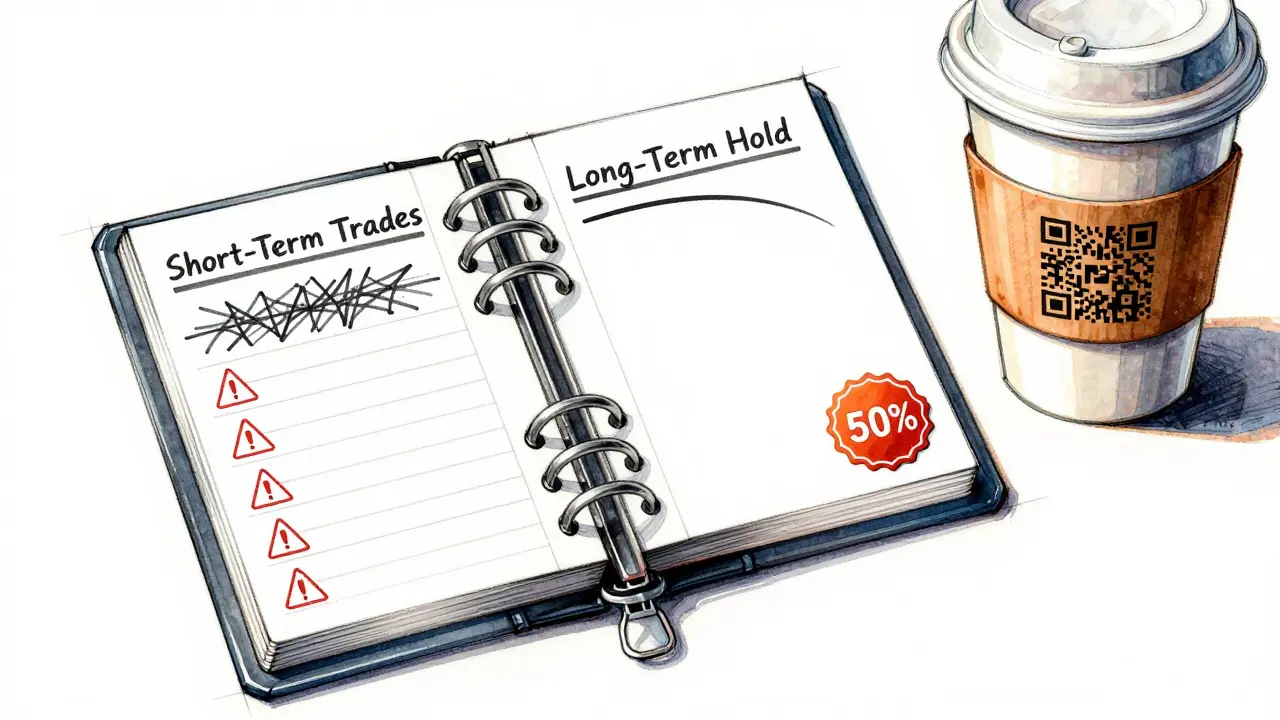
What About Staking, Airdrops, and Mining?
These aren’t CGT events. They’re income events. When you earn crypto through staking, mining, or an airdrop, the ATO treats it like wages. You pay income tax on the AUD value at the time you receive it. Example: You earn 0.5 ETH from staking in June 2024 when ETH is worth $3,000. That’s $1,500 of taxable income. You report it in your tax return under “other income.” Later, when you sell that ETH, you trigger a CGT event on the gain from $1,500 to your sale price. You don’t get taxed twice - you’re taxed once on income when you receive it, and once on capital gain when you sell. The ATO’s 2024 case law decision in Commissioner of Taxation v Bitcoin Trader confirmed this. Mining rewards are assessable income. The same applies to staking and airdrops.Cost Base: The Most Confusing Part
Your cost base is what you paid for the crypto - including fees. The ATO requires specific identification. That means you can’t just average your buys. You must track each coin’s purchase price, date, and fee. Say you bought 1 BTC in two parts:- 0.5 BTC on Jan 1, 2024, for $25,000 + $50 fee = $25,050 cost base
- 0.5 BTC on June 15, 2024, for $30,000 + $60 fee = $30,060 cost base
Personal Use Exemption: Don’t Fall for the Myth
There’s a myth that buying a coffee with crypto under $10,000 is tax-free. It’s not true. The personal use asset exemption only applies if you bought the crypto specifically to use it for personal items - not as an investment. And you must have bought it for less than $10,000 AUD. Example: You bought $500 worth of Bitcoin in 2023 just to pay for a laptop. You used it in 2025 to buy the laptop. You’re fine - no tax. But if you bought $500 worth of Bitcoin as an investment, held it for a year, then spent it on a laptop? That’s a CGT event. The $10,000 exemption doesn’t apply. The ATO says this clearly: “The personal use exemption does not apply if the asset was acquired as part of an investment strategy.”
Record Keeping: What You Must Save
The ATO requires you to keep records for five years. That includes:- Date of each transaction
- Value in AUD at the time
- What you bought or sold
- Exchange or wallet addresses involved
- Transaction IDs and fees
What’s Changing in 2026 and Beyond?
The ATO is ramping up enforcement. In February 2025, they started direct data sharing with major Australian exchanges like Swyftx, CoinSpot, and Independent Reserve. Your trades are now being reported to them automatically. By Q2 2026, they plan to integrate with the Digital Asset Data Exchange - a centralized system that will track every crypto transaction above $10,000. Compliance rates are expected to jump from 65% to over 85% by 2027. Meanwhile, experts predict staking rewards and DeFi transactions will get clearer rules by 2026. But the 50% CGT discount? That’s safe. EY’s Jane Kelly said in June 2025: “It’s politically popular. No government will touch it.”Final Advice: Plan, Don’t Panic
Crypto tax in Australia isn’t complicated - it’s just precise. You don’t need to be an accountant. But you do need to track your transactions, know your holding periods, and understand the difference between income and capital gains. If you’re a long-term holder: Wait 12 months. Save 50% on your gains. That’s the single best tax strategy in crypto. If you’re a trader: Accept that you’re paying full tax. Consider if your activity looks like a business. If so, you might need to register for GST and keep business records. And if you’re confused? Use software. Don’t guess. The ATO isn’t going to make this easier. But you don’t have to do it alone.Do I pay tax on crypto I haven’t sold?
No. You only pay tax when you dispose of crypto - sell, trade, spend, or gift it. Holding crypto, even if its value rises, doesn’t trigger tax. You’re taxed on the gain at the time of disposal, not on paper profits.
Can I offset crypto losses against other income?
No. Crypto capital losses can only be used to offset capital gains - not your salary, interest, or other income. If you lost $5,000 on crypto but made $10,000 on shares, you can use the $5,000 loss to reduce your $10,000 gain to $5,000. But you can’t use it to lower your wage income.
What if I lost my crypto in a hack or scam?
You may be able to claim a capital loss if you can prove the loss occurred and you had ownership. You need documentation - wallet addresses, transaction history, proof of the hack or scam. The ATO will review each case. It’s not automatic, but it’s possible.
Do I pay tax on crypto received as a gift?
If you receive crypto as a gift, you don’t pay tax at the time of receipt. But when you later sell or trade it, you pay CGT based on the original cost base of the person who gave it to you. If they bought it for $1,000 and gave it to you when it was worth $3,000, your cost base is $1,000. You’ll pay tax on the $2,000 gain when you sell.
Is crypto taxed differently if I use a local exchange vs an overseas one?
No. Where you trade doesn’t matter. Whether you use Swyftx, Binance, or Coinbase, the ATO treats all crypto transactions the same. Your tax obligation is based on your residency, not the exchange’s location. Australians must report all global crypto activity.
What happens if I don’t report my crypto gains?
The ATO has direct access to exchange data. If you don’t report, they’ll find out. Penalties range from 25% to 75% of the unpaid tax, plus interest. In serious cases, you could face criminal charges for tax evasion. Over 1.2 million Australians reported crypto in 2023-24. The ATO knows who’s missing.