Imagine trying to run a global payment network where every single transaction has to be verified by every single computer in the world. Sounds slow, right? That’s the bottleneck most blockchains hit today. Shardus is a distributed ledger software platform designed to solve this exact problem through sharding, allowing networks to scale linearly as more users join. But here’s the twist: Shardus isn’t just another blockchain you buy and hold for speculation. Its native token, ULT (Unblocked Ledger Token), functions primarily as a licensing mechanism for developers building on top of the Shardus framework.
If you’ve seen ULT trading at pennies with wild volume swings, you might wonder if it’s a hidden gem or a ghost town. The reality is nuanced. Shardus provides the engine; projects like Shardeum build the car. ULT is the ticket you need to ride along. This article breaks down exactly what Shardus is, how the tech actually works, why ULT exists, and what the current market data tells us about its viability in 2026.
The Core Problem: Why Traditional Blockchains Hit a Wall
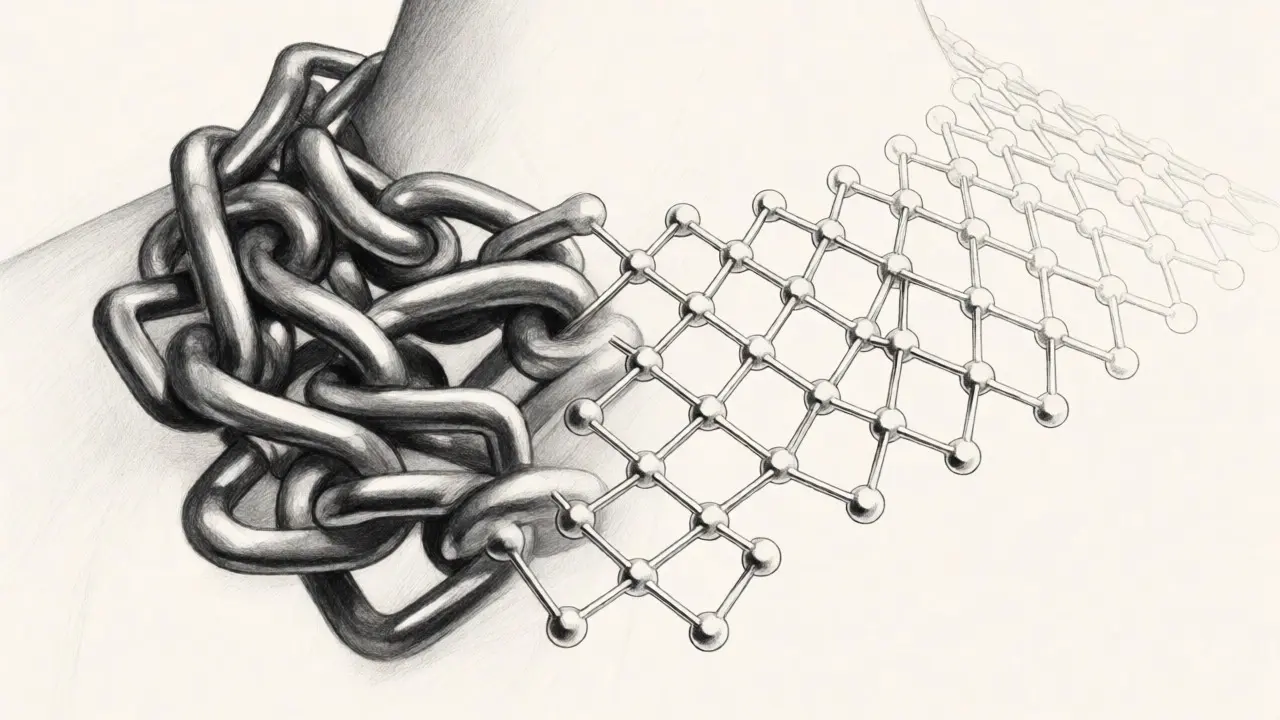
To understand Shardus, you first need to grasp why Bitcoin and Ethereum struggle with mass adoption. Most traditional blockchains use a "replicated state" model. Every node stores the entire history and current state of the ledger. When user count goes up, transaction speed doesn’t go up-it often goes down because nodes are overwhelmed syncing data. This is known as the scalability trilemma: you can have decentralization, security, or speed, but picking two usually means sacrificing the third.
Shardus Consensus Algorithm attacks this problem using compute and state sharding. Instead of one giant database, the network splits into smaller groups called shards. Each shard handles a portion of the transactions and state. If your network grows from 1 million to 10 million users, Shardus automatically creates more shards. More shards mean more parallel processing power. The result? Linear scaling. Throughput increases proportionally with the number of nodes, theoretically allowing billions of daily active users without clogging the pipes.
How Shardus Technology Works Under the Hood
The magic lies in the architecture. Unlike monolithic chains, Shardus uses a Proof-of-Quorum consensus mechanism. Here’s the simplified flow:
- State Sharding: The total state (balances, smart contract data) is divided among nodes. Node A only needs to know about accounts 1-1000; Node B knows 1001-2000.
- Compute Sharding: Transaction validation is also split. Nodes don’t verify everything; they verify their assigned subset.
- Inter-Shard Communication: When a transaction involves two different shards (e.g., Alice sends funds to Bob, who is on a different shard), the system uses a secure messaging protocol to finalize the transfer atomically.
This structure ensures immediate finality. Once a quorum agrees, the transaction is done. No waiting for six confirmations. For developers, this means building apps that feel like Web2-fast, responsive, and reliable-but with Web3 trustlessness.

ULT Token: Licensing, Not Just Speculation
So, where does the ULT coin fit in? It’s not used to pay for gas fees directly in the same way ETH pays for Ethereum gas. Instead, ULT acts as a license key. Any public network built using Shardus technology must allocate at least 1% of its total coin supply to ULT holders. This creates a unique revenue-sharing model.
| Feature | Traditional Blockchain (e.g., Ethereum) | Shardus Platform |
|---|---|---|
| Scaling Method | Layer 2 Rollups or Hard Forks | Native State & Compute Sharding |
| Throughput Growth | Sub-linear (bottlenecks at high load) | Linear (scales with node count) |
| Consensus Type | PoW / PoS (Global Finality) | Proof-of-Quorum (Local/Global Hybrid) |
| Token Utility | Gas Fees + Staking | Licensing Fee + Revenue Share |
| Target Use Case | General Purpose Smart Contracts | High-Frequency Global Networks |
This model aligns incentives. As new networks launch on Shardus (like Shardeum or Liberdus, they mint their own tokens. 1% of those tokens go to ULT holders. If Shardeum succeeds and its token value rises, ULT holders benefit directly from that success. It’s essentially an index fund for the Shardus ecosystem, though currently, the ecosystem is still in early stages.
Market Reality: Volatility and Liquidity Challenges
Let’s look at the hard numbers as of September 2026. The market data for ULT is... thin. Depending on whether you check CoinGecko or CoinMarketCap, you’ll see discrepancies. One source might list a market cap of $31 million, while another claims $150 million. This spread suggests fragmented liquidity and low trading activity.
Current price hovers around $0.07. While this seems cheap, don’t confuse low price with low value. The maximum supply is capped at 1 billion ULT. However, circulating supply reports vary. The real red flag is volume. Daily trading volume has dropped dramatically, sometimes falling below $50 across all exchanges combined. Low volume means high slippage. If you try to sell $10,000 worth of ULT, you might crash the price locally because there aren’t enough buyers on the other side.
Trading is mostly confined to Uniswap V3 on Polygon and ProBit. You won’t find ULT on Binance or Coinbase yet. This lack of major exchange listings limits retail access and keeps the token somewhat illiquid compared to top-tier assets.
Price Predictions and Expert Sentiment
Is ULT a good buy? Analyst platforms like 3Commas currently lean bearish. They issue "Sell" recommendations, citing poor growth potential and downward pressure. Forecasts for 2035 suggest an average price near $0.05, implying little to no capital appreciation over the next decade unless adoption explodes.
Why the pessimism? Two reasons:
- Dependency Risk: ULT’s value is tied entirely to the success of networks built on Shardus. If Shardeum fails to gain traction, ULT loses its primary utility driver.
- Distribution Model: Shardus doesn’t sell ULT publicly. Tokens were distributed to contributors during development. This reduces initial hype but also means fewer marketing dollars pushing the token narrative.
However, bulls argue that if Shardus achieves its promise of supporting billions of users, the licensing fees from dozens of successful networks could create significant demand for ULT. It’s a bet on infrastructure, not just a coin.
Who Should Consider ULT?
You shouldn’t buy ULT if you’re looking for quick flips or stable store-of-value assets. The volatility is extreme, and liquidity is risky. But consider ULT if:
- You believe sharding is the future of Layer 1 blockchains.
- You want exposure to the Shardeum ecosystem without buying SHM directly.
- You can tolerate holding a low-cap asset with minimal trading volume for years.
It’s a high-risk, high-reward play on backend infrastructure. Think of it less as "crypto currency" and more as "equity in a tech platform," albeit without legal equity protections.
Is Shardus the same as Shardeum?
No. Shardus is the underlying software framework and technology provider. Shardeum is a specific EVM-compatible blockchain network built *using* Shardus technology. Think of Shardus as the Android operating system and Shardeum as a specific phone app running on it.
How do I earn rewards with ULT?
ULT holders receive a share of licensing fees paid by networks using Shardus. Specifically, public networks must allocate 1% of their total token supply to ULT holders. This distribution happens periodically, effectively paying you in the native tokens of those new networks.
Where can I buy Shardus (ULT)?
As of late 2026, ULT is primarily traded on decentralized exchanges like Uniswap V3 (on the Polygon network) and centralized exchanges like ProBit. Major exchanges like Binance or Coinbase do not currently list ULT.
What is the maximum supply of ULT?
The maximum supply of ULT is fixed at 1,000,000,000 tokens. Circulating supply varies by source due to reporting differences, but the cap remains constant.
Is Shardus proof of work or proof of stake?
Neither exclusively. Shardus uses a proprietary Proof-of-Quorum consensus algorithm. It combines elements of both to achieve fast finality and security without the energy costs of PoW or the validator centralization risks of some PoS models.