You might have seen the ticker BRM pop up in your feed or heard whispers about "the most electrifying meme coin of 2025." If you are wondering what BullRun Meme actually is and whether it’s worth your attention in mid-2026, the short answer is: it’s a cautionary tale. What started as a high-energy community experiment has largely faded into obscurity, leaving behind a token with near-zero liquidity and a price that has collapsed by nearly 99%.
To understand where we stand today, we need to look past the hype and examine the hard data. This isn't just about checking a price chart; it's about understanding the mechanics of why this specific project failed to gain traction and what that means for anyone holding or considering buying BRM right now.
The Origin Story: Hype vs. Reality
BullRun Meme (BullRun Meme is a multichain cryptocurrency token launched on July 27, 2025, designed to capture the excitement of bull market cycles through community engagement and meme culture) entered the scene with a lot of noise. The development team, based in Romania, positioned BRM as an anthem for the crypto bull run. They didn't promise complex utility or revolutionary technology. Instead, they sold pure vibes-targeting "degens and believers" who thrive on speculative energy.
The technical setup was standard for the era. BRM operates as an ERC-20 token across three major networks: Ethereum, Polygon, and Base. Base, being a Layer 2 solution developed by Coinbase, was a popular choice for low-cost transactions in 2025 and 2026. By launching on these chains, the team aimed for broad accessibility. However, accessibility doesn't equal adoption. While the infrastructure was there, the fundamental driver-sustained community interest-began to evaporate quickly after the initial launch window.
Tokenomics: How the Pie Was Sliced
When analyzing any meme coin, the token distribution tells you who holds the power. BullRun Meme had a fixed total supply of 10 billion tokens. On paper, the allocation looked balanced enough to attract early investors:
- 35% allocated for community airdrops and giveaways (designed to create viral spread).
- 30% reserved for liquidity provisioning on exchanges (essential for trading stability).
- 20% dedicated to marketing initiatives.
- 15% held by the development team.
This structure is typical for projects trying to bootstrap growth. The heavy emphasis on airdrops (35%) suggests the team relied heavily on attracting new users rather than retaining existing ones through utility. In hindsight, this aggressive distribution model likely contributed to the selling pressure that followed once the initial hype died down. Without a mechanism to lock tokens or incentivize long-term holding, the supply flooded the market, driving prices down.
The Price Crash: A Data-Driven Autopsy
If you look at the price history of BRM, it paints a stark picture of volatility and eventual stagnation. At its peak, during the height of its promotional campaign in late 2025, BullRun Meme reached an all-time high of approximately $0.0329 per token. Some sources report a slightly lower peak around $0.001188, but even the conservative estimate shows significant value at the time.
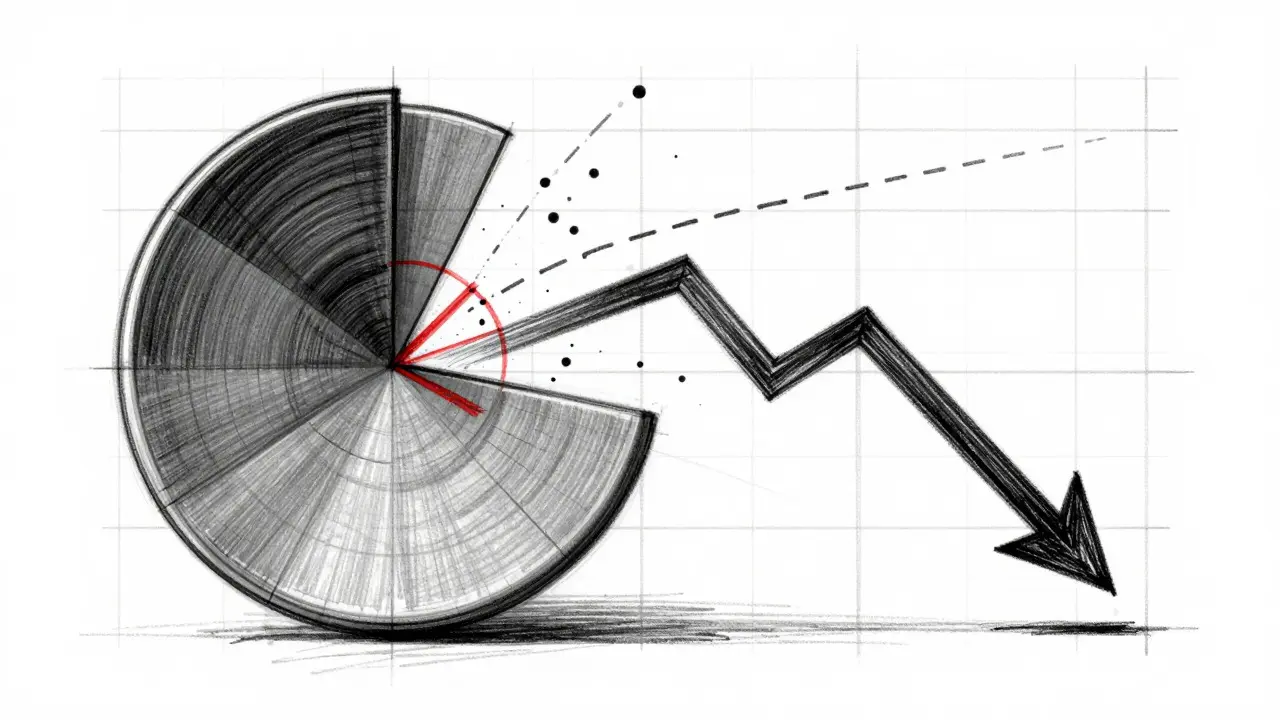
Fast forward to March 2026, and the situation has changed drastically. The current price hovers between $0.000021 and $0.00005 USD. That represents a decline of roughly 99.6%. For context, if you had invested $1,000 at the peak, you would be left with less than $4 today. This isn't just a correction; it's a collapse.
| Metric | Launch Phase (Mid-2025) | Current Status (2026) |
|---|---|---|
| All-Time High Price | $0.0329 | N/A (Peak passed) |
| Current Price Range | $0.01 - $0.03 | $0.000021 - $0.00005 |
| Market Cap Rank | Top 1,000 (Estimated) | #4,291 - #5,325 |
| 24-Hour Volume | High ($10k+) | Minimal ($1.6k - $8k) |
| Exchange Listings | DEX Only | Uniswap v3 (Base) Only |
The drop in trading volume is equally concerning. In 2026, the 24-hour trading volume sits at a mere $1,600 to $8,000. For a token with a fully diluted valuation nearing half a million dollars, this volume is dangerously low. It means there is almost no liquidity. If you tried to sell a large position, you would likely crash the price further because there aren't enough buyers to absorb the sale. This is known as "illiquidity risk," and it is one of the biggest dangers in the meme coin sector.
Liquidity and Accessibility Issues
One of the most critical red flags for BullRun Meme is its lack of presence on centralized exchanges (CEX). As of mid-2026, you cannot buy or sell BRM on major platforms like Binance, Coinbase, or Kraken. Trading is restricted to decentralized exchanges (DEX), primarily Uniswap v3 on the Base network.
While DEX trading offers freedom from KYC (Know Your Customer) checks, it also removes layers of security and ease of access. Retail investors often struggle with wallet management, gas fees, and slippage on DEXs. The absence of a CEX listing signals to institutional and serious retail investors that the project hasn't met the rigorous audit and compliance standards required by larger platforms. This isolation creates a feedback loop: fewer listings mean less visibility, which leads to lower volume, which discourages new listings.
Furthermore, reports indicate that the circulating supply shows 0 tokens in active circulation on many tracking platforms. This discrepancy usually points to issues with how liquidity pools are structured or reported. It suggests that while tokens exist, they may be locked in pools with little to no counter-party liquidity, making them effectively untradeable at fair market values.
Community and Roadmap: Promises vs. Progress
The BullRun Meme team outlined a roadmap that included staking options, governance tools, and partnerships within the meme coin sector. They promised to launch staking in 2026 to reward holders. However, as of mid-2026, concrete evidence of these features being live and utilized is scarce.
The community infrastructure relies on Twitter (@BullRunMem3) and Telegram (/t.me/bullrunmeme). While these channels were active during the launch phase, engagement metrics have dropped significantly. In the world of meme coins, community is everything. Without constant interaction, memes, and cultural relevance, the token loses its primary value proposition. The shift from "viral growth" to silence is a common pattern in failed meme projects.
The project emphasized "no gimmicks" and "pure meme-fueled madness." While this appeals to some traders, it leaves the asset vulnerable when the market sentiment shifts. Unlike established meme coins like Dogecoin (DOGE) or Shiba Inu (SHIB), which have built ecosystems, payment integrations, and massive brand recognition over years, BRM lacked the time and resources to cement its place in the culture.
Risk Assessment: Is BRM Dead?
Let’s be direct. Based on the data available in 2026, BullRun Meme exhibits all the characteristics of a failed speculative asset. Here are the key indicators:
- Value Destruction: A 99.6% loss from ATH indicates that early insiders or promoters likely exited their positions, leaving latecomers with worthless bags.
- Lack of Utility: There is no real-world use case, revenue stream, or technological innovation attached to the token.
- Low Liquidity: With daily volumes under $10k, exiting a position without significant slippage is difficult.
- No Institutional Backing: No venture capital firms or major exchanges support the project.
For investors, this serves as a reminder of the risks inherent in the meme coin sector. The barrier to entry is low, but the barrier to success is incredibly high. Most meme coins follow a hyperbolic trajectory: rapid rise, peak hype, and slow decay. BullRun Meme is currently in the decay phase.
Comparison with Established Meme Coins
To put BRM in perspective, let's compare it to giants in the space. Dogecoin, launched in 2013, has a market cap in the billions and is accepted as a payment method by companies like Tesla and Ticketmaster. Shiba Inu has developed its own Layer 2 blockchain (Shibarium) and an ecosystem of NFTs and DeFi protocols.
BullRun Meme, by contrast, remains a simple ERC-20 token with no additional layers. It competes in a saturated market against thousands of other meme coins. Without a unique selling point beyond its name, it struggles to retain user attention. The competitive landscape favors projects with deep liquidity, strong branding, and continuous development activity-areas where BRM is currently lacking.
Final Thoughts for Investors
If you are holding BullRun Meme, you are facing a difficult decision. The likelihood of a return to previous highs is statistically low given the current market dynamics. If you are looking to enter, proceed with extreme caution. Understand that you are speculating on a lottery ticket, not investing in a business.
The lesson here extends beyond BRM. Always check the liquidity depth, verify exchange listings, and assess the community's long-term engagement before committing funds to any meme coin. In 2026, the crypto market is maturing, and investors are becoming more discerning. Projects that rely solely on hype without substance are increasingly being filtered out by the market.
Is BullRun Meme (BRM) a scam?
While there is no definitive legal ruling labeling BRM as a scam, it exhibits many red flags associated with fraudulent or poorly managed projects. These include anonymous developers, a 99% price drop, minimal liquidity, and a lack of transparency regarding fund usage. In the crypto world, "scam" can range from outright theft to simply failing to deliver on promises, leading to total loss of value.
Where can I buy BullRun Meme in 2026?
You can only trade BRM on decentralized exchanges (DEX) like Uniswap v3 on the Base network. It is not listed on major centralized exchanges such as Binance, Coinbase, or Kraken. To buy it, you will need a compatible crypto wallet (like MetaMask) and ETH or BASE tokens to pay for gas fees.
Why did the price of BRM drop so much?
The price drop is due to a combination of factors: the natural lifecycle of meme coins (hype followed by abandonment), low liquidity which makes small sales impact the price heavily, and a lack of sustained utility or community engagement. Early investors likely sold off their holdings, causing a cascade effect.
Does BullRun Meme have any utility?
Currently, no. BRM is classified as a pure meme coin. Its original roadmap mentioned staking and governance, but as of mid-2026, there is no evidence of functional utility, revenue generation, or real-world use cases. Its value is derived entirely from speculative trading and community sentiment.
Is it safe to invest in BRM now?
Investing in BRM is considered extremely high-risk. With a 99.6% loss from its peak and minimal trading volume, the probability of recovering your investment is low. It is generally advised to avoid illiquid assets unless you are prepared to lose the entire amount. Diversification into more established cryptocurrencies is a safer strategy.