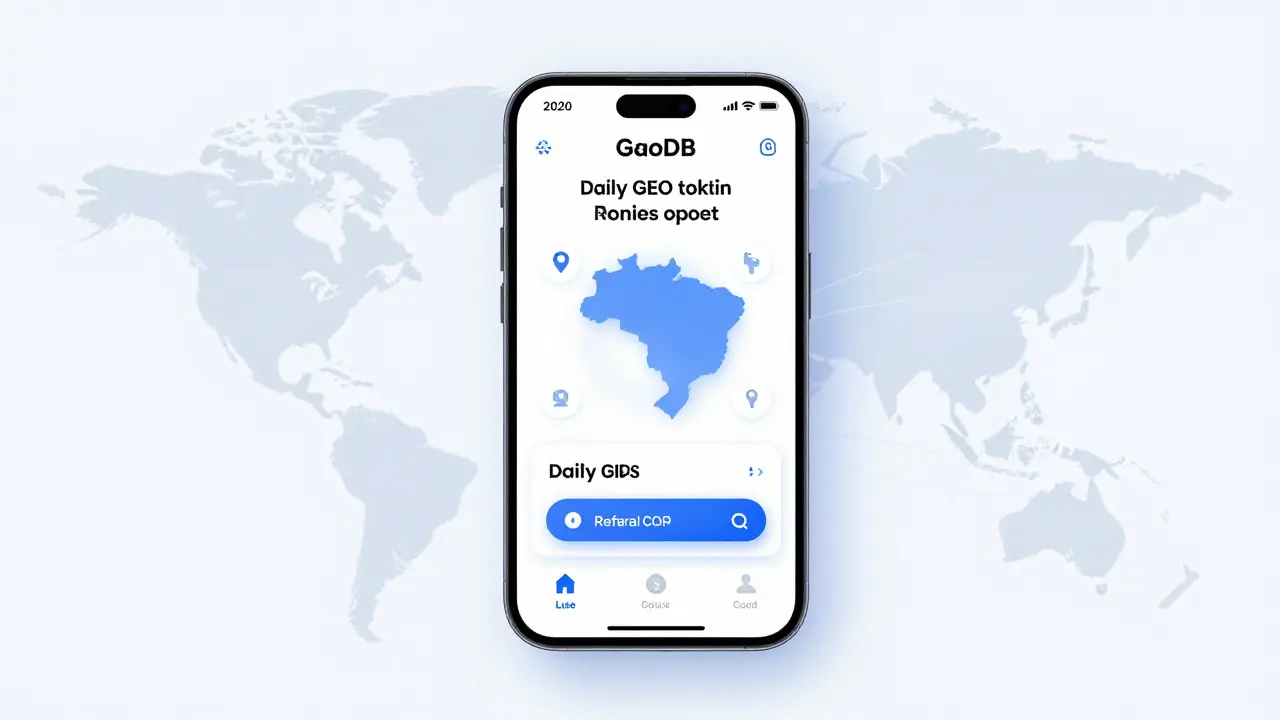
Back in 2020, a wave of crypto users downloaded a little-known app called GeoDB, hoping to earn free tokens just by using their phone. The promise? Get paid in GEOCASH - also called GEO - for letting the app track your location, browsing habits, and daily movements. It sounded too good to be true. And in many ways, it was.
At the time, GeoDB pitched itself as a revolution: instead of companies like Google and Facebook making billions off your data, you’d be the one getting paid. All you had to do was install the app, turn on location services, and invite friends. For many, especially in India, Brazil, and Southeast Asia, it felt like free money. But what happened after the hype died down? Where are those tokens now?
How the GEOCASH Airdrop Actually Worked
The GeoDB airdrop wasn’t just a one-time giveaway. It was a daily reward system built into their mobile app. Users who downloaded the app on Android or iOS could claim free GEO tokens every 24 hours - no strings attached. But here’s the catch: the real earnings came from referrals.
For every friend you invited using your personal referral code - like MDHALIM759_PXGYZQ - you’d get bonus tokens. Some users claimed they earned up to 10 GEO per day just from referrals. That’s around $5 at the time, based on early price estimates. The app even had a dashboard showing your “mining” progress, with charts tracking how much data you’d shared and how much you’d earned.
It wasn’t magic. You were trading your location data, Wi-Fi usage, app usage patterns, and even your phone’s idle time for tokens. In exchange, GeoDB claimed they’d sell that data to AI companies and advertisers - but instead of keeping all the profit, they’d give 70% back to users. The rest? Used to run the platform and reward developers building on their network.
The app, later renamed Wallace Wallet, acted as your personal wallet. It generated a private key and recovery phrase - just like any crypto wallet. Users were warned: if you lost your 12-word phrase, you lost your tokens. No customer support, no recovery option. Many users didn’t take that seriously.
The Token: GEO on Ethereum (and Now ODIN Chain)
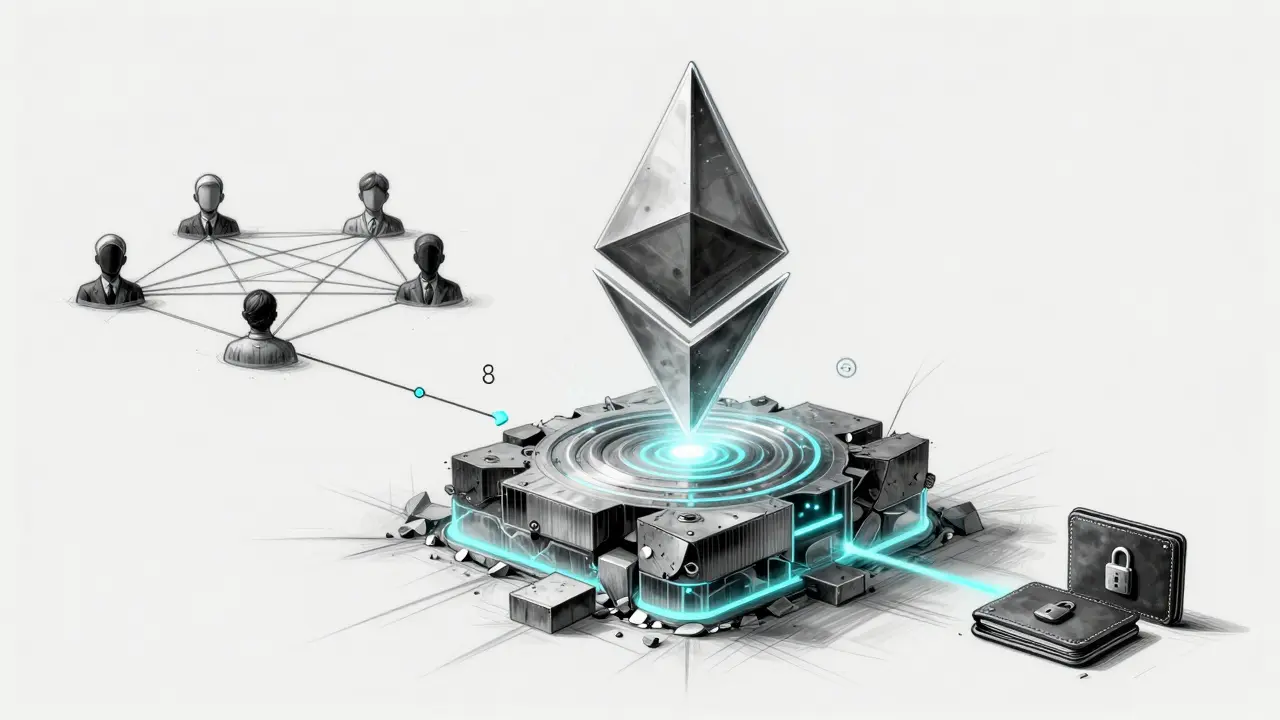
Originally, GEO was an ERC-20 token on the Ethereum blockchain. Its contract address was 0x147f...126750. The total supply was capped at 350 million tokens. By 2021, over 313 million had been minted, but only about 82 million were in circulation - the rest locked in team wallets, ecosystem funds, or staking pools.
Then came the shift. In late 2023, GeoDB announced they were migrating GEO from Ethereum to a new blockchain called ODIN Chain. This wasn’t just a technical upgrade. It meant every user had to manually claim their tokens on the new network. If you didn’t act, your tokens were stuck on Ethereum - and essentially frozen.
Many users didn’t even know about the migration. No big email. No in-app banner. Just a quiet update on their Telegram channel. By early 2024, hundreds of wallets were left behind. Some people still have 50,000 GEO sitting there, worth less than $10 today, and they have no idea how to move them.
Where Is GEO Trading Today?
As of March 2026, GEO is trading at around $0.0001664. That’s down over 90% from its peak during the airdrop frenzy. The 24-hour trading volume? Just $120.24. For comparison, even obscure tokens with tiny communities trade over $10,000 daily.
The only place you can still trade GEO is on Uniswap V2, using the GEO/WETH pair. The spread is tight - about 0.63% - but there are almost no buyers. The last trades happened over two days ago. You can’t sell if there’s no one to buy from.
On CoinMarketCap and CoinGecko, GEO shows up as “low liquidity” and “inactive.” It’s not delisted - but it’s not alive either. The market cap? Roughly equivalent to 0.2330 BTC. That’s not even $10,000.

What Happened to the Users?
Most users who joined the airdrop in 2020 never cashed out. Some didn’t even know how. Others tried to sell, but the price kept dropping. By 2022, the Telegram group had gone from 50,000 members to under 5,000. The YouTube videos promoting the airdrop - once getting 5,000-10,000 views - now get fewer than 50.
One Reddit user from Mumbai said they earned 12,000 GEO over six months. They held onto it, hoping it would hit $0.01. Now, it’s worth $2. They say they still open the Wallace Wallet app once a month, just to check. “It’s like checking an old bank account from college,” they wrote.
Another user from Brazil claimed they referred 400 people. They earned over 200,000 GEO. When they tried to cash out, they found the withdrawal fees were higher than the value of the tokens. They gave up.
Why Did It Fizzle Out?
There were three big reasons.
- No real utility - GEO tokens couldn’t be used to buy anything. No app, no service, no marketplace accepted them. They were just a number in a wallet.
- Overpromising - “Earn $5 a day” sounded great until users realized they needed to be on the app 12 hours a day, with location tracking on, and invite 10 friends daily just to hit that number. Most couldn’t sustain it.
- Bad timing - The airdrop peaked in late 2020, right after the crypto bull run began. But by 2021, the market was flooded with 500+ similar projects. GeoDB didn’t stand out. No team transparency. No whitepaper updates. No roadmap.
Worst of all? The company stopped posting updates. Their website went dark. Their Twitter account stopped replying. The CEO vanished from public events. The project didn’t get hacked. It just faded.
Is There Any Value Left?
Technically, yes - but only if you’re willing to dig.
If you still have GEO tokens from the 2020 airdrop:
- Check your Wallace Wallet app. Is it still installed?
- Find your recovery phrase. If you lost it, you’re out of luck.
- Visit the official ODIN Chain migration portal (if it’s still live) and try to bridge your tokens.
- If you’re on Ethereum, you can try to swap them on Uniswap - but expect near-zero liquidity.
Some collectors are now buying old GeoDB wallets with high token balances on secondary marketplaces, hoping the project will revive. It’s a long shot. But in crypto, weird things happen.
For everyone else? The lesson is simple: if a project doesn’t give you a real reason to hold its token - beyond “maybe it’ll go up” - then it’s not an investment. It’s a lottery ticket.
What Can You Learn From This?
The GEOCASH airdrop wasn’t a scam. It was a poorly executed experiment. They didn’t lie - they just didn’t deliver. And that’s worse.
Here’s what you should remember:
- Don’t trust “free money” - if it sounds too easy, it usually is.
- Check the token’s use case - can you spend it? Can you stake it? Does anything rely on it?
- Track the team - if they disappear after the airdrop, the project is dead.
- Save your keys - if you don’t, you lose everything. No exceptions.
The GeoDB airdrop is now a case study in crypto hype cycles. It’s not unique. Thousands of similar projects have come and gone. But for the people who joined - especially those who believed they were finally being paid for their data - it was real. And now? It’s just a memory.
Is the GeoDB airdrop still active?
No, the main airdrop campaign ended in 2021. While the GeoDB app still exists as Wallace Wallet, the daily token claims and referral bonuses were discontinued years ago. The project has shifted focus to its ODIN Chain migration, but no new airdrops have been announced.
Can I still claim GEO tokens from the 2020 airdrop?
If you still have access to your original Wallace Wallet and your 12-word recovery phrase, you may be able to access your tokens. However, the migration to ODIN Chain required manual action. If you didn’t complete the migration before the cutoff, your tokens are likely stuck on Ethereum and cannot be recovered.
What’s the current price of GEO?
As of March 2026, GEO is trading at approximately $0.0001664. This is down over 90% from its peak during the 2020-2021 airdrop period. Trading volume is extremely low, with only $120.24 traded in the last 24 hours.
Where can I trade GEO tokens today?
GEO is only actively traded on Uniswap V2 (Ethereum) via the GEO/WETH pair. It is no longer listed on major exchanges like Binance, Coinbase, or Bitforex. Liquidity is minimal, and most trades occur between a handful of wallets.
Did GeoDB ever deliver on its promise to pay users for data?
Technically, yes - users received GEO tokens for sharing data. But the value of those tokens collapsed, and there was never a marketplace or service where users could spend them. So while users were paid in tokens, they weren’t paid in usable value. The project failed to create real economic utility around its token.


Ian Thomas
5 March, 2026 . 04:22 AM
So let me get this straight: you traded your location data for digital confetti that now sits in a wallet like a forgotten birthday card? Classic crypto move. We’ve all been there - convinced we’re the next Satoshi because we downloaded an app and let it know we went to Starbucks at 3 PM on a Tuesday. The real tragedy? You didn’t get scammed. You got ignored. And that’s worse than theft - it’s existential neglect.
It’s not about the tokens. It’s about the illusion of agency. We were sold a fantasy that we could opt out of surveillance capitalism… by joining a different version of it. The only thing GeoDB gave us was a new way to feel exploited - with a dashboard.
Josh Moorcroft-Jones
5 March, 2026 . 11:18 AM
Okay, so, let’s break this down with surgical precision, because this is a textbook case of crypto’s fatal flaw: the conflation of activity with value. Users were incentivized not to create utility, but to perform data-generating behavior - which, statistically, is the exact same behavior that Google, Meta, and TikTok already monetize without compensation. So what GeoDB did was essentially rebrand ad-tech as a ‘user-owned economy,’ which is like calling a pirated Netflix account a ‘decentralized streaming protocol.’
And then, when the tokens crashed - which they inevitably would, because there was zero demand-side utility, no staking, no governance, no dApp integration, no NFTs to collect, no metaverse to wander in - they didn’t pivot. They didn’t iterate. They didn’t even send a polite ‘thanks for your time’ email. They just… vanished. Like a teenager who ghosted after a one-night stand. And now we’re left with 313 million tokens minted, 82 million circulating, and 231 million locked in team wallets that probably haven’t been touched since 2021. Which, by the way, is why the ‘migration’ to ODIN Chain felt like a bait-and-switch: you had to move your assets… to a blockchain no one else uses, because no one else cares. It’s not a chain. It’s a graveyard with Wi-Fi.
And the worst part? People still check their wallets. Once a month. Like a ritual. Like a funeral they keep showing up to, hoping the casket might be open this time. That’s not crypto. That’s grief.
jack carr
5 March, 2026 . 16:43 PM
Honestly? I think it’s kind of beautiful. People gave up their data for free tokens, and now they still check on them like a childhood pet they left with a friend. It’s not about the money. It’s about hope. The fact that someone in Mumbai opens Wallace Wallet every month? That’s not delusion - that’s devotion. We all want to believe we’re part of something bigger. Even if it’s just a ghost token in a dead app.
jay baravkar
7 March, 2026 . 09:12 AM
YOU GOT THIS 💪 Let me tell you - every crypto journey starts with a dream and ends with a lesson. And guess what? You’re not alone. Thousands of us are still holding on, still checking, still hoping. That’s the spirit of Web3! Keep believing, keep checking, keep trusting - because the next bull run? It could be just around the corner 🌟🙌
Jane Darrah
8 March, 2026 . 16:12 PM
Okay, but like… why did we think this was going to work? We literally gave Big Tech our GPS coordinates and our app usage history… and we thought a 12-word phrase would save us? Like, did anyone even read the terms? Did anyone think about what happens when the app’s server goes down? Or when the CEO gets bored and moves to Bali? I mean, I had 15,000 GEO. I thought I was rich. Now I’m just a sad person with a locked wallet and a Netflix subscription I can’t afford. I miss 2020. It was simpler. We were all just trying to get free money. Now? Now we’re trauma survivors of a crypto cult.
Denise Folituu
10 March, 2026 . 14:16 PM
THIS IS WHY WE CAN’T HAVE NICE THINGS. People think crypto is about innovation. It’s not. It’s about emotional manipulation. They gave us a fake dream - ‘you’re the owner of your data!’ - then vanished. No warning. No goodbye. Just silence. And now we’re left with people still checking wallets like it’s a shrine. It’s not a project. It’s a ghost story. And we’re all the haunted.
Eva Gupta
10 March, 2026 . 23:51 PM
As someone from India who actually earned 8,000 GEO back then… I still have the app. I don’t even open it to check the balance anymore. I just open it to see the logo - the little green globe. It reminds me of when I thought I could change things. I didn’t make money. But I made a habit. I thought about my data. I thought about who owns it. And honestly? That was worth more than the tokens. I still tell my cousins: ‘Don’t chase free crypto. Chase understanding.’
Nancy Jewer
12 March, 2026 . 09:04 AM
From a tokenomics perspective, this is a textbook example of asymmetric incentive misalignment. The protocol incentivized user acquisition and data generation - but failed to establish any demand-side mechanisms for token utility. The lack of staking, liquidity mining, or governance integration meant that the token had no embedded value proposition beyond speculative arbitrage - which collapsed under the weight of hyperinflationary supply and zero network effects. The migration to ODIN Chain was not a technical upgrade - it was a liquidity extraction event disguised as a chain upgrade. The result? A 99.7% decline in active holders, and a token that now trades below its gas cost to transfer. In economic terms? It’s a negative externality with a recovery phrase.
Leah Dallaire
13 March, 2026 . 10:09 AM
Let me ask you something… did anyone else notice that GeoDB’s website went dark right after the airdrop? And that the ‘ODIN Chain’ whitepaper was written in Google Translate? And that the team’s LinkedIn profiles all got deleted? I’m not saying it was a scam. I’m saying it was a coordinated exit strategy. They didn’t fail. They planned this. They knew the tokens would crash. They knew most users wouldn’t migrate. And now? The team’s wallets are still holding 230 million tokens… while we’re out here checking our phones like fools. Someone made millions. We made memories. And a very expensive phone battery drain.
prasanna tripathy
13 March, 2026 . 21:04 PM
My brother referred 300 people. Got 200,000 GEO. He thought he was a genius. Now he uses the Wallace Wallet app as a flashlight. Says the screen glows nice in the dark. I told him he should sell it. He said, ‘Nah. It’s my legacy.’ I didn’t understand… until I opened my own wallet. Still got 12,000. Still check it. Still feel something. Maybe it’s not about the money. Maybe it’s about believing - even when it’s gone.
James Burke
15 March, 2026 . 13:41 PM
It’s not that the project failed. It’s that we were never meant to win. We were the test subjects. The data. The traffic. The bait. The tokens were never the reward - the data was. And now we’re left wondering if we were the users… or the product.
Bill Pommier
15 March, 2026 . 17:26 PM
While it is empirically accurate to state that the GEO token experienced a catastrophic depreciation in market value, one must not conflate this with an absence of systemic integrity. The project’s architecture, though poorly communicated, was not inherently fraudulent. The migration to ODIN Chain, while inadequately publicized, was technically valid. The issue lies not with the protocol, but with the cognitive dissonance of users who conflated speculative optimism with financial literacy. This is not a failure of technology - it is a failure of education. The onus, therefore, rests not with the developers, but with the participants who failed to conduct due diligence. One cannot blame a mirror for reflecting an unprepared face.
Megan Lutz
17 March, 2026 . 00:50 AM
They didn’t lie. They just didn’t care enough to finish. And that’s the most dangerous kind of betrayal. Not the scammer who takes your money - the ghost who lets you believe you mattered.