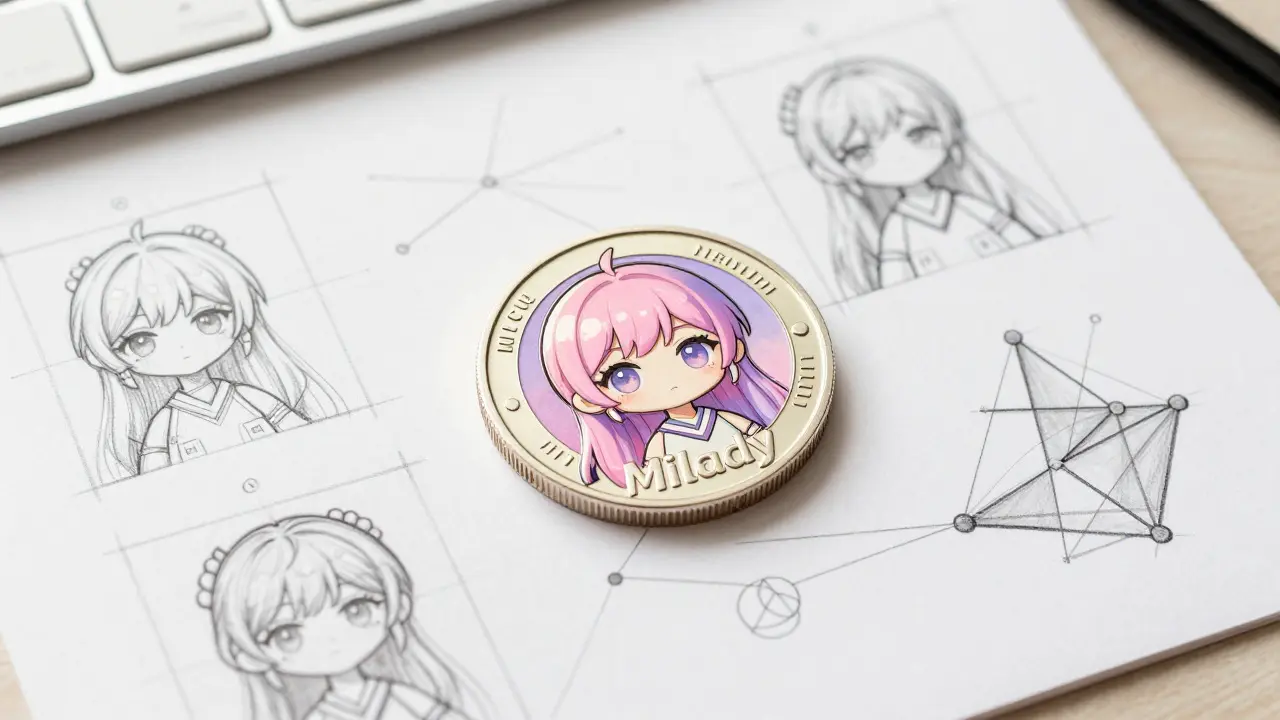
Imagine a digital currency that doesn't promise you utility, staking rewards, or protocol fees. Instead, it promises culture. That is exactly what Milady Cult Coin is. Tickered as CULT, this asset was created by Remilia Corporation, the group behind the famous Milady Maker NFT collection. It launched in December 2024 with a massive buzz, aiming to turn an internet subculture into a financial ecosystem. But what actually makes this coin tick? Is it just another meme, or does it have a real structure behind the hype?
In short, CULT is an ERC-20 token on the Ethereum blockchain. It functions as the official community token for the Remilia universe. Unlike traditional cryptocurrencies that try to solve specific technical problems like speed or privacy, CULT is designed to unify fans of the Milady aesthetic and reward their participation in the "cult"-a term used affectionately within the community to describe its tight-knit, often mysterious fanbase.
The Origins: From NFTs to Tokens
To understand CULT, you first need to understand where it came from. The project stems from Charlotte Fang, the artist and internet figure who leads Remilia. Since 2021, she has built a distinct brand around "neochibi" anime aesthetics and a vibe that mixes high art with internet irony. The Milady Maker collection, consisting of 10,000 unique profile pictures, became a cultural phenomenon, especially after celebrity endorsements and viral moments on social media.
However, holding an NFT is different from participating in the broader economic activity of a community. Remilia wanted a way to let everyone engage with the ecosystem, not just those who could afford expensive digital art. So, they introduced CULT. Announced in mid-2024 and officially launched on December 9, 2024, the token was positioned as a "fungible proxy" for the community. Think of it as a membership card that also happens to be tradable on open markets. The goal wasn't to replace the NFTs but to create a liquid layer of value that sits on top of them.
How the Token Works: Technical Basics
Under the hood, CULT is surprisingly simple. It uses the standard ERC-20 standard on the Ethereum network. This means it behaves like most other tokens you might hold in your wallet. There are no complex algorithms, no hidden fee-on-transfer mechanisms, and no rebasing logic. The smart contract, deployed at address 0x0000000000c5dc95539589fbD24BE07c6C14eCa4, relies on OpenZeppelin libraries, which are widely considered secure and battle-tested.
This simplicity is a double-edged sword. On one hand, it reduces the risk of smart contract bugs because there isn't much custom code to go wrong. On the other hand, it means the token has no native utility. You can't stake it directly through the base contract to earn yield, nor do you get voting rights built into the token itself. Any governance or staking features mentioned in community discussions are usually handled by third-party platforms or off-chain agreements, not by the core protocol.
Tokenomics: Supply and Distribution
The economics of CULT are defined by a fixed supply of 100 billion tokens. This number was minted once at genesis, meaning no new coins will ever be created. Here is how that supply is broken down:
- Cult Fund (50%): 50 billion tokens are reserved for the community. Half of this was distributed via airdrops to loyal holders of Milady NFTs and other achievements. The other half is managed by the "Manipulation Engine," a system designed to distribute tokens over several years to keep engagement high.
- Pre-sale (15%): 15 billion tokens were sold during the pre-launch phase. This raised approximately $20.5 million USD without any venture capital involvement, which was a major selling point for fairness-minded investors.
- Team Vesting (15%): Another 15 billion tokens are locked for the core team, with an 18-month vesting schedule to prevent immediate dumping.
- Treasury (20%): The remaining 20 billion tokens sit in the Remilia treasury, subject to a six-month lockup period before they can be used for ecosystem development.
This structure is heavily weighted toward the community. By dedicating half the supply to a fund that rewards existing fans, Remilia ensured that the initial holder base had a direct financial stake in the token's success. However, the large size of the treasury and the multi-year distribution plan mean that a significant portion of the supply remains under the control of the project team for the foreseeable future.
Market Performance and Volatility
Like all meme coins, CULT has experienced wild price swings since its launch. At its debut in late 2024, the fully diluted valuation (FDV) was estimated between $600 million and $800 million. This placed it among the higher-valued niche tokens at the time. However, the crypto market is notoriously fickle. By mid-2026, data from aggregators like CoinGecko and CoinMarketCap shows the price hovering around $0.00015 per token, with a market cap in the single-digit millions.
| Timeframe | Approximate Price (USD) | Market Cap Context |
|---|---|---|
| Launch (Dec 2024) | $0.006 - $0.008 | FDV ~$600M - $800M |
| Early 2025 | $0.0010 - $0.0016 | Mid-tier rank (~#600) |
| Mid 2026 | $0.00014 - $0.00015 | Low-cap rank (~#1400+) |
This drawdown illustrates the high-risk nature of the asset. While the brand remains influential within its niche, the broader speculative interest has cooled. Traders should expect volatility of 100-200% over short periods, driven largely by social media sentiment and general crypto market cycles rather than fundamental usage metrics.
Where to Buy and How to Use
If you want to get your hands on CULT, you have two main options. First, you can trade on centralized exchanges (CEXs) like Gate, KuCoin, MEXC, or LBank. These platforms offer spot trading pairs, usually against USDT, and require standard KYC verification. Second, you can buy directly on decentralized exchanges (DEXs) like Uniswap V3. For DEX users, you'll need an Ethereum-compatible wallet (like MetaMask), some ETH for gas fees, and the correct contract address to add the token manually.
Once you hold CULT, what can you do with it? Currently, its primary use is as a store of value within the Remilia ecosystem. Some community members use it to pay for exclusive merchandise or access to private events. Others simply hold it hoping for a resurgence in the Milady brand's popularity. There is no native staking, so if you're looking for passive income, you'd need to look at third-party DeFi protocols, which carry their own risks.

Risks and Controversies
No discussion of CULT would be complete without addressing the risks. The biggest factor is the reputation of the creator. Charlotte Fang and the Remilia project have faced criticism for edgy, sometimes controversial branding. In 2022, investigations linked the founder to past associations with niche online groups, leading to debates about the ethical implications of supporting the project. Additionally, in 2023, a developer associated with the ecosystem was accused of diverting funds from a related project, raising questions about internal governance.
These issues don't affect the technical security of the token itself, but they impact investor confidence. If the community loses faith in the "cult" narrative, the token's value-which is derived almost entirely from social consensus-can evaporate quickly. Furthermore, because the token lacks revenue-generating mechanics, it is highly susceptible to broader market downturns. If Bitcoin drops, CULT will likely drop harder due to its lower liquidity and speculative nature.
Is CULT Right for You?
Milady Cult Coin is not for the faint of heart. It is a pure play on internet culture and community loyalty. If you are already a fan of the Milady aesthetic and believe in the long-term viability of NFT-driven communities, CULT offers a way to participate financially. Its transparent pre-sale and large community allocation are positive signs of fair design. However, if you are looking for a stable investment or a token with clear utility and cash flows, you might want to look elsewhere. The extreme volatility and reliance on a specific subculture make it a high-risk, high-reward proposition. Always do your own research, monitor the community sentiment, and only invest what you can afford to lose.
Who created Milady Cult Coin?
Milady Cult Coin was created by Remilia Corporation, led by artist Charlotte Fang. It serves as the official token for the Milady Maker NFT ecosystem.
What is the total supply of CULT?
The total and maximum supply of CULT is 100 billion tokens. All tokens were minted at launch, and no new tokens will be issued.
Does CULT have staking or governance features?
The base ERC-20 contract does not include native staking or governance logic. Any such features are provided by third-party platforms or off-chain community coordination.
Where can I buy CULT?
You can buy CULT on centralized exchanges like Gate, KuCoin, and MEXC, or on decentralized exchanges like Uniswap V3 using an Ethereum wallet.
What is the main purpose of the Cult Fund?
The Cult Fund holds 50% of the total supply. It is used to reward community members through airdrops and ongoing distributions via the Manipulation Engine to sustain engagement.