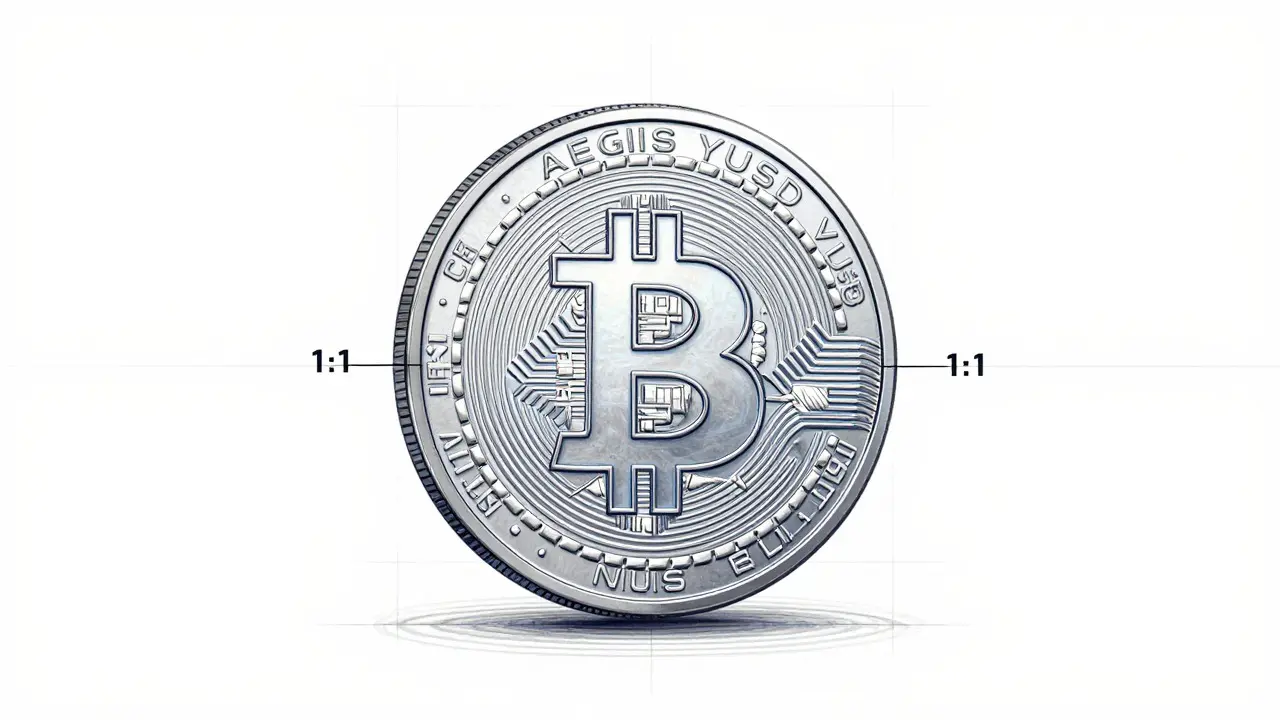
Imagine holding a digital dollar that doesn't just sit there, but actually pays you interest while staying perfectly stable. That is the core promise of Aegis YUSD, a decentralized stablecoin designed to maintain a strict 1:1 peg to the US dollar while generating passive income for its holders. Unlike traditional stablecoins that rely on banks and fiat reserves, YUSD uses a clever mechanism involving Bitcoin to keep its value steady and distribute profits automatically. If you are looking for a way to protect your wealth from inflation without dealing with the wild price swings of cryptocurrencies, this token might be exactly what you need to understand.
The Core Concept: Stability Meets Yield
At its heart, a Bitcoin-backed stablecoin engineered to maintain a 1:1 peg to the US dollar while simultaneously generating yield is a hybrid financial instrument. The main problem it solves is the volatility of Bitcoin. Normally, if you hold Bitcoin, your value goes up and down with the market. But YUSD uses a strategy called delta-neutral hedging to neutralize those swings. This means that whether Bitcoin goes up or down, the value of YUSD stays close to $1.00. The "delta" refers to the sensitivity of an asset's price to changes in the underlying asset. By making this zero, the protocol ensures stability independent of broader market conditions.
What makes YUSD different from other stablecoins like Tether or USD Coin is its source of backing. Instead of holding US Treasury bills or cash in bank accounts, Aegis holds Bitcoin in institutional-grade custodial vaults. This structure protects users from risks associated with the traditional banking system, such as bank failures or regulatory freezes. It also offers a unique benefit: because the protocol trades Bitcoin perpetual futures, it captures funding rates, which are then paid out to YUSD holders. You don't even have to stake the token; the yield is distributed directly to your wallet three times a day.
How the Technology Works Under the Hood
To understand how YUSD stays at $1, you have to look at the mechanics of its collateralization. When new YUSD tokens are created, users deposit stable assets like USDT, USDC, or DAI into the Aegis Mint smart contract. These deposits are immediately converted into Bitcoin via over-the-counter desks. Once the Bitcoin is secured, the protocol enters a short position on Bitcoin-margined perpetual contracts. This short position offsets the long exposure held by the Bitcoin reserves. If Bitcoin prices rise, the value of the reserves increases, but the short position loses value, keeping the net worth balanced. If Bitcoin falls, the reserves lose value, but the short position gains, again maintaining equilibrium.
This process happens entirely on-chain and relies on trusted custodians like Fireblocks, Copper, and CEFFU to manage the actual Bitcoin holdings. No assets are stored on centralized exchanges, reducing the risk of exchange hacks or insolvencies. The entire system is designed to be transparent, allowing anyone to verify the reserves and the hedging positions. This transparency is crucial for building trust in a new stablecoin, especially one that operates outside the traditional fiat banking perimeter.

Market Performance and Current Data
As of late April 2026, YUSD has shown remarkable stability. Across major tracking platforms, the price hovers very tightly around the $1 peg. For instance, data shows prices ranging from $0.9932 to $0.9988 depending on the exchange and time of day. This minimal deviation indicates that the arbitrage mechanisms are working effectively. Traders who see YUSD trading slightly below $1 can buy it cheaply, redeem it for collateral, and profit from the difference, pushing the price back up. Conversely, if it trades above $1, they can mint new YUSD and sell it, pushing the price down.
The circulating supply stands at approximately 28 million YUSD tokens. The market capitalization is valued in Bitcoin terms, reflecting its unique backing structure. While the absolute dollar value fluctuates with Bitcoin's price, the ratio remains consistent. The token has seen modest trading volumes, indicating it is still in a growth phase compared to giants like Tether. However, the low volatility and automatic yield distribution make it an attractive option for holders who want exposure to the crypto ecosystem without the stress of daily price monitoring.
Why Holders Choose YUSD Over Other Options
There are several reasons why investors are turning their attention to YUSD. First, there is the independence factor. In a world where central banks can freeze accounts and governments can impose capital controls, having a stablecoin backed by a decentralized asset like Bitcoin offers a layer of financial sovereignty. Second, the yield generation is passive. Unlike DeFi protocols where you might need to lock up your funds or manage complex liquidity pools, YUSD simply pays you for holding it. This makes it accessible to a wider audience, including those who are not technical experts.
Additionally, the risk profile is distinct. Traditional stablecoins carry counterparty risk related to their issuers and banks. YUSD shifts this risk to the Bitcoin network and the efficiency of the hedging strategy. Since Bitcoin is widely considered the most secure cryptocurrency, many view this as a robust foundation. The protocol also offers a variant called jUSD, which is backed by Jupiter Perpetuals liquidity provider tokens, providing another avenue for delta-neutral stability within the Solana ecosystem.
| Feature | Aegis YUSD | Traditional Stablecoins (e.g., USDT) |
|---|---|---|
| Collateral Type | Bitcoin (BTC) | Fiat Currency, Treasuries |
| Yield Generation | Yes (Funding Rates) | No (Usually) |
| Bank Dependency | Low (Custodians only) | High (Banks & Issuers) |
| Peg Mechanism | Delta-Neutral Hedging | Reserve Backing |
| Depeg Risk Source | Hedging Efficiency / BTC Custody | Issuer Solvency / Bank Failure |

Risks and Considerations to Keep in Mind
No financial product is without risk, and YUSD is no exception. The primary risk lies in the execution of the delta-neutral strategy. If the perpetual contracts behave unexpectedly or if there are significant funding rate spikes, the balance between the Bitcoin reserves and the short positions could be disrupted temporarily. Additionally, since the backing is Bitcoin, any systemic failure in the Bitcoin network would theoretically impact the value proposition, although the hedge should mitigate direct price loss. Another consideration is the reliance on custodians. While Fireblocks and others are reputable, they are still third-party entities. Users must trust that these institutions will correctly manage the Bitcoin assets.
Liquidity is another factor to monitor. As a newer token, YUSD may not have the deep order books of established stablecoins. This could lead to wider spreads during periods of high volatility or low trading activity. Investors should check the current trading volume on their preferred exchange before executing large trades. Despite these risks, the structural design aims to minimize them through diversification of custody providers and automated arbitrage incentives.
Getting Started with Aegis YUSD
If you decide to explore YUSD, the entry points are straightforward. You can acquire the token through decentralized exchanges that support Ethereum-based assets. Swapping USDT, USDC, or DAI for YUSD is seamless due to existing liquidity pools. Alternatively, you can mint YUSD directly by depositing collateral into the official smart contract. Once you hold YUSD, you don't need to do anything else to earn yield. The rewards are distributed automatically to your wallet address three times a day. Just ensure your wallet supports the token standard and that you have enough gas fees for any transactions you initiate. For those interested in the Solana side of the ecosystem, keep an eye on jUSD, which operates on similar principles but with different underlying collateral.
Is Aegis YUSD fully backed by Bitcoin?
Yes, YUSD is backed 1:1 by Bitcoin reserves held in institutional-grade custodial vaults. The protocol uses a delta-neutral hedging strategy to ensure the value remains stable at $1 despite Bitcoin's price fluctuations.
Do I need to stake YUSD to earn yield?
No, staking is not required. The yield comes from funding rate profits generated by the protocol's hedging activities and is distributed automatically to all token holders three times daily.
How does YUSD stay at $1 when Bitcoin is volatile?
It uses a delta-neutral strategy. For every unit of Bitcoin held, the protocol shorts an equivalent amount of Bitcoin perpetual contracts. This cancels out price movements, keeping the net value stable regardless of whether Bitcoin rises or falls.
Where is the Bitcoin for YUSD stored?
The Bitcoin is stored with premier custodians such as Fireblocks, Copper, and CEFFU. Assets are never kept on centralized exchanges, reducing the risk of exchange-related failures.
What is the difference between YUSD and jUSD?
Both are part of the Aegis protocol and aim for a $1 peg using delta-neutral strategies. However, YUSD is backed by Bitcoin, while jUSD is backed by JLP, the liquidity provider token of Jupiter Perpetuals on the Solana blockchain.