You hold Bitcoin. You’ve held it for a while. Now you’re thinking about selling, but the word 'tax' makes you hesitate. If you live in Germany, that hesitation might be unnecessary. In fact, if you’ve held your crypto for more than one year, the German government doesn’t just offer a break-it offers a complete exemption. That’s right: zero tax on your profits.
This isn't a loophole or a temporary glitch. It is a deliberate policy designed to treat cryptocurrency as a private asset rather than a speculative trading instrument. For millions of Germans who now own digital assets, this rule changes everything. It turns crypto from a short-term gamble into a legitimate long-term savings vehicle.
How the One-Year Rule Works
The core of Germany's crypto tax law is simple: time. Under Section 23 of the Income Tax Act (EStG), which governs private sales transactions (private Veräußerungsgeschäfte), any profit made from selling cryptocurrency is tax-free if you have held the asset for at least 12 months.
Let’s look at what this means in practice. Imagine you bought €10,000 worth of Ethereum on January 1st, 2024. By December 31st, 2024, its value has dropped to €5,000. You wait. On February 1st, 2025, the price surges, and your holdings are now worth €20,000. You decide to sell. Because you sold after the one-year mark (specifically, on day 397), the entire €10,000 profit is yours to keep. The tax man takes nothing.
But timing is precise. The clock starts ticking the exact minute you acquire the asset. It stops the exact minute you dispose of it. Disposal includes selling for fiat currency (like Euros), swapping one crypto for another (like Bitcoin for Solana), or even spending crypto on goods and services. If you buy a coffee with Bitcoin on day 364, that transaction triggers a taxable event. You need to calculate the gain based on the market value of that coffee at the moment of purchase.
This rule applies to almost all digital assets. Bitcoin, Ethereum, altcoins, stablecoins, and even Non-Fungible Tokens (NFTs) fall under this umbrella. The Federal Central Tax Office (Bundeszentralamt für Steuern or BZSt) treats them all as private assets. This clarity is rare in the crypto world, where many countries struggle to define what these assets actually are.
What Happens If You Sell Early?
Life happens. Sometimes you need cash before the one-year anniversary. Or maybe you panic-sold during a dip. If you sell within the first 12 months, the profits are considered income and are taxed accordingly.
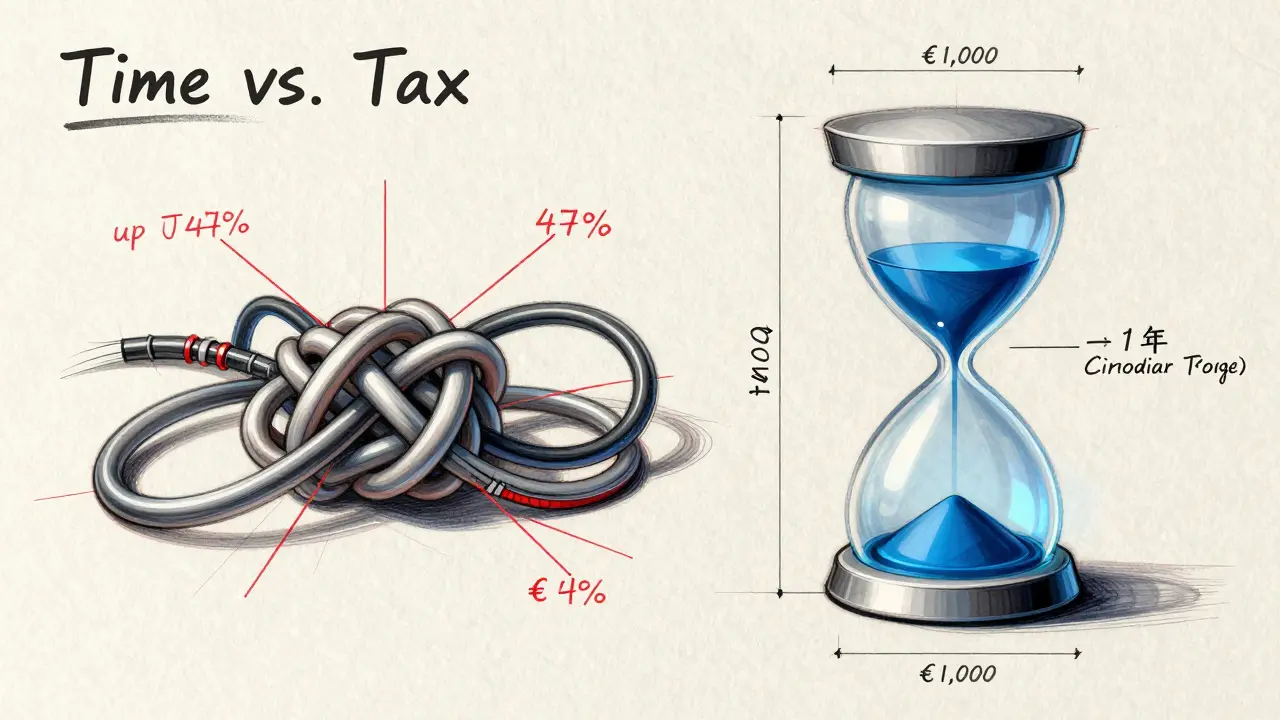
Your short-term gains are added to your other income sources-like your salary-and taxed at your progressive income tax rate. Depending on how much you earn overall, this rate can range from roughly 14% up to 45%. On top of that, there is the Solidarity Surcharge (Solidaritätszuschlag), which adds another 5.5% to your tax bill. This brings the maximum effective tax rate for high earners close to 47.4%.
However, there is a safety net. Germany offers an annual tax-free allowance of €1,000 for private sales transactions. This was increased from €600 in 2024. This means if you make multiple short-term trades throughout the year and your total net profit is €800, you pay zero tax. You only start paying taxes once your combined short-term gains exceed that €1,000 threshold. This allows small traders and those experimenting with DCA (Dollar Cost Averaging) strategies to operate without immediate tax friction.
Germany vs. The Rest of Europe
To understand why Germany’s policy is so popular, you have to look at the neighbors. In France, for example, crypto gains are hit with a flat 30% tax rate regardless of how long you hold. This includes social contributions, making it one of the most expensive places in Europe to trade crypto. The United Kingdom charges Capital Gains Tax at 10% or 20%, depending on your income bracket, with a shrinking annual allowance that dropped to £3,000 in 2025.
Portugal used to be a haven, offering tax-free status for long-term gains, but regulatory scrutiny has tightened significantly. Meanwhile, Switzerland imposes wealth taxes on crypto holdings, meaning you pay simply for owning the asset, not just when you sell it. Singapore treats frequent trading as business income, which attracts higher corporate-style taxation.
| Country | Long-Term Holding Benefit | Short-Term Tax Rate | Annual Allowance |
|---|---|---|---|
| Germany | 0% tax after 1 year | Progressive (14%-45%) + Surcharges | €1,000 |
| France | None (Flat rate applies) | 30% Flat (Income + Social) | Varies by election method |
| United Kingdom | None (Standard CGT applies) | 10% or 20% | £3,000 (2025) |
| Switzerland | No Capital Gains Tax (Private) | N/A (Wealth Tax applies) | N/A |
Germany stands out because it combines EU regulatory stability with investor-friendly incentives. It signals to investors that the state supports long-term wealth creation in digital assets, distinguishing it from jurisdictions that view crypto purely as a speculative commodity.
The Hidden Complexity: Staking and DeFi
While the buy-and-hold strategy is clear, modern crypto usage introduces gray areas. What about staking rewards? What about yield farming in Decentralized Finance (DeFi)?
Here, the rules get trickier. Staking rewards are generally not treated as part of the original coin’s acquisition date. Instead, each new reward token is considered a separate asset acquired at the moment it enters your wallet. Its value at that specific moment becomes its cost basis. If you stake ETH and receive 0.1 ETH as a reward, that 0.1 ETH has its own one-year clock starting from the day you received it. Selling the original ETH after a year is tax-free, but selling the rewards early could trigger taxes.
DeFi activities like lending or providing liquidity are even less defined. The BZSt has not issued comprehensive guidance for every smart contract interaction. Generally, interest earned from lending is treated as income and taxed immediately at your marginal rate. However, complex swaps within automated market makers (AMMs) can create hundreds of taxable events if done within the short-term window. Experts recommend treating DeFi income conservatively until clearer guidelines emerge, often consulting with a specialized accountant.
Tracking Your Holdings: The Paperwork Reality
The benefit of tax-free gains comes with a responsibility: proof. The German tax authority (Finanzamt) may ask for documentation during an audit. You need to prove exactly when you bought your coins and when you sold them.
This is where manual spreadsheets fail. Most investors use specialized software like Blockpit, Koinly, or CoinTracker. These tools connect to your exchanges via API keys to automatically import transaction history. They calculate the holding periods for each batch of coins, applying the FIFO (First-In, First-Out) or LIFO methods as required by German law. Setting this up usually takes a few hours, but it saves dozens of hours later.
If you prefer human help, professional crypto accountants in Germany charge between €150 and €500 annually, depending on complexity. Given the potential penalties for unreported gains-which can reach 40% of the unpaid tax plus interest-this fee is often worth it for portfolios with high volume or complex DeFi interactions.
Future Outlook: Will This Change?
As of mid-2026, the one-year rule remains solid. There are no immediate plans to repeal it. However, the European Union is pushing for harmonization through regulations like MiCA (Markets in Crypto-Assets). While MiCA focuses more on consumer protection and issuer licensing, it increases pressure on member states to align their fiscal policies.
Some analysts predict that by 2027-2030, we might see adjustments to prevent tax arbitrage across borders. But Germany has strong leverage. As Europe’s largest economy and a hub for blockchain innovation, changing the rules abruptly would drive investors and companies away. For now, the message from Berlin is clear: hold long, and keep your profits.
Is crypto really tax-free in Germany after one year?
Yes. According to Section 23 of the German Income Tax Act (EStG), any capital gains from the sale of cryptocurrencies held for more than 12 months are completely exempt from income tax. This applies to Bitcoin, Ethereum, and most other digital assets classified as private property.
Does swapping Bitcoin for Ethereum count as a sale?
Yes. Swapping one cryptocurrency for another is considered a disposal event. If you swap within the first year, you must calculate the profit or loss based on the market value of the new coin at the time of the swap. If you hold the new coin for another year before disposing of it, that subsequent gain will be tax-free.
What is the €1,000 tax-free allowance for?
The €1,000 allowance applies to short-term transactions (held less than one year). If your total net profits from all short-term private sales (including stocks and crypto) do not exceed €1,000 in a calendar year, you pay no tax. Any amount above this threshold is taxed at your personal income tax rate.
Are staking rewards tax-free after one year?
No, not automatically. Each staking reward is treated as a new asset acquired at the moment it is credited to your wallet. The one-year clock starts fresh for each reward batch. You must hold each specific batch of rewards for 12 months before selling them tax-free.
Do I need to report tax-free crypto sales to the Finanzamt?
Generally, no. If all your crypto disposals are tax-free due to the one-year holding period, you typically do not need to declare them in your annual tax return. However, you must keep detailed records (proof of purchase dates and amounts) for at least ten years in case of an audit.