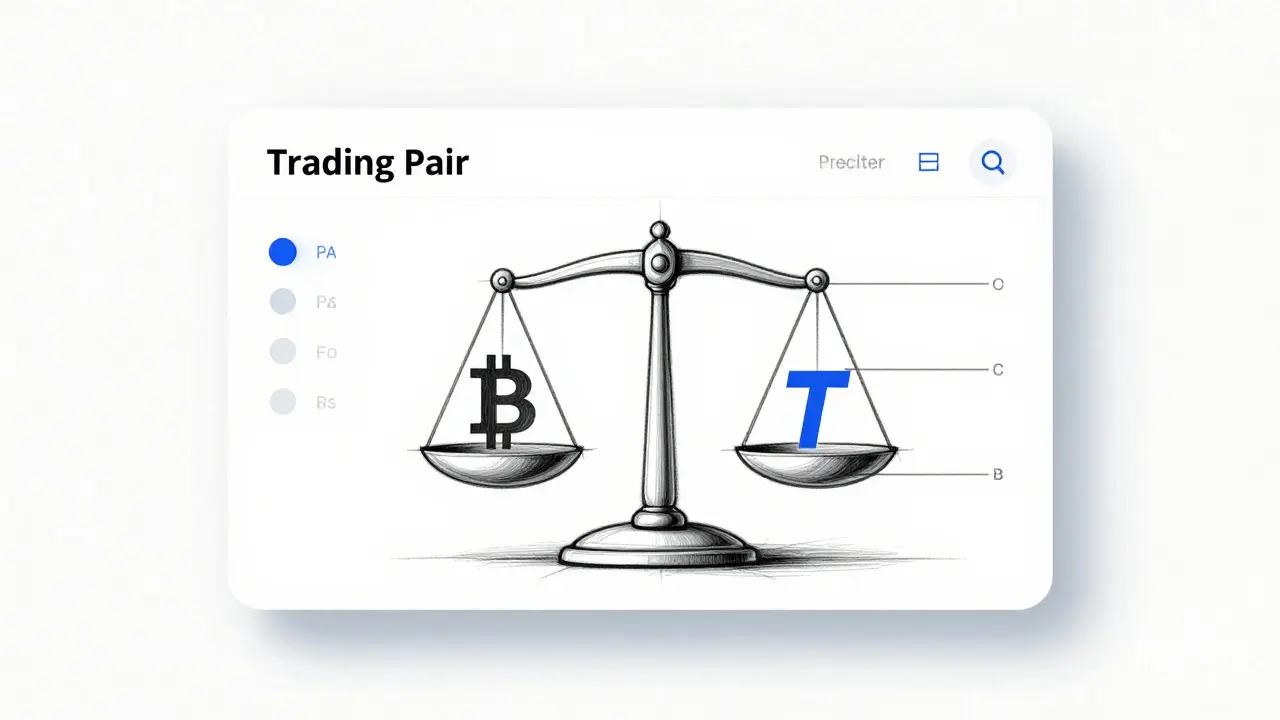
Imagine you're at an airport and need to swap your US dollars for Euros. You aren't just looking at a single price; you're looking at a BTC USDT trading pairs style exchange where one currency is traded directly for another. In the world of crypto, you rarely just "buy Bitcoin." Instead, you trade one asset for another. If you've ever looked at a trading screen and wondered why there are two tickers separated by a slash, you're looking at a trading pair.
The Basics: What Exactly is a Trading Pair?
A trading pair is simply two assets that can be exchanged for each other on an exchange. Think of it as a ratio. In every pair, there's a "base currency" and a "quote currency." The base currency is always listed first, and the quote currency is second.
For example, in the pair BTC/USDT, BTC (Bitcoin) is the base currency and USDT (Tether) is the quote currency. When you see a price of 65,000, it means one unit of the base currency (1 BTC) costs 65,000 units of the quote currency (65,000 USDT). If you're buying, you're spending the quote currency to get the base currency. If you're selling, you're giving up the base currency to collect the quote currency.
Breaking Down the Big Three: BTC, ETH, and USDT
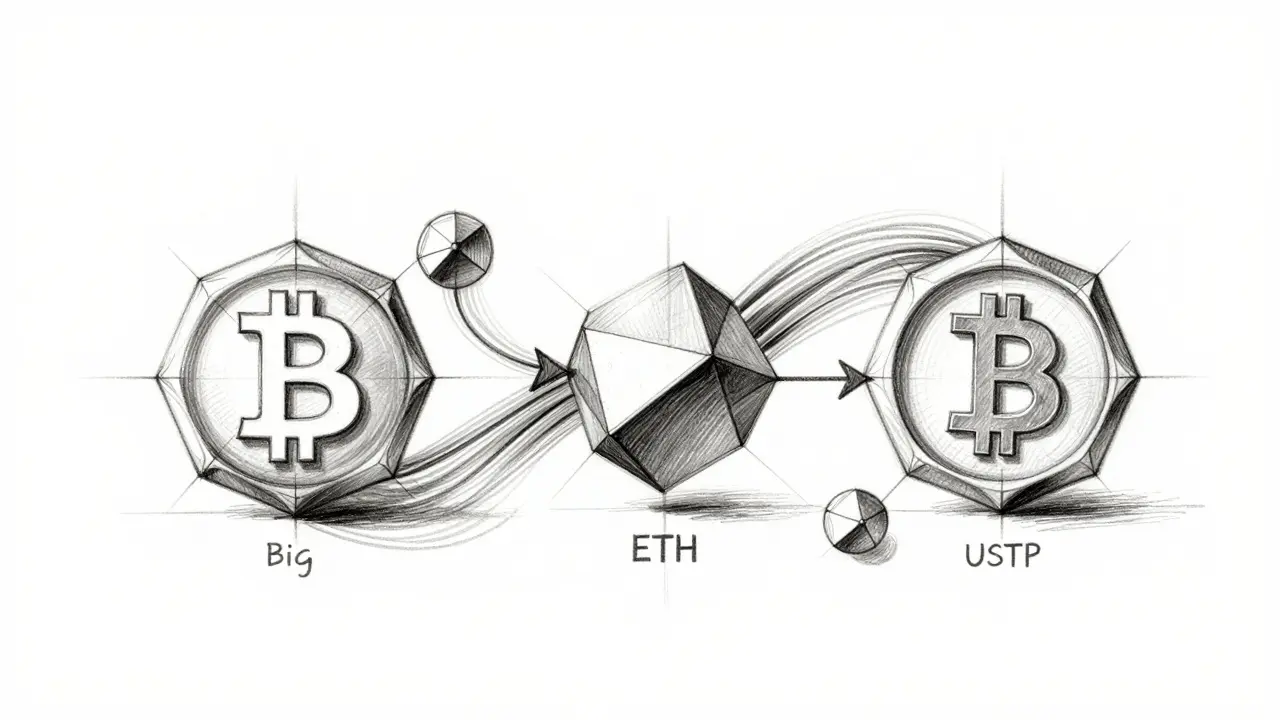
While there are thousands of coins, most of the market revolves around three heavy hitters. Understanding how they interact is the key to navigating any exchange.
Bitcoin (BTC) is the original. For years, it was the only quote currency available. If you wanted a small altcoin, you had to buy BTC first and then trade that BTC for the altcoin. While its dominance has dropped-from nearly 95% in 2014 to around 15% today-it still acts as the market's primary anchor.
Ethereum (ETH) is the second most influential asset. Because of its smart contract capabilities, it's often traded against both BTC and USDT. Trading ETH/BTC is a favorite for "pro" traders who want to measure the strength of Ethereum relative to Bitcoin without worrying about the US dollar value.
Tether (USDT) is a stablecoin pegged 1:1 to the US dollar. It was launched in 2014 and has fundamentally changed how people trade. Instead of moving money back into a traditional bank account (fiat) during a market crash, traders simply swap their volatile coins for USDT to "park" their value in a stable asset.
| Pair Type | Example | Primary Use Case | Volatility Level | Liquidity |
|---|---|---|---|---|
| Crypto-to-Stablecoin | BTC/USDT | Buying/Selling for "cash" value | Moderate | Very High |
| Crypto-to-Crypto | ETH/BTC | Accumulating more BTC or ETH | High | High |
| Altcoin-to-Stablecoin | ADA/USDT | Speculating on smaller projects | Very High | Moderate to Low |
Choosing Your Strategy: Stablecoin Pairs vs. Cross Pairs
Depending on your goals, you'll either want a stablecoin pair (like ETH/USDT) or a cross pair (like ETH/BTC). Each has a completely different impact on your portfolio.
Stablecoin pairs are the gold standard for beginners. They provide a clear price in dollars, making it easy to track profits and losses. According to market data, over 60% of all crypto trading volume now flows through USDT pairs. They are incredibly liquid, meaning the "spread" (the difference between the buy and sell price) is usually tiny, often between 0.02% and 0.05%. This means you get a price very close to the actual market value.
Cross pairs, on the other hand, are for those who don't care about the dollar value but care about the ratio between two assets. If you believe Ethereum will outperform Bitcoin over the next month, you trade the ETH/BTC pair. The big advantage here is efficiency. You skip the middleman (USDT), which means you avoid paying two sets of trading fees and you don't have to worry about whether a stablecoin issuer is actually keeping their reserves.
However, cross pairs are a double-edged sword. You're dealing with two volatile assets at once. If both BTC and ETH crash, but BTC crashes slower, your ETH/BTC position might still look like it's losing value even if the overall market is just behaving normally. It's a lot more mental math.
The Hidden Dangers: Liquidity, Slippage, and Counterparty Risk
Not all pairs are created equal. If you move away from the "Big Three," you enter a zone where the rules change. The biggest risk in low-volume pairs is slippage. This happens when there aren't enough buyers or sellers at your desired price, forcing the exchange to execute your trade at a worse price than you expected. In some low-liquidity pairs, a moderate trade can move the price by 1% to 3% instantly.
Then there's the issue of counterparty risk. Since USDT is managed by a private company (Tether Limited), you are essentially trusting them to hold the actual dollars backing your tokens. While Tether frequently releases reserve reports-showing a high percentage of cash and equivalents-the risk remains. We saw a glimpse of this during the May 2022 USDC depegging event, where a stablecoin briefly dropped below $1.00, causing chaos across every pair that relied on it.
Practical Tips for Navigating Pairs
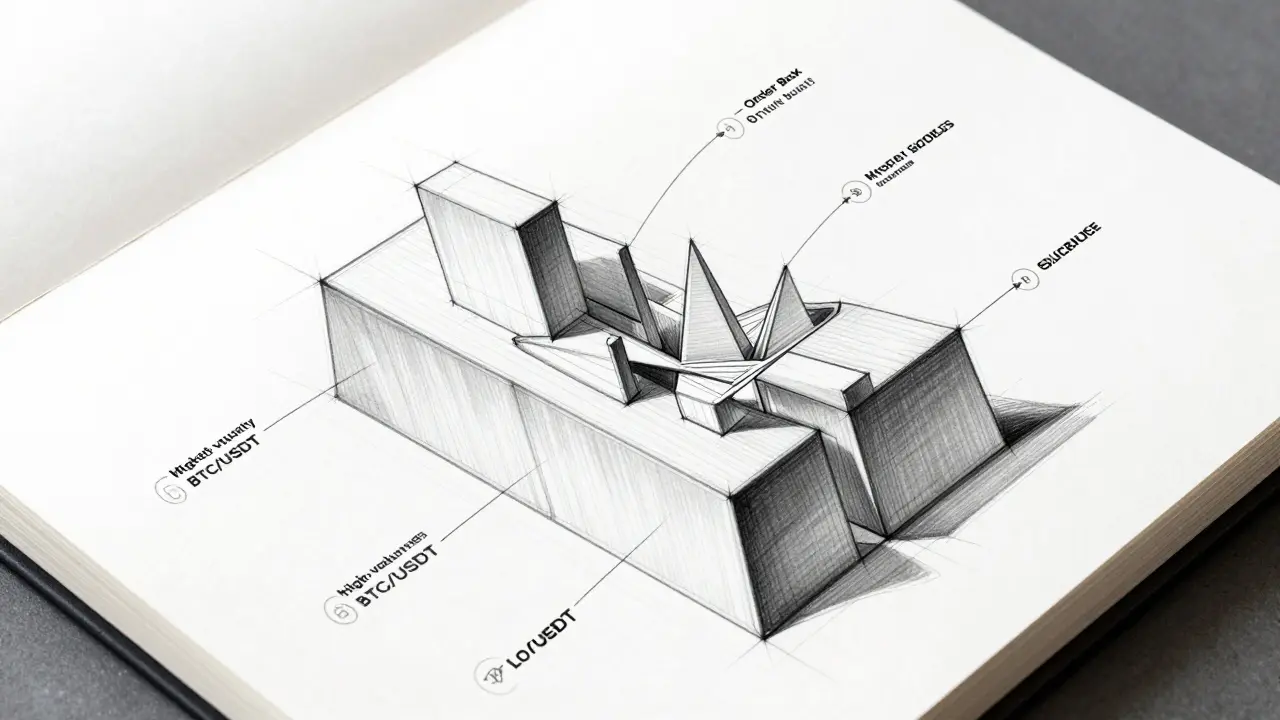
If you're just starting out, the best move is to stick to the high-volume lanes. BTC/USDT and ETH/USDT are the safest bets because they have the most "depth" in their order books. This means you can buy and sell large amounts without accidentally spiking the price.
A pro tip for analyzing the market: if you see ETH/BTC rising, don't immediately assume Ethereum is "pumping." Check the ETH/USDT and BTC/USDT pairs. If ETH/USDT is flat but BTC/USDT is crashing, the rise in the cross pair is actually caused by Bitcoin's weakness, not Ethereum's strength. Using stablecoins as a reference point removes the noise.
For those looking to grow their portfolio, consider the "base currency accumulation" strategy. Instead of trading everything back to USDT, some traders keep their profits in BTC. This allows them to grow their total amount of Bitcoin over time by trading the ETH/BTC pair effectively.
What is the difference between a base currency and a quote currency?
The base currency is the first asset listed in a pair (e.g., BTC in BTC/USDT) and is the asset you are buying or selling. The quote currency is the second asset (e.g., USDT) and is used to determine the price of one unit of the base currency.
Why would I trade ETH/BTC instead of ETH/USDT?
Trading ETH/BTC allows you to speculate on the relative strength of Ethereum compared to Bitcoin. It is useful for traders who want to increase their Bitcoin holdings by trading a volatile altcoin against it, and it avoids the need to convert to a stablecoin first, potentially saving on fees.
Is USDT actually safe to use in trading pairs?
USDT is widely used and highly liquid, but it carries counterparty risk because it is centrally managed. If the issuer fails to maintain reserves, the peg to the dollar could break. Many traders mitigate this by splitting their stablecoin holdings between USDT and other options like USDC.
What is slippage and how does it affect my trade?
Slippage is the difference between the expected price of a trade and the price at which the trade is actually executed. This usually happens in pairs with low liquidity where there aren't enough orders to fill your trade at a single price point, leading to a worse average entry or exit price.
Which trading pair is best for beginners?
BTC/USDT and ETH/USDT are generally best for beginners. They provide the highest liquidity, the lowest spreads, and the most straightforward pricing in terms of US dollars, making them easier to analyze and trade.



Nishant Goyal
17 April, 2026 . 00:05 AM
Solid breakdown for anyone just starting out.
Ian Chait
18 April, 2026 . 22:01 PM
Absolute joke that we trust Tether. The whole thing is a house of cards built by the globalists to control liquydity. Its obvious the reserves are just numbers on a screen and the cabal is laughing while we trade these fake pairs. Wake up people, the fiat system is just a precursor to the total collapse and these stablecoins are the leash they use to keep us in the game until the rug pull happens.
Shantal Sanjur
20 April, 2026 . 16:46 PM
Oh, wow, a guide that tells us BTC is the 'anchor'. Truly groundbreaking stuff. I'm sure the 'counterparty risk' section was written by someone who just discovered what a balance sheet is. It's almost cute how we pretend USDT is actually stable while the whales are just manipulating the order books to eat the retail traders alive. But sure, keep following the 'high-volume lanes' while your portfolio slowly bleeds out in a sideways market.
Andrew Southgate
22 April, 2026 . 15:31 PM
I really appreciate how you explained the base and quote currency concept because that is usually where most people get tripped up when they first open a trading interface. For those who are feeling a bit nervous, just remember that taking it slow and using a demo account can be a lifesaver before you dive into the real deep end of the market. If you look at the long-term charts, the volatility starts to smooth out, and you can really see how these pairs move in cycles, which makes the whole process feel much less like gambling and more like a calculated strategy for wealth building over the next decade.
Joshua Salwen
24 April, 2026 . 07:23 AM
LMAO the slipage part is so real!! I tried trading some random shitcoin last week and the price literally jumped 5% just cuz I clicked buy. It was a total disaster and I basically threw my money into a black hole!! This market is actualy insane and the volatility is just too much for my heart to handle lol
Kevin Lư
25 April, 2026 . 16:15 PM
Kinda lazy to just suggest the 'Big Three' but I guess for a beginner it works. Still, you gotta admit that staying in USDT is basically just holding a digital version of the dollar, which is a joke in itself since the dollar is printing like crazy. But hey, it's better than losing everything on a rug pull, right?
Chintu Parikh
27 April, 2026 . 09:35 AM
I must express my sincerest agreement with the points regarding the efficiency of cross pairs. It is truly an elegant way to optimize one's portfolio by avoiding the unnecessary middleman of stablecoins. Let us all strive to master these ratios together to ensure a prosperous future for the entire crypto community!
Adam Mann
28 April, 2026 . 13:16 PM
This is such a welcoming way to explain things! I remember being so confused by the slashes and the tickers when I first started, and I wish I had something this simple to read back then. It's just so wonderful to see the community helping each other out like this, and I truly believe that once we all understand the basics of how the plumbing of the market works, we can all grow together and find a path to financial freedom that is inclusive for everyone regardless of where they are starting from in life.
Mike Kempenich
28 April, 2026 . 15:21 PM
Stick to the BTC/USDT pair if you're unsure. It's the most reliable way to keep your head straight while you're learning the ropes.
Ankit Sindhu
29 April, 2026 . 02:11 AM
For those of you struggling with the concept of the base currency, just think of it as the item you are shopping for in a store. The quote currency is simply the price tag attached to it. Keep practicing and don't be afraid to start with very small amounts while you get comfortable.
Prachi Bhadarge
30 April, 2026 . 19:25 PM
Imagine actually thinking Tether is 'safe' just because it has high volume. Lol. Sure, use the high-volume lanes and get your stop-losses hit by the bots every single time. Pure genius.
Vicky Duffala
1 May, 2026 . 12:20 PM
Trading is really just a mirror of our own psychological state :) If you can master your emotions, the trading pairs are just tools. I love how this guide simplifies the technicals so we can focus on the philosophy of value! 🚀
Michelle Stanish
1 May, 2026 . 17:33 PM
I don't like stablecoins. They defeat the whole purpose of decentralization.
Adedamola Oyebo
1 May, 2026 . 20:47 PM
Very clear!! The slippage explanation is spot on!!
Luke George
2 May, 2026 . 08:32 AM
The reserves are a lie. Only a few of us realize that the entire USDT system is designed to feed the central banks' data centers to better predict our movemenst. I've kept my assets in cold storage and away from these 'pairs' because the moment you put your coins on an exchange, they aren't yours anymore.
Gaurav Undirwade
3 May, 2026 . 12:49 PM
It is profoundly disappointing that some individuals still cling to the notion that stablecoins are a viable long-term strategy. One must possess a shred of intellectual rigor to realize that relying on a private entity for 'stability' is an affront to the very principles of sound financial management. I suggest you all examine your moral bankruptcy before trusting a company with no transparency.
Shannon Kelly Smith
3 May, 2026 . 19:22 PM
Love the energy here! Keep pushing forward and keep learning! 📈🔥 The crypto world is huge and there's a place for everyone! 💎🙌
nathan jones
5 May, 2026 . 00:49 AM
Good info. Simple and to the point.
Evan Iacoboni
6 May, 2026 . 09:05 AM
Wait, so if I trade ETH/BTC, I'm basically betting that ETH will go up more than BTC does? That seems like a way faster way to lose money if you don't know what you're doing.
Trudy Morse
7 May, 2026 . 12:51 PM
It's all just numbers in a digital wind. But yeah, the guide is fine.
Saurav Bhattarai
9 May, 2026 . 09:48 AM
Oh, look at this 'beginner's guide'. How quaint. I'm sure the peasants find this very helpful while the real elites are trading complex derivatives on platforms you can't even access. This is just basic arithmetic dressed up as financial advice. How utterly pedestrian.
John and Lauren Busch
10 May, 2026 . 16:13 PM
Whatever, it's all just gambling anyway lol.
Gillian Kent
12 May, 2026 . 02:37 AM
Tbh I just keep evrything in USDC cuz its feels a bit more safe, but the lquidity isnt always as good as USDT
Michael Harms
12 May, 2026 . 12:59 PM
Hey, don't let the skeptics get you down! It's totally normal to be confused at first. Just take small steps, use the guides, and you'll be a pro in no time. We've all been there!
Adam Mann
14 May, 2026 . 00:15 AM
Exactly! The most important thing is just to keep a positive mindset and help each other out. If anyone has more questions, just jump in and we can all figure it out together as a community, because that's what makes this space so special in the first place!