
Imagine locking your money in a savings account to earn interest, but you can't touch that money for months. That's the classic problem with cryptocurrency staking. You earn rewards for securing the network, but your assets are frozen, meaning you miss out on other trading opportunities. MilkyWay is a Cosmos-based DeFi platform that solves this by combining liquid staking and restaking services for modular blockchains. Also known as MilkyWay Protocol, it allows users to earn rewards without locking up their capital, effectively turning "frozen" assets into liquid ones that can still grow.
The Core Concept: How MilkyWay Works
At its heart, MilkyWay operates as a Layer 1 chain within the Cosmos ecosystem. It focuses on "modular liquid staking." Instead of just locking your tokens, you deposit them into the protocol and get a representative token back.
For example, if you deposit TIA (the native token of the Celestia network), you receive milkTIA. This liquid token is pegged to the price of TIA and grows in value as staking rewards accumulate. This means you have a token you can actually use in other DeFi apps while your original TIA is still working in the background to secure the network.
The platform doesn't stop at just one asset. It has expanded its support to include other modular ecosystems, providing liquid versions of tokens like INIT (from Initia) and BABY (from Babylon), resulting in tokens like milkINIT and milkBABY.
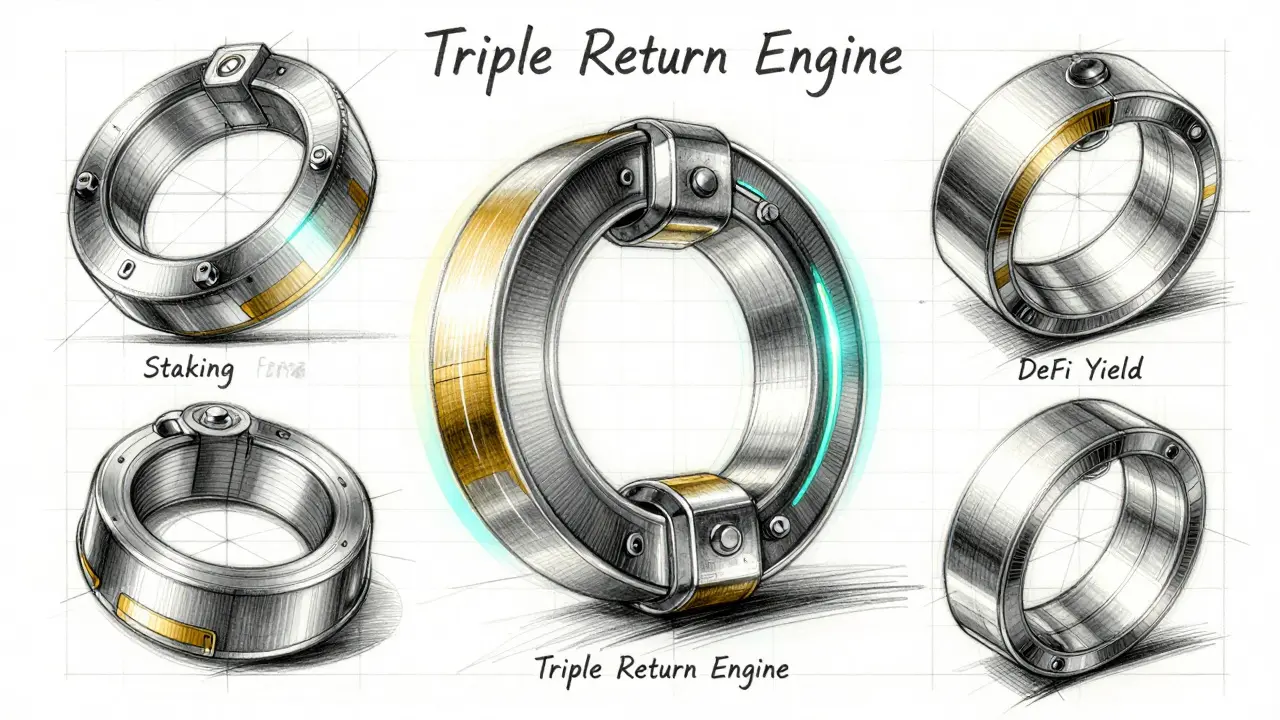
The "Triple Return" Strategy
The real draw of MilkyWay isn't just liquidity; it's the ability to stack earnings. The platform enables what it calls "triple returns" from a single single investment. Here is how that breakdown actually works in a real-world scenario:
- Base Staking Rewards: Your original tokens (like TIA) earn the standard rewards for securing their native blockchain.
- DeFi Yields: You take your liquid tokens (like milkTIA) and deposit them into other DeFi protocols to earn additional interest or trading fees.
- Restaking Rewards: Through its restaking mechanism, your staked assets provide security guarantees to other services, known as Active Validator Services (AVS), earning you a third layer of profit.
This creates a self-sustaining liquidity cycle. You aren't choosing between security and growth; you're achieving both simultaneously across multiple layers of the modular stack.
| Feature | Traditional Staking | MilkyWay Liquid Staking |
|---|---|---|
| Asset Availability | Locked/Frozen | Liquid (via milkTokens) |
| Revenue Streams | Single (Staking Rewards) | Triple (Staking + DeFi + Restaking) |
| Capital Efficiency | Low | High |
| Flexibility | Rigid Unstaking Periods | Immediate Liquidity |
Understanding the MILK Token
While the protocol provides the service, the MILK token is the fuel that runs the governance and utility side of the house. Launched via a Binance Wallet IDO in April 2025, MILK is designed as a deflationary asset with a maximum supply of 1.2 billion tokens.
If you hold MILK, you aren't just speculating on a price; you're gaining specific utility within the ecosystem:
- Governance: You can vote on protocol changes and new asset integrations.
- Revenue Sharing: A portion of the protocol's earnings is shared with token holders.
- Ecosystem Incentives: Holding MILK often qualifies users for specific rewards and airdrop campaigns.
It's worth noting that the MILK token has seen massive volatility. After hitting an all-time high of $0.2917, it experienced a sharp correction, which is common for new DeFi tokens. However, its recovery from all-time lows suggests that there is still a strong core of believers in the modular infrastructure it supports.
Why Modular Blockchains Matter
To understand why MilkyWay is gaining traction, you have to understand the shift toward modularity. Traditional blockchains like Bitcoin or Ethereum are "monolithic," meaning they handle everything-execution, settlement, and data availability-in one place. Modular blockchains split these tasks up.
Celestia, for instance, focuses specifically on data availability. Because these networks are specialized, they need a different kind of security and liquidity layer. MilkyWay acts as the glue, providing the pre-built security infrastructure that developers need. Instead of a new project spending months launching its own validator set, they can use MilkyWay's restaking services to bootstrap their security instantly.

Risks and Reality Checks
No crypto project is without risk, and MilkyWay is no exception. Because it relies on complex smart contracts to maintain the peg between tokens (like TIA and milkTIA), any bug in the code could lead to "de-pegging," where the liquid token loses its value relative to the original asset.
There is also the market risk. The protocol's success is heavily tied to the success of modular networks. If the trend shifts away from modularity, the demand for milkTokens will drop. Furthermore, the extreme price swings of the MILK token show that it is currently a high-volatility asset, making it a "high-risk, high-reward" play rather than a stable investment.
Despite these risks, the institutional backing is significant. Having names like Polychain Capital and Binance Labs involved provides a level of credibility. Their $6 million in funding helped the platform reach a Total Value Locked (TVL) that has peaked around $190 million, proving that big players see value in this specific approach to liquidity.
What exactly is the difference between staking and restaking on MilkyWay?
Staking is the act of locking your tokens to secure a single blockchain (like Celestia) in exchange for rewards. Restaking takes those already-staked assets and uses them to provide security for additional services or other blockchains simultaneously, allowing you to earn extra rewards on top of your base staking yield.
Is the MILK token safe to invest in?
Like most low-cap DeFi tokens, MILK is highly volatile. While it has strong backing from Binance Labs and Polychain Capital, its price has fluctuated significantly. It should be viewed as a high-risk asset. Always check current market data on sites like CoinMarketCap before investing.
How do I get milkTIA?
You get milkTIA by depositing your native TIA tokens into the MilkyWay protocol. The protocol stakes your TIA and issues you milkTIA as a liquid receipt that you can trade or use in other DeFi applications.
What happens if the price of TIA drops?
Since milkTIA is designed to maintain a price peg to the underlying TIA, if the price of TIA drops, the value of milkTIA will generally drop as well. You are still exposed to the market volatility of the underlying asset.
Does MilkyWay support other coins besides TIA?
Yes, MilkyWay has expanded to support other modular assets. This includes support for the Initia network (milkINIT) and Babylon (milkBABY), moving toward becoming a multi-chain liquidity hub.
Next Steps for Users
If you are a TIA holder and your assets are currently locked in a traditional validator, you might consider migrating to a liquid staking provider like MilkyWay to regain access to your capital. However, start with a small amount to understand how the liquid tokens behave in your wallet.
For DeFi farmers, look for pools that accept milkTokens. These often offer higher yields because they are providing liquidity for emerging modular networks. For developers, exploring the Active Validator Services (AVS) on MilkyWay can help you secure your new project without needing to find your own set of validators from scratch.




Scott Fenton
11 April, 2026 . 21:33 PM
The implementation of liquid staking on modular architectures is a significant step toward capital efficiency. It is prudent to remember that the risk of smart contract vulnerabilities remains a primary concern when interacting with these protocols.
Tracie and Matthew Hartley
12 April, 2026 . 16:10 PM
idk why everyone is so hyped lol. liquid staking is just a fancy way to say you're risking more stuff for a tiny bit more gain. its all a bubble anyway
James Bone
14 April, 2026 . 01:40 AM
The irony of "security" in crypto is that we just layer more complexity on top of complexity until the whole thing collapses. We call it "triple returns" but it's really just a triple-layered house of cards. Moral bankruptcy at its finest.
jennelle williams
15 April, 2026 . 19:37 PM
keep it simple just be careful
Samson Selleck
17 April, 2026 . 15:54 PM
The naive focus on TVL is quaint. One must analyze the actual liquidity depth and the slippage vectors associated with milkTIA before claiming this is a viable hedge. The systemic risk here is glaringly obvious to anyone with a basic grasp of game theory and modularity. This is just another derivative layer designed to obfuscate the underlying lack of organic demand. I find the exuberance around this specific L1 within Cosmos to be entirely decoupled from the technical reality of its settlement layer. If the peg slips by even 1%, the contagion will rip through the AVS services like a wildfire. It is essentially a leveraged bet on the stability of Celestia's data availability sampling. Most retail participants are merely providing exit liquidity for the VCs who got in during the IDO. The deflationary nature of the MILK token is a superficial gimmick that ignores the inflationary pressure of the rewards system. Truly a textbook example of over-engineering for the sake of yield farming. The cognitive dissonance required to see this as "safe" is astounding. We are seeing a recursion of risk that will inevitably lead to a cascading liquidation event. It is almost poetic in its inefficiency.
7stargee Emmanuel Obani
18 April, 2026 . 16:00 PM
too much risk for me 🙄
Jonathan Chamma
18 April, 2026 . 21:21 PM
It's like a little seed that grows in three different directions at once! Just remember that the soil needs to be stable for the plant to survive. Let's all try to learn how these modular bits fit together without getting too stressed.
Lane Montgomery
19 April, 2026 . 23:00 PM
Where'd you buy yours?
Omotola Balogun
21 April, 2026 . 15:54 PM
Actually, you missed a point here. The L1 structure of MilkyWay isn't just for show; it's essential for managing the state of the liquid tokens. Most ppl don't realize the complexity of cross-chain messaging in the Cosmos SDK. Its basic fundamentals though.
Aaliyah BROTHERS
22 April, 2026 . 00:11 AM
THEY WANT US TO LOCK OUR MONEY IN THEIR "MODULAR" TRAPS!!! This is just another way for the globalists to track every single satoshi we move!!! Wake up people!!! The "triple return" is a LIE to get you to trust the machine!!!
EDOZIEM MICHAEL
23 April, 2026 . 12:32 PM
money is just a dream we all agree on so why not dream of triple returns
Lela Singh
23 April, 2026 . 18:38 PM
Absolute game changer! 🚀
Alan Seiden
25 April, 2026 . 01:42 AM
Only the British understand true financial stability, and this "modular" rubbish is just another American-backed scheme to fleece the public. Absolutely pathetic that people fall for this.
Heather Warren
25 April, 2026 . 02:53 AM
I think this is a wonderful way for beginners to get into the ecosystem. Just be sure to read the documentation carefully before moving your funds.
Swati Sharma
26 April, 2026 . 20:54 PM
The synergy between the liquid staking derivatives and the AVS layers is truly impressive for optimizing capital efficiency.
Akshay Gorad
27 April, 2026 . 20:32 PM
I appreciate the detailed explanation of the MILK token's utility.
Lauren Abrams
29 April, 2026 . 19:04 PM
Just watching from the sidelines for now.
Chidinma Sandra okafor
30 April, 2026 . 04:36 AM
Oh sure, because we all know Binance Labs always picks the winners. What a lovely little pump and dump waiting to happen for the poor souls who buy at the top.
Emily H
2 May, 2026 . 02:06 AM
It is quite encouraging to see such innovation in the modular space. I recommend using a hardware wallet for the utmost security when dealing with these platforms.
Stanly Hayes
2 May, 2026 . 14:34 PM
This is basically just copying what LIDO did but for the modular crowd. Get some original ideas for once!
aletheia wittman
4 May, 2026 . 12:20 PM
omg the volatility of MILK is literally giving me anxiety just looking at the chart lol
logan bates
5 May, 2026 . 10:35 AM
Typical crypto nonsense.
Rob Mitchell
6 May, 2026 . 15:05 PM
Great breakdown of the triple return strategy.
Scott Fenton
7 May, 2026 . 03:19 AM
I must agree that the risk profile is elevated, though the potential for yield optimization is mathematically superior to traditional staking.