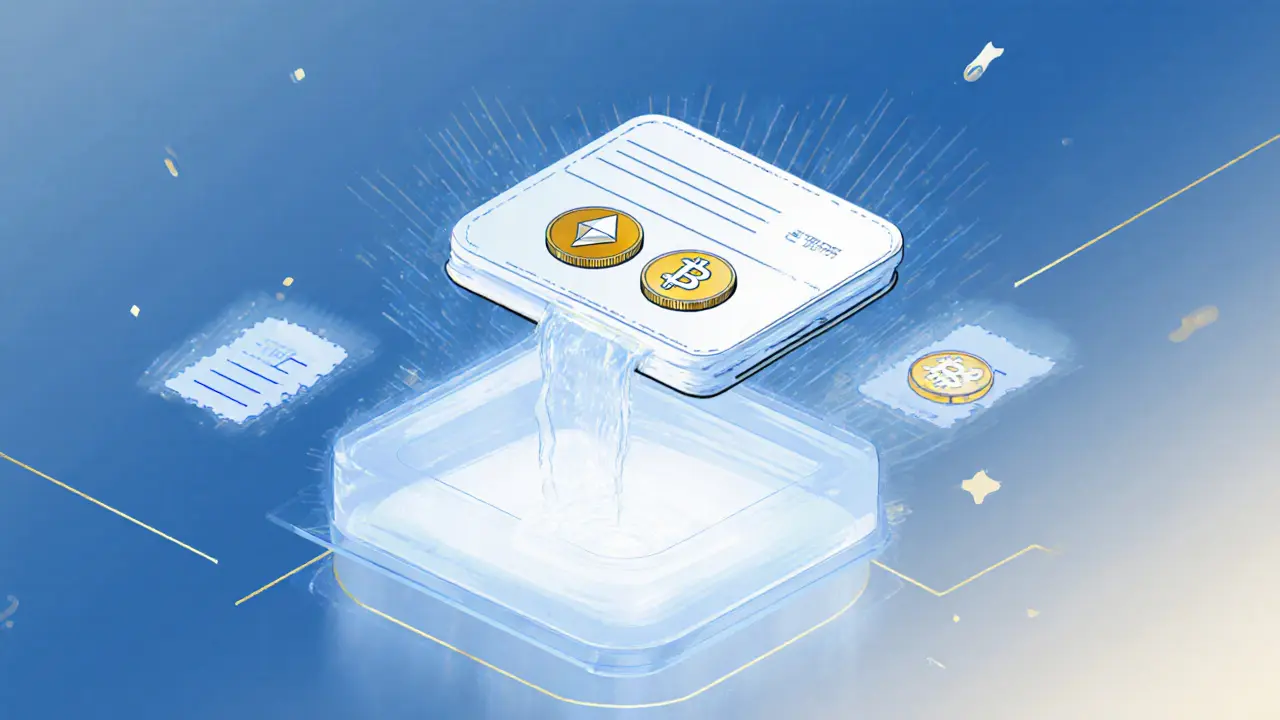
DeFi Liquidity Mining Calculator
Input Parameters
Results & Risk Assessment
Enter your parameters to see estimated returns
How This Works
Trading Fees: You earn 0.05%-0.3% of all trades in the pool, proportional to your share.
Token Rewards: Most protocols pay extra tokens (like UNI or SUSHI) for providing liquidity, typically 5-50% APY.
Impermanent Loss: If token prices change, your position's value can be less than holding the tokens directly. This risk increases with volatility.
What Exactly Is Liquidity Mining?
Liquidity mining is how decentralized finance (DeFi) platforms pay people to lock up their crypto in trading pools. It’s not mining like Bitcoin, where you need powerful computers. Instead, you just deposit tokens-like ETH and USDC-into a pool on a decentralized exchange (DEX), and you get paid in return. The more you lock up, and the longer you keep it there, the more you earn.
The system was first used by Synthetix in 2019, but it exploded in 2020 when Uniswap started giving out UNI tokens to liquidity providers. Suddenly, people weren’t just trading crypto-they were earning it just by leaving their money in a pool. By 2021, over $100 billion was locked in these pools. Even now, in 2025, more than $50 billion stays locked in DeFi liquidity pools, proving it’s not just a flash in the pan.
How Do You Actually Earn Rewards?
You earn rewards in two ways: trading fees and protocol tokens.
First, every time someone trades on a decentralized exchange, a small fee is charged-usually 0.05% to 0.3%. That fee gets split among everyone who provided liquidity to that pool. So if you put $1,000 into a pool with $100,000 total, you own 1% of the pool, and you get 1% of all the fees generated. This part is steady and predictable.
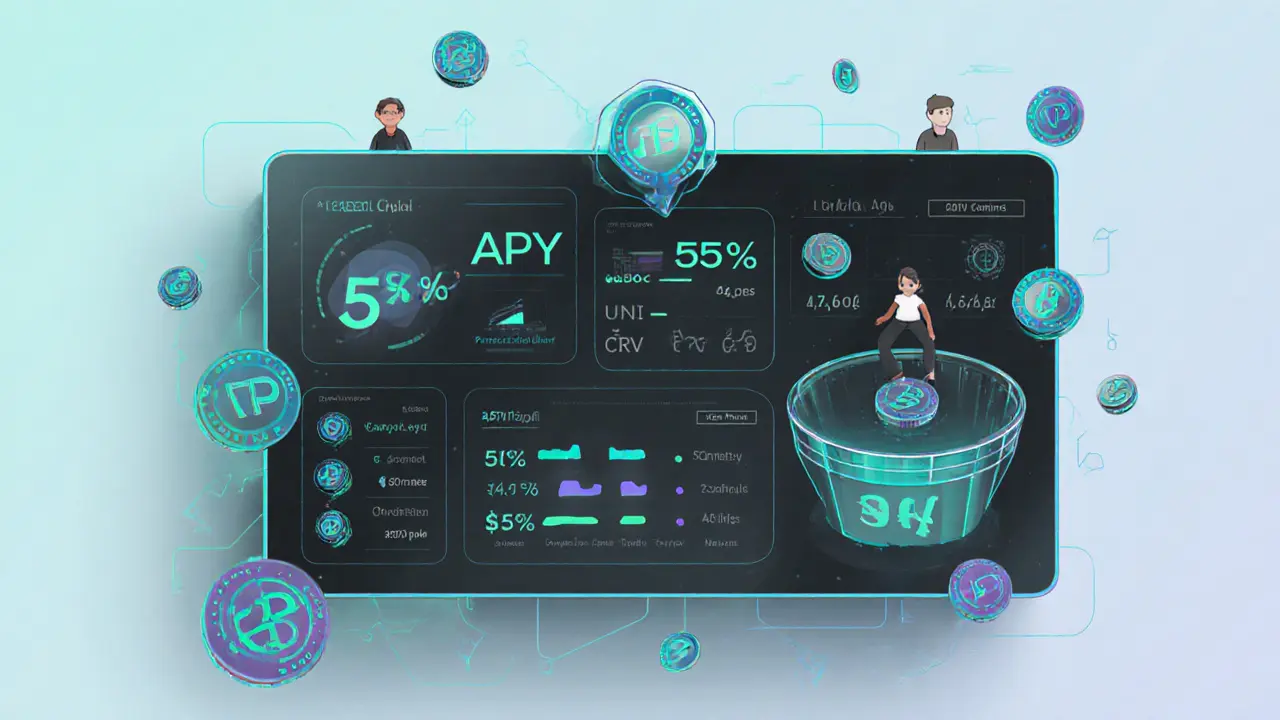
The second part is where things get interesting. Most DeFi platforms also give out their own native tokens-like UNI, SUSHI, or CRV-as extra rewards. To get these, you have to stake your LP tokens (the digital receipt you get when you deposit into a pool) into a separate "farm." This is called yield farming. The platform locks your LP tokens for a while and pays you daily or hourly in protocol tokens. The more people join the farm, the smaller your share becomes. But if you’re early, you can earn big.
For example, someone who put $500 into a new Uniswap V3 pool in early 2025 might earn 15% APY from trading fees and another 40% APY from UNI rewards-totaling 55% annual return. That’s not rare. On newer or less popular pools, APYs can hit 100% or more, but those come with higher risk.
What Are LP Tokens and Why Do They Matter?
When you deposit two tokens into a liquidity pool-say, ETH and DAI-you don’t just get a balance. You get LP tokens. These are digital receipts that prove you own a share of the pool. If you deposited $2,000 worth of ETH and DAI into a pool with $200,000 total, you’d get 1% of the LP tokens. You can’t spend them like regular crypto. But you can stake them to earn more rewards.
LP tokens are the bridge between providing liquidity and earning extra tokens. Without them, you’d only get trading fees. With them, you unlock the full reward system. But here’s the catch: if you withdraw your liquidity, you get back your original tokens-but their value might have changed. That’s where impermanent loss comes in.
What Is Impermanent Loss, and Should You Worry?
Impermanent loss is the biggest risk most people don’t understand. It happens when the price of the two tokens in your pool moves apart.
Let’s say you put in $1,000 of ETH and $1,000 of USDC. ETH is worth $2,000 per coin, so you add 0.5 ETH and 1,000 USDC. A week later, ETH rises to $3,000. The pool automatically rebalances to keep the value of both tokens equal. Now, you have less ETH and more USDC than you started with. If you pulled your money out right then, you’d have less total value than if you’d just held ETH in your wallet.
This loss is called "impermanent" because if ETH drops back to $2,000, the loss disappears. But if you withdraw while the price is off, it becomes real. Many new users lose money because they don’t realize this. The key? Stick to stablecoin pairs like USDC/DAI or ETH/USDC, where price swings are small. Avoid pairing volatile tokens like new memecoins with ETH unless you’re ready for big swings.
Why Do Protocols Even Do This?
DeFi protocols need liquidity to work. If no one’s putting money into a pool, traders can’t swap tokens. Prices jump around. Slippage gets bad. No one uses the platform.
Liquidity mining solves that. Instead of paying venture capitalists or insiders to fund liquidity, they pay everyday users. It’s a smart way to bootstrap a network fast. It also helps decentralize ownership. When thousands of people hold the protocol’s token, no single group controls it. That’s why Uniswap, Aave, and Curve all use it.
But not all programs are well-designed. Some give out too many tokens too fast. That floods the market, crashes the token price, and leaves users with worthless rewards. The best systems-like Curve’s veCRV-lock rewards for months to align long-term interests. Others tie rewards to actual fees generated, not just time spent. That’s the future.
What Are the Real Risks?
Beyond impermanent loss, there are three big dangers:
- Mercenary capital: People jump from one farm to another chasing the highest APY. One day, a pool has $10 million locked. The next, it’s gone because everyone left for a better offer. That crashes the token price and leaves the protocol broken.
- Token dump pressure: Every time you claim your rewards, you sell them. If thousands do it at once, the price crashes. That’s why some protocols now let you lock rewards for voting power instead of cashing out.
- Smart contract bugs: DeFi code isn’t perfect. In 2024, a popular yield farm on Arbitrum had a flaw that let someone drain $22 million before it was fixed. Always check audits and stick to well-known platforms.
Gas fees on Ethereum can also eat your profits. Claiming rewards might cost $10-$50 during busy times. That’s why many users now use Layer 2 chains like Polygon or Base, where fees are under $0.10.

Where Should You Start?
If you’re new, don’t chase 100% APYs. Start simple:
- Use MetaMask or Phantom wallet (for Solana).
- Go to Uniswap (Ethereum), SushiSwap (Ethereum or Polygon), or PancakeSwap (BSC).
- Pick a stable pair: ETH/USDC or USDC/DAI.
- Deposit $50-$200. Don’t risk more than you’re okay losing.
- Stake your LP tokens in the farm and claim rewards weekly.
Track your earnings on DeFiLlama or Zapper. They show real-time APYs and impermanent loss estimates. Most users who stick to this approach earn 5-15% APY net after fees and losses-solid for passive income.
What’s Next for Liquidity Mining?
The next wave is smarter design. Uniswap V3 lets you focus your liquidity in a price range-like only between $2,800 and $3,200 for ETH. That boosts your fee earnings but requires more attention. Curve’s veCRV model locks tokens for voting power, so users stay longer. New protocols are tying rewards to real usage: if you borrow $10,000 on Aave, you get COMP based on the interest you pay, not just time.
Regulators are watching too. The SEC has started questioning whether liquidity mining rewards count as unregistered securities. That could change how programs are built. But the core idea-paying users to provide liquidity-is too useful to disappear. It’s just getting more mature.
Final Thought: It’s Not Free Money
Liquidity mining isn’t magic. It’s a trade. You lock up your assets, take on risk, and get paid in tokens that might rise… or crash. The best earners aren’t the ones chasing the highest APY. They’re the ones who understand the mechanics, pick stable pairs, avoid new untested pools, and hold through the ups and downs.
If you treat it like a low-risk side income-not a get-rich-quick scheme-you’ll do fine. And if you’re lucky, you might even help build the next big piece of decentralized finance along the way.
Is liquidity mining the same as staking?
No. Staking means locking up a single token (like ETH or SOL) to help secure a blockchain and earn rewards. Liquidity mining means depositing two tokens into a trading pool on a decentralized exchange and earning fees plus extra tokens. They’re both ways to earn crypto, but they work in completely different systems.
Can you lose money doing liquidity mining?
Yes. The biggest risk is impermanent loss-if the price of your deposited tokens moves a lot, you could end up with less value than if you’d just held them. You can also lose money if the protocol’s token crashes, gas fees eat your profits, or a smart contract gets hacked. Always start small and understand the risks before putting in real money.
Which DeFi platforms are safest for beginners?
Stick with well-audited, long-running platforms: Uniswap (Ethereum), SushiSwap (Polygon), and PancakeSwap (BSC). These have been around for years, have large liquidity pools, and are less likely to have bugs. Avoid new or obscure protocols-even if they offer 200% APY. That’s usually a red flag.
Do you need to pay gas fees for liquidity mining?
Yes. Every deposit, withdrawal, or reward claim costs gas on Ethereum. Fees can range from $5 to $50 during busy times. To save money, use Layer 2 networks like Polygon, Base, or Arbitrum, where gas is under $0.10. Most new users now avoid Ethereum for liquidity mining because of cost.
How often should you claim your rewards?
Claiming too often can cost you more in gas than you earn. Most users claim weekly or biweekly. Some platforms let you compound rewards automatically-meaning your earnings get reinvested into the pool. That’s the best way to grow your position without paying extra fees. Check if your farm has a "reinvest" or "auto-compound" option.



Ryan Hansen
19 November, 2025 . 07:17 AM
I've been doing this since 2021 and honestly the real win isn't the APY it's learning how the market moves under pressure. You start noticing patterns in how pools react to ETH swings or when new tokens launch. It's like watching a live econ simulation. I used to think impermanent loss was a scam until I lost $800 on a Shiba/ETH pair and realized I had no idea how AMMs rebalance. Now I stick to USDC/ETH and only dip into new pools if the audit is public and the team has done at least three successful launches before.
Shanell Nelly
20 November, 2025 . 03:25 AM
If you're new and scared of losing money just start with $50 on SushiSwap on Polygon. Claim your rewards every week and don't touch the principal. You'll be surprised how fast $50 turns into $60 even after gas and minor impermanent loss. The key is consistency not chasing 200% APYs. I've watched so many people blow up their accounts trying to get rich quick. Slow and steady wins the race here.
Kathleen Bauer
21 November, 2025 . 00:21 AM
i just started last month and honestly i thought i was gonna lose everything but i’ve made like $18 in rewards so far on a $100 deposit on uniswap v3. i didnt even know what lp tokens were before this but now i check my positions every morning like its my morning coffee ☕️
Grace Craig
22 November, 2025 . 10:01 AM
The structural elegance of liquidity mining as a mechanism for decentralized network bootstrapping cannot be overstated. It represents a paradigmatic shift from centralized venture capital funding models to permissionless, market-driven capital allocation. The tokenomics of veCRV, in particular, demonstrate a profound understanding of incentive alignment over time horizons. One must appreciate the sophistication of locking mechanisms that transform transient yield farmers into long-term governance stakeholders. This is not merely financial engineering-it is institutional design at its most elegant.
Derayne Stegall
23 November, 2025 . 21:53 PM
YOOOOO JUST CLAIMED MY REWARDS AND MY BALANCE JUST WENT FROM $212 TO $228 😍😍😍 THIS IS LIKE FREE MONEY BUT ACTUALLY LEGIT 💸🔥 I'M TELLING MY MOM ABOUT THIS SHE THINKS I'M WASTING MONEY ON CRYPTO BUT NOW SHE'S ASKING HOW TO SET UP METAMASK 😂🙌
Rick Mendoza
24 November, 2025 . 09:52 AM
You people treat this like a side hustle. It's not. If you're not optimizing your capital across multiple chains and using MEV bots to front-run reward claims you're already behind. The fact that you're using Uniswap V3 without concentrated liquidity ranges means you're leaving 40% of potential fees on the table. And don't even get me started on people who claim weekly. You're paying gas to earn gas. Real players compound automatically and use Layer 2s with native token rewards. If you're not doing this you're not serious.
Aayansh Singh
24 November, 2025 . 18:46 PM
Liquidity mining is a Ponzi dressed in DeFi clothes. The protocols give away tokens they don't have value for to attract dumb money. Then when the token crashes everyone runs and the protocol dies. Look at the graveyard of dead farms from 2021. Over 90% of them are dead. The only ones surviving are the ones that actually generate real fees and have real users. You think you're earning? You're just the last sucker in line before the rug pull.
Rebecca Amy
25 November, 2025 . 02:14 AM
I read all this and still don't know if I should put my $200 in or not. Like I get the theory but what if I just... keep it in my wallet? Idk. Maybe I'm just lazy. Or maybe I'm smart. 🤷♀️
Laura Lauwereins
26 November, 2025 . 23:25 PM
So let me get this straight... you're telling me I can earn crypto just by leaving my money in a digital jar? And people call me crazy for not investing in Bitcoin in 2012. I guess I'm just too late to the party. But hey, at least I didn't lose my savings on FTX. 🤷♀️
Gaurang Kulkarni
27 November, 2025 . 06:55 AM
Everyone talks about impermanent loss like its some deep mystery. Its basic math. If token A goes up and token B stays flat your share of A decreases because the pool rebalances. Its not magic. Its arithmetic. And if you dont understand that you should not be touching LP tokens. The fact that people are risking thousands on new memecoins shows how little education exists in this space. Its not DeFi its DeFool.
Nidhi Gaur
28 November, 2025 . 20:07 PM
I tried this in India and the gas fees on Ethereum were killing me. Switched to PancakeSwap on BSC and now I make $3-5 a day with $150. No stress. No drama. Just chill rewards. People in US always think Ethereum is the only way but in developing countries we gotta be smart. BSC is the real MVP for small investors.
Usnish Guha
30 November, 2025 . 11:19 AM
You all are missing the point. This isn't about earning. It's about participation in a new economic order. The fact that you're focused on APYs and gas fees means you're still trapped in the fiat mindset. True decentralization means accepting risk, not avoiding it. If you're not willing to lose money you're not ready for the future. The real winners are the ones who lost everything once and came back smarter.
rahul saha
30 November, 2025 . 16:51 PM
I think liquidity mining is kinda like being a modern day banker but instead of wearing a suit you wear a hoodie and your office is your phone. I mean think about it-people used to lend money to get interest, now you lend crypto to get tokens. The system is beautiful in its chaos. I once lost $200 on a farm that vanished overnight but I learned more in that week than in all my finance classes combined. It’s messy. It’s real. It’s human.
Marcia Birgen
1 December, 2025 . 20:56 PM
To everyone new: you’re not behind. You’re exactly where you need to be. Start small. Learn as you go. Celebrate every $1 earned. This isn’t a race. It’s a journey. I’ve been in this space since 2018 and I still make mistakes. That’s okay. What matters is you keep showing up. 💪❤️
Jerrad Kyle
3 December, 2025 . 13:57 PM
There’s a quiet art to liquidity mining that most overlook. It’s not just about depositing and claiming-it’s about timing, emotional discipline, and understanding the pulse of the market. The best farmers aren’t the ones chasing the highest APY, they’re the ones who know when to walk away. I once held a position through a 70% token dump because I believed in the protocol’s long-term utility. Two months later, the token doubled. That’s the difference between gambling and strategy.
Usama Ahmad
4 December, 2025 . 12:20 PM
I just use auto-compound on PancakeSwap and forget about it. I check once a month. I made $120 last month. I’m happy. No stress. No drama. Just chill vibes. 🙌
Nathan Ross
4 December, 2025 . 15:29 PM
The regulatory implications of liquidity mining as a potential security offering have not been adequately addressed by the community. The Howey Test remains ambiguously applied, and the SEC’s recent actions against certain yield farming protocols suggest that the legal framework is evolving faster than the technology. One must consider the long-term viability of platforms that rely on token distribution as a primary incentive mechanism. The future may require a shift toward fee-based reward structures that align more closely with traditional fiduciary models.
garrett goggin
6 December, 2025 . 11:19 AM
They’re all lying. The real reason these protocols give out tokens is so they can dump them on retail. Every single one of these farms is a front for insiders to offload their bags. The ‘community’ is just the sucker pool. The devs are long on ETH and short on their own tokens. They pump the APY, you jump in, they dump, and then they say ‘impermanent loss’ was your fault. Wake up. This isn’t finance. It’s a casino run by billionaires in crypto bro hats.
Bill Henry
8 December, 2025 . 03:06 AM
I just started and I’m already addicted. Like I check my wallet like 10 times a day. I told my buddy and now he’s doing it too. We got a group chat called ‘LP Legends’ and we roast each other when we lose money. It’s fun. I lost $30 on a bad pool but I learned so much. Now I only do ETH/USDC. Best decision ever.
Jess Zafarris
9 December, 2025 . 15:17 PM
Funny how everyone’s scared of impermanent loss but no one talks about the real risk: emotional attachment. You start seeing your LP tokens like your kids. You cry when they dip. You celebrate when they rise. You stay in a losing pool because ‘I’ve already put so much in’. That’s not investing. That’s Stockholm syndrome with crypto. Let go. Move on. There’s always another pool.
jesani amit
10 December, 2025 . 13:33 PM
Bro I started with $50 on Polygon and now I’m up $75 after two months. Not rich but I paid my internet bill with rewards. I tell my friends in village they should try. They think I’m crazy but now they ask how. I just say: ‘Don’t be scared. Start small. Use BSC or Polygon. Claim weekly. That’s it.’ Simple. No fancy stuff.
Peter Rossiter
10 December, 2025 . 18:52 PM
I do this on the side. I don’t care about the APY. I just like watching the numbers go up. Sometimes I forget about it for weeks. Then I check and I’m like oh cool I made $15. It’s like a little digital hobby. Not a job. Not a lifestyle. Just… a thing I do.
Mike Gransky
10 December, 2025 . 22:28 PM
I used to think this was all hype. Then I did it. I lost $20 on my first try. Got scared. Quit. Came back six months later. Did it right. Now I make more than my part-time job. The key? Patience. And not touching your principal. You don’t need to be a genius. Just consistent.
Astor Digital
11 December, 2025 . 16:11 PM
I’m from Nigeria and we don’t have banks that pay interest. So I use DeFi. I earn more in a week than I used to in a month. My mom thinks I’m hacking something. I told her it’s like a digital piggy bank that pays you. She doesn’t get it but she’s proud. I sent her $50 last month to buy food. That’s why I do this.