Imagine logging into your favorite cryptocurrency trading app on a Tuesday morning, only to find the screen blank. The server is unreachable. Your portfolio is invisible. For thousands of Indian citizens in late 2025 and early 2026, this wasn't a glitch-it was government enforcement. The landscape for Indian crypto traders has shifted dramatically, moving from a period of relative wild-west freedom to a tightly regulated environment where access depends entirely on compliance.
If you are an Indian resident looking to trade digital assets today, you need to understand one core reality: cryptocurrency is not banned in India, but the platforms you use to buy it might be. The difference between legal trading and illegal activity now hinges on whether your exchange is registered with the Financial Intelligence Unit - India (FIU-IND). This guide breaks down exactly which exchanges are restricted, why they were targeted, how the new tax laws affect your bottom line, and what steps you must take to stay compliant in 2026.
The Great Crackdown: Why Exchanges Are Being Blocked
To understand the current restrictions, we have to look at the timeline. For years, Indian users flocked to offshore giants like Binance, KuCoin, and Bybit because domestic options lacked liquidity or variety. However, the Indian government viewed this as a regulatory blind spot. If an exchange isn't registered locally, how can authorities track money laundering or capital flight?
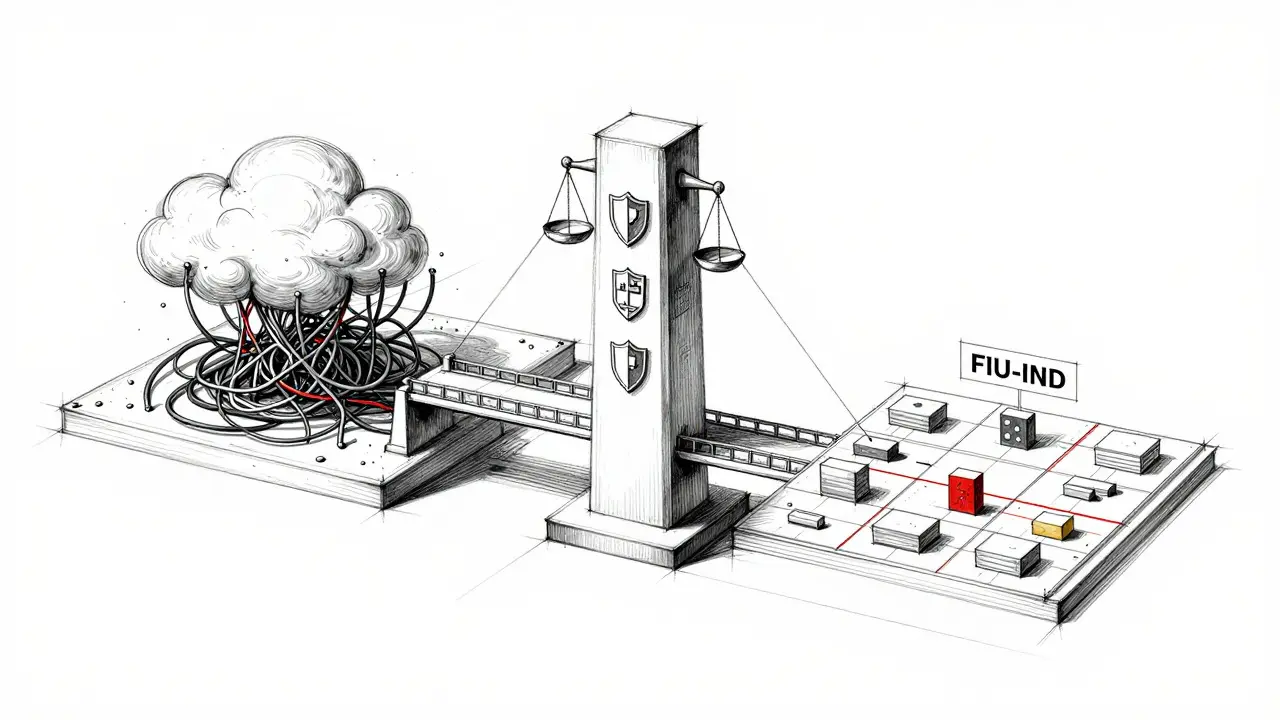
The turning point came with the Prevention of Money Laundering Act (PMLA) 2002. While originally designed for banks, the law was expanded to cover Virtual Digital Asset Service Providers (VDASPs). The Financial Intelligence Unit - India (FIU-IND) became the gatekeeper. To operate legally, any platform facilitating crypto-to-fiat conversion, asset transfer, or safekeeping for Indian users must register as a reporting entity.
In October 2025, the FIU-IND issued notices to 25 offshore exchanges for non-compliance. This wasn't a warning shot; it was an eviction notice. Platforms like Huione, Paxful, CEX.IO, Bitrue, CoinCola, Changelly, and BingX were ordered to cease operations accessible to Indian IPs. The government instructed Internet Service Providers (ISPs) to block their URLs and remove their apps from stores. This followed a similar crackdown nearly two years prior that targeted nine major players including Binance and OKX.
The logic is straightforward: if you want to serve Indian customers, you play by Indian rules. If you don't register, you get blocked. This creates a bifurcated market. On one side, you have compliant, registered exchanges. On the other, a growing list of blacklisted offshore platforms that are technically inaccessible without workarounds.
Which Exchanges Are Safe? The Compliant List
Navigating the sea of blocked domains can be stressful. How do you know if the platform you're using is safe? The answer lies in the FIU-IND registry. As of October 2025, approximately 50 VDASPs were registered. These entities have undergone due diligence and agreed to report suspicious transactions, maintain records, and adhere to Know Your Customer (KYC) norms.
When choosing an exchange, prioritize those that explicitly state their FIU registration number on their website. Major domestic players like WazirX (post-restructuring), CoinDCX, and ZebPay have long been part of this ecosystem. Some international brands have also adapted by setting up local subsidiaries or obtaining necessary licenses to remain accessible.
Here is a quick checklist to verify an exchange's status:
- Check the Footer: Legitimate compliant exchanges display their FIU-IND registration ID prominently in the website footer.
- KYC Requirements: If an exchange lets you trade anonymously with just an email address, it is likely non-compliant and high-risk. Registered entities require Aadhaar, PAN card, and bank account verification.
- App Store Availability: While not a perfect indicator, compliant exchanges usually remain available on Google Play and Apple App Store for Indian regions, whereas blocked ones are often removed.
Relying on unregistered platforms carries significant risk. Beyond the inconvenience of sudden blocks, your funds could be frozen during audits, or worse, involved in illicit activities linked to the platform, drawing scrutiny from Indian authorities.
The Tax Hammer: 30% Flat Rate and 1% TDS
Access to an exchange is only half the battle. The financial cost of trading crypto in India is among the highest in the world. The Ministry of Finance introduced a strict taxation regime that applies regardless of whether you made a profit or loss. This is a critical distinction that catches many new investors off guard.
You face a flat 30% tax on all income derived from virtual digital assets. Unlike traditional stock markets where losses can offset gains, here, every sale is taxed at 30%. If you bought Bitcoin for $10,000 and sold it for $8,000, you still owe tax on the transaction value, though you can carry forward losses for future set-offs within the same category under specific conditions. Additionally, there is no deduction for expenses, meaning trading fees, electricity costs, or hardware wallet purchases cannot be deducted from your taxable income.
Then there is the 1% Tax Deducted at Source (TDS). Every time you transfer crypto from one wallet to another, or sell it for fiat, the exchange deducts 1% of the transaction value. This cash flow hit impacts active traders significantly. If you trade frequently, that 1% adds up quickly, reducing your effective capital. You can claim this TDS back when filing your annual Income Tax Return (ITR), but it ties up your liquidity until then.
This tax structure discourages short-term speculation and favors long-term holding. It effectively turns crypto into a low-turnover asset class for most retail investors. Before executing a trade, calculate the total friction cost: exchange fees + 1% TDS + potential 30% tax liability. Many find that after these deductions, the margins for small trades disappear.
Regulatory Players: Who Is Watching You?
The regulatory environment in India involves multiple agencies, each with a different perspective. Understanding who holds the power helps you anticipate future changes.
| Agency | Role & Stance | Impact on Users |
|---|---|---|
| FIU-IND | Enforces PMLA compliance; registers VDASPs. | Determines which exchanges are accessible. Blocks non-compliant platforms. |
| Reserve Bank of India (RBI) | Cautious; views crypto as macroeconomic risk. | Limits banking integration; pushes for CBDC (Digital Rupee). |
| Ministry of Finance | Policy maker; sets tax rates. | Imposes 30% tax and 1% TDS; drafts legislation. |
| SEBI | Securities regulator; more open to regulation. | May oversee tokenized securities; suggests multi-regulator framework. |
The RBI remains skeptical. They worry about capital flight and monetary policy stability. Their solution? The Digital Rupee (e₹), a central bank digital currency. While e₹ aims to modernize payments, it does not replace private cryptocurrencies. Instead, it competes with them. The Ministry of Finance, meanwhile, is balancing revenue generation through taxes with the desire to curb illicit flows. A proposed bill to ban private cryptocurrencies has been discussed but not yet passed, leaving the current "tax and regulate" model in place for 2026.
SEBI offers a glimmer of hope for institutional adoption. They have suggested that crypto could be regulated similarly to securities, implying a future where tokens representing real-world assets might be traded on licensed exchanges. For now, however, retail trading remains under the FIU-IND's purview.
Practical Steps for Indian Traders in 2026
So, how do you navigate this complex web? Here is a practical roadmap for staying compliant and secure.
- Audit Your Exchanges: Immediately check if your current platforms are FIU-registered. If not, consider migrating your assets to a compliant exchange before further blocks occur. Moving crypto to a cold wallet is also a safe intermediate step.
- Maintain Records: With the 1% TDS and 30% tax, record-keeping is vital. Save every transaction receipt. Use portfolio tracking tools that integrate with Indian tax calculators to estimate liabilities accurately.
- File ITR Correctly: When filing your Income Tax Return, ensure you declare all crypto holdings and transactions. The government cross-checks data from exchanges via the Annual Information Statement (AIS). Hiding transactions is risky and easily detectable.
- Avoid VPN Risks: Many users try to bypass blocks using Virtual Private Networks (VPNs). While technically possible, accessing a blocked exchange may violate the IT Rules if deemed an attempt to evade regulatory oversight. Proceed with caution and understand the legal grey area.
- Watch for Legislation: Keep an eye on parliamentary updates regarding the private crypto ban bill. While unlikely to pass immediately, any shift in political sentiment could change the rules overnight.
The key is transparency. The Indian government wants visibility, not necessarily elimination. By using registered exchanges and paying your taxes, you align yourself with the current regulatory intent. This reduces the risk of account freezes, legal notices, or unexpected penalties.
The Future Outlook: What Comes Next?
As we move through 2026, the trend is clear: consolidation. The number of usable exchanges for Indians will shrink as non-compliant offshore platforms exit the market or fail to adapt. This benefits established, compliant players who gain market share. However, it may reduce liquidity and variety for niche altcoins.
We may also see the rise of decentralized finance (DeFi) protocols that are harder to block. Since DeFi operates on blockchain networks rather than centralized servers, ISPs cannot simply shut down a URL. However, regulators are already exploring ways to monitor on-chain transactions and flag wallets interacting with sanctioned entities. The cat-and-mouse game continues.
For the average citizen, the message is simple. The days of anonymous, unrestricted crypto trading in India are over. The era of regulated, taxed, and tracked participation has begun. Adaptation is not optional; it is essential for preserving your digital wealth.
Is cryptocurrency completely banned in India in 2026?
No, cryptocurrency is not banned in India. Trading and holding digital assets are legal. However, the platforms you use must comply with the Prevention of Money Laundering Act (PMLA) by registering with the FIU-IND. Non-compliant exchanges are blocked, but the asset itself remains legal.
Which crypto exchanges are currently blocked in India?
As of late 2025 and early 2026, several major offshore exchanges have been restricted, including Binance, KuCoin, OKX, Bybit, Huione, Paxful, CEX.IO, Bitrue, CoinCola, Changelly, and BingX. The list expands periodically as the FIU-IND targets new non-compliant entities.
How much tax do I pay on crypto profits in India?
You pay a flat 30% tax on all income from virtual digital assets, plus a 4% health and education cess. Additionally, 1% Tax Deducted at Source (TDS) is applied to every transfer or sale above certain thresholds. No expenses can be deducted from the taxable income.
Can I use a VPN to access blocked crypto exchanges?
Technically, yes, but it carries risks. Using a VPN to access a service blocked by government order may be seen as evading regulatory compliance. While individual prosecutions are rare, your funds on such platforms remain at risk of being frozen or lost if the exchange faces legal pressure globally.
What is the role of the FIU-IND in crypto regulation?
The Financial Intelligence Unit - India (FIU-IND) is the nodal agency responsible for receiving, processing, and analyzing information related to suspected financial transactions. In the crypto space, it registers Virtual Digital Asset Service Providers (VDASPs) and ensures they comply with anti-money laundering laws.
Are there any exemptions to the 30% crypto tax?
Currently, there are very few exemptions. The 30% tax applies to all transfers of virtual digital assets. Losses incurred in one transaction can be set off against gains in another transaction within the same financial year, but no other deductions (like trading fees) are allowed.