The Philippines Securities and Exchange Commission (SEC) didn’t just warn crypto exchanges - it cut them off. On August 1, 2025, the SEC publicly named 15 cryptocurrency exchanges operating illegally in the country. By August 25, that list had grown, and by October, major internet providers like PLDT and Globe Telecom started blocking access to these platforms. If you’re a Filipino crypto trader, you’ve likely seen the error page: “This site is not authorized to operate in the Philippines.” This isn’t a glitch. It’s enforcement.
Who Got Blacklisted?
The SEC’s first wave targeted the biggest names in crypto: OKX, Bybit, KuCoin, Kraken, MEXC, Bitget, CoinEx, Phemex, BitMart, and Poloniex. These aren’t small-time platforms. OKX handles over $10 billion in daily trading volume globally. Kraken has been around since 2011 and is known for strict compliance in the U.S. and Europe. Yet none of that mattered. The SEC didn’t care about reputation. They cared about registration. A second wave added Blofin, CoinW, DigiFinex, LBank, and Pionex. That’s 15 exchanges - all of them international, all of them unregistered under Philippine law. The list isn’t final. The SEC warned that any platform “designed to onboard Philippine users without registration” will be added next. That means if you’re running a crypto app and Filipinos are signing up, you’re already on notice.Why Did This Happen?
It wasn’t random. In May 2025, the SEC released two binding rules: Memorandum Circular No. 4 and No. 5. These created the first-ever Crypto Asset Service Provider (CASP) framework in the Philippines. Under these rules, any exchange wanting to serve Filipino users must:- Be registered as a domestic corporation in the Philippines
- Hold at least 100 million pesos ($1.8 million USD) in capital
- Have a physical office inside the country
- Separate customer funds from company funds
- Submit detailed monthly financial reports to the SEC
How the Blockade Works
The SEC didn’t just issue a warning. They made it impossible to ignore. On August 7, 2025, PLDT and Globe Telecom started blocking access to the listed exchanges at the network level. That’s not a website takedown - it’s a nationwide internet filter. If you try to open OKX or Bybit, your browser shows a government-mandated block page. No error 404. No DNS failure. Just a clear message: “This service is not licensed in the Philippines.” To get around it, users turned to VPNs. Traffic to VPN services in the Philippines spiked 300% in the first month after the block. But using a VPN doesn’t make the exchange legal. It just hides your location. The SEC still considers your trading activity a violation of Philippine law.What’s the Penalty for Violating?
The SEC doesn’t play around. Each violation carries a fine of 50,000 to 10 million pesos. That’s up to $180,000 USD per offense. If the violation continues? Add 10,000 pesos per day. That’s $180 every day the exchange stays online without registration. For a company like Bybit or OKX, that could mean millions in penalties before they even respond. The SEC also has the power to freeze assets held in Philippine banks by these companies. They’ve already begun working with local banks to identify accounts linked to unregistered exchanges. This isn’t just about blocking websites - it’s about cutting off financial lifelines.
Is Crypto Trading Banned?
No. The SEC is very clear on this. You can still buy, sell, and hold Bitcoin, Ethereum, and other digital assets. The ban is only on unregistered platforms offering services to Filipinos. Think of it like this: you can still drive a car. But if you want to run a taxi business, you need a license. Same here. The SEC even said: “We recognize the importance of a free, competitive market, but one that is responsibly regulated.” They’re not trying to kill crypto. They’re trying to protect Filipinos from the kind of exchange collapses that wiped out savings in other countries.What About the Approved Exchanges?
Only two exchanges have fully registered under the CASP framework as of January 2026: PDAX and Coins.ph. Both are Filipino-founded, have local offices, meet the capital requirement, and file monthly reports. They’re the only legal platforms for Filipinos who want to trade crypto without using a VPN. PDAX offers a simple interface, low fees, and direct bank transfers. Coins.ph has been around since 2018 and is already used by millions for remittances and mobile payments. Both have added crypto trading as a feature, not their main business. That’s the model the SEC wants: local companies that are accountable, not offshore platforms with no physical presence.Why Kraken and OKX Were Included
Some people were surprised Kraken made the list. After all, it’s one of the most regulated exchanges in the world. But the SEC doesn’t care what rules Kraken follows in the U.S. or EU. If it’s serving Filipinos without registering here, it’s breaking Philippine law. Same with OKX. Even though it’s one of the top three exchanges globally, it didn’t set up a Philippine entity. So it got blocked. This shows the SEC’s stance: no exceptions. No “but they’re safe” arguments. If you’re not registered, you’re not allowed. It’s that simple.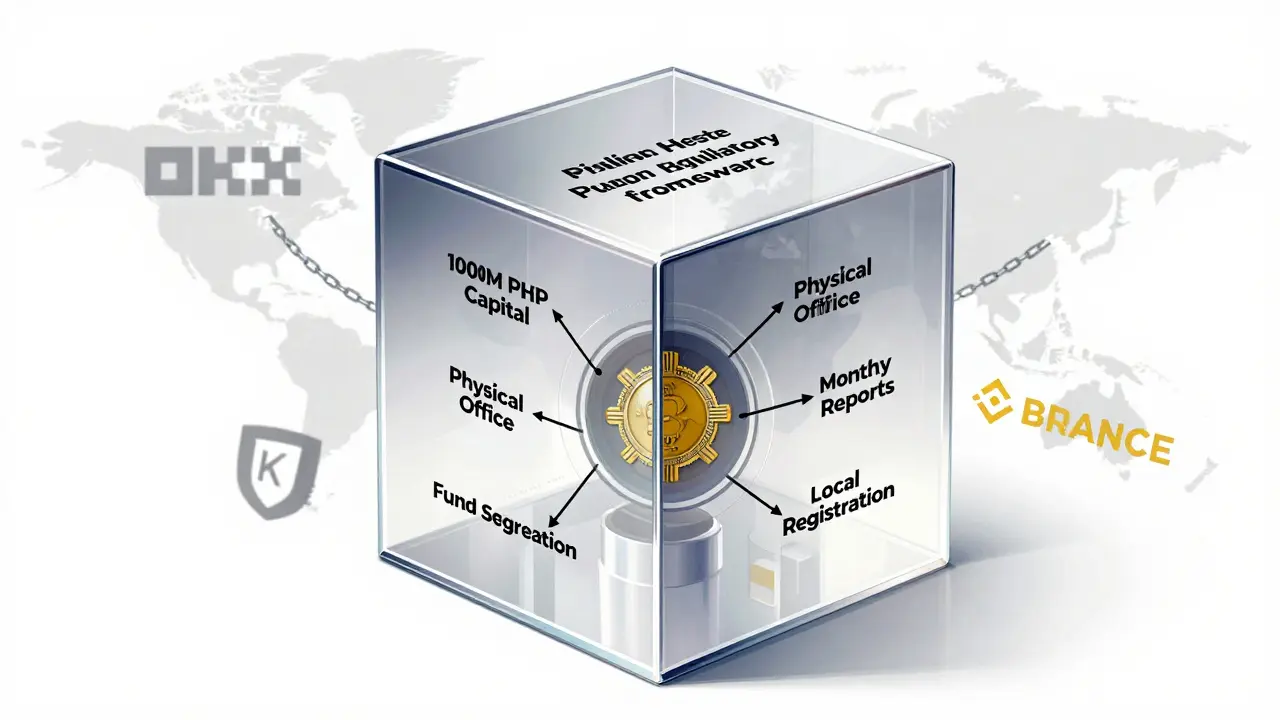
Regional Trends: Southeast Asia Is Getting Tougher
The Philippines isn’t alone. Thailand blocked five exchanges in May 2025, including Bybit and OKX. Indonesia raised taxes on offshore crypto trades from 0.2% to 1%. Singapore tightened its licensing rules. Vietnam is drafting similar laws. This isn’t coincidence. It’s a coordinated regional push to bring crypto under national control. The goal? Stop money laundering. Stop scams. Stop Filipino savings from vanishing into offshore platforms with no accountability. And yes - to create space for local companies to grow without being crushed by global giants who don’t pay local taxes or follow local rules.What Should You Do?
If you’re trading on one of the blocked exchanges:- Withdraw your funds immediately. The longer you leave them, the higher the risk.
- Move to PDAX or Coins.ph if you want to trade legally.
- Don’t rely on VPNs as a long-term solution. The SEC can still track your activity through bank transactions and tax records.
- Watch for new registered platforms. The SEC says more may join PDAX and Coins.ph in 2026.
What’s Next?
The SEC has signaled it’s not done. They’re reviewing over 50 other platforms for potential violations. They’re also working with the Bangko Sentral ng Pilipinas (BSP) to track crypto-to-peso conversions. Tax authorities are preparing to audit users who traded on blocked platforms in 2025. You might not get fined today - but you could get hit with a tax bill next year. The message is clear: if you want to trade crypto in the Philippines, you play by Philippine rules. No shortcuts. No loopholes. No exceptions.Are all crypto exchanges banned in the Philippines?
No. Only unregistered international exchanges are blocked. Two local platforms - PDAX and Coins.ph - are fully licensed and legal to use. You can still trade crypto legally through them.
Can I still use Binance in the Philippines?
No. Binance was blocked in 2024 after failing to register under the old rules. The 2025 CASP framework made registration even stricter. Binance has not applied for a license and remains blocked.
Is using a VPN to access blocked exchanges illegal?
Using a VPN itself isn’t illegal in the Philippines. But using it to access unregistered crypto exchanges violates the SEC’s CASP rules. You could face legal consequences if the SEC links your trading activity to a blocked platform, especially if you’re making large transactions or earning income from crypto.
What happens to my funds if I leave them on a blocked exchange?
If the exchange collapses or gets hacked, you have no legal recourse. The SEC doesn’t protect users on unregistered platforms. Your funds are at risk with no guarantee of recovery. Withdraw them as soon as possible.
Will more exchanges be added to the blacklist?
Yes. The SEC has said it will keep adding platforms that target Filipino users without registering. Over 50 others are under review. If your favorite exchange isn’t on the list yet, it might be soon.
Can I trade crypto on international platforms if I’m not in the Philippines?
Yes. The SEC’s rules only apply to exchanges serving users within the Philippines. If you’re traveling or living abroad, you can use any exchange you want. But if you’re physically in the Philippines, the rules apply - even if you’re using a foreign SIM or VPN.


Brenda Platt
27 January, 2026 . 22:17 PM
This is actually kind of amazing 🙌 Philippines is finally stepping up to protect its people from offshore crypto scams. I’ve seen friends lose everything on these platforms-no recourse, no help. Local exchanges like Coins.ph are the way forward. Safe, regulated, and actually accountable. 🇵🇭✨
Bonnie Sands
29 January, 2026 . 01:17 AM
lol so now the government is just gonna control all your money? next they’ll ban Bitcoin entirely. this is the beginning of the financial dictatorship. they’re scared of decentralization. wake up people.
Paru Somashekar
30 January, 2026 . 07:06 AM
As someone from India who has watched similar regulatory moves unfold here, I can confirm this is a textbook example of responsible crypto governance. The capital requirements, physical presence, and fund segregation are not overreach-they’re basic investor protection. Global exchanges have had years to comply. This isn’t suppression, it’s standardization.
Jen Allanson
30 January, 2026 . 23:57 PM
I find it deeply troubling that anyone would defend unregulated financial platforms. These are not 'tech startups'-they are gambling dens with blockchain branding. The SEC is doing the right thing. If you can't register under clear, public rules, you don't deserve to operate in a sovereign nation. End of story.
Nadia Silva
31 January, 2026 . 13:20 PM
Canada did this too. We let Binance in because we’re soft. Then we had to claw back 300 million in investor losses. Philippines is smarter. No VPNs, no excuses. If you want to trade here, you play by our rules. Respect.
Shamari Harrison
1 February, 2026 . 03:29 AM
Honestly, I used to trade on Kraken because I trusted them. But the SEC’s point is valid: trust doesn’t equal legality. If you’re serving users in a country, you owe that country’s regulators transparency. Kraken’s U.S. compliance doesn’t mean squat in Manila. This isn’t anti-crypto-it’s pro-accountability.
Melissa Contreras López
2 February, 2026 . 02:28 AM
To everyone panicking about VPNs: breathe. You’re not being punished for using tech-you’re being reminded that financial freedom without responsibility is just chaos with a crypto logo. PDAX and Coins.ph are legit, easy to use, and they’ve been helping Filipinos for years. Move your funds. You’ll thank yourself later 💛
Steve Fennell
3 February, 2026 . 19:04 PM
I’ve lived in both the U.S. and the Philippines. The SEC’s move mirrors how Japan and Singapore handle crypto-strict licensing, local oversight, investor safety. This isn’t authoritarianism. It’s maturity. Global exchanges have had 18 months to adapt. They chose profit over principle. Now they’re getting what every other jurisdiction gives them: the door.
Deepu Verma
3 February, 2026 . 19:05 PM
As an Indian, I see this as a win. Too many people think crypto is a free-for-all. It’s not. It’s finance. And finance needs rules. The Philippines is showing the world how to do it right-without crushing innovation, just by demanding responsibility. PDAX and Coins.ph are proof that local players can thrive when given fair ground.
Darrell Cole
4 February, 2026 . 15:14 PM
This is just the start of the crypto crackdown. Next they’ll track your wallet addresses. Then your IP. Then your bank. They’re building a surveillance state under the guise of regulation. You think this is about protection? It’s about control. Mark my words
carol johnson
4 February, 2026 . 19:39 PM
OMG I can’t believe Kraken got blocked 😭 I thought they were the GOOD ONE. Like, I mean, they have like a whole compliance team in New Jersey. How is this fair?? This is so unfair to us loyal users. I’m crying right now. This is literally the end of crypto freedom. 💔
Tammy Goodwin
6 February, 2026 . 13:06 PM
I’m just here to say… I used to trade on Bybit. I lost a chunk of money when they froze withdrawals. I didn’t complain. I moved to PDAX. It’s slower, sure. But when I called their support, someone answered in Tagalog. That’s the difference. I’d rather wait 30 seconds for a withdrawal than risk losing everything.
katie gibson
8 February, 2026 . 06:34 AM
this is sooo extra why do they even care?? like i get it but like… its just crypto? its not even real money? why are we making this a thing? its like banning people from using paypal because they dont have a branch in tokyo??
Andy Simms
8 February, 2026 . 19:21 PM
The 100 million peso capital requirement? That’s not a barrier-it’s a filter. It stops fly-by-night operators who set up a website and vanish with user funds. Look at what happened with Terra/Luna. The Philippines didn’t want that story repeated. Smart move.
Jonny Lindva
10 February, 2026 . 01:44 AM
I’ve been using Coins.ph since 2020 for remittances. Adding crypto was a no-brainer. I don’t need a VPN. I don’t need to risk my savings. I just need a simple app that works with my bank. The SEC’s rules make sense. Why would you trust some offshore site with your life savings when you’ve got a local option that’s already proven?
Julene Soria Marqués
10 February, 2026 . 17:16 PM
I’m just saying… if you’re not using a VPN, are you even doing crypto? 😏 Like, the whole point is to be decentralized. If you’re gonna play by government rules, why not just buy stocks? This whole thing feels like a scam to funnel people into PDAX so they can charge fees. Just saying.
Mark Estareja
11 February, 2026 . 09:44 AM
The CASP framework is a regulatory masterpiece. The capital adequacy ratios, AML/KYC integration, and fund segregation protocols are ISO-compliant at a level most jurisdictions can’t match. The fact that global exchanges refused to localize demonstrates structural arrogance. This isn’t nationalism-it’s institutional maturity.
Mike Stay
12 February, 2026 . 10:08 AM
Let’s be clear: this isn’t about banning crypto. It’s about ensuring that any financial service operating within a nation’s borders is subject to its laws. The U.S. does it. The EU does it. Japan does it. Why should the Philippines be an exception? The exchanges had every opportunity. They chose not to engage. Now they’re surprised? This isn’t tragedy. It’s consequence.
Dave Ellender
14 February, 2026 . 06:23 AM
I’ve been in the crypto space since 2017. Seen it all. This is the first time I’ve seen a regulator actually get it right. Not heavy-handed. Not hypocritical. Just… fair. Local companies get a chance. Global ones get a choice. No one’s stopping anyone from trading. Just stop pretending you can ignore local laws.
Clark Dilworth
15 February, 2026 . 04:13 AM
The regulatory arbitrage era is over. Exchanges thought they could exploit jurisdictional gaps. The Philippines just closed that loophole. This sets a precedent for every emerging market. If you want access to 110 million people, you pay the price. It’s not protectionism-it’s reciprocity.
Adam Fularz
15 February, 2026 . 21:02 PM
I’m just gonna say it: if you’re using a VPN to trade crypto, you’re already doing something sketchy. And now you’re mad the government blocked it? You’re not a victim. You’re a risk-taker who ignored the warnings. Don’t cry when the house wins.
MOHAN KUMAR
16 February, 2026 . 04:38 AM
I work in fintech in India. We had the same fight with Binance. They said 'we don't serve Indian users'-but 40% of their traffic was from India. Same here. The SEC isn't blocking access. They're saying: if you want to serve Filipinos, register. Simple. No drama.
Linda Prehn
17 February, 2026 . 06:48 AM
I dont even know why we even care about this like its just money and people are so dramatic about it like its the end of the world but like if you want to use a vpn then use a vpn no one is stopping you but why are we making it a national issue
Matthew Kelly
17 February, 2026 . 13:32 PM
I’m Canadian. We had a similar situation with Binance. The difference? We fined them $100M and forced them to shut down. The Philippines is being way more reasonable. They’re giving people a legal path. That’s leadership. Respect.
Adam Lewkovitz
19 February, 2026 . 00:08 AM
This is why America is falling behind. We let companies run wild. The Philippines is showing how a developing country can outsmart global giants by enforcing basic rules. No more free rides. If you want our market, you pay our price. Good for them.