You’ve probably seen headlines about people earning massive returns on their crypto holdings without selling a single coin. They call it yield farming. It sounds like magic-plant digital money, wait a bit, and harvest profits. But if you’ve ever tried to navigate the world of Decentralized Finance (DeFi), you know it’s less like gardening and more like walking through a minefield while juggling chainsaws.
So, what exactly is yield farming? At its core, it’s a way for you to earn rewards by lending your cryptocurrency to decentralized platforms. You’re not just sitting on your assets; you’re putting them to work. But here’s the catch: those high yields come with real risks. Before you dive in, you need to understand how it works, why it exists, and how to avoid losing your shirt.
How Yield Farming Actually Works
Imagine a traditional bank. You deposit cash, and they lend it out at interest. The bank keeps some profit and gives you a small cut. Now, imagine that same process, but there’s no bank, no middleman, and no customer service line. That’s DeFi.
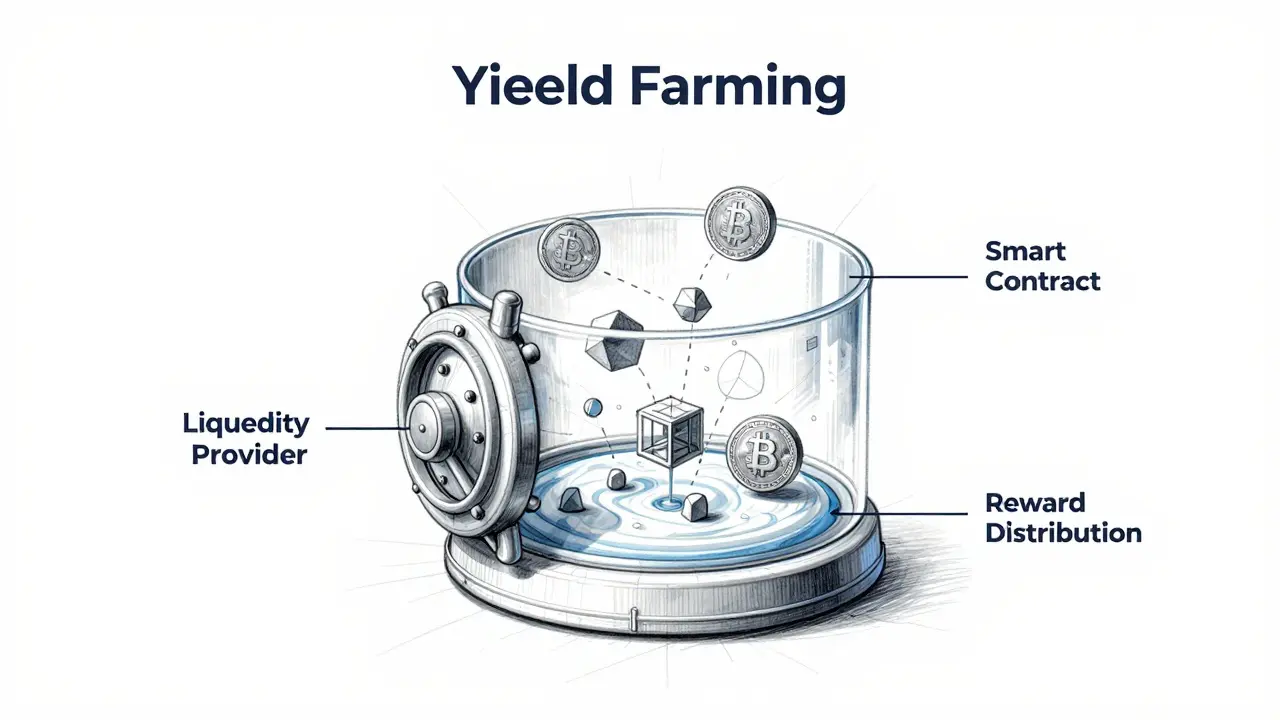
In yield farming, you provide liquidity to these decentralized protocols. Most often, this means depositing pairs of tokens into a liquidity pool. Think of a pool as a shared pot of money that allows traders to swap one cryptocurrency for another instantly. For example, someone wants to trade Ethereum (ETH) for USDC. Instead of waiting for a buyer, they trade against the ETH/USDC pool.
When you add funds to this pool, you become a Liquidity Provider (LP). In return, the protocol pays you. These payments usually come from two sources:
- Trading Fees: Every time someone swaps tokens in the pool, they pay a small fee. You get a share of these fees based on how much of the pool you own.
- Governance Tokens: Many protocols issue their own native tokens (like UNI for Uniswap or SUSHI for SushiSwap) as extra incentives to attract liquidity. This is where the crazy high Annual Percentage Yields (APYs) come from.
The technical side runs on smart contracts-self-executing code on the blockchain. Once you deposit your assets, the contract handles everything automatically. No human intervention required.
The Big Risk: Impermanent Loss Explained
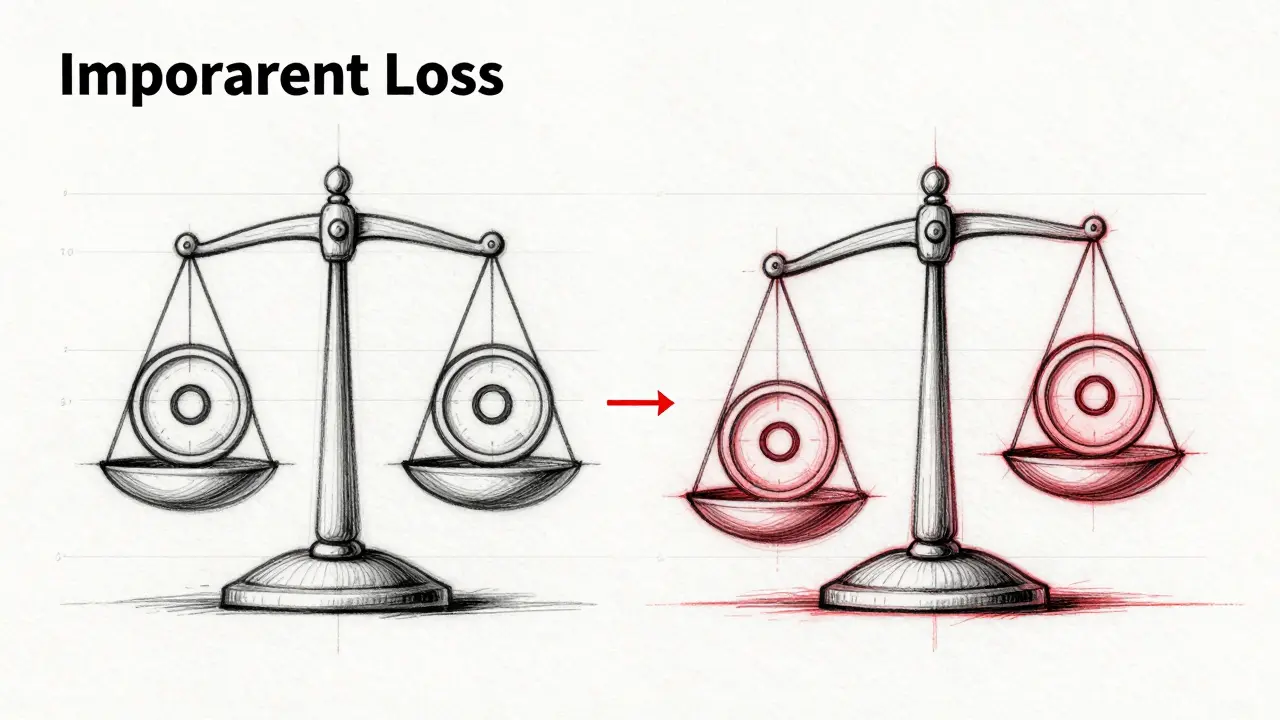
If yield farming were risk-free, everyone would do it. The biggest hurdle isn’t hacking or bad luck-it’s a mathematical concept called impermanent loss. It sounds scary, but it’s just math.
Here’s the scenario: You deposit $1,000 worth of ETH and $1,000 worth of USDC into a pool. Total value: $2,000. Over time, the price of ETH skyrockets. Because the pool must maintain a balance between the two assets, the smart contract automatically sells some of your rising ETH to buy more stable USDC to keep the ratio even.
Now, compare your current position to what would have happened if you had just held the ETH and USDC in your wallet. If ETH went up 50%, your "held" portfolio would be worth significantly more than your LP position. That difference is impermanent loss. It’s only "impermanent" because if prices revert to where they started, the loss disappears. But if ETH stays high, that loss becomes permanent when you withdraw.
Stablecoin pools (like DAI/USDT) have minimal impermanent loss because the prices don’t move much. Volatile pairs (like ETH/UNI) carry high impermanent loss risk. Always check the potential IL before entering a farm.
Yield Farming vs. Staking: What’s the Difference?
Newcomers often confuse yield farming with staking. They are related but distinct strategies.
| Feature | Yield Farming | Staking |
|---|---|---|
| Complexity | High (requires managing multiple protocols) | Low (usually one-click on an exchange) |
| Risk Level | Very High (smart contract risk + impermanent loss) | Medium (slashing risk + market volatility) |
| Typical APY | 5% - 1000%+ (highly variable) | 3% - 10% (more stable) |
| Liquidity | Can be locked for long periods | Often liquid or short unbonding periods |
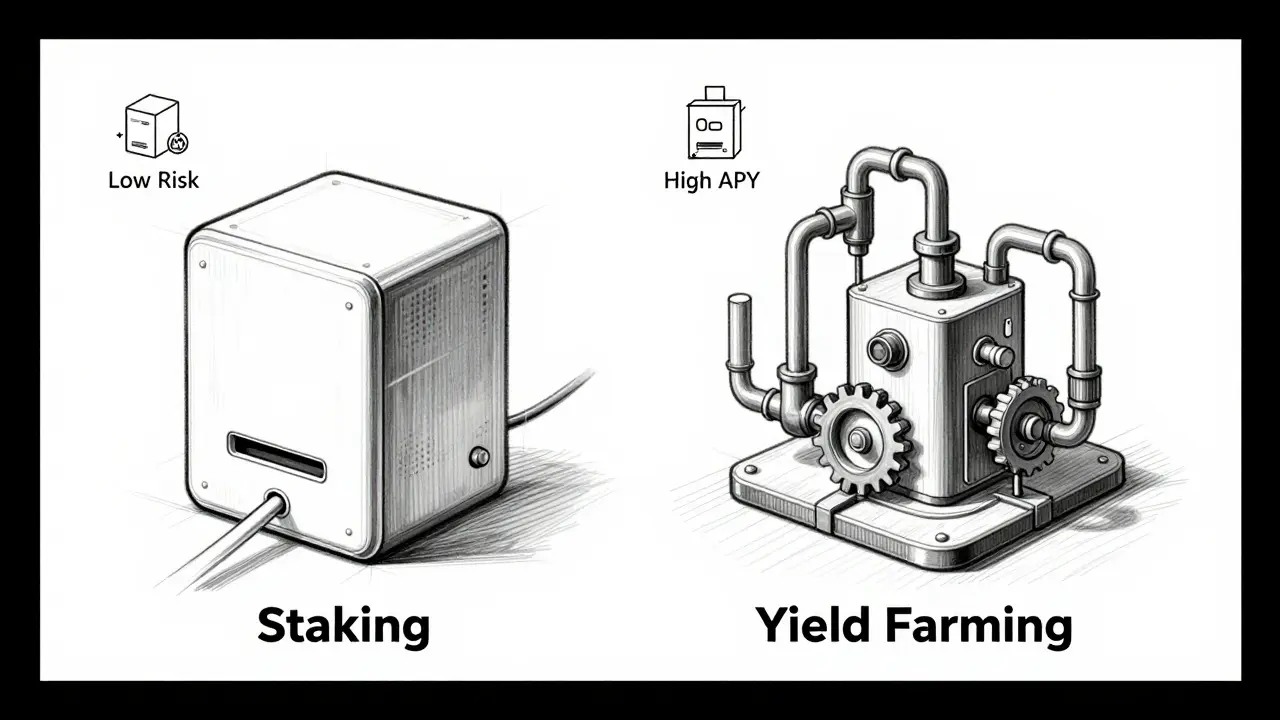
Staking involves locking up coins to secure a Proof-of-Stake network (like Ethereum or Solana). You help validate transactions and get paid for it. Yield farming involves providing liquidity to DeFi apps. You help facilitate trades and get paid in fees and tokens. Staking is generally safer and simpler. Yield farming offers higher potential rewards but demands more active management and carries greater risk.
Step-by-Step: How to Start Yield Farming
Ready to try it? Here is the practical path to getting started safely.
- Set Up a Web3 Wallet: You can’t use a centralized exchange like Coinbase directly for most farms. You need a non-custodial wallet like MetaMask or Trust Wallet. Write down your seed phrase on paper. Never share it. Ever.
- Fund Your Wallet: Buy cryptocurrency on an exchange and transfer it to your wallet address. Make sure you have enough native currency for gas fees (ETH for Ethereum, MATIC for Polygon, BNB for BSC).
- Choose a Reputable Platform: Stick to established protocols initially. Uniswap, Aave, and Curve Finance are industry standards. Avoid random new projects promising 10,000% APY-they are likely scams.
- Connect and Deposit: Go to the platform’s website, connect your wallet, select a pool, and approve the transaction. Watch out for slippage settings. For volatile assets, set slippage tolerance slightly higher (1-3%) to ensure the transaction goes through.
- Monitor and Compound: Yield farming isn’t truly passive. You need to check your positions regularly. When you earn rewards, you can reinvest them (compound) to boost your earnings, or take profits off the table.
Hidden Costs: Gas Fees and Slippage
Before you celebrate those high APYs, remember the costs. On the Ethereum mainnet, every transaction requires a gas fee. During busy times, a simple deposit can cost $50 or more. If you’re farming with only $200, the fees will eat your profits alive.
This is why many farmers migrate to Layer 2 solutions like Arbitrum or Optimism, or alternative chains like Polygon and BNB Chain. These networks offer similar DeFi experiences with fractions of the cost.
Slippage is another silent killer. If you’re trading a large amount in a low-liquidity pool, the price might change unfavorably during the transaction. Always check the pool depth before committing large sums.
Is Yield Farming Safe? Security Risks
DeFi is built on code, and code can have bugs. Smart contract vulnerabilities are the leading cause of losses in yield farming. Hackers exploit flaws in the code to drain funds from pools. In 2022 alone, billions were lost to DeFi hacks.
To protect yourself:
- Audit Matters: Only use protocols that have been audited by reputable firms like CertiK or OpenZeppelin. Even then, audits aren’t a guarantee of safety.
- Revoke Permissions: When you approve a token for a dApp, you’re giving it permission to spend your funds. Use tools like Revoke.cash to remove permissions from old or unused protocols.
- Phishing Awareness: Never click links in Discord DMs or Telegram messages claiming to be support. Always type the URL manually or use trusted bookmarks.
Also, consider regulatory risk. Governments are still figuring out how to classify DeFi tokens. While retail users haven’t faced direct legal action yet, the landscape is shifting. Stay informed about regulations in your country.
Realistic Expectations: What Returns Can You Get?
Don’t believe the hype. Early in 2020, yields of 100%+ were common because protocols were desperate to bootstrap liquidity. Today, sustainable yields are lower.
Expect 1-5% APY from stablecoin pools on major platforms. Volatile asset pairs might offer 10-50% APY, but with higher impermanent loss risk. Anything above 100% APY should raise red flags. Ask yourself: Is this reward coming from real trading fees, or is it being printed out of thin air via inflationary token emissions? If it’s the latter, the value of your rewards may plummet faster than they accumulate.
The goal of yield farming shouldn’t be to get rich quick. It should be to optimize your crypto holdings for better efficiency than simply holding them in a cold wallet. Treat it as a sophisticated financial strategy, not a lottery ticket.
Can I lose all my money in yield farming?
Yes, it is possible. You can lose money through impermanent loss if asset prices diverge significantly. More dangerously, you can lose everything if the smart contract you deposited into is hacked or contains a critical bug. Additionally, if the governance token you receive as a reward crashes to zero, your effective return can be negative.
Do I need a lot of money to start yield farming?
Not necessarily, but it helps. On Ethereum mainnet, high gas fees make small deposits inefficient. However, on Layer 2 networks like Arbitrum or Optimism, or chains like Polygon, you can start with as little as $50-$100. The key is ensuring your potential earnings outweigh the transaction costs.
What is the best platform for beginners?
For absolute beginners, starting with a simple lending protocol like Aave or Compound is safer than complex liquidity pools. You deposit a single asset and earn interest without worrying about impermanent loss. Once comfortable, you can explore Automated Market Makers (AMMs) like Uniswap or Curve.
How do taxes apply to yield farming?
Tax laws vary by country, but in many jurisdictions, rewards earned from yield farming are considered taxable income at the time of receipt. When you sell those rewards or your underlying assets, capital gains tax may also apply. Always consult a local tax professional familiar with cryptocurrency regulations.
Is yield farming illegal?
Generally, no. Yield farming itself is not illegal. However, regulators like the SEC in the US are scrutinizing certain DeFi tokens as unregistered securities. Participating in yield farming does not typically expose individual users to legal liability, but the platforms themselves face increasing regulatory pressure.