WadzPay Token (WTK) isn’t another meme coin. It was built for banks, governments, and big businesses - not for retail traders. But here’s the problem: even though it was designed to power real financial systems, its value has collapsed by 99.97% from its peak. Today, one WTK is worth just $0.000159. And worse, almost all of the one billion tokens in existence aren’t even circulating. So what’s really going on with WadzPay Token?
What Is WadzPay Token (WTK) Really For?
WadzPay Token (WTK) is the native utility token of the WadzPay platform, a blockchain-based payments system launched in 2018 out of Singapore. Unlike most crypto projects that chase hype, WadzPay targets institutions: central banks, financial firms, and enterprise payment processors. Its goal? To make digital money - including Central Bank Digital Currencies (CBDCs) - work smoothly across borders, without replacing legacy systems, just layering on top of them.
The token isn’t meant to be a speculative asset. It’s meant to be a tool. You use WTK to pay for services within the WadzPay ecosystem - things like tokenizing real estate, processing cross-border invoices, or securing digital assets for banks. It’s part of the engine, not the prize.
The Blockchain Behind WTK: XDC Network, Not Ethereum or Algorand
You’ll find conflicting info online. Some sites say WTK runs on Ethereum. Others say Algorand. The truth? According to CoinMarketCap and official documentation, WTK is deployed on the XinFin XDC Network as an XRC20 token.
Why XDC? Because it’s built for finance, not fun. XDC offers near-instant transactions, gas fees so low they’re practically zero, and military-grade security - perfect for institutions that can’t afford delays or hacks. Unlike Ethereum, which struggles with congestion and high fees, XDC was chosen specifically for trade finance, asset tokenization, and CBDC integration. This isn’t a random pick. It’s a deliberate design choice to serve enterprise needs.
Tokenomics: A Billion Tokens, But Almost None Are in Circulation
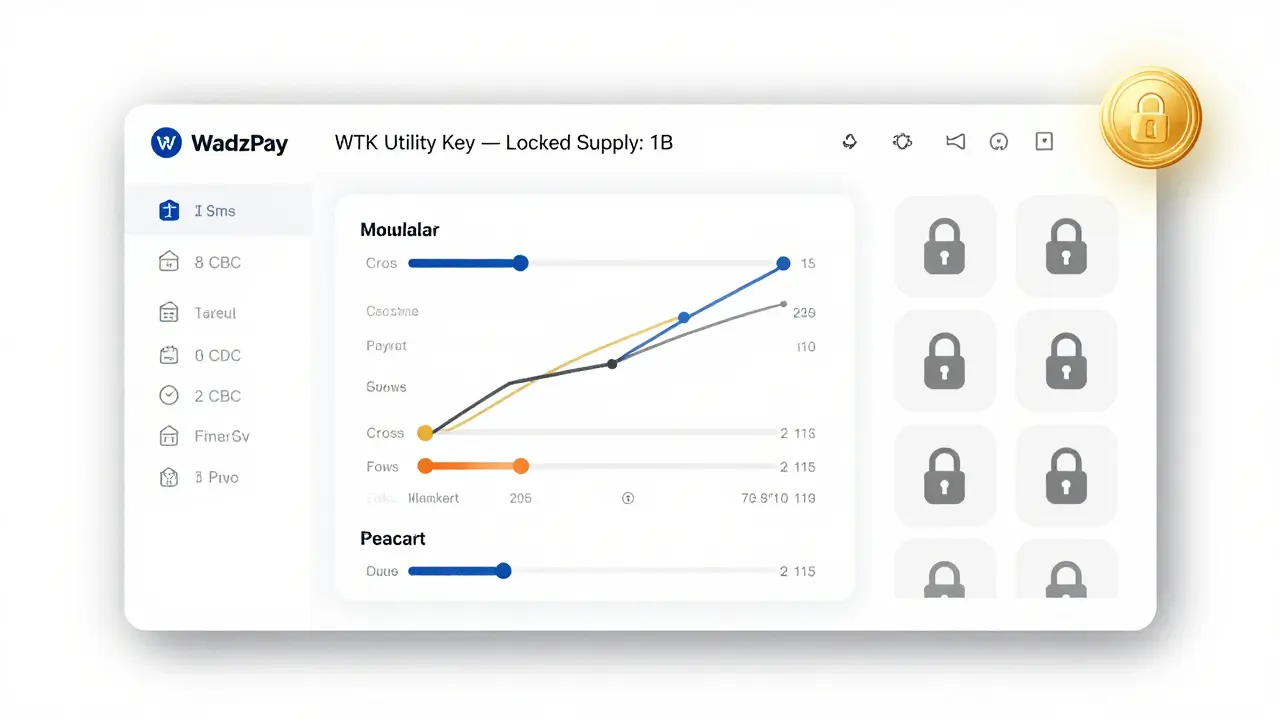
WadzPay Token has a total supply of 1,000,000,000 (one billion). That sounds huge. But here’s the catch: as of February 2026, the circulating supply is listed as zero. Not 10 million. Not 50 million. Zero.
That means every single WTK token is locked up - held by the company, reserved for future releases, or tied up in long-term institutional agreements. There’s no open market for them. No liquidity. No way for regular users to buy or sell.
Even the public sale was tiny: only 714,290 tokens (0.07% of total supply) were ever made available to the public. Compare that to the initial projected fully diluted valuation of $70 million during its IEO - now down to a mere $153,930. That’s a 99.78% drop in market value. And with only $0.16 traded in the last 24 hours, there’s almost no active trading happening at all.
How WadzPay Actually Works: Five Core Solutions
WadzPay doesn’t sell a coin. It sells solutions. And WTK is just the key that unlocks them. Here’s how the platform functions in practice:
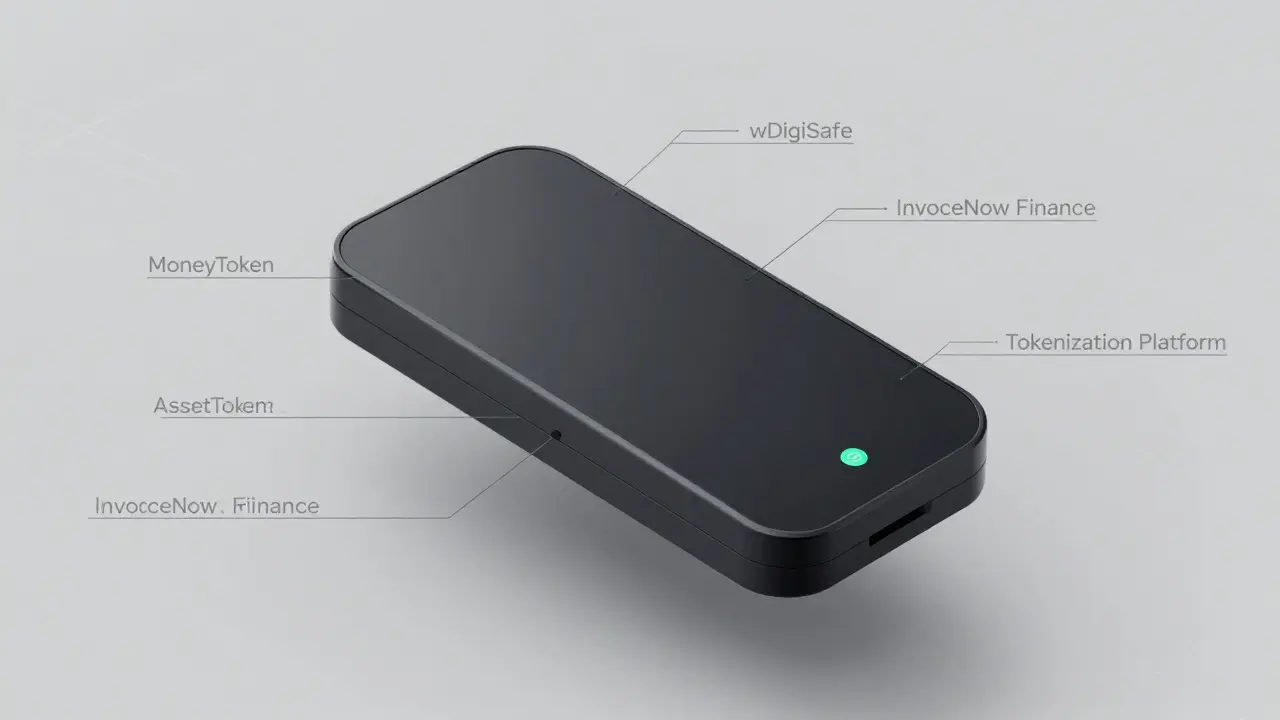
- MoneyToken: Turns traditional fiat currency (like USD or EUR) into blockchain-backed digital tokens. Each token is backed 1:1 by real money held in reserve. Used for instant cross-border payments without banks.
- AssetToken: Lets you tokenize illiquid assets - gold, diamonds, real estate, even artwork - and sell fractions of them. Imagine owning 0.1% of a luxury apartment in Singapore. That’s AssetToken.
- wDigiSafe: A white-labeled custody solution for banks and financial institutions. It lets them securely store, transfer, and manage crypto assets without building their own infrastructure.
- InvoiceNow.Finance: Lets businesses issue invoices and get paid in crypto. No need to change your accounting software. Just plug in WadzPay’s API.
- Tokenization Platform: Enables loyalty programs, tradeable vouchers, and custom tokens for businesses - all built on blockchain.
These aren’t theoretical. They’re live. WadzPay already works with institutions in Asia, the Middle East, Africa, Europe, and the U.S. For example, it’s used to process international patient payments for medical tourism - where patients pay for treatments abroad using stablecoins or digital tokens.
Why Did WTK Crash So Hard?
WTK hit an all-time high of $0.38 in April 2022. Today? $0.000159. That’s not a market correction. That’s a total collapse.
Here’s why:
- Supply vs. Demand: One billion tokens exist. But almost none are out there to trade. No supply = no market.
- Slow Adoption: WadzPay claims to work with banks and governments, but there’s no public proof. No major partnerships announced. No live case studies. If institutions aren’t using it, the token has no utility.
- Market Sentiment: The broader crypto market tanked after 2022. Tokens tied to institutional use - especially those without retail appeal - got left behind.
- Lack of Transparency: There’s no clear roadmap. No updates on token unlocks. No data on how many institutions are actually using the platform. That breeds distrust.
The token’s price isn’t just low - it’s meaningless. With zero circulating supply and near-zero trading volume, the price you see on exchanges is likely a ghost number. It’s not reflecting real market activity. It’s just a placeholder.
Who Is WadzPay For? (And Who Should Stay Away)
WadzPay isn’t for traders. It’s not for DeFi degens. It’s for:
- Central Banks: Trying to launch their own CBDCs without reinventing the wheel.
- Financial Institutions: Banks that want to offer crypto services without overhauling their entire tech stack.
- Enterprise Payment Providers: Companies that process cross-border payments and need faster, cheaper alternatives to SWIFT.
If you’re an individual investor looking to flip WTK? Don’t. There’s no liquidity. No roadmap. No transparency. The token is effectively locked away.
If you’re a business or institution evaluating blockchain payments? WadzPay’s platform might be worth a look - especially its MoneyToken and wDigiSafe modules. But don’t bet on WTK rising in value. It’s not designed to be an investment. It’s designed to be a tool.
The Big Question: Is WadzPay Still Alive?
Yes, the platform is still active. The website is up. The solutions are still listed. The team still talks about CBDCs and tokenization.
But the token? It’s dead in the water.
WadzPay could survive without WTK. The platform’s value lies in its enterprise tools - not its native coin. If the company unlocks even 5% of the token supply and starts integrating it into real services - like paying fees on InvoiceNow.Finance or staking for governance - then WTK might regain some relevance.
But right now? It’s a ghost. A billion tokens with no home. A once-promising project that lost its way.


Cheryl Fenner Brown
1 March, 2026 . 01:21 AM
lol wtk is just a ghost token 😂 no one’s trading it, and the price is basically a glitch. someone’s still updating CoinMarketCap like it’s 2021.
Michael Teague
1 March, 2026 . 16:20 PM
zero circulating supply? that’s not a token. that’s a PowerPoint slide pretending to be crypto.
Brian Lemke
2 March, 2026 . 07:12 AM
This is actually one of the most honest deep dives I’ve seen on a crypto project. Most people just scream 'rug pull' without understanding the institutional design. WadzPay’s real value is in MoneyToken and wDigiSafe - the token was always just the grease, not the engine. Shame it got dragged into the speculative circus.
kati simpson
3 March, 2026 . 23:19 PM
i think the whole thing is just too quiet now like no one talks about it anymore and the website looks like it hasn't been updated since 2023
Cory Derby
5 March, 2026 . 20:58 PM
It's important to distinguish between a utility token and a speculative asset. WTK was never intended for retail investors. The lack of liquidity isn't a failure - it's a feature of its design. Institutional adoption moves slowly, and without public reporting, it's hard to gauge progress. That said, transparency is critical for trust.
Colin Lethem
6 March, 2026 . 10:47 AM
i clicked on the xdc network link and it’s still live. the platform’s not dead - just the token. like a car with no gas. the engine’s fine, but no one’s filling the tank.
lori sims
6 March, 2026 . 23:56 PM
it’s wild how something built for banks ended up being a cautionary tale about misaligned incentives. the token’s ghost status says more about crypto culture than the tech itself.
Reggie Fifty
8 March, 2026 . 06:57 AM
this is why america needs to stop letting foreign tech companies run our financial infrastructure. singapore thinks it’s smart to build crypto for banks? laughable. real money doesn’t need blockchains.
Kristi Emens
8 March, 2026 . 15:15 PM
i appreciate how detailed this breakdown is. the distinction between token utility and market perception is something too many people overlook. institutions don’t care about price charts - they care about uptime, compliance, and integration. if wadzpay delivers on that, the token might find its purpose eventually.
Deborah Robinson
10 March, 2026 . 09:49 AM
i love how some projects build real tools and get ignored while meme coins blow up 🥲 maybe if they had a dog coin version of wtk called 'wadzdog' it’d be trading at $0.50
Michelle Mitchell
10 March, 2026 . 14:30 PM
so like... if no one can buy it... is it even real? i think this is just a scam with fancy slides
Kaitlyn Clark
11 March, 2026 . 05:38 AM
this is why we need to stop pretending crypto is about 'enterprise solutions' - it’s all just vaporware until someone actually uses it. wadzpay’s platform is cool but if the token’s locked up forever, it’s just digital wallpaper 🤷♀️
christopher luke
12 March, 2026 . 11:46 AM
the fact that this exists and still has a price at all is a miracle 🤞 maybe one day they unlock 1% and we’ll see if anyone actually uses it. fingers crossed!
Mary Scott
13 March, 2026 . 00:13 AM
this whole thing is a fed puppet show. they’re using wtk to test cbdc infrastructure under the guise of 'private innovation'. the token’s dead because the government doesn’t want retail investors to touch it. they’re building a digital surveillance economy and wtk is the front door.
Sriharsha Majety
13 March, 2026 . 06:06 AM
i read this and i feel like wadzpay is like a really good restaurant that no one knows about because it’s hidden in the back alley. the food is amazing but no one walks in
Tabitha Davis
15 March, 2026 . 04:37 AM
oh my god another 'institutional crypto' scam. let me guess - next they’ll say the tokens are 'locked for regulatory compliance' and then vanish. classic. this is why i don’t trust anything that says 'for banks'.
Vishakha Singh
17 March, 2026 . 02:09 AM
I believe that the true potential of blockchain lies in its ability to empower institutions with efficiency and transparency. WadzPay's architecture, despite its token stagnation, demonstrates a thoughtful approach to cross-border finance. The challenge lies not in the technology but in communication and adoption timelines.
Arya Dev
18 March, 2026 . 23:27 PM
this is why i hate crypto... everything looks so fancy on paper... then you check the numbers... and it’s just... zero... literally zero... trading volume... what a joke...
Andrew Hadder
20 March, 2026 . 11:44 AM
i think the real issue is that no one told retail investors this wasn’t for them. they marketed it like a coin you could buy and flip. now everyone’s mad. but the platform? it might still work.
Neeti Sharma
20 March, 2026 . 16:07 PM
india should never trust singaporean fintech. they dont even know what real finance is. this is why our rupee is still strong - we dont play with fake tokens
Nadia Shalaby
20 March, 2026 . 21:36 PM
i just scroll past this stuff now. crypto is too much drama. if the token’s dead, move on. the platform might be fine. who cares?
Fiona Monroe
22 March, 2026 . 20:28 PM
The analysis presented here is both rigorous and commendable. The distinction between token utility and market speculation is not merely semantic - it is foundational to understanding modern financial infrastructure. That WadzPay’s token remains non-circulating is not indicative of failure, but rather of a deliberate, long-term institutional strategy. The absence of retail liquidity is not a flaw; it is a feature of its intended function.
Molley Spencer
24 March, 2026 . 18:25 PM
the whole 'enterprise blockchain' narrative is just jargon to mask vaporware. 'tokenization of real estate'? sounds like a pitch deck from a 2018 startup incubator. this isn’t innovation - it’s branding theater. and the 99.97% drop? that’s the market screaming 'no'.
John Fuller
24 March, 2026 . 18:43 PM
dead token. dead project. move on.
Brian Lemke
25 March, 2026 . 23:54 PM
You know what’s funny? The same people who dismiss this as 'dead' are the ones who cried foul when Bitcoin’s price dropped 80% in 2018. But here’s the thing - Bitcoin kept building. WadzPay’s platform still exists. The tools are live. The token might never matter, but the infrastructure? That’s what lasts. The market doesn’t always reward the right thing - but the right thing often survives anyway.