Remember when you could trade crypto on a decentralized exchange without waiting minutes for confirmation or paying more in gas fees than the trade itself was worth? That was the promise of Serum, a high-speed decentralized exchange built on the Solana blockchain. At its peak, it felt like the future of finance had arrived: sub-second trades, fractions of a penny in fees, and a fully on-chain order book that rivaled centralized giants. But if you look at SRM today, the picture looks very different. The price has dropped significantly, volume is quiet, and the brand is mostly silent on social media.
So, what exactly is Serum (SRM) now? Is it a dead project, or just a sleeping giant? To answer that, we need to look past the current low price tag and understand the technology, the controversial history, and the specific utility the SRM token still holds. If you are holding some old SRM or considering buying the dip, here is the real story behind the coin.
The Core Concept: A Decentralized Exchange That Felt Centralized
Most decentralized exchanges (DEXs) use something called an Automated Market Maker (AMM). Think of Uniswap on Ethereum. You swap tokens against a liquidity pool, and the price changes based on supply and demand within that pool. It’s simple, but it can be inefficient for large trades and offers little control over your entry price.
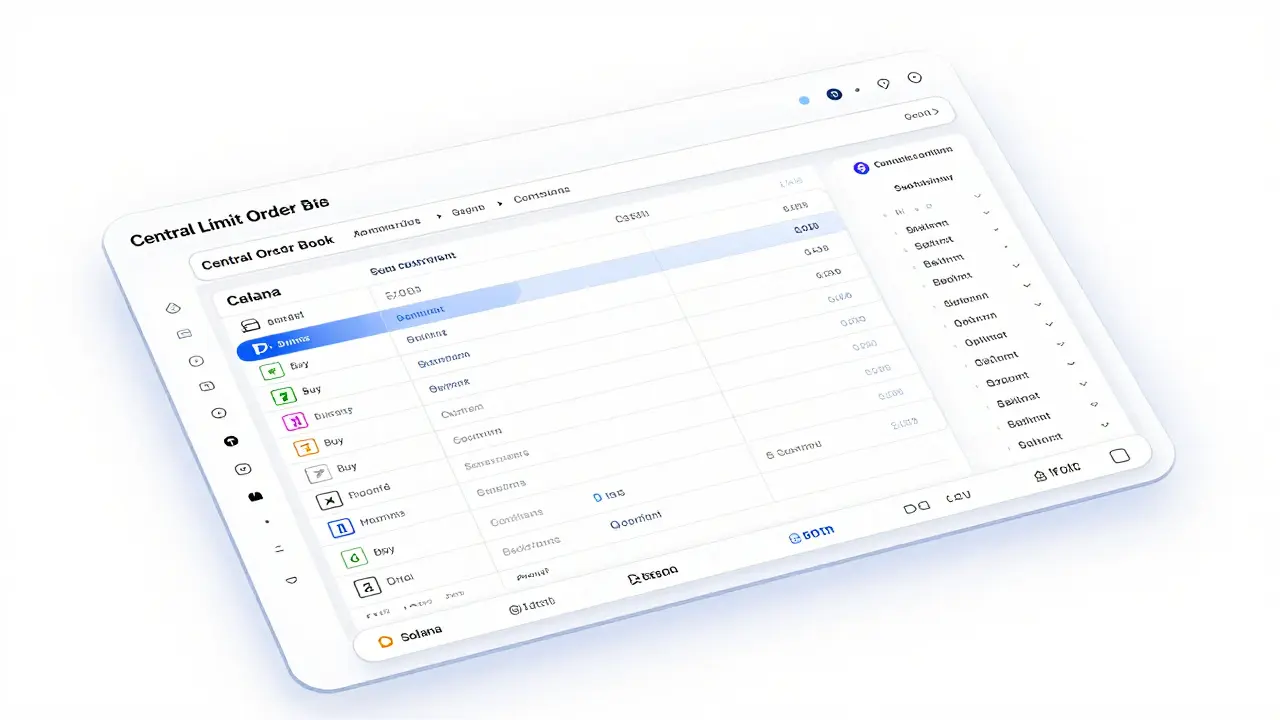
Serum took a different approach. It built a Central Limit Order Book (CLOB) entirely on-chain. This means buyers and sellers placed actual limit orders-"I want to buy Bitcoin at $60,000" or "I want to sell at $61,000"-and smart contracts matched them up automatically. No middleman, no central server matching orders off-chain. Just pure code running on Solana.
Why does this matter? Because Solana is fast. While Ethereum might take seconds or minutes to process a block, Solana processes thousands of transactions per second. This allowed Serum to offer:
- Sub-second confirmations: Your trade settles almost instantly.
- Tiny fees: Fees were often as low as $0.00001 per trade.
- Price precision: You got the exact price you wanted, not an approximate one from a pool.
For professional traders and institutions, this was a game-changer. It bridged the gap between the safety of DeFi (you keep custody of your assets) and the functionality of CeFi (centralized exchanges like Binance).
The Controversial Origins: FTX and Alameda Research
You cannot talk about Serum without talking about its founders. Serum was launched in August 2020 by a consortium including the Solana Foundation, FTX, and Alameda Research. Sam Bankman-Fried, the founder of both FTX and Alameda, was the public face of the project.
At the time, this partnership made sense. FTX needed a way to settle derivatives on-chain, and Solana needed a killer app to prove its speed. Serum became that app. However, the collapse of FTX in November 2022 cast a long shadow over everything associated with it, including Serum.
Here is the crucial distinction: Serum itself did not fail. The protocol is open-source and permissionless. It runs on Solana, independent of any company. When FTX collapsed, it didn’t shut down Serum. The code kept running. But the reputational damage was severe. Many users left out of fear, and the marketing engine that drove early adoption vanished overnight. This explains why SRM’s price and volume have remained depressed compared to other Solana DeFi projects.
SRM Tokenomics: Utility, Discounts, and Burning
So, what do you actually get when you hold SRM? It is not a governance token in the traditional sense where you vote on major protocol changes directly. Instead, it is a utility token designed to reduce costs and align incentives.
| Feature | Description | Benefit |
|---|---|---|
| Fee Discounts | Holding SRM reduces trading fees on the Serum DEX. | Up to 50% discount on taker fees; makers pay zero fees. |
| Buy-and-Burn | 100% of net fees collected by the DEX are used to buy and burn SRM. | Deflationary pressure; reduces total supply over time. |
| Cross-Chain Compatibility | Exists as SPL (Solana) and ERC-20 (Ethereum) tokens. | Easier to move between ecosystems and wallets. |
| MegaSerum (MSRM) | 1 MSRM = 1,000,000 SRM locked together. | Higher governance weight and rewards for large stakeholders. |
The fee discount structure is aggressive. If you are a high-frequency trader, holding SRM saves you significant money. Makers (those who provide liquidity by placing limit orders) pay zero fees regardless of their SRM balance. Takers (those who fill existing orders) pay a small fee, which is cut in half if they hold SRM.
The buy-and-burn mechanism is interesting because it ties the token’s value directly to the usage of the exchange. More trades = more fees = more SRM burned. However, since trading volume on Serum has dropped considerably since its 2021 peak, the burning rate has slowed down too.
Current Status: Is Serum Still Relevant?
If you check the charts today, SRM is trading at a fraction of its all-time high. Volume is modest, and the official social media accounts are largely inactive. Does this mean the project is dead?
Not necessarily. In the world of open-source software, "dead" is a strong word. The code is still there. The order book is still functioning. Solana developers can still build on top of Serum’s infrastructure. However, user attention has shifted.
Since 2023, new DEXs like Raydium and Orca have gained massive popularity on Solana. They offer hybrid models (combining AMMs with CLOB features) and have active development teams, vibrant communities, and constant marketing. Serum, lacking a corporate entity to drive growth, has become more of a legacy infrastructure layer.
That said, Serum remains unique. It is still one of the few true on-chain CLOBs on Solana. For certain institutional players or advanced traders who prefer the transparency of an order book over an AMM, Serum still offers a functional, low-cost environment. It’s just no longer the shiny new toy it once was.
How to Use SRM Today
If you decide to engage with SRM, here is how you do it safely and effectively.
- Get a Solana Wallet: You will need a wallet like Phantom or Solflare. These support SPL tokens natively.
- Acquire SOL: Buy Solana (SOL) on a major exchange like Coinbase or Kraken and send it to your wallet. You need SOL to pay for transaction fees on the network.
- Swap for SRM: Go to a DEX like Raydium or Jupiter (which aggregates liquidity across Solana DEXs, including Serum). Swap your SOL for SRM. Note that SRM is also available as an ERC-20 token on Ethereum, but the native SPL version on Solana is required for using the Serum DEX.
- Use the DEX: Connect your wallet to the Serum interface. Hold SRM in your wallet to automatically qualify for fee discounts when you trade.
Be careful with cross-chain bridges. If you buy SRM on Ethereum, you must bridge it to Solana to use it on the Serum DEX. Bridging carries risks, so always verify addresses and use reputable bridges.
Risks and Considerations
Before you invest or trade, keep these factors in mind:
- Liquidity Risk: Lower volume means wider spreads. You might not get the best price if you try to move large amounts of SRM quickly.
- Development Stagnation: Without a dedicated team pushing updates, Serum may fall behind newer technologies. Smart contract bugs, while unlikely given its age, are never impossible.
- Reputational Baggage: The association with FTX continues to deter some investors, regardless of the technical merits of the protocol.
- Competition: Newer Solana DEXs are more user-friendly and actively marketed. Serum requires a bit more technical know-how to use effectively.
Final Thoughts
Serum (SRM) is a fascinating case study in crypto. It proved that high-performance, on-chain order books were possible. It showed us the power of Solana’s speed. But it also highlighted the fragility of reputation in this industry. Today, SRM is a niche asset. It works. It’s cheap to use. And it still burns tokens when you trade. But it lacks the momentum and community energy that drives most crypto gains.
If you are a developer building on Solana, Serum is still a valuable tool. If you are a trader looking for low fees, it’s worth keeping in your toolkit. But if you are hoping for a quick moonshot based on hype, you might want to look elsewhere. The era of Serum’s dominance is over, but its code remains a testament to what decentralized finance can achieve.
Is Serum (SRM) a scam?
No, Serum is not a scam. It is a legitimate, open-source decentralized exchange protocol built on the Solana blockchain. However, it was co-founded by FTX and Alameda Research, which collapsed due to fraud. While Serum itself operates independently and transparently on-chain, the association has negatively impacted its reputation and price.
Can I still use Serum to trade?
Yes, the Serum DEX is still operational. You can connect a Solana wallet like Phantom to the Serum interface and trade tokens. However, liquidity is lower than in the past, so you may experience higher slippage on large trades compared to newer DEXs like Raydium or Orca.
What is the difference between SRM and MSRM?
MSRM (MegaSerum) is a high-denomination version of SRM. One MSRM equals 1,000,000 SRM locked together. Holding MSRM provides greater governance influence and slightly higher rewards within the Serum ecosystem. It is designed for large, long-term stakeholders like market makers.
Does holding SRM give me voting rights?
SRM holders have limited governance rights primarily focused on fee distribution and protocol parameters. However, unlike many DAOs, Serum does not have a complex voting system for every decision. The primary utility of SRM is fee discounts and participation in the buy-and-burn mechanism.
Where can I buy SRM?
You can buy SRM on several centralized exchanges like Kraken, Binance, and Crypto.com. Alternatively, you can swap for it on Solana-based DEXs like Raydium or Jupiter if you already have SOL in your wallet. Remember to ensure you are buying the SPL version on Solana if you plan to use the Serum DEX.