You might have stumbled upon Colony (CLY) while browsing old market data or looking into the history of the Avalanche blockchain. If you’re asking what it is today, the short answer is that it’s a project in its final stages. Colony Lab, the team behind the token, announced plans to cease operations at the end of Q1 2026. For anyone holding the token or curious about its past, understanding its original design, why it failed to sustain momentum, and what happens next is crucial.
This isn’t just another forgotten altcoin. Colony was once one of the most ambitious experiments in decentralized venture capital. It tried to solve a real problem: how can regular people invest in early-stage crypto startups? Let’s break down what Colony was, how the CLY token worked, and where things stand as we move through mid-2026.
What Was Colony Lab?
At its core, Colony Lab was a community-driven accelerator and ecosystem fund focused on early-stage projects built on the Avalanche blockchain. Think of it as a hybrid between a traditional Venture Capital (VC) firm and a Decentralized Autonomous Organization (DAO).
In the traditional world, if you wanted to invest in a promising tech startup before it went public, you needed millions of dollars and connections with angel investors. Colony tried to democratize this. By using the CLY token, they allowed retail investors-people with much smaller amounts of money-to pool their resources. This collective capital was then used to fund new projects on Avalanche, provide liquidity to DeFi protocols, and stake AVAX for network security.
The idea was "Ecosystem Farming." Instead of betting on one coin, you staked CLY to gain exposure to the growth of the entire Avalanche ecosystem. You got rewards from validator yields, fees from an index fund, and airdrops from the startups Colony funded. It sounded perfect on paper. In practice, execution proved difficult.
Understanding the CLY Token
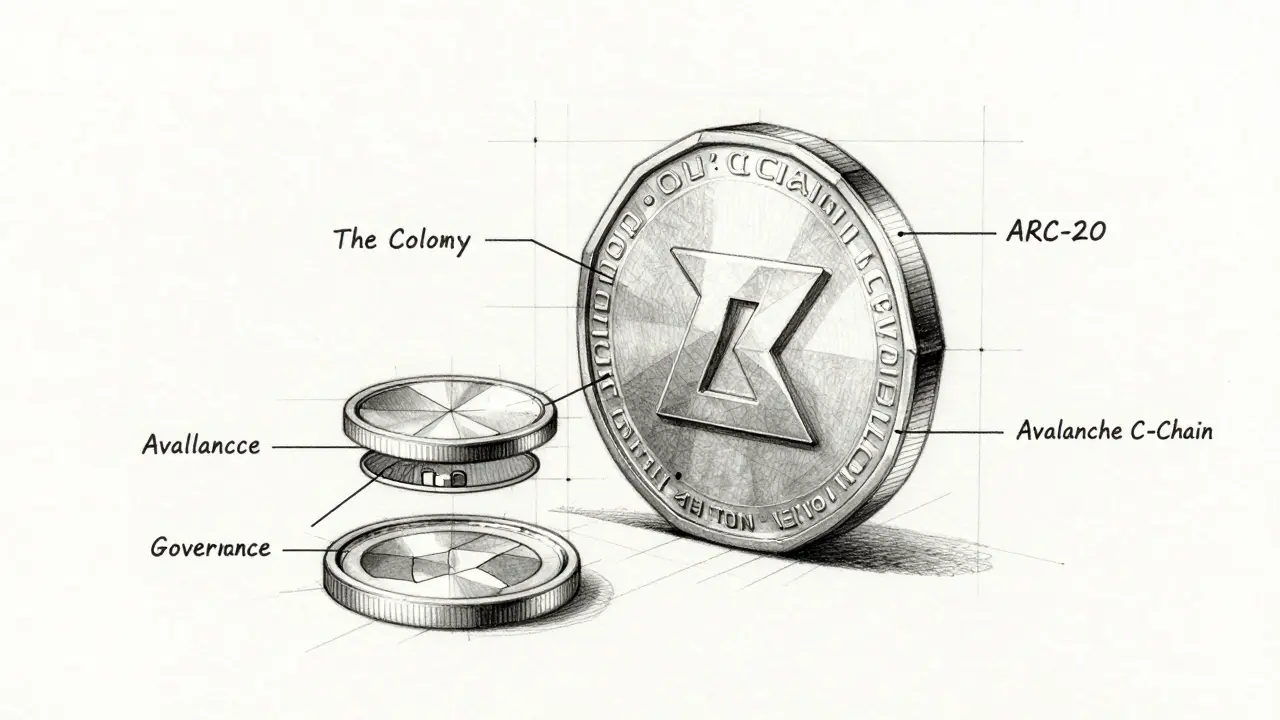
To understand Colony, you need to understand the asset itself. CLY is an ARC-20 governance and utility token deployed on the Avalanche C-Chain.
| Attribute | Value |
|---|---|
| Blockchain | Avalanche (C-Chain) |
| Token Standard | ARC-20 |
| Total Supply | 150,000,000 CLY (Fixed Cap) |
| Circulating Supply (Mid-2026) | ~112,700,000 CLY |
| Contract Address | 0xec3492a2508DDf4FDc0cD76F31f340b30d1793e6 |
| Mineable? | No (Non-mineable) |
The token wasn’t mined like Bitcoin. It was created entirely through sales and incentives. The total supply was capped at 150 million tokens, which meant no inflation could dilute holders later on. However, by mid-2026, over 112 million of those tokens were already in circulation, meaning most of the planned distribution had happened years ago.
How Did the Tokenomics Work?
When Colony launched in late 2021, it raised significant attention. They secured $20.5 million across seed, private, and IDO rounds. The allocation of the 150 million CLY tokens was structured to align incentives:
- 70% for Token Sale: Funding the initial development and treasury.
- 10% Team Allocation: Held by the developers and founders.
- 10% Liquidity Provision: Ensuring there was enough depth on exchanges.
- 7% Community Incentives: Rewards for users and stakers.
- 3% Advisors: Compensation for industry experts.
The genius of the design was the staking mechanism. To use any of Colony’s features, you had to stake your CLY. When you staked, the system converted your CLY into "ANT" derivative tokens at a ratio of 1 CLY = 100 ANT. These ANT tokens tracked your share of the rewards. There was also a 2% deposit fee when staking, designed to protect existing stakers from sudden influxes of new capital that could dilute yields.
The Four Pillars of Value Generation
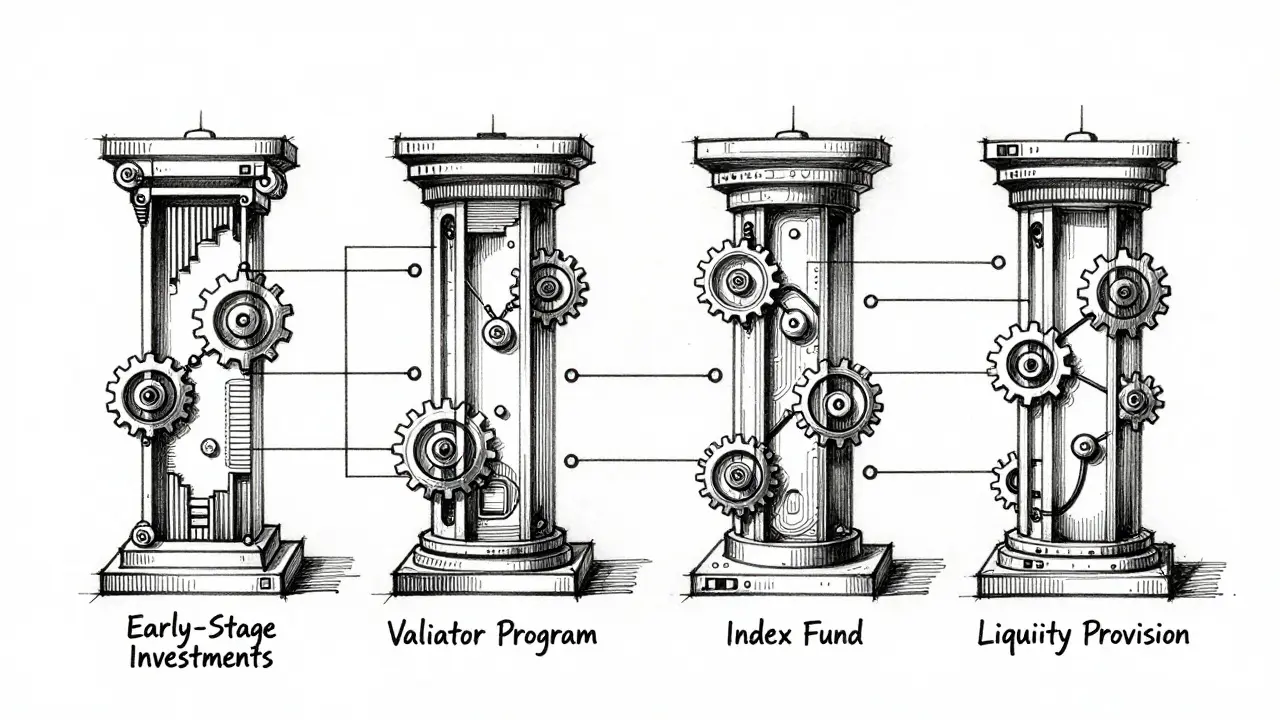
Why would anyone stake CLY? Because the platform promised four distinct streams of value. This was the "utility" part of the utility token label.
- Early-Stage Investments: Colony acted as a VC fund. They invested in new Avalanche projects during their seed or private rounds. As these projects grew and distributed tokens to investors, CLY stakers received proportional airdrops.
- Validator Program: Colony staked AVAX (the native token of Avalanche) to secure the network. The rewards earned from this validation work were shared with CLY stakers.
- Colony Avalanche Index (CAI): This was an index fund of top-performing Avalanche projects. Holding CLY gave you exposure to the performance of this basket of assets, similar to an ETF in traditional finance.
- Liquidity Provision: Colony provided liquidity to DeFi pools. The trading fees generated from these pools flowed back to the stakers.
For a time, this model worked. Users connected wallets like MetaMask, deposited at least 50 CLY, and waited for rewards. It lowered the barrier to entry for complex DeFi strategies.
Current Market Status: A Sharp Decline
If you look at the charts today, the picture is starkly different from the hype of 2021-2022. Between 2024 and early 2025, CLY traded in the range of $0.05 to $0.09, with a market cap reaching nearly €10 million. That represented genuine interest and activity.
As of July 2026, the situation has changed dramatically. Data from aggregators like CoinGecko and Bybit shows CLY trading around $0.0003 to $0.0005. The market cap has collapsed to under $60,000. Daily trading volume often dips below $300.
This isn’t just a normal market correction; it’s a 99% decline from peak levels. Such a drop usually signals one of two things: a catastrophic technical failure or a loss of confidence leading to a wind-down. In Colony’s case, it’s the latter.
The Shutdown Announcement
Here is the critical information you need right now: Colony Lab has announced plans to cease operations at the end of Q1 2026.
After roughly five years of operation, the team decided to shut down. The official statement emphasized ethical closure. They committed to not selling their own CLY holdings or using community funds for personal gain during the liquidation phase. Instead, they plan to make a final allocation to staking and gradually take down the front-end interfaces.
What does this mean for you?
- No More Active Management: The team will no longer seek out new investment opportunities or manage the index fund actively.
- Front-End Removal: The user-friendly website and app will go offline. Interacting with the remaining smart contracts will require direct wallet interaction, which is risky for non-technical users.
- Residual Value Only: Any remaining value in CLY comes purely from the residual assets in the treasury and any ongoing automated staking yields, but without active management, these yields are likely diminishing.
Is CLY Still Worth Anything?
From a speculative standpoint, buying CLY now is extremely high-risk. You are essentially buying a distressed asset with no future development roadmap. The "utility" of the token-access to investments and yields-is being dismantled.
However, if you already hold CLY, you aren't necessarily left with zero. The underlying smart contracts on the Avalanche blockchain remain valid. The treasury still holds some assets (AVAX, other tokens). The question is whether the value of those remaining assets exceeds the cost of extracting them, especially given the low liquidity.
Unlike a scam where the team runs away with the money, Colony’s shutdown appears orderly. But "orderly" doesn't mean "profitable." The massive price drop reflects the market's assessment that the remaining assets are worth very little per token.
Lessons from the Colony Experiment
Colony was ahead of its time in many ways. It tried to bring institutional-grade portfolio management to the masses via DeFi. It showed that DAOs could govern real capital deployment. But it also highlighted the fragility of such models.
Dependence on continuous ecosystem growth is a double-edged sword. When the broader crypto market cooled, and Avalanche’s narrative shifted, Colony struggled to find new, high-yield opportunities. Without fresh inflows of capital and successful exits from early investments, the yield engine slowed down. Once yields dropped, stakers left. When stakers left, the token price fell. It became a downward spiral that even strong tokenomics couldn't reverse.
For future projects, Colony serves as a case study in sustainability. Governance tokens need more than just voting rights; they need sustainable revenue models that don't rely solely on perpetual bull markets.
Is Colony (CLY) a scam?
No, Colony is not considered a scam. It was a legitimate project with transparent documentation, audited smart contracts, and a clear business model. However, it is shutting down due to operational challenges and declining market conditions, which has led to a significant loss in value.
Can I still buy CLY tokens?
Technically, yes, if there is remaining liquidity on decentralized exchanges like Trader Joe or Uniswap V3 on Avalanche. However, due to the shutdown announcement and extremely low trading volume, liquidity is very thin. Buying now carries a high risk of being unable to sell later.
What happens to my staked CLY after the shutdown?
The team has stated they will not force unstaking or seize funds. However, as the front-end interfaces are removed, you may need to interact directly with the smart contract to retrieve your tokens. The rewards associated with staking will likely cease or diminish significantly as active management stops.
Why did Colony fail?
Colony faced a combination of factors: a prolonged bear market in crypto, difficulty in finding high-yield investment opportunities for its fund, and the inherent complexity of managing a decentralized venture capital fund. As yields dropped, user retention fell, leading to a collapse in token demand.
Is CLY still listed on major exchanges?
As of mid-2026, CLY has been delisted from most major centralized exchanges. It remains available on some decentralized platforms on the Avalanche network, but trading volume is negligible compared to its peak years.