Have you ever stumbled upon a cryptocurrency with a name that sounds familiar but feels completely empty when you look for details? That is exactly what happens when you search for Class Coin. It sits on your screen with a ticker symbol-CLASS-and a price that hovers near zero, yet it lacks the community, documentation, or clear purpose that defines most digital assets. If you are wondering whether this is a hidden gem waiting to explode or just another forgotten token from the 2021 boom, you are not alone. The truth is far more mundane: Class Coin is a classic example of a "zombie" asset in the crypto world.
To understand what Class Coin actually is, we first need to strip away the hype and look at the raw data. Unlike Bitcoin, which has a clear history starting in 2009, or Ethereum, which powers a vast ecosystem of applications, Class Coin exists primarily as a line item on price aggregators. It is a BEP-20 token issued on the BNB Smart Chain, also known as BNB Chain. This technical foundation tells us how it works, but it doesn't tell us why it exists. In fact, the lack of information is its defining characteristic.
The Data Discrepancy: Why Prices Don't Match
If you check different websites for the price of Class Coin, you will likely get four different answers. This isn't because the market is volatile; it's because there is almost no trading happening at all. When liquidity dries up, price trackers start guessing based on stale data or single, isolated trades.
As of May 2026, the numbers paint a picture of extreme illiquidity:
- CoinTracker: Lists the price around $0.000002269 with a total supply of roughly 105 million tokens. This implies a total market value of less than $240 if every single token were sold at once.
- Binance Price Index: Shows a price of $0.000006 but lists the circulating supply as 0 and the market cap as $0. Binance includes it in their index for tracking purposes only, not for trading.
- Crypto.com: Displays a price near $0.000002119 but explicitly states that CLASS is "not tradable yet" on their platform.
- WorldCoinIndex: Reports a higher price of $0.000189, but with 24-hour volume of $0.00, indicating no recent trades occurred on the venues they monitor.
This divergence is a red flag for any investor. In healthy markets like Bitcoin or Ether, prices across major exchanges differ by fractions of a percent because high volume keeps them synchronized. For Class Coin, the wide gap between these figures suggests that the "price" you see is often just a snapshot of the last trade that happened months ago, or worse, a manipulated order book with no real buyers behind it.
| Platform | Listed Price (USD) | 24h Volume | Tradability Status |
|---|---|---|---|
| CoinTracker | $0.000002269 | Negligible | Data Only |
| Binance | $0.000006 | $0 | Not Listed for Trade |
| Crypto.com | $0.000002119 | N/A | Not Tradable |
| WorldCoinIndex | $0.000189 | $0.00 | No Recent Activity |
Technical Foundation: BNB Smart Chain and BEP-20
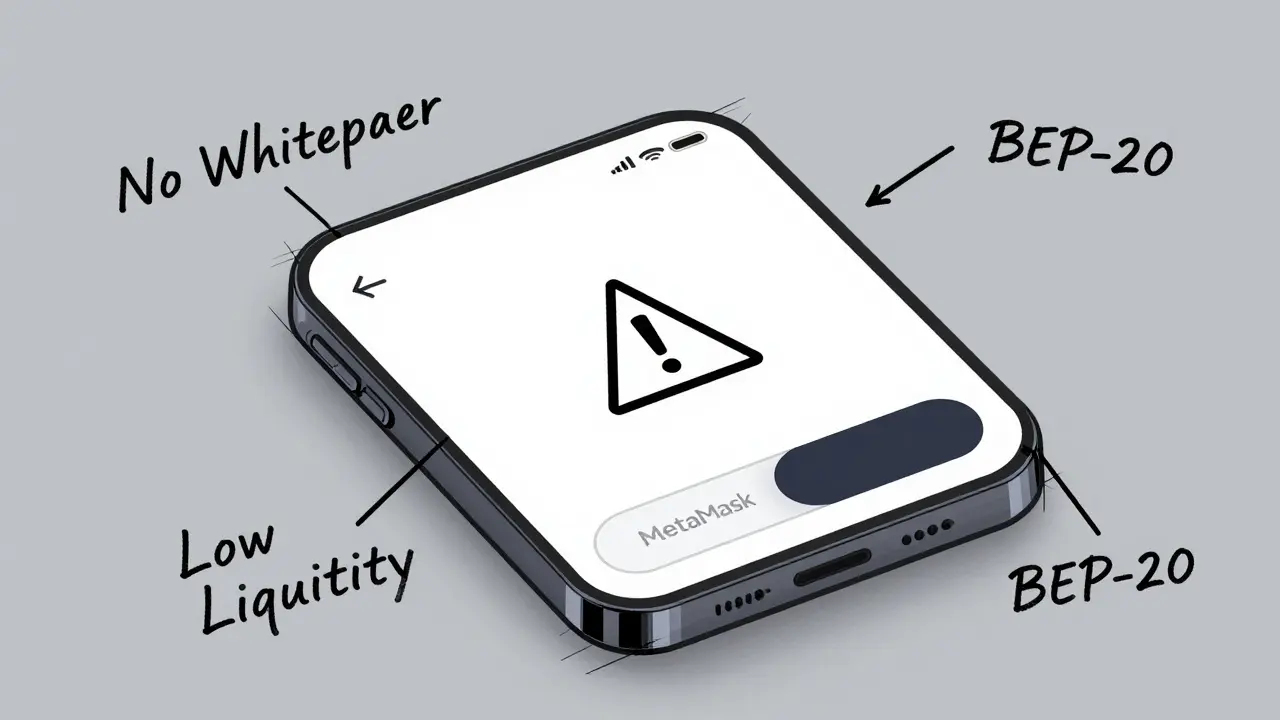
While the economics of Class Coin are unclear, its technical structure is standard. It operates on the BNB Smart Chain (BSC), using the BEP-20 standard. To put this in perspective, BEP-20 is the BSC equivalent of Ethereum’s ERC-20. It defines how the token behaves: how balances are checked, how transfers are executed, and how approvals work.
Being on BNB Smart Chain means Class Coin benefits from fast block times (roughly 3 seconds) and low transaction fees, often costing less than $0.10 per transfer. However, it also inherits the security profile of the network. BSC uses a Proof-of-Staked-Authority (PoSA) consensus mechanism with a limited set of validators. While this makes transactions cheap and quick, it is more centralized than networks like Ethereum or Solana. For a token with no active development team, this centralization risk is compounded by the lack of oversight.
Because Class Coin is a BEP-20 token, it can be held in wallets compatible with BSC, such as MetaMask (configured for BSC) or Trust Wallet. You don't need special hardware to hold it, but you do need to be careful about where you send it. Without a verified contract address from an official source, sending funds to the wrong address could result in permanent loss.

The Mystery of the Missing Whitepaper
In the crypto world, a whitepaper is usually the project’s resume. It explains who built the coin, what problem it solves, and how the tokens will be distributed. For Class Coin, this document appears to be missing entirely. None of the major data aggregators link to an official website, a GitHub repository, or a founding team.
This absence is significant. Compare this to established projects:
- Bitcoin: Launched with a whitepaper by Satoshi Nakamoto in 2008.
- Ethereum: Backed by Vitalik Buterin and a detailed technical specification.
- Uniswap: Provides extensive developer documentation and governance reports.
Class Coin has none of this. There is no roadmap, no audit report from firms like CertiK or Trail of Bits, and no social media presence that resembles an active community. On Reddit, Twitter, or Bitcointalk, searches for "Class Coin" yield mostly automated bot posts or scattered mentions from years ago, rather than genuine user discussions. This silence suggests that the project is either abandoned or was never intended to be more than a speculative experiment.
Risk Assessment: Is It Safe?
When evaluating a micro-cap token like Class Coin, safety is not just about hacking risks; it's about structural viability. Regulators like the Canadian Securities Administrators (CSA) emphasize that cryptocurrencies without inherent utility derive their value solely from supply and demand. For Class Coin, both supply and demand are effectively non-existent.
Here are the key risks you need to consider:
- Liquidity Risk: With 24-hour volumes consistently reported as $0, you may find yourself unable to sell your tokens even if the price seems to rise. Illiquid tokens suffer from extreme slippage, meaning a small sale could crash the price by 50% or more.
- Information Asymmetry: Without a public team or audit, there is no way to verify if the smart contract contains malicious code, such as functions that allow the creator to mint unlimited tokens or freeze your wallet.
- Market Manipulation: Thinly traded tokens are easy targets for "pump and dump" schemes. A few large buys can artificially inflate the price, luring in retail investors before the manipulators sell off their holdings.
- Opportunity Cost: Money tied up in a dormant token like CLASS cannot be used in more productive investments, such as established DeFi protocols or blue-chip cryptocurrencies.
Institutional analysts, such as those at Wellington Management, note that for an asset to be considered investable, it needs reliable price discovery and meaningful daily volume (often tens of millions of dollars). Class Coin fails these criteria by orders of magnitude.
How to Interact with Class Coin (If You Must)
If you still decide to explore Class Coin, perhaps out of curiosity or because you already hold some, here is how the process typically works on the BNB Smart Chain.
First, you need a wallet. MetaMask is the most common choice. You must add the BNB Smart Chain network manually if it isn't pre-loaded. Next, you need BNB (the native currency of BSC) to pay for gas fees. Even though Class Coin transactions are cheap, you cannot pay fees with CLASS itself; you need BNB.
To acquire CLASS, you would likely need to use a decentralized exchange (DEX) like PancakeSwap. You would connect your wallet, paste the exact contract address for CLASS (which you must verify carefully, as fake tokens exist), and swap BNB for CLASS. However, due to the lack of liquidity pools, this swap might fail or result in a massive price impact. Always check the pool depth before attempting a trade.
Remember, since Binance and Crypto.com do not support direct trading of CLASS, you are limited to DEXs or smaller, unregulated exchanges. This adds another layer of complexity and risk to the process.
Conclusion: A Lesson in Due Diligence
Class Coin serves as a stark reminder of the wild west nature of the cryptocurrency market. It is not a scam in the traditional sense-it is simply a token that exists on a blockchain but lacks the community, utility, or economic activity to sustain relevance. It is a ghost town in the digital landscape.
For investors, the lesson here is clear: always look beyond the ticker symbol. Check for active development, transparent teams, audited contracts, and consistent trading volume. If a project has none of these, as Class Coin does, it is best to treat it as a novelty rather than an investment. The crypto market is full of thousands of similar micro-caps created during the 2020-2021 boom. Most have faded into obscurity, and Class Coin appears to be following that same path.
Can I buy Class Coin on Binance?
No, you cannot directly buy Class Coin on Binance. While Binance displays a price index for CLASS, it is listed as an informational asset only, with a circulating supply of 0 and no trading pairs available on the spot market.
Is Class Coin a safe investment?
Class Coin carries extremely high risk. It has negligible trading volume, no known development team, and no public whitepaper or audit. These factors make it susceptible to manipulation and total loss of value. It should not be considered a safe investment.
Why do different websites show different prices for CLASS?
The price discrepancies occur because Class Coin has very low liquidity. Different aggregators pull data from different sources, such as stale trades, isolated DEX pools, or index estimates. Without consistent high-volume trading, prices do not synchronize across platforms.
What is the total supply of Class Coin?
According to CoinTracker, the current supply is approximately 105,648,257 CLASS tokens. However, other sources like Binance list the circulating supply as 0, highlighting the lack of standardized data for this micro-cap asset.
Does Class Coin have a whitepaper?
There is no publicly available or verifiable whitepaper for Class Coin. Major data aggregators do not link to an official website or documentation, which is unusual for legitimate cryptocurrency projects.
How can I store Class Coin?
Since Class Coin is a BEP-20 token on the BNB Smart Chain, you can store it in any wallet that supports BSC, such as MetaMask or Trust Wallet. Ensure your wallet is configured to connect to the BNB Smart Chain network.

Jerry CUNNINGHAM SR
21 May, 2026 . 00:51 AM
It is truly unfortunate that so many individuals invest their hard-earned capital into assets that lack fundamental utility or community support. The data presented here clearly illustrates the dangers of neglecting due diligence in favor of speculative excitement. One must always prioritize transparency and verifiable development over mere ticker symbols. It is my hope that readers take this as a cautionary tale rather than an opportunity for profit.
Shelby Cantu
22 May, 2026 . 01:25 AM
Thanks for sharing this info! It helps to know what to avoid.
Tobias Gjerlufsen
23 May, 2026 . 09:45 AM
you people are so blind to the obvious truth here the market is not broken it is merely reflecting the true value of worthless digital scribbles created by idiots who think they can print money from thin air without any backing whatsoever its a miracle anyone still believes in this garbage
Ruben Michel
23 May, 2026 . 22:26 PM
The absence of a whitepaper is not merely an oversight; it is a profound indictment of the project's legitimacy. In the realm of high finance, documentation serves as the bedrock of trust. Without it, one is left with nothing but speculation and potential fraud. It is quite amusing how such entities manage to exist at all in a regulated environment.
Gavin Wonnacott
25 May, 2026 . 08:39 AM
I actually hold some of these tokens and I find your analysis deeply insulting to my intelligence and investment strategy. You seem to have no understanding of the hidden liquidity pools that only insiders know about. Keep telling yourself that you are smart while I sit on bags that will eventually moon because the masses are too stupid to see the potential. Your little article is just noise designed to pump fear into weak minds.
Samara McCallum
26 May, 2026 . 11:43 AM
i feel like everyone is missing the point entirely why do we even need whitepapers when the blockchain itself tells the truth? maybe the silence is the message perhaps the emptiness is the feature not the bug i just vibe with the void sometimes it feels more real than all the hype
Sheldon Friesen
27 May, 2026 . 09:01 AM
Oh, look at us! We're all so clever for pointing out that a token with zero volume is bad! Groundbreaking stuff! Truly, the next Satoshi Nakamoto right here! But seriously, if you are going to buy shitcoins, at least read the contract code first. It might save you from getting rug-pulled by a script kiddie in a basement somewhere. Not that you'll listen, obviously!
Tricia Alach
28 May, 2026 . 15:29 PM
its so interesting how the price changes on diff sites i thnk its bcuz the algos r guessing lol but yeah prob best to stay away unless u wanna lose ur money fast typos aside this was a good read tho
Jan Gilmore
28 May, 2026 . 21:32 PM
Let me explain something to you folks who don't get it. BEP-20 tokens are easy to create, which is why there are millions of them. Most are trash. Class Coin is just one of thousands of abandoned projects. If you want to make money, focus on Ethereum or Solana where the actual developers are working. Stop chasing ghosts.
Caique Muniz
29 May, 2026 . 21:20 PM
another boring post about dead coins yawn i bet the author doesnt even own any crypto just writes articles for clicks lol whateverz
Bradley Geldenhuys
31 May, 2026 . 19:35 PM
Look man, its simple philosophy really. The coin has no soul. No team, no plan, no heart. Just numbers on a screen. You gotta believe in something deeper than just green candles. This thing is empty. Dont put your energy into a black hole. Find something that resonates with your spirit instead ok?
robert Whitehead
1 June, 2026 . 04:40 AM
The moral failing here is clear. Investors who buy these tokens are enabling a system of deception and waste. There is no virtue in gambling on illiquid assets. It is selfish and irresponsible. We should demand better standards from every project we engage with. Anything less is a betrayal of the technology's promise.
Mike S
2 June, 2026 . 04:12 AM
Absolutely pathetic! How does this garbage even exist? I mean, seriously, who gives a damn about Class Coin? It's a joke. A complete farce. And yet here we are, reading about it like it matters. Wake up sheeple! This is exactly why crypto gets a bad reputation. Pure trash.