Imagine logging into your favorite global crypto app only to find a blank screen or an error message saying the service is unavailable. For millions of Indian traders, this wasn't a hypothetical nightmare-it was reality starting in early 2024. If you are wondering which platforms you can no longer use from within India, the answer isn't just a list of names; it's about understanding the Financial Intelligence Unit-India (FIU-IND) compliance crackdown.
The landscape has shifted dramatically. It is not that cryptocurrency itself is illegal in India. You can still own Bitcoin, Ethereum, or Solana. What changed is *where* you can legally buy and sell them using Indian Rupees (INR). The government didn't ban crypto; they banned the gateways that weren't playing by their rules. This distinction is crucial because it means trading is still alive and well, but only on specific, registered platforms.
The Core Rule: FIU-IND Registration Is Mandatory
To understand why certain exchanges disappeared from the Play Store and stopped working on browsers, you need to look at one regulatory body: the Financial Intelligence Unit-India (FIU-IND). Think of the FIU as India's anti-money laundering watchdog for digital assets. Under the Prevention of Money Laundering Act (PMLA), any entity acting as a Virtual Digital Asset (VDA) service provider must register with the FIU.
If an exchange does not have this registration, it cannot legally operate in India. The government, through the Ministry of Electronics and Information Technology (MeitY), issues directives to internet service providers (ISPs) to block access to these non-compliant websites and apps. This isn't a temporary glitch; it is a systematic enforcement action designed to bring crypto trading into the formal financial system.
The key takeaway here is simple: compliance equals access. Any platform without FIU-IND registration is effectively banned for users located in India. This includes many major international giants that initially chose to ignore Indian regulations, assuming their global brand power would shield them.
Which International Exchanges Were Blocked?
The crackdown targeted several high-profile international exchanges. These platforms were popular among Indian traders due to their deep liquidity, wide range of altcoins, and advanced trading features. However, their failure to register with the FIU led to their blocking.
| Exchange Name | Status in India | Reason for Blocking |
|---|---|---|
| Binance | Banned/Blocked | Failed to obtain FIU-IND registration; faced penalties for non-compliance. |
| KuCoin | Banned/Blocked | Lack of FIU-IND registration; blocked by ISPs per MeitY directive. |
| Bybit | Banned/Blocked | Non-compliance with PMLA requirements; paid fines but remains restricted. |
| Coinbase | Restricted | Services limited until full FIU compliance is demonstrated. |
For example, Binance, once the world's largest exchange by volume, found its doors closed to Indian users who relied on INR deposits. While Binance attempted to negotiate and even offered incentives to comply, the initial period of non-registration resulted in widespread blocking. Users reported that their apps stopped loading, and customer support became unresponsive for Indian-specific queries.
Similarly, KuCoin and Bybit faced similar fates. These platforms struggled to secure partnerships with Indian banks because banks, fearing regulatory repercussions, refused to process transactions for non-FIU registered entities. This created a domino effect: no bank transfers meant no easy way to fund accounts, rendering the platforms useless for most retail investors.
The Rise of Domestic Champions: Who Can You Use?
As international platforms fell away, domestic exchanges stepped up. These companies had already anticipated the regulatory shift and secured their FIU-IND registrations early. They didn't just survive; they thrived, absorbing millions of users migrating from banned platforms.
Here are the primary compliant platforms currently operating in India:
- CoinDCX: One of the earliest adopters of compliance, CoinDCX saw deposit growth exceed 2,000% during the crackdown. It offers a robust interface, insurance funds, and seamless INR integration via UPI and net banking.
- WazirX: A veteran in the Indian space, WazirX maintained its position by ensuring strict adherence to KYC (Know Your Customer) and AML (Anti-Money Laundering) norms.
- Mudrex: Known for its focus on crypto mutual funds and simplified investing, Mudrex onboarded over 10,000 new users within weeks of the bans, appealing to beginners who wanted a hassle-free experience.
- ZebPay and Unocoin: Both established players continued operations smoothly, offering reliable fiat on-ramps and educational resources for new traders.
These platforms provide what banned exchanges could not: legal recourse. If you face an issue with a frozen account or a failed transaction on a compliant exchange, you have a path to grievance redressal under Indian law. On a banned platform, you are essentially on your own.
Why Compliance Matters Beyond Just Access
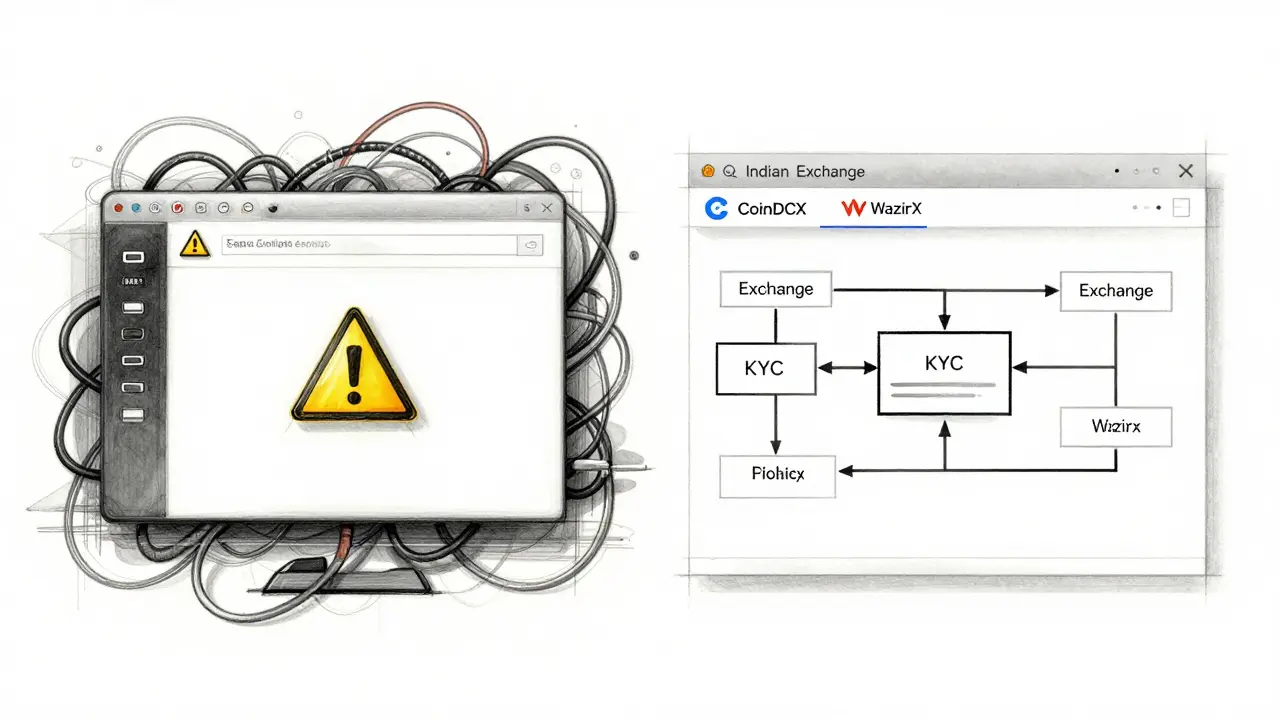
You might be tempted to use VPNs to access blocked exchanges like Binance or KuCoin. While technically possible, this comes with significant risks that go beyond just losing access to your app.
First, there is the issue of banking restrictions. Even if you can log in, sending INR to a non-compliant exchange is nearly impossible. Banks monitor transactions closely. If they detect a transfer to a flagged entity, they may freeze your entire bank account pending investigation. This has happened to numerous traders who tried to bypass the blocks.
Second, consider taxation. India imposes a flat 30% tax on crypto gains, plus a 1% TDS (Tax Deducted at Source) on every transaction. Compliant exchanges automatically calculate and report this data to the Income Tax Department. If you trade on a banned platform, you lose this automated reporting. You must manually track every single trade, calculate capital gains, and file complex returns. Failure to do so correctly can lead to penalties of up to 60% under Section 158BA(7) for undisclosed income.
Third, there is the risk of fraud and insolvency. Without FIU oversight, there is no guarantee that the exchange holds your assets securely. History has shown us numerous cases of offshore exchanges collapsing or being hacked, leaving users with worthless tokens. Compliant Indian exchanges are required to maintain segregation of client funds and adhere to stricter security standards.
The Future Outlook: Will Bans Be Lifted?
The regulatory environment in India is evolving. The Finance Bill introduced changes under Section 285BAA, mandating detailed record-keeping for all registered exchanges. This suggests the government is not looking to ban crypto permanently but rather to integrate it into the formal economy.
International exchanges like Binance and Coinbase are actively pursuing FIU registration. If they succeed in meeting all compliance requirements, they could potentially resume services in India. However, this process takes time and involves rigorous audits. Until then, the ban remains in effect.
For now, the strategy is clear: stick to FIU-registered platforms. The market has corrected itself, with domestic exchanges gaining dominance not through superior technology alone, but through legal certainty. As the framework matures, we may see more international players return, but they will do so on India's terms, not theirs.
Practical Steps for Indian Traders in 2026
If you are navigating this landscape today, here is your checklist for staying safe and compliant:
- Verify FIU Status: Before signing up for any exchange, check the FIU-IND website for the list of registered VDA service providers. Do not rely on marketing claims alone.
- Avoid Unverified DeFi Protocols: Decentralized Exchanges (DEXs) often lack central oversight. While they offer privacy, they also expose you to higher risks of smart contract vulnerabilities and regulatory scrutiny. Use them cautiously and understand that they may not report taxes for you.
- Keep Detailed Records: Regardless of the platform, maintain your own records of all transactions. Download monthly statements and store them securely. This is crucial for accurate tax filing.
- Use Bank Transfers Wisely: Only send money to exchanges that have verified banking partners. Avoid peer-to-peer (P2P) trades with unknown individuals, as these can trigger fraud alerts on your bank account.
- Stay Updated on Regulations: Crypto laws change frequently. Follow official announcements from the Ministry of Finance and the Reserve Bank of India (RBI) rather than relying on social media rumors.
The era of wild west crypto trading in India is over. The current phase is about maturity, compliance, and long-term sustainability. By choosing compliant platforms, you protect your capital, simplify your tax life, and participate in a growing market that is becoming increasingly integrated with India's financial infrastructure.
Is cryptocurrency completely banned in India?
No, cryptocurrency itself is not banned in India. You can legally own and hold digital assets like Bitcoin and Ethereum. What is restricted is the ability to trade them on exchanges that are not registered with the Financial Intelligence Unit-India (FIU-IND). Trading on compliant platforms is legal and regulated.
Can I use Binance in India in 2026?
As of 2026, Binance remains blocked for Indian users unless it has successfully completed its FIU-IND registration process. Using Binance via a VPN carries significant risks, including frozen bank accounts and lack of legal recourse. It is safer to use FIU-compliant domestic exchanges like CoinDCX or WazirX.
How much tax do I pay on crypto profits in India?
India charges a flat 30% tax on all cryptocurrency gains, regardless of how long you held the asset. Additionally, a 1% TDS (Tax Deducted at Source) is deducted on each transaction above a certain threshold. There are no set-offs allowed against losses, meaning you cannot offset gains with previous losses.
What happens if I trade on a banned exchange?
Trading on a banned exchange exposes you to multiple risks. Your bank account may be frozen if the bank detects transactions to a non-compliant entity. You will have no legal protection if the exchange hacks or goes bankrupt. Furthermore, you are responsible for manually calculating and filing complex tax returns, risking heavy penalties if errors occur.
Which crypto exchanges are safe to use in India?
Safe exchanges are those registered with the FIU-IND. Currently, prominent compliant platforms include CoinDCX, WazirX, Mudrex, ZebPay, and Unocoin. Always verify the current registration status on the official FIU-IND website before depositing funds.
Will international exchanges like Coinbase return to India?
It is possible. International exchanges are actively seeking FIU-IND registration to regain access to the Indian market. Once they meet all compliance requirements, including data localization and reporting standards, they may resume services. However, this timeline is uncertain and depends on regulatory approvals.
Does the RBI ban cryptocurrencies?
The Reserve Bank of India (RBI) previously issued a circular prohibiting banks from dealing with crypto, but this was struck down by the Supreme Court in 2020. Currently, the RBI does not enforce a blanket ban but monitors the sector closely. The primary regulator for exchanges is the FIU-IND under the Ministry of Finance.
Are decentralized exchanges (DEXs) legal in India?
Decentralized exchanges operate in a grey area. Since they lack a central operator, they cannot easily register with the FIU-IND. While using DEXs is not explicitly criminalized, they do not offer the same consumer protections or tax reporting automation as centralized, compliant exchanges. Users bear full responsibility for compliance and security.