
When Bitcoin first launched, people thought mining was just a nerdy tech experiment. But by 2024, Bitcoin’s annual electricity use hit 112.06 terawatt-hours - more than the entire country of Norway. That’s not sustainable. And that’s why Proof of Stake became the biggest shift in blockchain history.
How Proof of Stake Slashes Energy Use by 99.95%
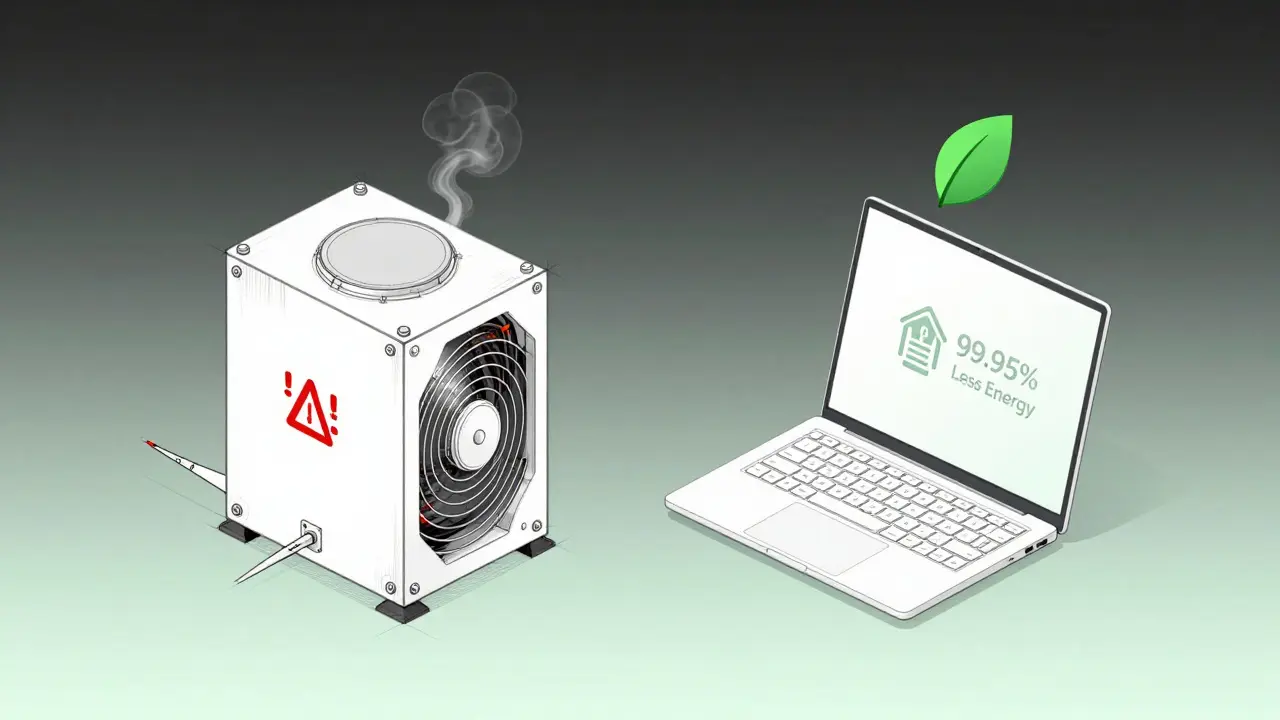
Proof of Work, the system Bitcoin uses, is like a global competition where miners race to solve math puzzles. The faster your computer, the more electricity it eats. One Antminer S21 Hydro uses over 5,300 watts - enough to power a small refrigerator nonstop. And it’s not just one machine. Thousands of them run 24/7, burning through fossil fuels just to confirm transactions.
Proof of Stake throws that whole system out. Instead of brute-force computing, validators are chosen based on how much crypto they lock up - or “stake.” No mining rigs. No overheated data centers. Just a regular laptop with 8 GB of RAM, running quietly in the corner. Ethereum’s switch to PoS in September 2022 cut its energy use from 5.13 gigawatts to just 2.62 megawatts. That’s a 1,957x drop. To put that in perspective: if Bitcoin used the same amount of power as Ethereum now, it would be using less electricity than your local coffee shop.
Real Numbers: PoW vs PoS in Action
Let’s compare what’s actually happening on the networks.
| Metric | Bitcoin (PoW) | Ethereum (PoS) |
|---|---|---|
| Annual Energy Use | 112.06 TWh | 0.00262 TWh (2.62 MW) |
| Energy per Transaction | 830 kWh | 0.036 kWh |
| CO2 Emissions (Annual) | 62.51 million tonnes | ~1.2 million tonnes (including all PoS networks) |
| Transactions per Second | 5 | 15-45 (up to 100,000+ with sharding) |
| Hardware Needed | ASIC miners ($5k-$20k) | Standard PC (8GB RAM, 64GB storage) |
One Bitcoin transaction uses as much power as an average U.S. household does in 28 days. One Ethereum transaction? Less than your phone charging overnight. And PoS networks like Polkadot and Cardano are even leaner. Their combined emissions are less than 200 American homes. Bitcoin? It’s equivalent to 1.5 million homes.
Why This Matters Beyond Electricity Bills
This isn’t just about saving power. It’s about survival.
In 2023, the European Union passed MiCA regulations - the first major legal framework for crypto. It doesn’t ban PoW, but it makes PoS the default for regulated products. Why? Because institutions won’t touch a blockchain that uses more energy than a small country. Fidelity, Grayscale, and BlackRock all said the same thing after Ethereum’s Merge: “We can’t recommend this to our clients if it’s this wasteful.”
Companies holding crypto as part of their treasury now prioritize PoS assets. A 2024 report showed 73% of corporate treasuries prefer PoS - up from just 28% in 2021. Why? ESG compliance. Investors demand it. Regulators track it. And customers notice.
Even the World Bank and IMF have started asking questions. If blockchain is going to be part of the global financial system, it can’t be a climate liability. PoS is the only path forward that scales without destroying the planet.
It’s Not Just Ethereum - The Whole Ecosystem Moved
People think Ethereum was the only one that switched. But it wasn’t. Cardano, Solana, Polkadot, Tezos, and even newer chains like Avalanche all use PoS. Together, they now make up 38% of the entire crypto market - over $482 billion in value.
And it’s accelerating. In 2023, 78% of new blockchain projects launched with PoS. Only 22% even considered PoW. Why? Because developers know the future is green. Why build a network that needs a power plant if you can run it on a $500 laptop?
Solana’s Proof-of-History hybrid, Algorand’s Pure PoS, and Ethereum’s upcoming Verkle Trees upgrade all build on the same core idea: eliminate computation. Replace it with economic incentives. Validators don’t burn electricity - they risk their own money. If they cheat, they lose their stake. That’s smarter than burning gigawatts.
Can You Even Participate Without a Fortune?
One myth about PoS is that you need $100,000 to join. That’s only true if you run your own validator on Ethereum - which requires 32 ETH (about $102,400 as of late 2024). But here’s the real story: most people don’t do that.
Over 32% of all staked ETH is managed by services like Lido and Coinbase. You can stake $10 on Coinbase and earn 3-4% annual returns. No tech skills. No hardware. Just click and earn. In Q1 2024 alone, Coinbase added 1.2 million new stakers. That’s not just techies - that’s teachers, nurses, small business owners.
Compare that to Bitcoin mining, where you need $15,000 in equipment, a warehouse, and a power contract with your local utility. The barrier to entry is designed to exclude everyone but corporations and industrial miners.
PoS flips that. It democratizes participation. You don’t need to be rich or technical. You just need to believe in the network - and that’s exactly how it should work.

What About Centralization Risks?
Yes, critics say PoS could lead to centralization. If only the rich can afford to stake, then only the rich control the network. It sounds plausible - but so far, it hasn’t happened.
On Ethereum, the top 10 staking providers control about 45% of the network. That’s less concentrated than the top 5 mining pools controlled over 70% of Bitcoin’s hash rate in 2021. And unlike Bitcoin miners, who are anonymous and unaccountable, PoS validators are tied to real identities and financial stakes. If they act maliciously, they lose millions.
Plus, liquid staking derivatives let you stake small amounts while still earning rewards and keeping liquidity. That’s a built-in safeguard against hoarding. No one owns the network. Everyone has a share.
The Future Is Already Here
Gartner predicts that by 2027, 95% of enterprise blockchains will use PoS or a variant. Why? Because ESG isn’t a buzzword anymore - it’s a requirement. Banks, governments, and corporations won’t adopt tech that’s environmentally irresponsible.
The Cambridge Centre for Alternative Finance summed it up best: “PoS is the only consensus mechanism with a viable path to net-zero blockchain operations at scale.”
Bitcoin might still have its loyal followers. But the future belongs to the efficient, the scalable, and the sustainable. And that future runs on Proof of Stake.
Is Proof of Stake really 99.95% more energy efficient than Proof of Work?
Yes. Ethereum’s transition from PoW to PoS in September 2022 cut its energy use from 5.13 gigawatts to 2.62 megawatts - a 99.95% reduction. This was confirmed by the Ethereum Foundation, EY, and FTSE Russell. The math is consistent: PoW needs massive computing power to solve puzzles; PoS replaces that with economic stakes. No mining = no energy waste.
Can I stake crypto without buying expensive hardware?
Absolutely. You don’t need ASICs or specialized rigs. With platforms like Coinbase, Kraken, or Lido, you can stake as little as $10 using your phone or laptop. These services handle the technical side - you just earn rewards. Your only cost is the electricity your phone uses to run the app - about $0.01 per day.
Why did Ethereum switch to Proof of Stake?
Ethereum switched to PoS primarily to cut energy use and improve scalability. Before The Merge, Ethereum used more power than entire countries. After the switch, it became as energy-efficient as a single household. It also made the network faster, cheaper, and more accessible to everyday users - not just mining farms.
Are PoS blockchains more secure than PoW?
Yes - in different ways. PoW security relies on brute-force computing power. PoS security relies on economic penalties. If you try to attack a PoS network, you risk losing your entire staked amount - potentially millions of dollars. This makes attacks far more expensive and less attractive than in PoW, where attackers only need to control 51% of hash power. PoS turns security into a financial disincentive.
What’s the environmental impact of Bitcoin vs. Ethereum today?
Bitcoin emits about 62.5 million tonnes of CO2 annually - roughly equal to the Netherlands. Ethereum, post-Merge, emits less than 1.2 million tonnes - less than a small city. Even the entire PoS ecosystem combined (Ethereum, Cardano, Solana, etc.) uses less energy than 200 U.S. households. Bitcoin’s footprint is 50 times larger than all major PoS chains together.



Madhavi Shyam
19 December, 2025 . 03:17 AM
PoS is O(1) energy complexity vs PoW's O(n) - the asymptotic efficiency is non-negotiable for planetary-scale systems.
Shruti Sinha
20 December, 2025 . 12:45 PM
Interesting breakdown. I've been staking on Cardano for a year now - my laptop barely warms up, and I'm earning more than my savings account. No noise, no heat, no guilt.
Kelsey Stephens
21 December, 2025 . 23:04 PM
I used to think crypto was just a wild west. But seeing how PoS lets regular people like my neighbor, a nurse, earn passive income without buying a mining rig? That’s the kind of innovation that actually helps people.
Greg Knapp
23 December, 2025 . 21:38 PM
PoW is just fossil fuel addiction with blockchain glitter on it and honestly if you still mine bitcoin you're either rich or clueless or both
Florence Maail
25 December, 2025 . 01:52 AM
They say PoS is greener but what they don’t tell you is that the validators are all owned by big funds anyway... it’s just centralized control with a greenwash label 😏
Cheyenne Cotter
26 December, 2025 . 04:35 AM
People act like Ethereum’s switch was some magical event but the math has been clear since 2018 - PoW scales linearly with hash rate while PoS scales logarithmically with stake. The energy drop isn’t a coincidence, it’s a design feature. And yes, the 99.95% figure is accurate - the Ethereum Foundation’s post-merge audit confirmed it with real-world telemetry from 150+ nodes. The real issue is that Bitcoin maximalists keep recycling the same debunked talking points like it’s 2017.
SeTSUnA Kevin
26 December, 2025 . 13:35 PM
Efficiency is not a virtue if it sacrifices decentralization. PoS is elegant, but elegance without resilience is just aesthetics.
Jack Daniels
27 December, 2025 . 07:08 AM
I used to run a rig... now I just watch the power bill climb and wonder if I’m part of the problem. I switched to staking. It’s not the same rush, but I sleep better.
Terrance Alan
27 December, 2025 . 10:13 AM
Let’s be honest here - PoS is just Wall Street’s way of turning crypto into a gated investment club. The rich get richer by locking up coins they already own, while the rest of us are left buying tokens on exchanges with no real stake in the network. This isn’t democratization, it’s financial feudalism dressed up in eco-friendly packaging. The ‘you can stake $10’ myth is a distraction - the real governance power lies with the top 0.1% of holders. They’re not building a decentralized future. They’re building a better version of the same old system.
Dionne Wilkinson
29 December, 2025 . 08:32 AM
I wonder if we’re asking the right question. Instead of ‘which is more efficient,’ maybe we should ask ‘what kind of society do we want to build?’ If we value speed and scale over energy, are we really building something worth saving?
Donna Goines
31 December, 2025 . 00:10 AM
Did you know the people pushing PoS also work for venture capital firms that invested in Ethereum? This isn’t about the environment, it’s about control. They needed to kill Bitcoin mining because miners were too independent. Now they’ve got validators who need licenses and KYC. It’s not greener, it’s surveilled.
Patricia Amarante
1 January, 2026 . 07:05 AM
Just staked $20 on Coinbase. Got a notification that I earned $0.12 today. My coffee costs more than my electricity bill for this. 🤷♀️
Tom Joyner
2 January, 2026 . 05:23 AM
Comparing PoS to PoW is like comparing a Tesla to a horse-drawn carriage. The former is engineered for the 21st century. The latter is a romantic relic that refuses to acknowledge physics.
Heather Turnbow
3 January, 2026 . 01:32 AM
Thank you for presenting the data so clearly. It’s rare to see such a balanced and well-sourced perspective on a topic that so often devolves into ideological shouting. I appreciate the nuance in acknowledging both the benefits and the valid concerns around centralization. It’s a step toward more thoughtful discourse.
Abby Daguindal
4 January, 2026 . 22:01 PM
So you’re saying if I don’t like PoS, I’m just a climate denier? That’s not how logic works. You’re conflating technical efficiency with moral superiority. And no, I don’t want to be lectured by someone who thinks a laptop is ‘green’ when the server farms powering Coinbase are in Iowa burning coal.
Sue Bumgarner
6 January, 2026 . 13:05 PM
Let’s not forget that the US government owns 20% of all staked ETH through its pension funds. So when you say PoS is ‘democratic,’ you’re really saying America’s financial elite gets to control the blockchain. That’s not freedom. That’s state-backed crypto.
Sean Kerr
7 January, 2026 . 02:57 AM
Broooooo just staked my first 0.05 ETH on Lido and now I’m basically a blockchain wizard 🤓💸 no more mining rigs, no more noise, just chillin’ while my wallet grows 😌✨ #PoSIsTheFuture