Remember when buying an NFT meant paying a premium for a JPEG that could vanish if the server hosting it went dark? Those days are fading fast. As we move through 2026, the conversation around NFT data storage has shifted dramatically from simple file preservation to complex infrastructure challenges involving artificial intelligence, cross-platform interoperability, and massive scalability demands.
The market has stabilized. In the first half of 2025, trading volumes settled at $2.82 billion, showing only a slight dip from late 2024 while transaction counts surged by nearly 80%. This isn't speculative frenzy anymore; it's utility-driven adoption. And with utility comes heavier data requirements. The old way of storing everything on-chain is dead due to cost, but the new hybrid models are raising critical questions about who owns your data, where it lives, and how long it will last.
The Hybrid Reality: On-Chain Metadata vs. Off-Chain Content
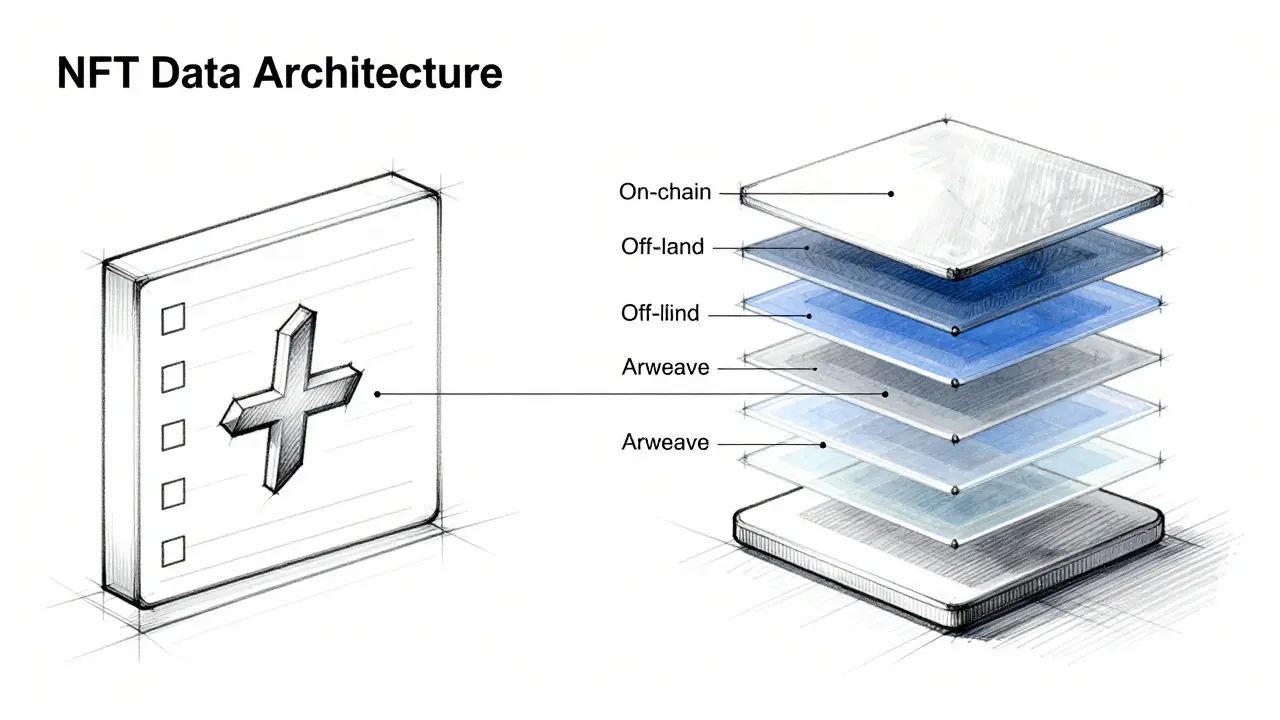
To understand where we are going, you have to look at how things work right now. Almost every major NFT project uses a hybrid architecture. Why? Because blockchains like Ethereum or Solana are terrible at storing large files. They are great ledgers, not hard drives. Storing a high-resolution video or a complex 3D model directly on-chain would cost thousands of dollars in gas fees alone.
So, here is the standard setup:
- On-Chain Metadata: This includes the token ID, ownership history, and a pointer (hash) to the actual file. It lives permanently on the blockchain, ensuring provenance and immutability.
- Off-Chain Content: The actual image, audio, or video file lives elsewhere. This is where the storage wars are happening.
This separation creates a vulnerability known as "link rot." If the off-chain server shuts down, your NFT points to nothing. That’s why decentralized storage solutions have become non-negotiable for serious projects. You need systems that guarantee availability without relying on a single company’s uptime.
The Big Three: IPFS, Arweave, and Filecoin
When developers talk about robust off-chain storage, three names dominate the landscape. Each serves a different purpose, and choosing the wrong one can kill your project’s longevity.
| Protocol | Storage Model | Cost Structure | Best For |
|---|---|---|---|
| IPFS | Peer-to-Peer (P2P) | Free (but requires pinning) | Open-source projects, temporary access |
| Arweave | Permanent (Endowment-based) | One-time upfront fee | Historical records, permanent art |
| Filecoin | Rented Storage Network | Subscription/Monthly | Large datasets, enterprise needs |
IPFS (InterPlanetary File System) is the most common starting point. It’s free to use because anyone can host pieces of your file. But here is the catch: if no one pins your file, it disappears. Most serious projects pay for "pinning services" to ensure their data stays accessible, adding a layer of centralization back into the system.
Arweave solves this with a different economic model. You pay once, and the protocol invests that money so the interest pays for storage forever. It’s true permanence. For artists and historians, this is the gold standard. However, the upfront cost can be prohibitive for massive collections.
Filecoin operates more like a cloud service provider but decentralized. You rent space from miners who compete to offer the lowest price. It’s scalable and cost-effective for businesses handling terabytes of data, but it requires active management and ongoing payments.
The Rise of Intelligent NFTs (iNFTs) and ERC-7857
If static images were the past, dynamic, evolving assets are the future. Enter Intelligent NFTs (iNFTs). These aren’t just pictures; they are programmable digital assets that can change appearance, behavior, or value based on external data or user interaction.
In January 2025, 0G Labs announced the ERC-7857 standard, which is reshaping how we think about storage. Unlike traditional standards like ERC-721, ERC-7857 supports secure transfer of AI agents with re-encryption of sensitive data for new owners. This means an NFT could contain not just an image, but a running AI personality with private memories that only the current owner can access.
This introduces massive storage complexity. How do you store mutable data-data that changes over time-while maintaining blockchain integrity? You need versioning systems that track every state change. You need real-time processing capabilities. An iNFT might update its visual traits daily based on weather data or the owner’s location. The storage backend must handle these updates seamlessly without breaking the chain of custody.
AI Integration: 30% of New Projects Are AI-Driven
Artificial Intelligence is no longer a buzzword in the NFT space; it’s a core component. Approximately 30% of new NFT projects launched in 2025 incorporate AI elements. We are seeing AI-curated collections that analyze user preferences to generate personalized art, and autonomous in-game agents that act independently.
Consider an AI-generated avatar that evolves as you play games. Every action you take modifies its codebase and visual representation. This requires a storage solution that can handle:
- Dynamic Content Generation: Storing the algorithm, not just the output.
- Real-Time Data Processing: Fetching external data feeds to trigger changes.
- State Management: Keeping a historical record of all previous versions for verification.
Traditional static storage fails here. You need hybrid systems that combine decentralized file storage with edge computing capabilities. The trend shows strong momentum into 2026, with search interest for "AI NFT" recovering sharply from its 2024 slump. Platforms that can support this level of interactivity will win the next cycle.
Gaming Tokenization and Cross-Platform Interoperability
The gaming industry is the biggest driver of storage innovation. The NFT gaming market was valued at approximately $471.90 billion in recent estimates and is forecasted to reach $942.58 billion by 2029. Why? Because gamers want true ownership of their skins, weapons, and characters.
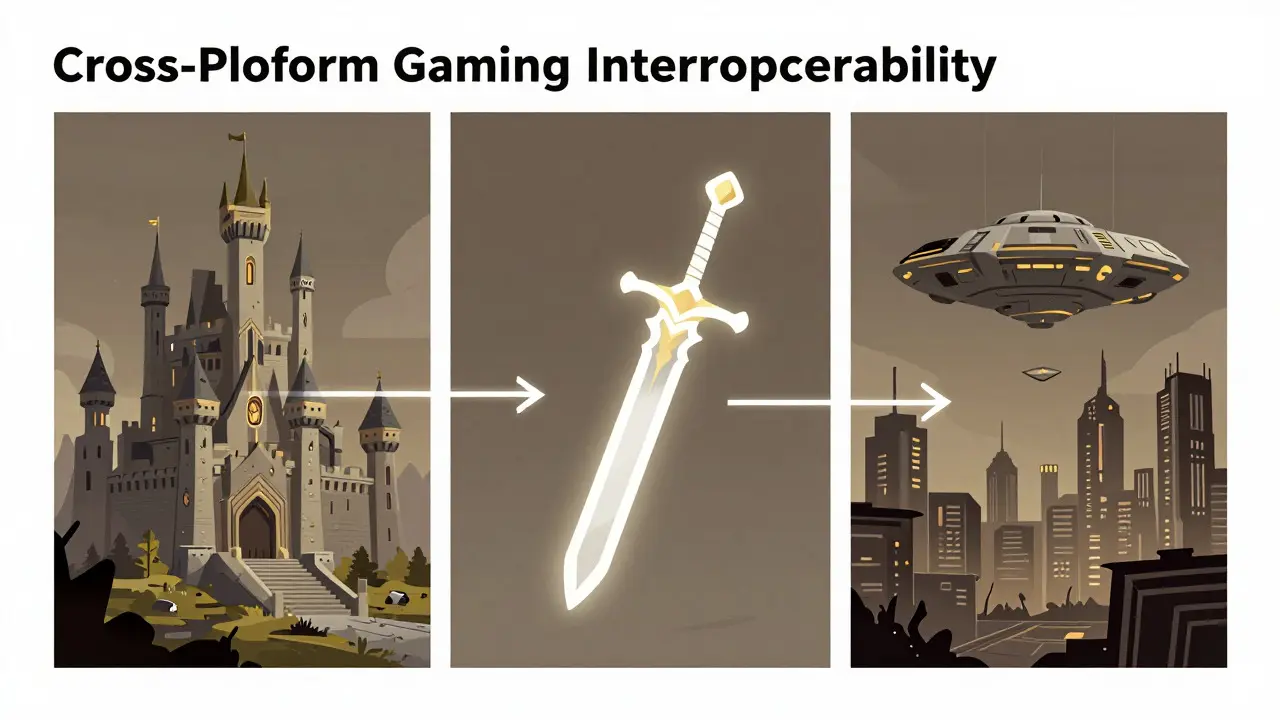
But here is the friction point: 70% of users demand cross-platform functionality. They want to take their sword from World A and use it in World B. This requires storage standards that support seamless asset transfer between different ecosystems. Currently, fragmentation is a huge problem. An asset stored on an IPFS node optimized for one game engine might not render correctly in another.
Solutions like ERC-1155 help establish compatibility foundations by allowing semi-fungible tokens, but next-generation storage systems must go further. They need to embed metadata that describes not just what the asset is, but how it behaves across different environments. This means richer, more structured data schemas that any platform can read and interpret.
Privacy, Security, and Regulatory Compliance
As NFTs move into enterprise applications-think dynamic licensing, educational credentials, or brand avatars-privacy becomes paramount. Public blockchains are transparent by design, which is bad for sensitive data.
Off-chain storage offers a crucial advantage here. By keeping the actual data off the public ledger and only storing encrypted hashes on-chain, you achieve superior data protection. This aligns with regulations like GDPR. If a user requests deletion of their personal data, the off-chain provider can remove the file, while the on-chain hash remains as a neutral proof of existence.
However, this requires trust in the storage provider. Zero-knowledge proofs (ZKPs) are emerging as a solution to verify data integrity without revealing the data itself. Future storage protocols will likely integrate ZKP capabilities natively, allowing users to prove they own a specific piece of content without exposing the content to the world.
Market Maturation: From Speculation to Utility
The wild west era of NFTs is over. Long-term holders now dominate activity, and low-effort projects are fading out. This stabilization impacts storage infrastructure requirements significantly. Speculative traders don’t care much about permanent storage; they just want to flip the token. Serious collectors and enterprises do.
We are seeing a shift toward enterprise-grade reliability. Storage providers focusing on security, scalability, and SLA (Service Level Agreement) guarantees are gaining market share. Solutions optimized solely for simple collectible storage may become obsolete as the market demands increasingly sophisticated functionality. The virtual economy, driven by online gaming and metaverse expansion, could surpass $50 billion by 2025, requiring infrastructure that supports massive scale and real-time interactions.
What Comes Next? Programmable Digital Life
By 2026, we are moving toward storage systems that support "programmable digital life." Static collectibles are becoming niche. The future belongs to living assets that grow in cultural and financial value over time. Think of an NFT that acts as a lifelong companion, learning from your interactions and adapting its personality.
This convergence of AI and NFTs requires storage infrastructure that is:
- Malleable: Capable of updating content frequently.
- Interoperable: Accessible across multiple chains and platforms.
- Secure: Protecting both the data and the privacy of the user.
For developers, this means moving away from simple file uploads and toward building comprehensive data management layers. For buyers, it means looking beyond the artwork to the underlying technology stack. Does the project use Arweave for permanence? Do they support ERC-7857 for future-proofing? These are the questions that will determine value in the coming years.
Is IPFS safe for permanent NFT storage?
Not inherently. IPFS is a peer-to-peer protocol, meaning files stay available only as long as someone hosts them. Without paid pinning services or integration with permanent storage like Arweave, your NFT data risks disappearing over time due to link rot.
What is the difference between ERC-721 and ERC-7857?
ERC-721 is the standard for static, unique digital assets. ERC-7857, introduced by 0G Labs, is designed for Intelligent NFTs (iNFTs). It supports mutable data, AI agent transfers, and re-encryption of sensitive data, making it suitable for dynamic, evolving digital assets rather than static files.
Why is off-chain storage necessary for NFTs?
Storing large files directly on blockchain networks is prohibitively expensive and causes network congestion. Off-chain storage allows for cost-effective handling of large datasets while using the blockchain only for ownership verification and metadata pointers, ensuring scalability and lower transaction fees.
How does AI impact NFT storage requirements?
AI-driven NFTs require storage systems that can handle dynamic content generation, real-time data processing, and version control. Unlike static images, AI NFTs evolve, necessitating infrastructure that supports frequent updates and complex data structures while maintaining blockchain provenance.
Which storage solution is best for gaming NFTs?
For gaming, speed and interoperability are key. Filecoin offers scalable, cost-effective storage for large assets, while solutions supporting cross-chain standards like ERC-1155 are crucial for asset transferability. Many gaming projects use a hybrid approach, combining fast retrieval methods with permanent backup on Arweave.