Getting a crypto license in Switzerland is not like flipping a switch. It is a marathon that tests your legal structure, your tech stack, and your patience. For exchanges aiming to operate in the "Crypto Valley," understanding the FINMA crypto licensing requirements is the difference between opening doors for institutional clients and getting shut down by regulators.
Switzerland has built a reputation as one of the most progressive yet strict jurisdictions for digital assets. The Swiss Financial Market Supervisory Authority (FINMA) does not just hand out licenses; they vet your entire business model against anti-money laundering laws, financial market infrastructure rules, and new distributed ledger technology regulations. If you are planning to launch an exchange in Zurich or Zug, here is exactly what you need to know about the process, costs, and hurdles in 2026.
Understanding the Regulatory Landscape
Before you file a single document, you need to understand who is watching you. FINMA regulates crypto activities through three main pillars: the Anti-Money Laundering Act (AMLA), the Financial Market Infrastructure Act (FMIA), and the Distributed Ledger Technology (DLT) Law. This framework was solidified after the 2017-2018 boom, with major updates in 2023 to clarify how decentralized finance (DeFi) fits into traditional banking laws.
The key thing to grasp is that Switzerland uses an activity-based approach. They don't care if you call yourself a "web3 platform" or a "bank." They look at what you actually do. Are you holding customer funds? Are you matching trades? Are you issuing tokens? Each action triggers different regulatory obligations. This means a simple peer-to-peer swap might be low-risk, but running a centralized order book requires heavy lifting.
Why does FINMA use an activity-based approach?
FINMA focuses on the function of the service rather than the label. This prevents companies from bypassing regulations by rebranding traditional financial services as "crypto" or "Web3" products. It ensures consumer protection and market integrity regardless of the technology used.
Choosing the Right License Type
You cannot apply for a generic "crypto license." You must identify which specific license matches your business model. Getting this wrong will lead to immediate rejection.
- Crypto Exchange License: Required if you facilitate trading between cryptocurrencies and fiat money (like CHF or USD) or between different cryptocurrencies. This is the standard license for platforms like Binance.ch or Bitstamp operating in Switzerland.
- VASP License: Virtual Asset Service Provider status is mandatory for anyone providing custody, transfer, or exchange services. In Switzerland, VASP registration is often a prerequisite before applying for a full exchange license.
- DLT Trading Venue License: Introduced under the 2020 DLT Law amendments, this is for platforms that offer integrated trading, clearing, settlement, and custody for DLT-Securities. This is the gold standard for institutional-grade security token exchanges. It allows you to serve both professional and retail investors under one roof.
- Crypto Broker/Trading License: For intermediaries who execute trades on behalf of clients or deal directly in their own inventory.
If you are building a DeFi protocol, be careful. FINMA’s December 2023 guidance clarified that even technically decentralized structures can trigger licensing requirements if there is a central entity exercising control over governance or operations. The "substance-over-form" principle means you cannot hide behind code to avoid regulation.
Company Structure and Capital Requirements
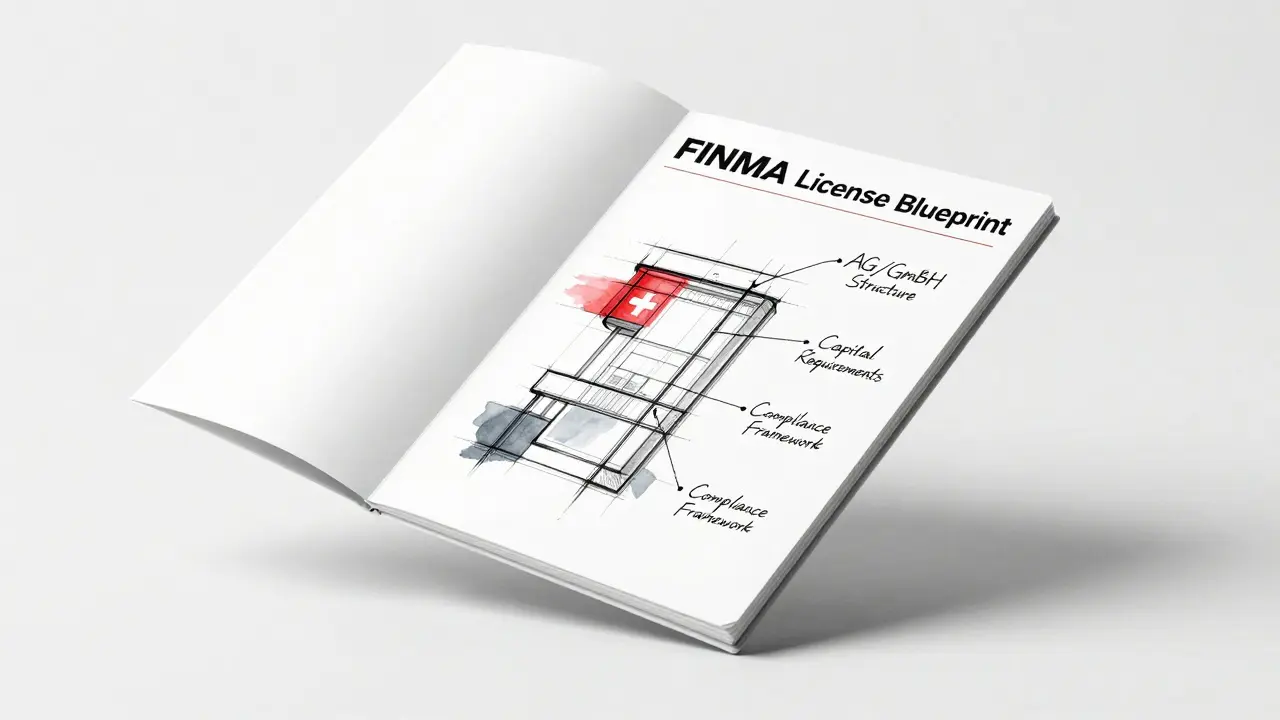
You cannot apply for a FINMA license as a sole proprietorship or a simple LLC registered offshore. You must incorporate a company in Switzerland. The two accepted forms are:
- AG (Aktiengesellschaft): A joint-stock company. This is the preferred structure for larger exchanges. It requires a minimum share capital of CHF 100,000.
- GmbH (Gesellschaft mit beschränkter Haftung): A limited liability company. Suitable for smaller startups. It requires a minimum share capital of CHF 20,000.
The incorporation process itself takes 3-4 months. During this time, you must prepare your documentation package. Do not rush this step. FINMA expects your corporate governance to be bulletproof from day one. You will need to demonstrate clear ownership structures, independent board members, and robust internal controls.
According to Gofaizen & Sherle's 2024 cost analysis, total setup costs range from CHF 20,000 to CHF 100,000+. Government fees alone account for CHF 5,000-15,000. But the real cost comes from legal consultants and compliance experts, who charge CHF 8,000-15,000 monthly during the application phase.
Technical and Security Standards
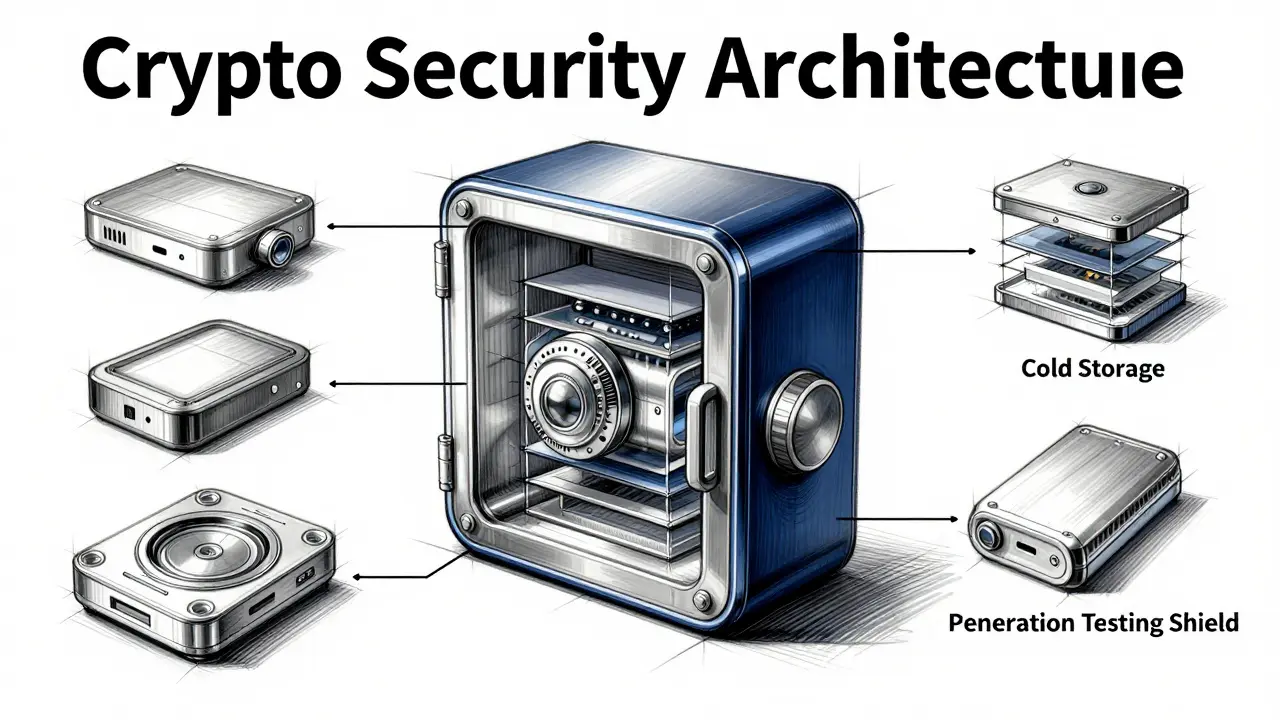
FINMA doesn't just check your paperwork; they audit your tech. Your security architecture must meet strict criteria to protect client assets. Here is what you need to have in place before submitting your application:
- Multisignature Wallets: You must use multi-signature wallets with at least a 3-of-5 signing requirement for all hot wallets.
- Cold Storage: At least 95% of client assets must be stored in cold storage (offline wallets).
- Penetration Testing: Annual penetration testing by FINMA-approved auditors is mandatory.
- Operational Resilience: Your systems must have a maximum Recovery Time Objective (RTO) of 4 hours and a Recovery Point Objective (RPO) of 15 minutes for critical systems.
These standards are designed to prevent hacks and ensure business continuity. If your system goes down for more than four hours, you are already in violation territory. This level of reliability requires significant investment in infrastructure and engineering talent.
The Application Process: Step-by-Step
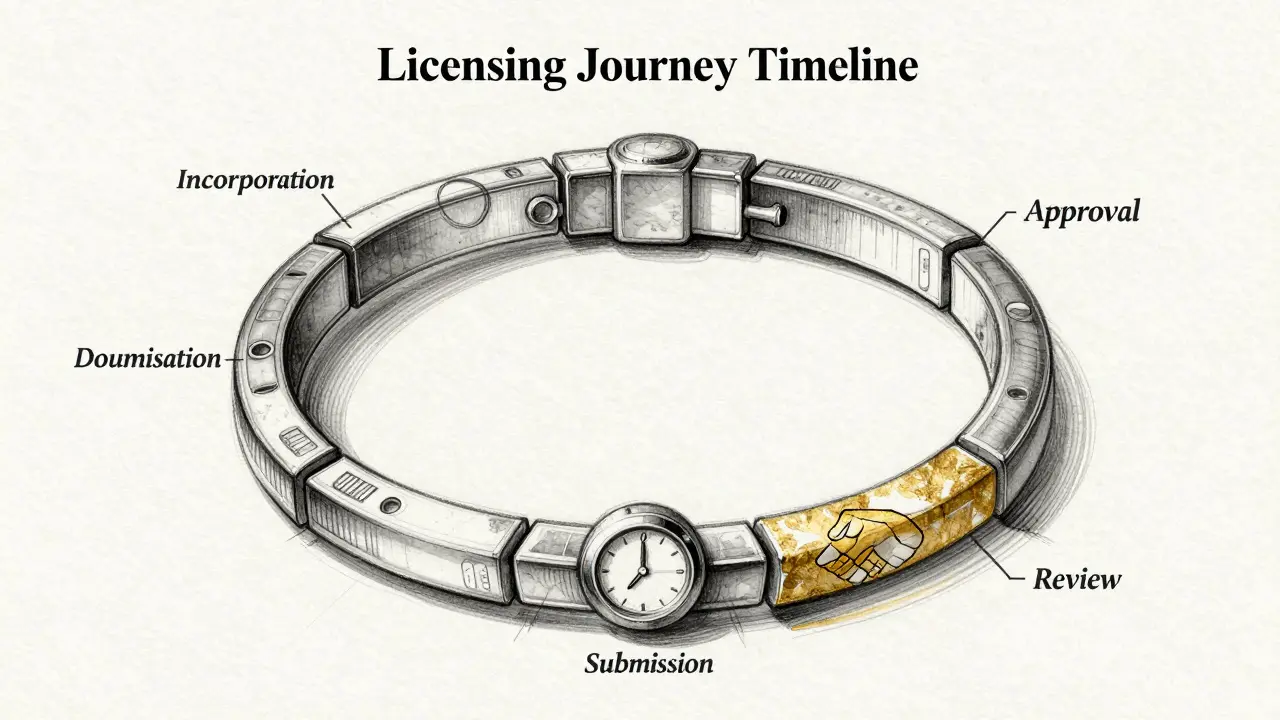
The timeline from initial setup to operational authorization typically spans 4-8 months. Here is how it breaks down:
- Incorporation (Months 1-4): Register your AG or GmbH in Switzerland. Open bank accounts (this is notoriously difficult; 62% of applicants report issues finding willing banks).
- Documentation Preparation (Months 2-5): Compile your business plan, financial projections, AML/KYC policies, and security architecture docs. Hire qualified compliance staff. The average licensed exchange employs 3.2 full-time compliance officers.
- Application Submission (Month 5-6): Submit your dossier to FINMA. Ensure every detail aligns with their latest guidelines.
- Review and Feedback (Months 6-8): FINMA reviews your application. They may ask for clarifications. Respond quickly. Written feedback is usually provided within 10 business days at each stage.
- Approval (Month 8+): If everything checks out, you receive your license. Recent streamlining efforts for DLT Trading Venues have reduced approval times to 6-8 weeks for applications meeting predefined technical standards.
Patience is key. Delays often happen because applicants underestimate the complexity of their AML policies or fail to provide sufficient proof of capital adequacy.
Comparing Switzerland to Other Jurisdictions
Why choose Switzerland when other countries offer faster routes? Let's compare.
| Feature | Switzerland (FINMA) | EU (MiCA) | Singapore (MAS) | Liechtenstein |
|---|---|---|---|---|
| Processing Time | 4-8 months | 6-12 months | 6-8 weeks | 3-6 months |
| Minimum Capital | CHF 100,000 (AG) | Varies by member state | USD 100,000 equivalent | CHF 50,000 |
| Market Access | Global + Bilateral agreements | All 27 EU states (Passporting) | Asia-Pacific focus | Niche European market |
| Institutional Trust | Very High (78% of EU institutional flows) | High | High | Medium |
| DeFi Friendliness | Low (Strict substance-over-form) | Medium (Evolving) | Medium | High (Blockchain Act) |
Switzerland excels in credibility. According to a 2024 PwC survey, 78% of institutional crypto transactions in Europe flow through FINMA-licensed entities. However, if speed is your priority, Singapore offers a faster route. If you want easy access to the entire European market, the EU’s MiCA regulation (fully implemented in June 2024) provides a passporting system that Switzerland lacks. But remember: MiCA does not automatically grant you trust with conservative institutional investors in the same way a Swiss license does.
Challenges and Pitfalls to Avoid
Even with perfect preparation, many applications get stuck. Here are the most common reasons:
- Banking Relationships: Finding a Swiss bank willing to hold your corporate funds is hard. Banks are risk-averse. Start looking for partners early.
- Compliance Staffing: FINMA wants to see experienced people, not juniaries learning on the job. Hiring a Chief Compliance Officer with prior FINMA experience is crucial.
- DeFi Misinterpretation: Assuming your protocol is "decentralized" enough to skip licensing. FINMA looks at who controls the treasury, who upgrades the smart contracts, and who makes governance decisions. If there is a central team, you need a license.
- Underestimating Costs: Ongoing compliance costs exceed initial projections by 25-40% for 62% of licensed businesses, according to a COREDO survey.
User experiences vary. On Reddit’s r/CryptoSwitzerland, developers praise FINMA’s clear communication channels but complain about the length of the process. One founder noted that while the 8-month wait was grueling, the responsive case officers made it manageable. Another shared that their DeFi protocol was rejected because their governance token distribution didn’t meet the "professional basis" threshold, despite similar models being approved in Liechtenstein.
Future Outlook: What’s Next for Swiss Crypto Regulation?
The landscape is evolving. In September 2024, FINMA announced streamlined procedures for DLT Trading Venue licenses, cutting approval times significantly for compliant applicants. The revised Anti-Money Laundering Act (AMLA), effective January 1, 2025, introduces stricter "travel rule" compliance for transactions above CHF 1,000. This means exchanges must transmit sender and receiver information for every transaction exceeding this amount.
Looking ahead, FINMA plans to launch a sandbox for DeFi protocols in Q2 2025. This could relax capital requirements for non-custodial models, potentially opening the door for more innovative projects. Meanwhile, the SIX Digital Exchange (SDX) continues to set the standard, processing CHF 1.2 billion in tokenized securities in Q2 2024 alone.
Despite competition from the EU’s MiCA framework, Switzerland remains a top choice for serious players. With 92% of licensed exchanges reporting profitability by year three, the long-term viability of a Swiss license is strong. The combination of political stability, deep integration with traditional finance, and clear regulatory pathways makes it a worthwhile investment for those targeting institutional clients.
How much does it cost to get a FINMA crypto license?
Total costs range from CHF 20,000 to over CHF 100,000. This includes government fees (CHF 5,000-15,000), legal and consulting fees (CHF 8,000-15,000 per month during application), and capital requirements (CHF 20,000 for GmbH or CHF 100,000 for AG). Ongoing compliance costs can add another 25-40% annually.
Can I operate a DeFi protocol without a FINMA license?
Only if your protocol is truly decentralized with no central control. FINMA applies a "substance-over-form" test. If a team controls governance, treasury, or upgrades, you likely need a license. Check FINMA’s December 2023 DeFi guidance for specifics.
What is the difference between a VASP and a DLT Trading Venue license?
A VASP license covers basic custody and exchange services. A DLT Trading Venue license is more comprehensive, allowing integrated trading, clearing, settlement, and custody for security tokens. It is required for platforms serving retail investors with complex financial products.
How long does the FINMA licensing process take?
Typically 4-8 months from company incorporation to license approval. Incorporation takes 3-4 months, and license review takes 1-4 months. Streamlined procedures for DLT Trading Venues can reduce review time to 6-8 weeks.
Is a Swiss crypto license recognized in the EU?
Not automatically. Unlike the EU’s MiCA passporting system, Switzerland relies on bilateral recognition agreements with only 12 countries as of late 2024. You may need separate licenses to operate in EU member states.