How Blockchain Insurance Platforms Are Changing the Game
Imagine getting paid for a damaged roof the moment a storm passes - no paperwork, no adjusters, no waiting weeks. That’s not sci-fi. It’s happening today through blockchain insurance platforms. These systems use smart contracts on public blockchains to automatically trigger payouts when real-world events match pre-agreed conditions. No middlemen. No delays. Just code doing what it was built to do.
Traditional insurance still moves at glacial speed. The average claim takes 7 to 14 days to settle. For small businesses or farmers hit by weather damage, that delay can mean lost income, missed payments, or even bankruptcy. Blockchain insurance cuts that time to minutes - sometimes seconds. It’s not about replacing all insurance. It’s about fixing the parts that are broken.
What Exactly Is a Blockchain Insurance Platform?
A blockchain insurance platform is a digital system that uses decentralized ledgers and smart contracts to handle policy issuance, claims verification, and payouts. Unlike traditional insurers that rely on centralized databases and human review, these platforms run on open networks like Ethereum. Every policy, claim, and payment is recorded permanently and can’t be altered.
The core engine? Smart contracts. These are self-executing programs stored on the blockchain. When a condition is met - say, wind speeds hit 120 mph in a specific area - the contract automatically releases funds to the policyholder. No one has to approve it. No one can delay it. The system just works.
Platforms like Nexus Mutual is a decentralized insurance protocol founded in 2017 that offers coverage for smart contract failures and crypto-related risks and InsurAce is a multi-chain insurance platform launched in 2021 providing coverage for DeFi protocols and blockchain assets operate this way. They don’t have headquarters or call centers. They have code. And token holders who vote on risk pools and payouts.
How It Works: From Policy to Payout in Minutes
Here’s how a typical blockchain insurance claim unfolds:
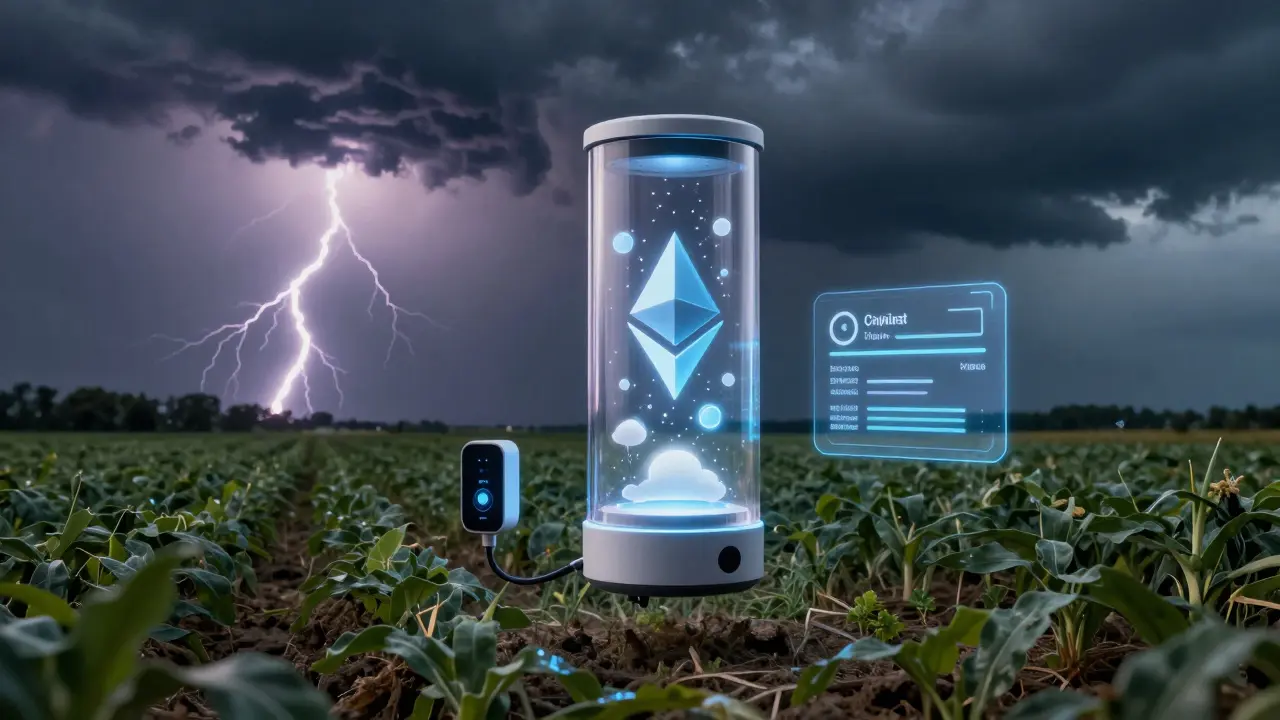
- You buy a parametric crop insurance policy for your farm. The contract says: if NOAA confirms wind speeds over 100 mph in your ZIP code during the growing season, you get $5,000.
- A storm hits. Sensors in your region send real-time data to an oracle network - like Chainlink is a decentralized oracle network that provides verified external data to smart contracts on blockchains.
- Chainlink verifies the data and feeds it into the smart contract on Ethereum.
- The contract checks: Did wind speed exceed 100 mph? Yes. Then it sends the payout directly to your crypto wallet.
- You get the money in under 10 minutes. No form. No call. No waiting.
This isn’t theoretical. In 2024, a pilot program in South Korea paid out $2.3 million in agricultural claims within 48 hours after a typhoon - all automated. Traditional insurers took over 45 days for the same event.
Where Blockchain Insurance Shines (and Where It Falls Short)
Blockchain insurance isn’t perfect. But it’s incredibly strong in three areas:
- Cyber insurance for DeFi: Most traditional insurers won’t touch smart contract hacks. Blockchain platforms like Nexus Mutual do. They cover losses from exploits, rug pulls, and protocol failures.
- Parametric weather insurance: Farmers, event planners, and logistics companies use it to hedge against droughts, floods, or extreme heat. Payouts trigger based on verified weather data - no inspections needed.
- Smart contract coverage: Developers and DAOs buy policies that protect against code vulnerabilities. If a bug drains funds, the contract pays out automatically.
But here’s the catch: only 15% of insurance claims can be fully automated. Complex liability cases - like a car accident with multiple parties, medical malpractice, or product defects - still need humans. Blockchain can’t replace judgment. It can only automate the clear-cut stuff.
Why This Is Growing So Fast
The numbers don’t lie. The blockchain insurance market is projected to jump from $2.74 billion in 2025 to $82.56 billion by 2033. Why?
- Cost cuts: Traditional insurers spend 20-30% of premiums on overhead. Blockchain platforms cut that to 8-12% by removing brokers, underwriters, and paper systems.
- Fraud drops: With every transaction on a public ledger, fake claims become nearly impossible. Studies show fraud in blockchain insurance is 30-40% lower than traditional models.
- Regulatory shifts: The EU’s MiCA framework now gives legal clarity to crypto-based insurance. Singapore and South Korea are actively piloting these systems. Even in the U.S., states like Wyoming are opening doors.
- IoT integration: Sensors in cars, homes, and farms now feed real-time data to blockchains. A smart thermostat can trigger home insurance if a pipe bursts. A drone can verify crop damage. The data is live. The payout is instant.
By 2026, over 77% of insurers expect smart contracts to handle most policy issuance and claims. That’s not a prediction - it’s a shift already underway.
Real-World Players and Their Tech
Here are the key platforms making waves:
| Platform | Founded | Blockchain | Specialization | Key Feature |
|---|---|---|---|---|
| Nexus Mutual | 2017 | Ethereum | Cyber & DeFi | Member-owned, governance by token voting |
| InsurAce | 2021 | Ethereum, Polygon | Multi-chain DeFi | Cross-chain coverage pools |
| Uno Re | 2021 | Ethereum | Reinsurance | Connects traditional reinsurers with on-chain risk pools |
| Nayms | 2019 | Private consortium | Infrastructure | Builds blockchain insurance systems for legacy insurers |
| Ensuro | 2020 | Ethereum | Parametric insurance | Focus on weather and natural disaster coverage |
These aren’t just startups. They’re reshaping how risk is pooled, priced, and paid out. Nexus Mutual, for example, has over $200 million in coverage capacity, entirely funded by its community of token holders - not shareholders.
The Hidden Hurdles
It’s not all smooth sailing. Blockchain insurance still faces real problems:
- Throughput limits: Ethereum handles only 15-30 transactions per second. For a global insurer processing millions of policies, that’s a bottleneck. Upgrades like Dencun in late 2024 cut costs by 90%, but speed is still a constraint.
- Legacy system integration: Most insurers still run on 20-year-old software. Connecting that to a blockchain requires custom APIs and middleware - often taking 35-40% of project time and budget.
- Regulatory patchwork: Only 28 countries have clear rules for blockchain insurance. In the U.S., each state has its own stance. That makes scaling hard.
- Learning curve: Insurance agents need 80-120 hours of training just to understand how these platforms work. Developers need deep knowledge of Solidity, oracles, and risk modeling.
And then there’s the trust issue. People are used to talking to an agent, getting a phone call, having someone explain things. A smart contract doesn’t explain. It just executes. That’s a cultural shift as big as the technical one.
What’s Next? The Road to 2027
The next three years will define whether blockchain insurance becomes mainstream or stays niche.
Three developments will be critical:
- AI-powered smart contracts: Right now, contracts only handle yes/no triggers. Soon, they’ll analyze patterns - like whether a claim matches historical fraud behavior - and flag anomalies for human review.
- Cross-chain interoperability: Platforms like InsurAce and Uno Re are testing bridges that let policies move between Ethereum, Solana, and others. This will unlock liquidity and scale.
- IoT explosion: By 2025, parametric insurance will expand to 12 new lines - from drone damage coverage to supply chain delays triggered by port congestion data.
The goal isn’t to replace all insurance. It’s to fix the slow, expensive, and fraud-prone parts. When a farmer in Kenya gets paid within minutes after a drought - no bank account needed - that’s when blockchain insurance stops being a tech experiment and becomes a lifeline.
Is This Right for You?
If you’re:
- A small business owner in a climate-vulnerable region - yes.
- A DeFi user or crypto project builder - absolutely.
- A farmer, logistics company, or event planner exposed to weather or supply chain shocks - this is your next tool.
If you’re:
- Looking for life insurance or home insurance with complex liability - not yet.
- Uncomfortable with crypto wallets or self-custody - wait until user-friendly interfaces mature.
- Expecting a human to walk you through every step - you’ll need to adapt.
Blockchain insurance isn’t magic. But it’s the most practical, scalable innovation in risk management since the first insurance policy was written. The future isn’t about replacing agents. It’s about letting them focus on what matters - helping people, not processing forms.
Can blockchain insurance replace traditional insurance companies?
No, not entirely. Blockchain insurance excels at automating clear-cut, data-driven claims like weather damage or smart contract failures. But it can’t handle complex, subjective claims - like medical malpractice or car accidents with multiple parties - that require human judgment. Traditional insurers will still handle those cases. The future is hybrid: blockchain for automation, humans for complexity.
Is blockchain insurance safe?
It’s safer against fraud - every transaction is on a public, immutable ledger. But it’s not risk-free. Smart contracts can have bugs. Oracles can be hacked. And if you lose your private key, you lose access to your policy and payout. Security depends on how well the platform is built and how carefully you manage your crypto wallet. Always use platforms with audited contracts and strong community oversight.
Do I need cryptocurrency to use blockchain insurance?
Yes, currently. Payouts are made in crypto - usually ETH or stablecoins like USDC. You need a wallet to receive them. Some platforms, like Nayms, are working with traditional banks to allow fiat payouts, but that’s still rare. If you don’t use crypto, you’ll need to learn how to set up a wallet and convert funds to cash after payout.
How much does blockchain insurance cost?
Premiums are often lower than traditional insurance because overhead is cut. For example, parametric crop insurance on blockchain can cost 20-30% less than traditional policies. But there are gas fees - small transaction costs on the blockchain - usually under $1 per claim. These are paid by the user, not the insurer. Overall, the total cost is typically lower, especially for frequent, small claims.
Can I buy blockchain insurance in New Zealand?
Yes, but not directly through local insurers. Platforms like Nexus Mutual, InsurAce, and Uno Re are accessible globally. You can buy coverage from anywhere with internet access. However, payouts are in crypto, and tax treatment in New Zealand is still evolving. Check with a local tax advisor before purchasing. Regulatory clarity is growing, but you’re entering a global, borderless market.


Santosh kumar
10 February, 2026 . 18:22 PM
This is actually life-changing for small farmers like my uncle in Punjab. He lost a whole season last year to erratic rains and waited 6 weeks for a payout. With this, he could just get the money and replant. No bureaucracy. Just code working for real people. I hope this scales fast.
Claire Sannen
11 February, 2026 . 23:00 PM
The efficiency here is undeniable. I've worked in claims processing for over a decade, and the manual review bottleneck is brutal. This isn't about replacing humans-it's about freeing them from repetitive tasks so they can focus on complex cases that actually need empathy. The real win is the reduction in burnout among adjusters.
blake blackner
13 February, 2026 . 21:17 PM
Bro this is the future. No more waiting for checks. My cousin got paid in ETH after a hailstorm hit his RV park-12 mins. No forms. No calls. Just a notification. Traditional insurers are dinosaurs with clipboards. They don’t even know what hit them. 😎
kelvin joseph-kanyin
14 February, 2026 . 12:46 PM
YESSSS this is the energy we need!! 🚀 Imagine a kid in rural Kenya getting money within minutes after a drought. No banks. No red tape. Just code doing the right thing. This isn't tech for tech's sake-it's justice with a blockchain. Let's flood the market with this. We can do this.
Grace Mugambi
14 February, 2026 . 17:49 PM
I think we're missing the deeper shift here. It's not just about automation-it's about trust being rebuilt through transparency. When every payout is on a public ledger, you can't hide fraud. You can't delay. You can't manipulate. The system itself becomes the guarantor. That’s a philosophical shift from ‘trust the institution’ to ‘trust the process.’ And that’s profound.
Crystal McCoun
16 February, 2026 . 13:35 PM
I'm concerned about the gas fees. They're small, yes-but for someone living paycheck to paycheck, even $0.80 can be a barrier. And what happens when the blockchain is congested? Does the payout get delayed? Or is the contract just... silent? We need to ensure accessibility isn't sacrificed for efficiency. This isn't just a tech problem-it's a human one.
Elijah Young
17 February, 2026 . 01:59 AM
The data is compelling, but I'm skeptical about scalability. Ethereum's TPS is still a bottleneck for global adoption. Even with Dencun, processing millions of micro-claims daily? Not happening without layer-2 solutions. And most legacy insurers don't have the bandwidth to integrate. This will remain a niche tool unless the infrastructure evolves faster than regulation.
Desiree Foo
18 February, 2026 . 12:28 PM
Let’s be real: this is just crypto masquerading as innovation. You’re telling me we should trust code written by anonymous devs with no accountability? What if the oracle gets hacked? What if the contract has a bug? And don’t even get me started on tax implications. This isn’t progress-it’s a gamble with your livelihood. And you’re calling it ‘lifeline’? Please.
Kaz Selbie
18 February, 2026 . 22:23 PM
You’re all acting like this is some revolutionary breakthrough. Newsflash: parametric insurance has existed for decades. All you did was slap a blockchain on it and call it ‘smart.’ The real innovation? Marketing. The payout speed? Still depends on oracle reliability. And let’s not pretend people in developing nations are just waiting to adopt crypto wallets. This is Silicon Valley fantasy dressed as humanitarian aid.
Robbi Hess
20 February, 2026 . 16:57 PM
This is peak overhyped nonsense. They say 'no paperwork' but now you need a crypto wallet, an oracle, a smart contract, gas fees, and a basic understanding of blockchain. That’s not simpler. That’s just a different kind of paperwork with more jargon. And who’s auditing these contracts? Some guy on Discord with 300 karma?
Keturah Hudson
21 February, 2026 . 20:31 PM
I love how this bridges the gap between ancient risk-sharing models and modern tech. Indigenous communities have used communal risk pools for centuries. This is just digitizing that. It’s not new-it’s returning. And that’s beautiful. The real question isn’t whether it works, but whether we’re ready to let go of the middlemen we’ve built up to control access to safety.
Brittany Meadows
22 February, 2026 . 18:38 PM
So... let me get this straight. You’re telling me I should trust a contract written by someone who probably coded it while high on energy drinks? And then you say it’s ‘immune to fraud’? What if the oracle is bought? What if Chainlink gets hacked? What if the whole thing gets rug-pulled by a DAO vote? This isn’t insurance-it’s a lottery with a 30% chance of losing your premium and your peace of mind. 😅
SAKTHIVEL A
24 February, 2026 . 18:10 PM
It is imperative to elucidate that the operational paradigm of blockchain-based insurance is predicated upon a foundational assumption of deterministic environmental triggers, which, in practice, are subject to stochastic variance and measurement latency. The reliance upon centralized oracle nodes constitutes a systemic vulnerability that contravenes the very tenets of decentralization. Furthermore, the economic model of gas-fee internalization disproportionately burdens micro-claimants in low-income jurisdictions. This is not innovation; it is algorithmic colonialism.
krista muzer
25 February, 2026 . 15:03 PM
i just think people are forgetting that not everyone has a smartphone or knows what a wallet is. i mean, my grandma tried to send me crypto once and sent it to a random address and lost $500. she’s not gonna understand why her roof claim got paid in usdc instead of cash. we need to make this easier. like, way easier. not just techy stuff.
Tammy Chew
27 February, 2026 . 04:31 AM
This is exactly what happens when engineers think they understand risk. You don’t manage uncertainty with code. You manage it with judgment, experience, and human intuition. A smart contract doesn’t know if the storm was actually bad or if someone rigged the sensor. You think you’re cutting costs? You’re just outsourcing liability to people who don’t even understand what they’re signing up for.
Lindsey Elliott
27 February, 2026 . 06:35 AM
So wait-you’re saying farmers in Kenya are gonna get paid in crypto? Lol. They don’t even have reliable internet. And you think they’re gonna convert USDC to cash? Nah. This is just another way for rich people to feel good about tech while ignoring real infrastructure gaps. We need roads first, then blockchains.
Christopher Wardle
28 February, 2026 . 19:13 PM
The most interesting part isn't the automation-it's the shift in power. Instead of insurers holding all the data, policyholders now have verifiable proof of coverage on-chain. That changes everything. It turns the insured from a claimant into a participant. And that’s the real innovation: dignity through transparency.