When you're looking for a cryptocurrency exchange that actually follows the rules, ZBX stands out - but not because it's cheap or has the most coins. It's built for a very specific group: Europeans who need a regulated crypto platform, especially if they're tied to the iGaming or betting industry. If you're just trying to trade Bitcoin on the cheap, ZBX will frustrate you. But if you need banking-grade security, EU compliance, and a Swiss bank link, it might be one of the few options left that won't get you in trouble with regulators.
What Is ZBX Exchange?
ZBX, short for ZBX Exchange, is a crypto trading platform registered in Malta and regulated under the EU's Markets in Crypto-Assets (MiCA) framework. It's operated by Zillion Bits AG, a Swiss company that specializes in secure financial infrastructure for online gaming and betting firms. Unlike Binance or OKX, ZBX doesn't aim to be the biggest. It aims to be the most compliant. Launched in 2018, it has since built a reputation for working with businesses that need to move crypto money legally - think casino operators, sports betting sites, and payment processors across Europe.
It’s not available in the U.S., Canada, or many other countries outside Europe. That’s not an accident. ZBX made a deliberate choice to focus on markets where regulators demand clear licenses - and they got one. The Malta Financial Services Authority (MFSA) oversees its operations, and its Swiss banking partners provide insured accounts up to 100,000 CHF. That’s rare for a crypto exchange. Most platforms claim to be secure. ZBX has actual banking licenses backing it.
How ZBX Works: Simple for Beginners, Powerful for Pros
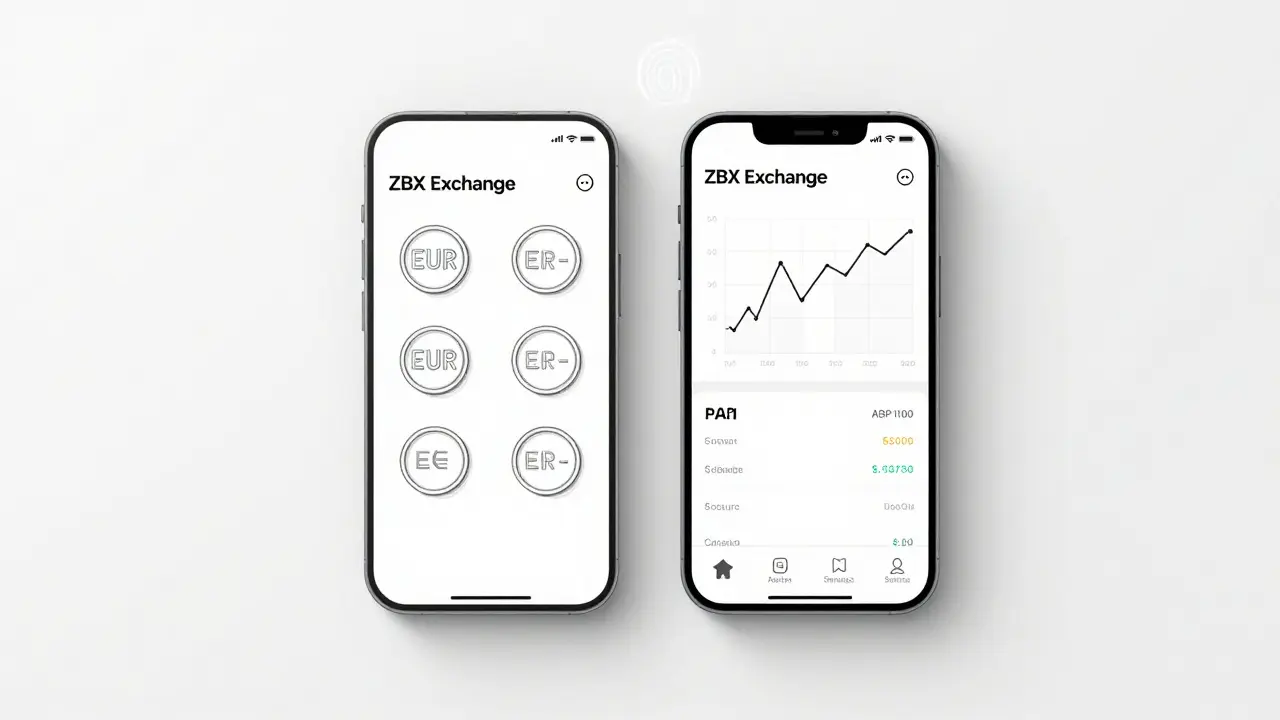
ZBX gives you two trading interfaces: a Simplified Mode for new users and a Full Feature Mode for those who want charts, order types, and API access. Both work the same across web, iOS, and Android. The mobile apps are updated regularly - the iOS version is at 3.0.5 as of late 2023, and Android supports OS 8.0 and up. You can log in with biometrics (fingerprint or face ID), which adds a layer of convenience without sacrificing security.
Trading pairs are limited but focused: BTC, ETH, LTC, USDT, USDC, SOL, ADA, TRX, and XRP - all paired with EUR. No USD pairs. No meme coins. No obscure tokens. This isn’t a place to chase the next 100x. This is a place to buy, sell, and hold crypto with confidence that your money is backed by real banking infrastructure.
Security: Cold Storage, Audits, and Swiss Standards
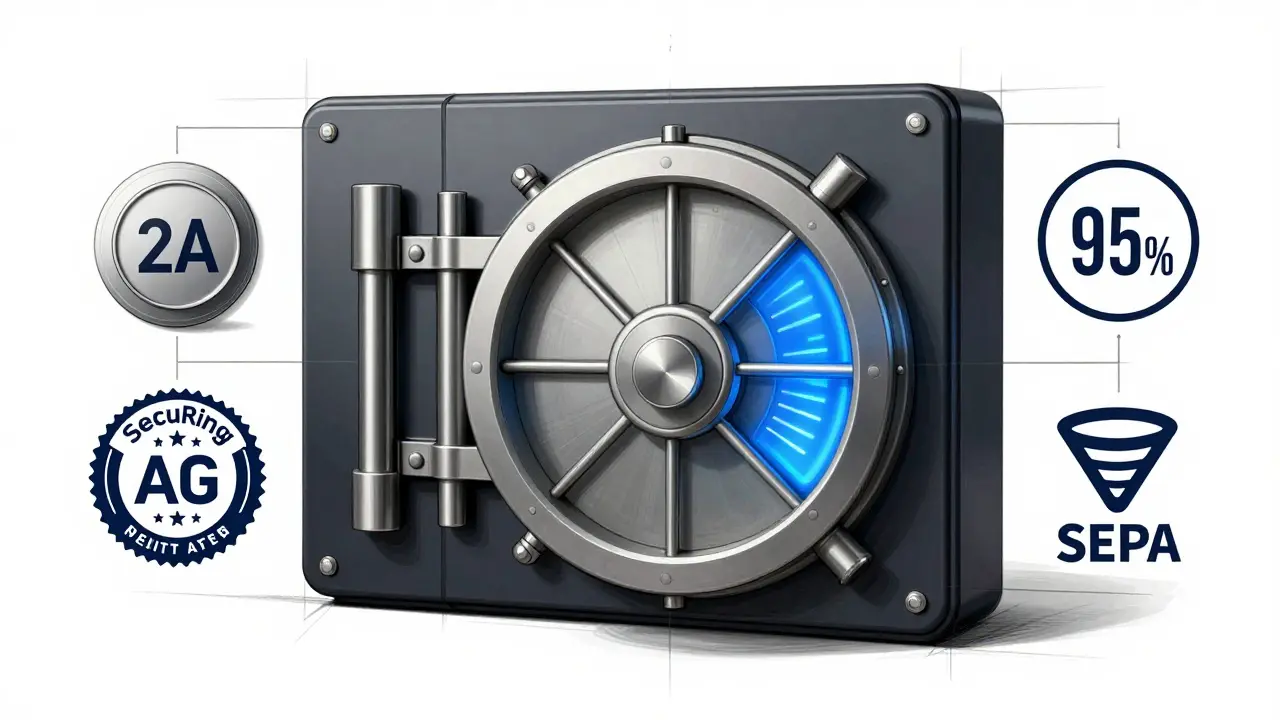
ZBX doesn’t cut corners on security. According to its 2023 Security Whitepaper, 95% of customer funds are stored offline in cold wallets. The remaining 5% - needed for daily withdrawals - are kept in hot wallets with strict access controls. Two-factor authentication (2FA) is mandatory, and you can enable biometric login on mobile. All transactions are monitored for suspicious activity, and the platform uses Swiss cybersecurity firm SecuRing AG for regular third-party audits.
Unlike decentralized exchanges, ZBX is custodial. That means they hold your private keys. Some people hate that. But for institutional users - like a casino that needs to pay out winnings in crypto - having a licensed custodian is a feature, not a bug. Wallet Scrutiny’s 2023 analysis called it a “typical centralized exchange with enterprise-grade safeguards,” which is exactly what ZBX is designed to be.
Fees: The Big Catch
Here’s where most people get turned off. ZBX charges a flat 0.50% fee for both taker and maker trades. That’s nearly double the industry average. On Binance, you pay 0.1% as a taker. On KuCoin, it’s 0.075%. ZBX’s fee is among the highest of any major exchange - ranking in the 78th percentile for cost according to Cryptowisser’s 2023 data.
Why? Because they’re not competing on price. They’re competing on compliance. Their fees cover the cost of being licensed, maintaining Swiss bank accounts, and serving regulated clients. For a casual trader, this feels steep. But for a gaming company that needs to settle thousands of crypto payments daily? It’s a small price to avoid legal risk.
Withdrawal fees are more reasonable. Sending Bitcoin costs 0.001 BTC - about average. No hidden fees on EUR deposits via bank transfer. Credit card deposits are accepted but come with a 3.5% processing fee, which is standard.
Who Is ZBX Actually For?
ZBX isn’t for everyone. If you’re in the U.S., you can’t use it. If you trade 10 times a day, you’ll pay too much in fees. If you want 500+ coins to speculate on, you’ll be disappointed.
But if you’re:
- A European resident who wants to link crypto directly to a Euro or Swiss Franc bank account
- An iGaming operator needing compliant crypto payment processing
- Someone who values regulatory oversight over trading volume
- Used to paying higher fees for peace of mind
…then ZBX is one of the few platforms that actually fits your needs.
Reddit users like “EuroTrader89” say it’s “invaluable” to have a single platform that handles both crypto trading and SEPA transfers. SourceForge reviews highlight the intuitive interface and responsive support for institutional clients. Trustpilot ratings are mixed (3.2/5), but the complaints are almost always about fees or the lack of U.S. access - not security or reliability.
Customer Support and Learning Curve
ZBX offers 24/7 live chat support. For standard users, response times average 22.7 minutes. For institutional accounts with priority status, it drops to 4.2 minutes. That’s a big difference - and it shows who they prioritize.
Documentation is solid. Their API docs are detailed and well-maintained (version 2.1.4 as of August 2023). But if you’re new to crypto, there’s little in the way of tutorials, guides, or educational content. No YouTube series. No blog explaining how to buy your first Bitcoin. You’re expected to already know the basics.
Onboarding takes 24-72 hours for KYC verification. You’ll need a government ID and proof of address. No instant signup. No anonymous trading. This isn’t a darknet exchange. It’s a regulated financial institution.
Market Position and Future Outlook
ZBX serves around 120,000 users globally, with 65% from Europe. It’s estimated to handle $15 million in annual revenue - tiny compared to Binance’s $10 billion, but growing. Its client base includes 370 iGaming companies, and its user base grew 37% year-over-year in 2023.
Their roadmap includes integration with the European Central Bank’s digital euro sandbox, enhanced OTC desks for institutions, and multi-currency corporate accounts (EUR, CHF, GBP). These aren’t flashy features for retail traders. They’re strategic moves to lock in their niche.
Analysts at CryptoSlate predict 25-35% growth over the next year - not because ZBX is becoming the next Coinbase, but because MiCA is forcing other exchanges to either comply or leave Europe. ZBX is already compliant. That’s a huge advantage.
Pros and Cons at a Glance
| Feature | ZBX | Industry Average |
|---|---|---|
| Trading Fees (taker/maker) | 0.50% | 0.22% / 0.18% |
| Regulation | EU MiCA, MFSA licensed | Varies widely |
| Crypto Pairs | 9 major coins (EUR only) | 500+ |
| Bank Integration | Swiss bank accounts, SEPA/SWIFT | Usually limited |
| Security | 95% cold storage, biometric login, third-party audits | Typically 80-90% cold storage |
| US Availability | No | Most major exchanges yes |
| Support Response Time (Standard) | 22.7 minutes | 15-30 minutes |
Frequently Asked Questions
Is ZBX Exchange safe to use?
Yes, ZBX is one of the safer exchanges for users in Europe. It’s licensed by Malta’s MFSA under MiCA, stores 95% of funds in cold storage, uses biometric logins, and undergoes regular audits by Swiss cybersecurity firm SecuRing AG. It’s not risk-free - no custodial exchange is - but its security practices meet or exceed regulatory requirements.
Can I use ZBX if I live in the United States?
No. ZBX does not serve users in the U.S., Canada, Australia, or several other countries. This is intentional. The platform focuses on regulated European markets where it holds licenses. U.S. users will not be able to sign up or deposit funds.
Why are ZBX’s trading fees so high?
ZBX’s 0.50% fee covers the cost of regulatory compliance, Swiss banking integration, and institutional-grade security. Unlike exchanges that compete on low fees, ZBX targets businesses that need legal certainty over cost savings. For casual traders, it’s expensive. For regulated entities like iGaming companies, it’s worth it.
Does ZBX offer a mobile app?
Yes. ZBX has official apps for iOS (version 3.0.5) and Android (requires OS 8.0+). Both support biometric login, real-time trading, and push notifications. The apps are regularly updated and have received positive feedback for usability.
What cryptocurrencies can I trade on ZBX?
ZBX supports nine major cryptocurrencies: Bitcoin (BTC), Ethereum (ETH), Litecoin (LTC), Tether (USDT), USD Coin (USDC), Solana (SOL), Cardano (ADA), TRON (TRX), and XRP. All trade against EUR. There are no USD pairs or altcoin trading pairs.
Is ZBX good for beginners?
ZBX’s interface is simple and clean, which helps beginners. But it offers almost no educational content - no guides, no webinars, no glossary. If you already understand how crypto trading works, you’ll find it easy to use. If you’re learning, you’ll need to look elsewhere for tutorials.
How long does KYC take on ZBX?
Identity verification typically takes 24 to 72 hours. You’ll need a government-issued ID and proof of address. Institutional accounts require additional documentation and may take longer. There’s no instant verification option.
Final Verdict
ZBX isn’t trying to be everything to everyone. It’s not Binance. It’s not Coinbase. It’s a tightly focused, regulation-first exchange built for a small but critical slice of the crypto world: European businesses that need to move money legally. If you’re one of them, ZBX is a rare and valuable tool. If you’re not, you’ll pay too much and find too few options.
For most retail traders, there are better choices. But for those who need compliance, security, and banking integration - ZBX isn’t just a good option. It’s one of the few left.

ann neumann
11 March, 2026 . 06:04 AM
ZBX is a scam wrapped in a regulation blanket
They're not protecting you-they're protecting the banks and the EU bureaucracy
95% cold storage? That's just a fancy way of saying they're hoarding your coins while they charge you 0.5% just to breathe
Swiss bank link? Please. That's just a shell company with a fancy name and a lawyer on retainer
I've seen this before-regulation is just the new crypto tax
They don't care if you lose money-they just want you to pay for the privilege of losing it
And don't even get me started on the 'institutional clients'-that's code for 'we're letting the casinos run the show'
It's all a front
They're not building trust-they're building a walled garden so they can charge you double for everything
Meanwhile, Binance is out there giving you real options
But no, we gotta have 'compliance'
Compliance is just a word they use to make you feel safe while they siphon your cash
I'm not saying ZBX is evil
I'm saying it's a perfectly legal money machine designed to suck in people who think safety means paying more
And that's the real tragedy here
You're not getting security-you're getting a luxury tax on your paranoia
Mara Alves Mariano
12 March, 2026 . 08:27 AM
Oh wow so ZBX is the crypto equivalent of a Swiss watch that only tells time once a year
Let me get this straight-you pay DOUBLE the fees because some guy in Malta says you're 'regulated'? That's not safety, that's extortion with a business card
And don't even mention 'Swiss bank accounts'-those are just numbered accounts with a fancy logo and a guy who doesn't speak English
I'm from America and I can't even use this thing? So now crypto is a European club membership?
Next they'll start charging you in euros and require you to know the lyrics to 'Ode to Joy' to withdraw
This isn't innovation-it's crypto colonialism
They're not serving the people-they're serving the suits
And the worst part? People are actually praising this
What happened to freedom? To choice? To the wild west of crypto?
Now we just get polished prisons with 24/7 live chat and a 0.5% fee to scream into the void
Brandon Kaufman
14 March, 2026 . 03:18 AM
I get why people are frustrated with the fees, but I think we're missing the point
For the right user-someone running a betting site or needing to settle crypto payouts legally-this is a lifesaver
Most exchanges are wild west. ZBX is the only one that actually gives you a paper trail
Yes, 0.5% is steep
But when you're moving $50k a day and the regulator is breathing down your neck, that fee is cheaper than a lawyer
I've worked with a few iGaming clients who switched from Binance to ZBX
They cried about the fees at first
Then they stopped getting flagged by their bank
And that? That’s priceless
It’s not for everyone
But for those who need it? It’s the only game in town
Stop judging it like it’s supposed to be Binance
It’s not. And that’s okay
Craig Gregory
14 March, 2026 . 21:09 PM
The entire premise is a logical fallacy
Regulation doesn't equal security-it equals control
By accepting MiCA, ZBX has surrendered its decentralized nature and become a financial instrument of the state
The Swiss bank link? A Trojan horse
It’s not about safety-it’s about surveillance
Every transaction is logged, monitored, and reported
They call it 'compliance'-I call it surrender
And the 95% cold storage? A distraction
They still control your keys
They still own your assets
And if the EU decides to freeze accounts tomorrow-you have zero recourse
This isn't crypto
This is a bank with a blockchain logo
And you're paying 0.5% to be a customer of a bureaucracy
How is this any better than traditional finance?
It isn't
It's just more expensive
Anshita Koul
16 March, 2026 . 00:26 AM
Wow, I just read this entire thing and I’m so inspired!
Let me tell you, in India, we don’t have access to anything like this-so many of us are stuck with unregulated platforms, no KYC, no security, just chaos!
ZBX may seem expensive, but think about it-what is the cost of losing your life savings to a rug pull?
What is the cost of being frozen out by your bank because you used a shady exchange?
0.5% is nothing compared to the peace of mind of knowing your money is backed by real institutions!
Yes, the interface is simple-but simplicity is power!
Yes, only EUR pairs-but that’s because they’re focused on what matters: stability, not gambling!
And yes, no U.S. access-but that’s because the U.S. is still stuck in the wild west while Europe is building the future!
This isn’t a crypto exchange-it’s a movement toward responsible finance!
Let’s not hate because we don’t have it-let’s celebrate because someone is doing it right!
Thank you ZBX for existing!
And thank you for writing this article-it made me cry happy tears!
PIYUSH KOTANGALE
17 March, 2026 . 21:04 PM
0.5% fee? Yeah that’s high 😅
But if you’re legit biz? Totally worth it 🤝
Swiss bank + MiCA = no sleepless nights 💤
Us in India? We’d kill for this kind of stability!
Real talk: most of us are just gambling on memes
ZBX? It’s like a safe house for crypto grown-ups 🏠
Not for everyone-but perfect for the ones who need it 🙌
vishnu mr
18 March, 2026 . 17:13 PM
i never thought i'd say this but zbx is kinda cool
yes fees are high but think about it
no one is gonna hack a platform that has swiss bank backing
and miica? that's legit
us users? we're just jealous because we cant use it lol
and the 95% cold storage? that's more than most
maybe i'm just a sucker for security but this feels like the future
not the wild west
the library
with bitcoin
and i'm here for it 😊
Grace van Gent-Korver
20 March, 2026 . 01:38 AM
I live in the U.S. and I can't use ZBX.
But I'm happy for the people who can.
Not everyone wants to gamble.
Some people just want to move money without getting flagged.
And that's okay.
Not every platform has to be for everyone.
Some just need to be right for someone.
And ZBX seems to be that for a lot of Europeans.
That's beautiful.
Douglas Anderson
20 March, 2026 . 10:49 AM
I’ve used ZBX for my small crypto payment processing business.
Before ZBX, we were using Binance and got flagged by our bank three times in six months.
Every time, we lost access to our EUR account for weeks.
ZBX? We’ve been using it for 14 months.
No flags.
No delays.
Just clean, compliant transfers.
The 0.5% fee? It’s less than the legal fees we paid trying to explain our Binance transactions to a banker who didn’t understand crypto.
And yes, the interface is barebones-but we don’t need charts.
We need reliability.
And ZBX delivers.
It’s not sexy.
But it works.
William Montgomery
22 March, 2026 . 05:31 AM
You’re all missing the real issue.
Regulation isn’t about safety.
It’s about control.
And ZBX is the perfect tool for the state to monitor crypto flows under the guise of protection.
They don’t care if you’re safe.
They care if you’re traceable.
That 95% cold storage? It’s not for you.
It’s for the auditors.
The Swiss bank? Not your shield.
It’s your leash.
And the fact that you’re praising this?
That’s the real tragedy.
You’ve traded freedom for a receipt.
Adam Ashworth
23 March, 2026 . 10:03 AM
Let’s be real: ZBX is the only exchange that doesn’t act like a casino.
Most platforms are built for gamblers.
ZBX? Built for businesses.
Yes, the fees are high.
But so what?
Would you rather pay 0.1% and have your bank freeze your account?
Or pay 0.5% and actually get paid?
I run a small e-sports betting platform.
ZBX let us scale without fear.
That’s worth more than any meme coin.
Allison Davis
24 March, 2026 . 00:44 AM
As someone who’s reviewed dozens of crypto platforms, ZBX is oddly refreshing.
No hype.
No meme coins.
No promises of 100x returns.
Just clean, regulated, institutional-grade infrastructure.
It’s boring.
And that’s why it works.
Most people want crypto to be flashy.
ZBX proves you don’t need flash to be trusted.
It’s not for traders.
It’s for institutions.
And honestly? The world needs more of that.
Tom Jewell
24 March, 2026 . 11:11 AM
There’s a quiet revolution happening here.
Not the kind with rockets and moon emojis.
But the kind where someone, somewhere, decides to do the right thing-even if it’s expensive, even if it’s slow, even if it’s boring.
ZBX isn’t trying to be the biggest.
It’s trying to be the most responsible.
And in a world where every exchange is a casino with a whitepaper,
That’s radical.
Not revolutionary.
Just… human.
It’s not perfect.
But it’s trying.
And sometimes, that’s enough.
karan narware
25 March, 2026 . 16:39 PM
Ohhhhh so ZBX is the 'responsible' crypto exchange?
How quaint.
Let me guess-their CEO wears a tie made of blockchain fibers?
And their 'Swiss bank link' is just a shell account in a basement in Zurich?
Regulation? Please.
The EU is just trying to monetize crypto by making it expensive and bureaucratic.
And you people are applauding?
That’s not safety.
That’s capitalism with a velvet glove.
Next they’ll require you to recite the MiCA charter before you can withdraw 0.01 BTC.
How poetic.
How tragic.
How… European.
Michael Suttle
26 March, 2026 . 16:31 PM
0.5% fee? That’s a crypto tax.
And who’s collecting it?
The same people who want to ban crypto in the U.S.
They’re not building a platform.
They’re building a trap.
One fee at a time.
They want you to think you’re safe.
But you’re just paying for the illusion.
And once you’re locked in?
They own you.
And they’ll charge you more.
Always more.
This isn’t crypto.
This is a Ponzi scheme with a license.
Jenni James
27 March, 2026 . 14:07 PM
Let me address the elephant in the room: this article reads like a corporate whitepaper written by someone who was paid in ZBX tokens.
"Swiss bank link?"
How about "bank account with a Swiss branch name on it?"
"MiCA regulated?"
That’s like saying "I’m regulated by the rulebook I made up."
And 95% cold storage? Every exchange says that.
Have they published their wallet addresses?
Have they allowed third-party verification?
Or is this just marketing fluff wrapped in a legal disclaimer?
And why is the support response time for "institutional clients" four minutes?
Because they’re the ones paying the 0.5% fee.
Everyone else? They’re collateral.
Let’s stop pretending this is about security.
It’s about extraction.
Chelsea Boonstra
27 March, 2026 . 17:22 PM
I’m not saying ZBX is bad.
I’m saying the whole narrative around "compliance" is toxic.
Why should a crypto platform be held to banking standards?
Isn’t the whole point of crypto to bypass this crap?
And why are we celebrating a platform that bans U.S. users?
That’s not security.
That’s gatekeeping.
And the fact that people are calling this "responsible"?
That’s the real problem.
We’ve normalized surrender.
And we’re calling it progress.
Alex Thorn
27 March, 2026 . 19:30 PM
There’s something deeply beautiful about ZBX.
It doesn’t shout.
It doesn’t promise miracles.
It just… exists.
For the people who need it.
Not for the ones who want to flip coins.
For the ones who need to pay out winnings.
For the ones who need to sleep at night.
For the ones who don’t want to be a statistic.
It’s quiet.
It’s slow.
It’s expensive.
But it’s real.
And in a world of noise?
That’s the most revolutionary thing of all.
Howard Headlee
28 March, 2026 . 21:22 PM
Y’all are overthinking this.
ZBX isn’t for you.
It’s for the people who actually have to move money legally.
Like, real businesses.
Not degens trying to buy Dogecoin on margin.
0.5%? That’s the cost of doing business without getting raided by the feds.
And yeah, no U.S. access?
Good.
Let them build their own.
Meanwhile, I’m glad someone’s actually building something that works.
Not hype.
Not memes.
Just… a tool.
And sometimes?
That’s enough.
Julie Tomek
30 March, 2026 . 03:57 AM
As someone who has spent over a decade in financial compliance, I can say with certainty: ZBX is an anomaly in the best possible way.
It does not exploit regulatory arbitrage.
It does not cut corners on AML.
It does not mask its custodial structure.
It accepts its obligations-and charges accordingly.
While most exchanges operate in a legal gray zone, ZBX operates in a clear, documented, audited space.
Its fee structure is transparent.
Its security protocols are published.
Its banking relationships are verifiable.
Yes, it is expensive.
Yes, it is limited.
Yes, it is not for retail traders.
But it is the first crypto platform I have ever seen that prioritizes institutional integrity over user acquisition.
That is not a flaw.
That is a blueprint.
And if the future of finance is regulated, transparent, and responsible?
Then ZBX is not just a platform.
It is a pioneer.
Zephora Zonum
30 March, 2026 . 16:36 PM
Of course ZBX is regulated
Of course it's expensive
Of course it's boring
Of course it's not for you
It's not supposed to be
It's for the people who already have money
And want to keep it
Without anyone asking questions
And you're surprised?
That's not innovation
That's capitalism
And you're just mad you don't have a Swiss bank account
And a lawyer on speed dial
So stop pretending this is about crypto
It's about class
And you're not in the club
Anthony Marshall
1 April, 2026 . 00:27 AM
Look-I get it.
0.5% hurts.
But what’s worse?
Getting your account frozen because your bank says "crypto suspicious"?
Or being unable to pay your contractors because your exchange got shut down?
ZBX doesn’t promise moonshots.
It promises payments.
And for a small business owner like me?
That’s everything.
It’s not sexy.
But it’s real.
And sometimes?
Real beats revolutionary.
ann neumann
2 April, 2026 . 00:00 AM
You think ZBX is safe?
Let me tell you what really happens.
They freeze your funds under "suspicious activity"-no explanation.
Then they ask for 17 documents.
Then they say "we’re reviewing your case"-for 90 days.
And guess what?
They keep the 0.5% fee.
Even if you never trade.
Even if you just deposited.
That’s not security.
That’s a pay-to-play prison.
And the people who defend this?
They’re the ones who got used to paying for safety.
They don’t want freedom.
They want a receipt.
Brandon Kaufman
3 April, 2026 . 05:39 AM
That’s the fear talking.
But I’ve been on the other side.
ZBX doesn’t freeze funds arbitrarily.
They have a formal dispute process.
And if you’re a legit business, you get a dedicated account manager.
It’s not perfect.
But it’s not a trap.
It’s a system.
And systems can be navigated.
Unlike the chaos of unregulated exchanges.
Where you’re just a number.
And your funds? Disappear.
Without a trace.
Without recourse.
ZBX gives you a path.
Even if it’s slow.
Even if it’s expensive.
It’s a path.