Most crypto projects promise to change finance, but few actually let you lend or borrow any token - not just the big ones. UniLend (UFT) is one of them. It’s not another DeFi platform that only supports Bitcoin, Ethereum, or a handful of popular tokens. UniLend opens the door to over 9,000 ERC-20 tokens, including obscure ones you’ve never heard of. If you own a lesser-known token and want to use it as collateral, earn interest, or trade it directly, UniLend is built for that.
What UniLend Actually Does
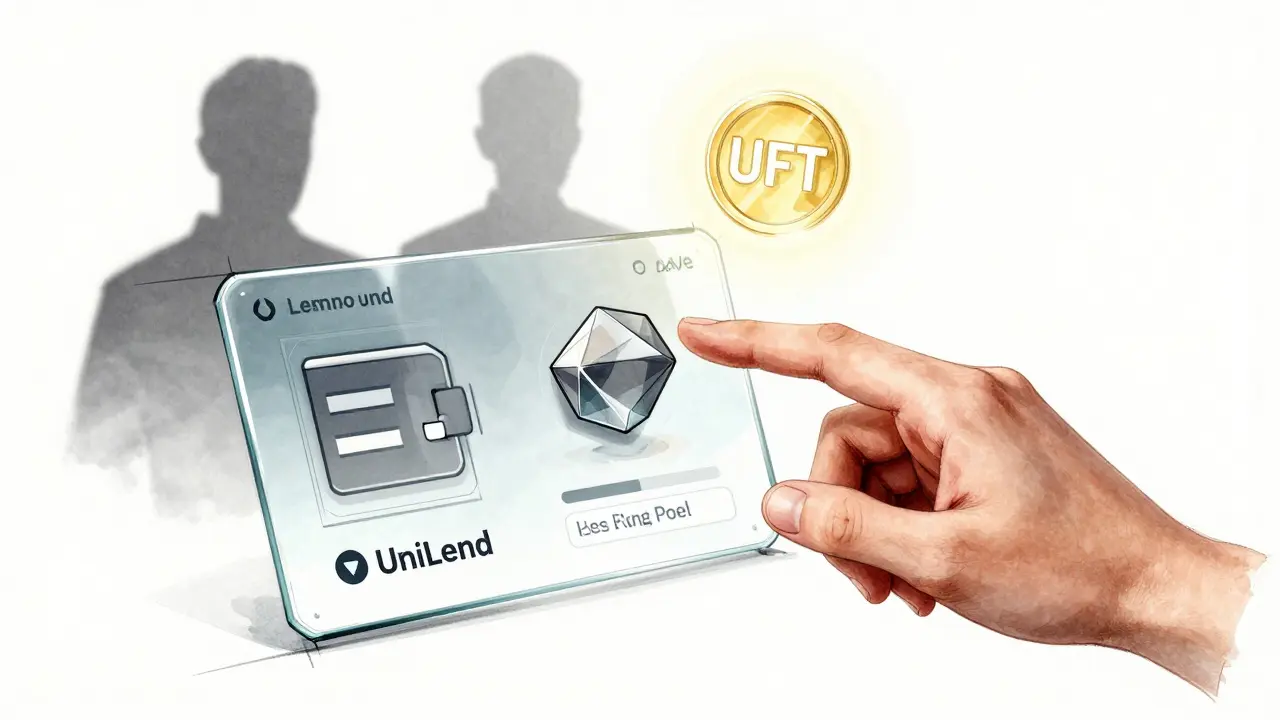
UniLend Finance is a decentralized protocol on Ethereum that lets you lend, borrow, and trade crypto without needing a bank or middleman. Unlike Aave or Compound, which only allow a limited list of tokens, UniLend lets anyone list any ERC-20 token. That means if you have a new token from a small project, you can still use it to borrow USDC, lend it out for interest, or trade it for another token - all in one place.
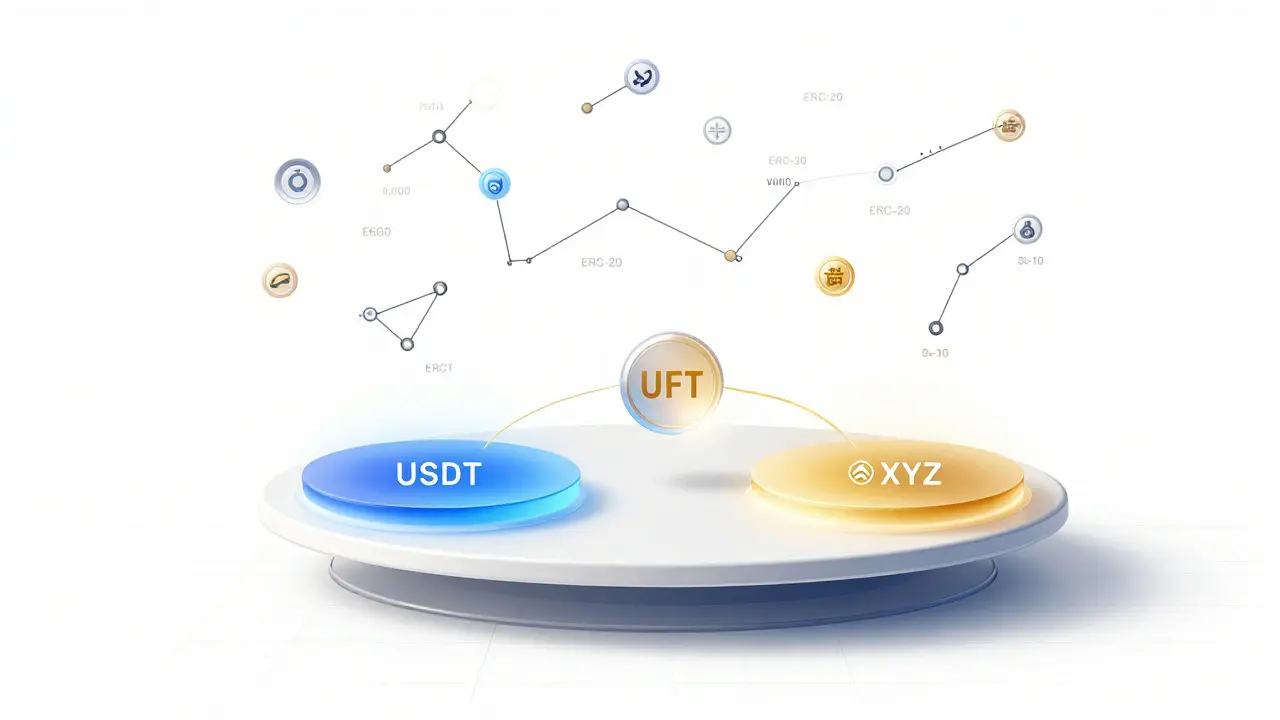
The secret? Isolated dual asset pools. Each pair of tokens - say, USDT and a random token called XYZ - lives in its own separate pool. If XYZ crashes, it doesn’t drag down the whole system. That’s different from older DeFi platforms where one bad asset can cause a chain reaction. UniLend’s design stops risk from spreading.
The UFT Token: More Than Just a Coin
The UFT token isn’t just a speculative asset. It’s the backbone of UniLend’s governance and incentives. Holders can vote on changes to the protocol - things like adjusting loan-to-value ratios, choosing which price oracles to trust, or even adding new token pairs. Voting happens both on-chain (using your UFT wallet) and off-chain through Snapshot, so you don’t pay gas fees just to make a decision.
UFT is also used to reward liquidity providers. When you deposit tokens into UniLend’s pools to help others borrow or trade, you earn fees plus UFT tokens. It’s a way to keep the system running without relying on venture capital.
UFT Token Stats (as of September 2025)
- Total supply: 100,000,000 UFT
- Circulating supply: 91,668,971.447 UFT
- Current price: ~$0.004001
- Market cap: ~$366,785
- 24-hour volume: ~$48,941
- All-time high: $4.47 (Feb 23, 2021)
- All-time low: $0.0044 (Jun 17, 2025)
- Ranking: #2429 (as of Sept 2025)
The price drop from $4.47 to under $0.005 might look bad, but it’s not unusual for DeFi tokens. Many projects peak early and settle into long-term growth. UFT’s real value isn’t in its price - it’s in what it enables. If UniLend gains traction among users who need to use obscure tokens, UFT could become more valuable as demand for governance and rewards grows.
Why UniLend Stands Out
Think of other DeFi platforms like exclusive clubs. Only the biggest, most trusted tokens get in. UniLend is more like an open public library. You can bring any book - even a self-published zine - and check it out. This matters because thousands of tokens exist that aren’t listed anywhere else. A new DeFi project launches a token. It has utility, but no way to lend or borrow it. UniLend lets that token live in DeFi.
That’s powerful for early adopters. If you’re into niche projects, UniLend gives you tools most platforms don’t. You can lend your $0.01 token and earn interest, or use it as collateral to borrow stablecoins. No other platform offers that level of access.
Trade-Offs and Risks
But there’s a catch. The more tokens you support, the harder it is to price them accurately. UniLend uses price oracles to determine token values, but for obscure tokens, those prices can be unreliable. A token with low trading volume might show a fake price, leading to under-collateralized loans. That’s a risk.
Also, UniLend’s user base is small. With only $48,941 traded in 24 hours, it’s nowhere near Aave or Compound. Liquidity is thin. If you try to trade a rare token, you might get a bad rate. And because the project raised only $3 million, it doesn’t have the marketing muscle of bigger players.
Still, UniLend’s technology is real. It solves a real problem. The question isn’t whether the system works - it does. The question is whether enough people will use it.

Who Should Care About UniLend?
- Token creators: If you launched an ERC-20 token and want it to be usable in DeFi, UniLend is one of the few places you can list it yourself.
- DeFi power users: If you hold a mix of tokens - some popular, some obscure - and want to maximize their utility, UniLend gives you more options.
- Long-term believers: If you think the future of DeFi is about inclusivity, not just the top 10 tokens, then UniLend’s mission aligns with your view.
It’s not for casual traders looking for quick flips. UFT’s price is volatile, and trading volume is low. But if you’re looking to actually use crypto beyond speculation - to lend, borrow, or trade tokens others ignore - UniLend is one of the few places that lets you do it.
The Bigger Picture
UniLend isn’t just about lending. The team is now working on integrating AI and blockchain tools into the protocol. That means future updates might let users earn rewards for data contributions, or use decentralized AI to improve price oracle accuracy. It’s still early, but the direction suggests they’re building toward something broader than just another lending platform.
The real test? Can UniLend grow beyond its niche? Right now, it’s a tool for a small group of users who need access to the full ERC-20 ecosystem. But if more projects start relying on it to give their tokens DeFi functionality, it could become essential.
For now, UniLend (UFT) is a quiet innovator. It doesn’t have the name recognition of the big players. But if you care about true decentralization - where any token, no matter how small, can participate in finance - then it’s one of the few projects actually making that real.
What is the UFT token used for?
The UFT token is the governance and utility token of UniLend Finance. Holders can vote on protocol changes like loan-to-value ratios, price oracles, and new token listings. It also rewards users who provide liquidity to lending pools by earning fees and additional UFT tokens.
Can I lend any ERC-20 token on UniLend?
Yes. UniLend’s permissionless listing system allows any ERC-20 token to be added to its lending and borrowing pools without approval from a central team. This includes obscure tokens that aren’t listed on major DeFi platforms.
Is UniLend safe to use?
UniLend uses audited smart contracts and isolated asset pools to limit risk. However, because it supports over 9,000 tokens, some may have unreliable price feeds or low liquidity, which can lead to liquidation risks. Always research the token you’re using and understand the collateral requirements before borrowing.
How does UniLend compare to Aave or Compound?
Aave and Compound only support a limited number of well-known tokens. UniLend supports over 9,000 ERC-20 tokens, including obscure ones. UniLend also combines lending, borrowing, and spot trading in one interface, while Aave and Compound focus mainly on lending. However, UniLend has lower liquidity and fewer users, so trading and borrowing rates may be less favorable.
Why is UFT’s price so low now?
UFT peaked at $4.47 in early 2021 during the DeFi boom. Since then, it has faced challenges in user adoption and market interest. With only $48,941 traded daily and a low market cap, investor sentiment remains cautious. The token’s value now reflects its current usage, not its potential. If UniLend grows its user base, UFT could recover - but that’s not guaranteed.




Ryan Burk
27 February, 2026 . 11:43 AM
This is just another vaporware project with a fancy name. 9,000 tokens? Most of them are dead coins with zero liquidity. You think people are gonna use some random $0.0001 token as collateral? Lol. Wake up.
Neeti Sharma
1 March, 2026 . 00:14 AM
USA always overhypes shit. In India we know real DeFi. This UFT is garbage. No volume no future. Stick to ETH and SOL.
Amanda Markwick
1 March, 2026 . 07:01 AM
I actually think this is one of the most underrated protocols out there. The isolated pools are genius - it’s like building firewalls between toxic assets. If you’ve ever been burned by a flash crash on Compound, you’ll appreciate this. It’s not glamorous, but it’s *smart* engineering.
Derek Sasser
3 March, 2026 . 02:36 AM
The real value isn't in the price of UFT - it's in the permissionless listing. That’s the innovation. Most protocols gatekeep. UniLend says ‘come as you are.’ Even if you’re holding a token nobody else recognizes. That’s decentralization in action.
Molley Spencer
4 March, 2026 . 05:48 AM
Let’s be real - this is a graveyard of dead tokens masquerading as innovation. The ‘isolated pools’ are just a band-aid on a bullet wound. When liquidity is this thin, you’re not lending - you’re gambling on oracle manipulation. And don’t even get me started on the 91M circulating supply. This is a classic pump-and-dump shell.
Jessica Carvajal montiel
4 March, 2026 . 15:19 PM
They say ‘any ERC-20’ but everyone knows the team whitelists the ones they want to push. This isn’t permissionless - it’s performative. And that $4.47 all-time high? That was bought by bots during the 2021 meme frenzy. Now they’re milking the narrative that ‘it’s just early.’ Bullshit. It’s dead.
Amita Pandey
5 March, 2026 . 05:12 AM
The concept is philosophically sound - financial inclusion for obscure assets. But philosophy without adoption is poetry. And poetry doesn't pay gas fees. This protocol will remain a curiosity until it solves the oracle problem for low-volume tokens. Until then, it’s a technical demo with no users.
Lilly Markou
5 March, 2026 . 23:51 PM
I appreciate the technical depth, but I'm deeply concerned about the lack of institutional backing. No VC funding, minimal marketing, and under $50k daily volume? This isn't a protocol - it's a hobby project with a whitepaper. I wouldn't risk even $10 on this.
precious Ncube
7 March, 2026 . 09:41 AM
If you're still holding UFT after the crash, you're either a masochist or a cultist. The tokenomics are a disaster. 91M circulating? That’s inflation on steroids. And ‘governance’? Ha. Who votes? The same 3 wallets that hold 60% of supply. This isn't DeFi - it's a centralized shell game.
Jeremy buttoncollector
8 March, 2026 . 23:19 PM
The isolated dual asset pools are a fucking revelation. It’s like compartmentalizing nuclear waste - each risk is contained, no chain reactions. Most protocols are single-threaded catastrophes waiting to happen. UniLend? It’s the anti-FTX. The UFT token isn’t a coin - it’s a governance substrate. And if you think market cap tells the story, you’re still in 2020. Real value is in composability. This is the first protocol that treats every ERC-20 as a first-class citizen. Not everyone gets it. That’s why it’s quiet. Not dead.
Daisy Boliaan
10 March, 2026 . 03:34 AM
I’ve been in DeFi since 2017. I’ve seen this movie. Every time someone says ‘any token’ they’re just hiding a rug pull. And now they’re adding AI? Please. That’s just buzzword bingo. If this was legit, why is the 24h volume lower than my coffee budget? I’m out.
Andrew Hadder
12 March, 2026 . 01:40 AM
I don’t trade UFT. But I’ve used it to borrow USDC against a niche NFT token I own. It worked. No drama. No liquidation. Took me 3 minutes. That’s the whole point. You don’t need hype. You need utility. And this delivers it.
Nicki Casey
14 March, 2026 . 01:08 AM
Let me ask you this: if UniLend is so revolutionary, why is it not on CoinGecko’s top 100? Why does it have less trading volume than a shitcoin from a Discord group? The answer is simple - it’s a honeypot. The devs are sitting on UFT. The ‘governance’ is a joke. And the ‘AI integration’? That’s just a placeholder for a future exit. This isn’t DeFi. It’s a crypto pyramid with a whitepaper.
Robert Conmy
15 March, 2026 . 19:08 PM
I used to think this was a joke. Then I tried it. I deposited a token I got from a friend’s airdrop - something called ‘DegenChain’ - and borrowed 50 USDC. It worked. No approval. No waiting. No gatekeepers. That’s the power of this protocol. You don’t need to be a whale. You just need a wallet. And that’s the future.
Fiona Monroe
16 March, 2026 . 17:28 PM
The structural design of UniLend's isolated asset pools represents a significant advancement in risk containment within decentralized lending protocols. While the current market valuation of UFT may appear negligible, one must evaluate the protocol's underlying utility rather than speculative price metrics. The governance mechanism, coupled with incentivized liquidity provision, aligns with core principles of sustainable decentralization. It is not a panacea, but it is a coherent, technically sound architecture.
McKenna Becker
16 March, 2026 . 23:43 PM
It works. That’s all that matters.
Robert Kromberg
18 March, 2026 . 22:00 PM
I get why people hate this. It’s not flashy. No influencers. No $10M marketing. But that’s why it’s real. The big players don’t want this to succeed - because it breaks their monopoly on which tokens ‘deserve’ to be in DeFi. UniLend doesn’t care about your hype. It cares about your token. And that’s worth more than any NFT.
Nadia Shalaby
19 March, 2026 . 18:28 PM
I don’t own UFT. I don’t trade it. But I keep an eye on it. Every time I see a new token launch, I check if it’s on UniLend. Sometimes it is. Sometimes it’s not. But the fact that it *can* be - that’s the quiet revolution. You don’t need permission to participate. That’s the whole point.