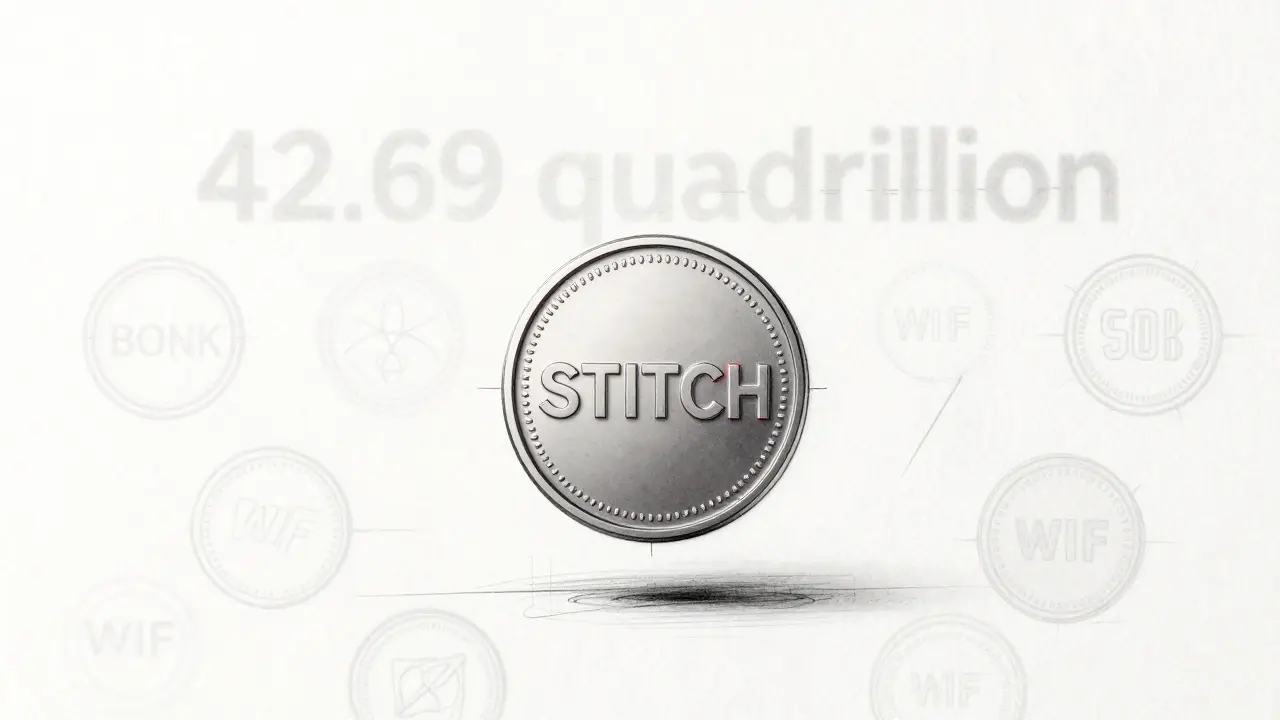
Stitch (STITCH) isn’t just another cryptocurrency. It’s a strange case study in how crypto can go wrong - or worse, how it can be engineered to look like something real when it’s not.
If you’ve seen headlines claiming STITCH is a "next big meme coin" or that you can turn $100 into $1,000 in weeks, stop. This isn’t a project. It’s a data glitch with a website and a ticker symbol.
What is Stitch (STITCH)?
Stitch (STITCH) is a token built on the Solana blockchain. That’s the only thing that’s technically true. Beyond that, almost everything about it is either misleading, inconsistent, or outright false.
According to some sources, STITCH launched in 2025 with a total supply of 42,690,000,000,000,000 tokens - that’s 42.69 quadrillion. To put that in perspective, Shiba Inu (SHIB) has 589 trillion. STITCH has over 70 times more tokens than SHIB. Why does this matter? Because when you flood the market with that many units, each individual token becomes nearly worthless. One STITCH token is worth less than a fraction of a penny. In fact, some exchanges list it at $0.0000000000003765. That’s 0.00000003765 cents. You’d need over 2.6 billion STITCH tokens to make one dollar.
The Price Chaos
Here’s where it gets weirder. Different websites show wildly different prices for the same token.
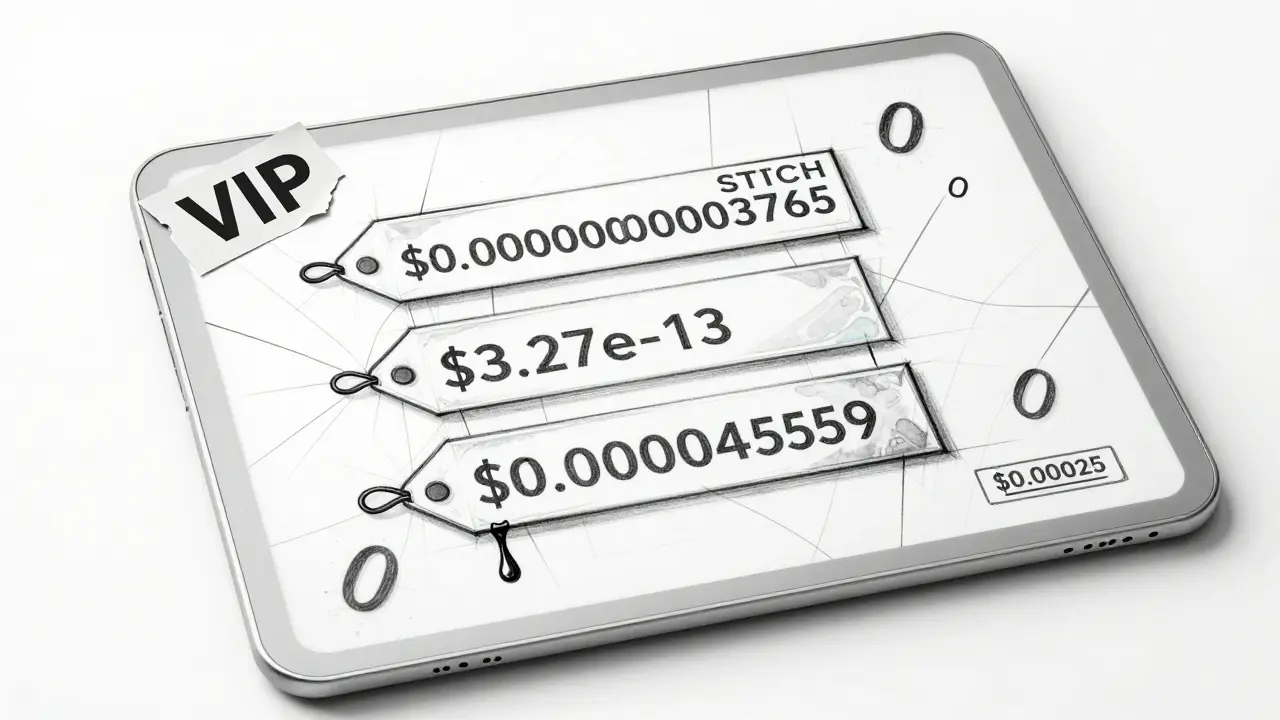
- CoinMarketCap says it’s worth $3.27e-13 (that’s 0.000000000000327 USD)
- Crypto.com lists it at $3.765e-13
- CoinCodex claims it’s $0.00004559 - over 100,000 times higher
How can the same coin have prices that differ by five orders of magnitude? It’s not a bug. It’s a sign of manipulation. One site might be pulling data from a fake liquidity pool. Another might be tracking a different token with the same ticker. Some platforms even list STITCH as "not available" or "not tradable." That’s not a technical issue - it’s a red flag.
And the trading volume? Liquidity Finder reports $0.00 in 24-hour volume. Binance shows sporadic spikes of 6% to 19% in a day, but then 95% drops over 30 days. That’s classic pump-and-dump behavior: a small group of people buys, pushes the price up, then sells to newbies who think they’re getting in early.
Why Does the Supply Matter?
Most cryptocurrencies limit their supply. Bitcoin caps at 21 million. Ethereum has no hard cap but issues new coins at a controlled rate. Even meme coins like Dogecoin or Shiba Inu have supplies in the trillions - not quadrillions.
Stitch’s 42.69 quadrillion supply isn’t a feature. It’s a trap. It makes the math impossible. For STITCH to reach just $0.000001 per token, its market cap would need to hit $42.69 billion. That’s more than the entire Solana network was worth during its peak in 2022. It’s more than the market cap of Ethereum Classic, Polygon, or Chainlink. For a token with zero development team, zero community, and zero utility, that’s fantasy.
And here’s the kicker: if you try to send STITCH, you’ll run into Solana’s minimum transaction fee of about $0.00025. That’s enough to buy over 600,000 STITCH tokens. So you’re paying more in fees than the tokens you’re sending are worth. That’s not a blockchain - that’s a joke.
No Team, No Whitepaper, No Future
Legitimate crypto projects don’t hide. They show you who built it, what they’re doing, and where they’re going. STITCH does none of that.
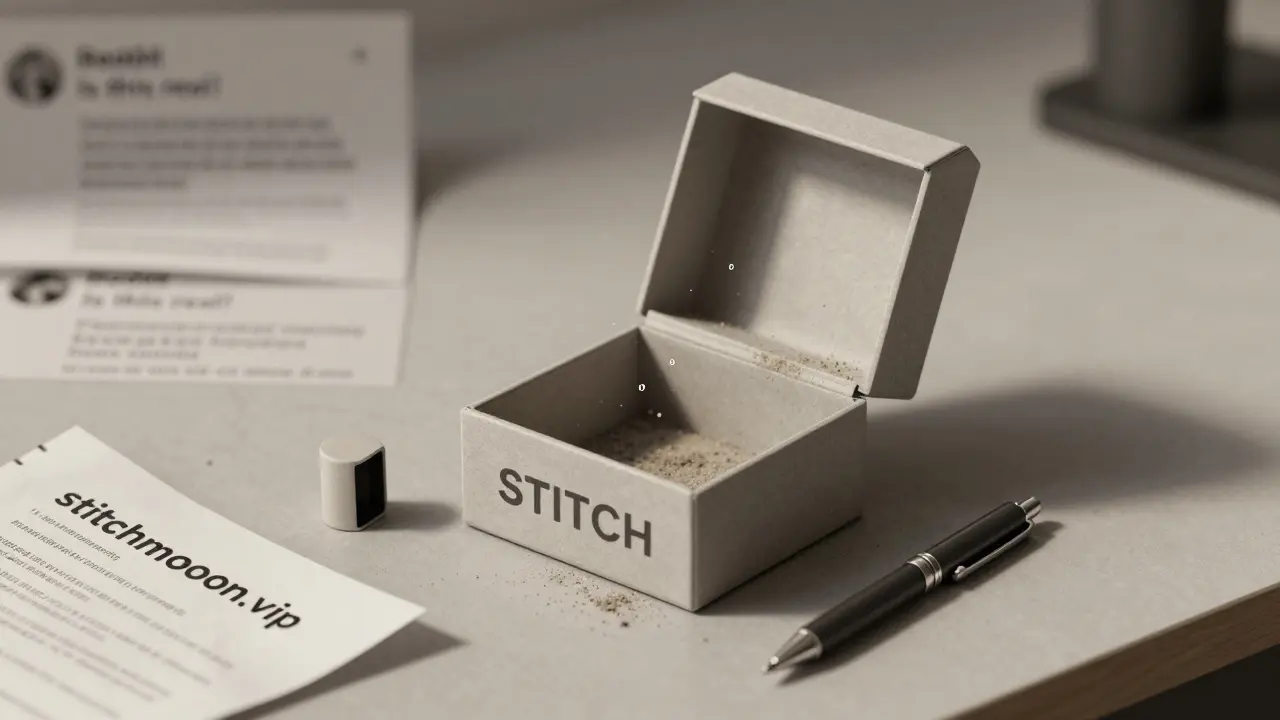
There’s no whitepaper. No GitHub repository. No development updates. No team members listed. No LinkedIn profiles. No press releases. No interviews. Just a website: https://stitchmooon.vip - notice the misspelled "mooon." That’s not a typo. It’s a pattern. Real projects don’t use .vip domains with misspellings. They use .org, .com, or even .io. This domain was likely registered yesterday.
And where’s the community? Check Reddit. Search r/Solana, r/CryptoCurrency, r/SolanaMemeCoins. You’ll find three posts in the last year. All asking: "Is this real?" No one’s talking about buying, holding, or using STITCH. Compare that to Dogwifhat (WIF), which has a Telegram group of 52,000+ members. Or Bonk, which has active Discord servers with thousands posting daily. STITCH has nothing.
Market Data Doesn’t Add Up
Let’s look at the numbers again.
| Token | Supply | Price (USD) | 24h Volume | Market Cap |
|---|---|---|---|---|
| Stitch (STITCH) | 42.69 quadrillion | $0.0000000000003765 | $0.00 | ~$0.014 |
| Bonk (BONK) | 100 trillion | $0.000041 | $127M | $4.1B |
| Dogwifhat (WIF) | 1.05 billion | $2.80 | $380M | $2.9B |
| Raydium (RAY) | 110 million | $1.75 | $247M | $192M |
STITCH’s market cap is so low it’s practically invisible. It doesn’t even show up in the top 5,000 cryptocurrencies. Meanwhile, Bonk and WIF are top 50. Raydium is a core DeFi protocol on Solana. STITCH is just a number on a screen.
Who’s Behind It?
No one knows. No one claims responsibility. No one has been verified. No developer has ever committed code under a real name. No investor has been named. No lawyer has filed paperwork. That’s not anonymity - that’s invisibility.
Compare this to Dogecoin, which started as a joke but had a public team, active forums, and even Elon Musk tweeting about it. STITCH has no such anchor. It’s floating in the dark, with no connection to reality.
Why Do People Still Buy It?
Because of the number.
When you see "I own 10 million STITCH," it feels like you’re rich. You’re not. You own 10 million units of something worth less than a penny. But the brain latches onto big numbers. It’s the same reason people buy lottery tickets - they imagine the outcome, not the math.
Some websites even claim STITCH will hit $0.000155 by June 2025 and give you a 391% return. That’s impossible. That’s mathematically absurd. If STITCH were to reach that price, its market cap would be $6.6 trillion. That’s more than Apple, Microsoft, and Google combined. And it’s all based on a token with zero trading volume and zero users.
Should You Buy It?
No.
Not because it’s risky. Because it’s not real.
There’s no utility. No roadmap. No team. No community. No liquidity. No future. The only thing STITCH has is a ticker symbol and a website that looks like it was made in 2012.
If you’re looking for Solana-based tokens, look at Bonk, WIF, or Raydium. They have volume, teams, and real use cases. STITCH? It’s a ghost.
And if you’ve already bought it? Don’t chase it. Don’t try to "double down." You’re not investing. You’re just feeding a data error.
Final Thought
Stitch (STITCH) isn’t a crypto coin. It’s a warning.
It shows how easy it is to create something that looks like a cryptocurrency - with fake data, inflated numbers, and zero substance - and trick people into thinking it’s valuable. The blockchain doesn’t care if you believe in it. But you should.
If a project doesn’t have a team, a whitepaper, or a community - it doesn’t matter how many zeros are in the supply. It’s not crypto. It’s just a number.
Is Stitch (STITCH) a real cryptocurrency?
Technically, yes - it exists as a token on the Solana blockchain. But it lacks the core elements of a real cryptocurrency: a development team, a whitepaper, community, liquidity, or any verifiable use case. It’s more accurately described as a speculative token with manipulated data.
Why is the STITCH supply so high?
The 42.69 quadrillion supply is likely designed to make individual tokens seem cheap and encourage retail investors to buy large quantities. But this structure makes price stability impossible. Moving the price even slightly would require a market cap larger than most major cryptocurrencies combined.
Can I trade STITCH on Binance or Coinbase?
No. Major exchanges like Binance, Coinbase, and Crypto.com either list STITCH as "not tradable" or show no data. The few trades that occur happen on obscure decentralized exchanges with almost no volume. This lack of exchange support is a major red flag.
Is STITCH a scam?
There’s no official confirmation it’s a scam, but it has all the hallmarks: fake website, zero transparency, no team, inflated price claims, and no real trading activity. It fits the pattern of a pump-and-dump scheme targeting inexperienced investors drawn in by huge supply numbers.
What’s the best way to avoid tokens like STITCH?
Look for three things: 1) A published team with LinkedIn profiles or public identities, 2) Active social channels (Telegram, Discord) with thousands of real members, and 3) Real trading volume on major exchanges. If any of these are missing, walk away. Tokens with quadrillion supplies and .vip domains are almost always traps.

Brandon Kaufman
13 March, 2026 . 09:39 AM
Been following crypto for years, and honestly? STITCH is the most transparent scam I've seen in a while. Not because it's sneaky - but because it's so blatantly fake. No team, no code, no liquidity. Just a ticker and a .vip domain. If you're buying this, you're not investing. You're donating to someone's gambling habit.
Anshita Koul
15 March, 2026 . 09:07 AM
42.69 quadrillion?? That's not a coin-it's a math error with ambition! It's like printing a trillion dollar bills and calling it 'money'... except even the printer didn't believe in it!
PIYUSH KOTANGALE
17 March, 2026 . 06:51 AM
Bro, if you see 'mooon' in the URL... just scroll past. 🤦♂️
Grace van Gent-Korver
18 March, 2026 . 05:54 AM
I'm from the U.S. but my grandma in Mexico still thinks this is real. She sent me a screenshot of her 'STITCH portfolio.' I cried. Not because I'm sad-because I had to explain blockchain to someone who thinks 'crypto' is a type of taco.
Tina Keller
20 March, 2026 . 03:44 AM
This is what happens when you let algorithms decide what’s valuable. No one’s building anything. No one’s solving a problem. Just slapping zeros on a token and hoping people confuse quantity with quality. We’re not in the gold rush anymore-we’re in the digital equivalent of selling shovels to ghosts.
vasantharaj Rajagopal
20 March, 2026 . 07:16 AM
The liquidity pool metrics are non-compliant with DeFi standards. The token has no vesting schedule, no tokenomics whitepaper, and zero on-chain governance. The supply inflation rate exceeds the entropy of the Solana network itself. This is not a financial instrument-it’s a data artifact.
ann neumann
21 March, 2026 . 20:14 PM
They’re using this to track our movements. You think this is a coin? Nah. It’s a backdoor. The 42 quadrillion supply? That’s not for trading-it’s for surveillance. Every transaction logs your wallet, your IP, your habits. The government didn’t create this. The AI did. And it’s watching. You’re not rich. You’re a data point.
Tom Jewell
23 March, 2026 . 03:33 AM
It’s weird how people get emotional about tokens with no utility. It’s like getting excited about a dictionary that’s missing every word. You can stare at the pages all day, but nothing’s there. STITCH isn’t a failure-it’s an absence. And yet, somehow, people still throw money at it like it’s a wishbone.
Zephora Zonum
23 March, 2026 . 13:03 PM
Wow, this post is so basic. You didn’t even mention that STITCH is likely a honeypot contract designed to drain wallets that attempt to sell. The real story is how the devs are using it to harvest private keys from amateur traders who don’t understand contract verification. You’re not losing money-you’re volunteering your crypto soul.
Anthony Marshall
24 March, 2026 . 20:07 PM
STOP HATING! This is the next big thing! I bought 10 quadrillion at $0.0000000000001 and I’m gonna be a billionaire by 2026! YOLO! 🚀💎
Lindsay Girvan
26 March, 2026 . 10:25 AM
Real talk: if you’re still arguing about STITCH, you’re already part of the problem.
Douglas Anderson
27 March, 2026 . 03:24 AM
My cousin lost $800 on this. Said he saw a YouTube ad that said ‘STITCH = 1000x’. He didn’t even check the website. Just clicked ‘buy now’. I showed him this post. He still says ‘but what if?’ That’s the real tragedy. Not the scam. The hope.
Allison Davis
27 March, 2026 . 15:20 PM
Market cap is $0.014? That’s less than the cost of one Solana transaction fee. It’s like trying to buy a Ferrari with Monopoly money. The only thing more absurd than the token is the people who still believe.
Sherry Kirkham
28 March, 2026 . 02:20 AM
Canada has a better chance of becoming a crypto powerhouse than STITCH has of reaching $0.000001. Just saying.
Sharon Tuck
28 March, 2026 . 03:40 AM
Hey, I get it. You just want to feel like you’re part of something big. But sometimes the biggest thing is walking away. You don’t need to own a token to be smart. Sometimes the smartest move is not clicking ‘buy’.
Jenni James
28 March, 2026 . 16:22 PM
How quaint. You’ve written a 2000-word essay on why a meme coin is a scam. Did you also write a 10-page paper on why the moon is not made of cheese? Please. The blockchain is chaos. STITCH is just the universe laughing.
Chelsea Boonstra
29 March, 2026 . 11:34 AM
Wait-so if STITCH has a market cap of $0.014, and the transaction fee is $0.00025, then technically, sending one token costs 17 times its value? That’s not a blockchain. That’s a reverse Ponzi. You pay more to move it than it’s worth. Who designed this? A mathematician with a vendetta?
Alex Thorn
30 March, 2026 . 20:37 PM
It’s not about whether STITCH is real. It’s about why we keep letting things like this exist. We’re not just ignoring red flags-we’re decorating them with confetti. We want to believe. And that’s the real vulnerability.
Howard Headlee
1 April, 2026 . 00:06 AM
STITCH isn’t a coin. It’s a Rorschach test. Some people see a scam. Others see a miracle. The truth? It’s just a mirror. And what you see in it says way more about you than about the token.
Julie Tomek
2 April, 2026 . 18:32 PM
From a regulatory and economic standpoint, the token’s design violates fundamental principles of monetary supply equilibrium. The lack of liquidity, absence of vesting, and non-existent team structure render it non-compliant with any jurisdiction’s securities framework. Furthermore, the .vip domain registration, dated within the last 72 hours, indicates a transient, likely fraudulent, infrastructure. This is not an investment vehicle. It is a compliance risk.
Craig Gregory
4 April, 2026 . 17:24 PM
You missed the point. STITCH isn’t a scam. It’s a stress test. The crypto world is so broken that even this garbage gets traction. That’s the real horror story. Not the token. The ecosystem that lets it live.
William Montgomery
5 April, 2026 . 01:32 AM
If you bought STITCH, you’re either a fool or a genius. And if you’re still reading this, you’re too dumb to be either.