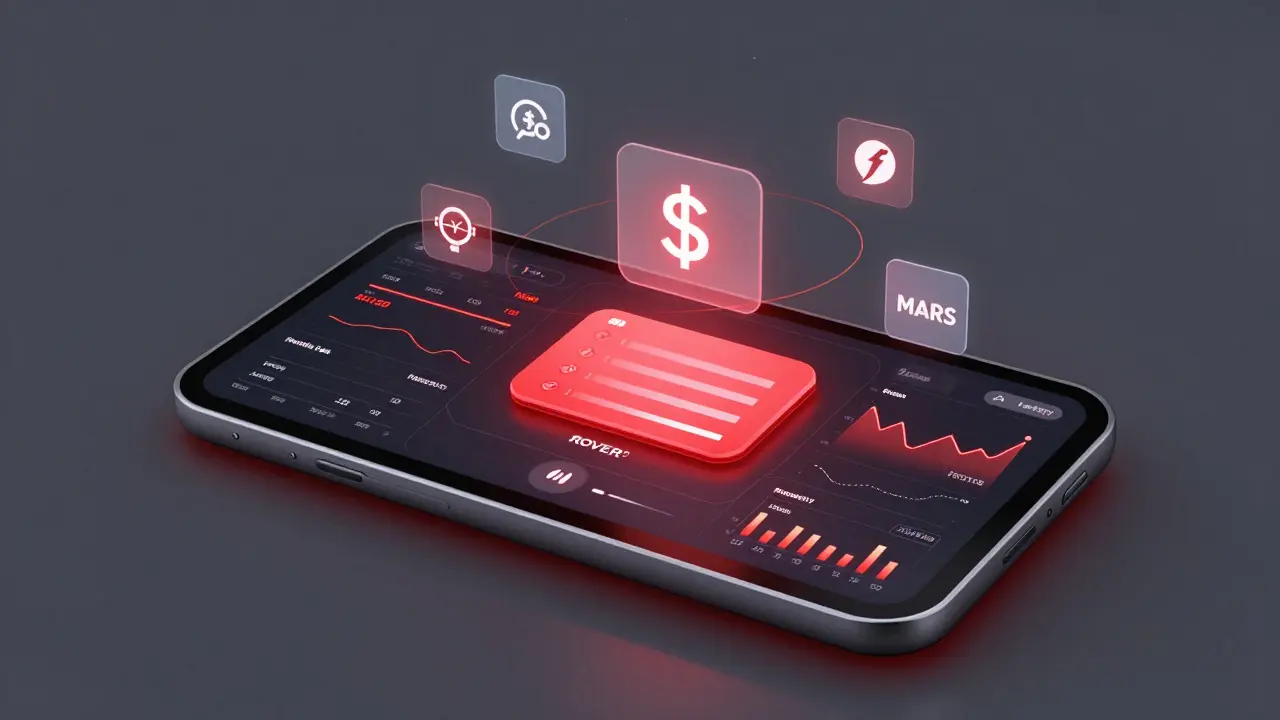
Mars Protocol (MARS) isn’t just another cryptocurrency. It’s a DeFi leverage protocol built to let users trade, borrow, and farm yield with advanced financial tools - all on-chain. Unlike typical crypto coins that act as currency or store of value, MARS powers a full financial system where users can open leveraged positions, use any asset as collateral, and even copy expert traders - all in one account. It’s designed for people who want more control than traditional DeFi lending platforms offer.
How Mars Protocol Works: The Red Bank and Rover
Mars Protocol runs on two core systems: the Red Bank and Rover. The Red Bank is a money market where users can lend and borrow crypto. But what makes it different is how it handles borrowing. Originally on Terra, it allowed two types: collateralized (like most DeFi loans) and uncollateralized (for trusted protocols). That meant smart contracts could borrow without putting up assets - something rare in DeFi - while lenders still earned higher interest. Today, that system has evolved.
The real game-changer is Rover, Mars Protocol’s credit account system. Think of it like a Binance subaccount, but fully on-chain and non-custodial. With Rover, you deposit assets - say, USDC, OSMO, or even ATOM - and instantly turn them into collateral for multiple strategies. You can go long on one asset, short another, farm yield, and trade perpetual futures - all under one account. There’s no need to manage separate positions or liquidation points. If one trade goes bad, the whole account is at risk, but you also get to use all your assets together to maximize efficiency.
What You Can Do with Mars Protocol
Here’s what users can actually do today:
- Perpetual futures trading with up to 10x leverage on top assets, settled in real-time USDC.
- Spot and margin trading with flexible leverage, executed instantly on-chain.
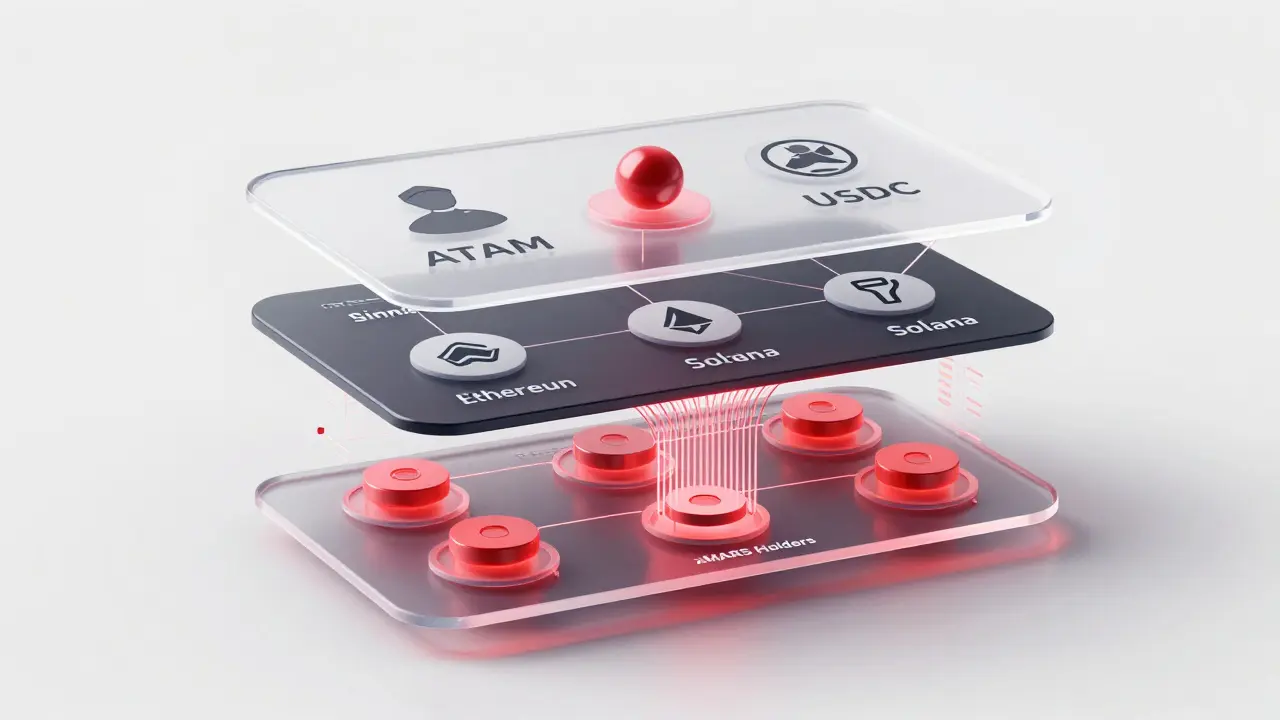
- Lending and borrowing with cross-collateralization - meaning you can use your ETH, SOL, or OSMO all at once as collateral.
- Leveraged LP farming - deposit liquidity into pools and borrow more to amplify your returns.
- Copy Trading Vaults (launching soon) - follow expert traders or create your own strategy vaults and share profits with others.
This isn’t just trading. It’s building a personal DeFi portfolio with tools that used to be only available on centralized exchanges like Binance or Bybit - but without giving up control of your funds.
The MARS Token: Governance, Revenue, and Risk-Sharing
The MARS token is the backbone of the protocol. It’s not a currency you spend - it’s a tool that gives you power over the system. Holders can stake MARS to receive xMARS, which unlocks three key benefits:
- Governance - vote on upgrades, fee structures, and new features.
- Revenue sharing - earn a cut of protocol fees generated from trading and borrowing.
- Risk-sharing - in case of a shortfall (like a liquidation cascade), xMARS holders can sell up to 30% of their stake to cover losses, helping keep the system solvent.
Originally, the total supply was planned at 100 million MARS. But current data shows major shifts. CoinMarketCap reports a maximum supply of 454.02 million, with 291.29 million in circulation. CoinGecko lists 270 million circulating. That gap suggests recent token unlocks or distribution changes. The price is volatile and thin - trading volumes hover around $600k daily. That means liquidity is low, and large trades could swing the price hard. Don’t treat this like Bitcoin or Ethereum. This is a niche, high-risk asset.

From Terra to Cosmos: Why the Shift Matters
Mars Protocol started on Terra, trying to compete with Anchor Protocol. But when Terra collapsed in 2022, Mars didn’t die - it moved. It rebuilt on Osmosis, a decentralized exchange built for the Cosmos ecosystem. This wasn’t just a backup plan. It was a strategic upgrade.
Osmosis is optimized for cross-chain liquidity and advanced trading. That’s why Rover’s credit accounts work so well here. The Cosmos network lets Mars Protocol connect to other chains like Ethereum, Solana, and Avalanche through bridges. That means one day, you might use your Mars account to trade Bitcoin on Ethereum, farm yield on Solana, and borrow against Polkadot - all from the same interface. That’s the future Mars is building: a unified DeFi layer across blockchains.
Who Is This For? And Who Should Stay Away?
Mars Protocol isn’t for beginners. If you don’t understand leverage, liquidation, or collateral ratios, you could lose everything. But if you’ve traded on DeFi or used margin on centralized exchanges, this could be your next step.
Best for: Experienced DeFi users who want to combine leverage, yield farming, and spot trading in one place. Traders who want to short assets without using centralized exchanges. Yield farmers looking to amplify returns with borrowed capital.
Avoid if: You’re new to crypto, don’t understand risk management, or expect stable returns. The low liquidity and high volatility mean prices can swing wildly. And since the protocol is still evolving, smart contract risks remain. No audits have been publicly published in detail, so proceed with caution.
The Big Picture: Mars in the DeFi Landscape
There are other leverage protocols - like GMX, dYdX, and Hyperliquid - but they’re mostly on Ethereum or Solana. Mars is the only one built from the ground up for Cosmos. That gives it a unique advantage: low fees, fast transactions, and deep integration with Osmosis liquidity pools. It’s not the biggest, but it’s one of the most innovative.
The Copy Trading Vaults feature, when live, could be a game-changer. Imagine following a trader who consistently makes 20% monthly returns with leveraged farming - and automatically copying their trades without knowing how they do it. That’s the promise. It turns expert knowledge into something accessible.
Right now, Mars Protocol is in a growth phase. The token is still being distributed. The ecosystem is expanding. And the technology is being tested. It’s not a finished product - it’s a live experiment in decentralized finance.
Is Mars Protocol safe to use?
There’s no public audit report available for Mars Protocol’s current version, which raises concerns. While the team behind it - Delphi Digital - has a strong reputation in DeFi, users should assume risk. The protocol’s use of cross-collateralization and single liquidation points means a single bad trade can wipe out your entire position. Never deposit more than you can afford to lose. Treat it like a high-risk trading platform, not a savings account.
Can I buy MARS coin on Coinbase or Binance?
No, MARS is not listed on major exchanges like Coinbase or Binance. It’s only available on decentralized exchanges like Osmosis, Jupiter, or other Cosmos-based DEXs. You’ll need to connect a wallet like Keplr or Leap, swap for OSMO or USDC first, then trade for MARS. This limits accessibility and contributes to its low trading volume.
What’s the difference between MARS and other DeFi tokens like AAVE or COMP?
AAVE and COMP are lending protocols - you lend or borrow, and that’s it. MARS is a leverage platform. It lets you trade, short, farm yield, and borrow all at once. It’s more like GMX or dYdX, but built for Cosmos instead of Ethereum. MARS also has a unique risk-sharing mechanism through xMARS, where holders can help cover losses - something neither AAVE nor COMP offers.
Why is the MARS token price so low?
The low price - around $0.0005 - is mostly due to the massive supply. With over 270 million tokens in circulation, even small trading volumes push the price down. It’s not a sign of failure - it’s a reflection of supply. Compare it to Bitcoin: if Bitcoin had a supply of 10 billion, its price would be cents too. The real question is whether demand will grow as the protocol adds users and features.
Do I need to be on Osmosis to use Mars Protocol?
Yes, currently. Mars Protocol is built on Osmosis, which runs on the Cosmos blockchain. You need a Cosmos-compatible wallet like Keplr. You can’t use it directly from Ethereum or Solana wallets. However, bridges let you move assets from other chains into Osmosis - so you can bring ETH or USDT over, convert them, and use them in Mars Protocol.
Final Thoughts
Mars Protocol (MARS) is a bold experiment in DeFi. It’s not a coin you hold for long-term gains - it’s a tool for active traders who want advanced leverage on a decentralized chain. The technology is solid, the team is experienced, and the ecosystem is growing. But the market is tiny, the token is volatile, and the risks are high. If you understand leverage, know how to manage risk, and want to trade across multiple strategies in one place - Mars Protocol might be worth exploring. If not, stay on the sidelines until the ecosystem matures.


Shana Brown
22 March, 2026 . 21:23 PM
I've been using Mars Protocol for a few weeks now and honestly? It's changed how I trade. No more juggling 5 different apps. One account, all my leverage, farming, and shorts. I went from 0.5 ETH to 1.8 ETH in 3 weeks just by copying a vault. Low liquidity? Yeah, but that's why the spreads are insane. And the fees? Barely anything.
Just don't over-leverage. I learned the hard way when OSMO dipped 15% and wiped my margin. But hey, that's DeFi.
Dominic Taylor
24 March, 2026 . 20:31 PM
The architectural elegance of Mars Protocol's Red Bank-Rover stack is non-trivial. Leveraging cross-collateralized debt positions across heterogeneous asset classes within a non-custodial, Cosmos-native execution layer represents a paradigm shift from Ethereum-centric DeFi primitives. The risk-sharing mechanism via xMARS staking introduces a novel incentive alignment layer absent in AAVE or Compound. This isn't just innovation-it's systemic reengineering.
Leona Fowler
24 March, 2026 . 23:27 PM
If you're new to leverage, don't touch this. I've seen too many people lose everything because they thought '10x' meant '10x fun'. But if you know what liquidation means, and you've managed collateral ratios before? This is the most powerful tool on Cosmos. The integration with Osmosis pools is seamless. I use it daily. Just start small.
Sarah Terry
26 March, 2026 . 06:46 AM
Mars Protocol isn't for everyone. But for those of us who want to trade like a hedge fund without giving up our keys? It's the closest thing we've got. I've been farming leveraged LP on OSMO/USDC for months. My returns are wild, but I always keep 30% of my position as buffer. The team knows what they're doing. Just don't FOMO in.
Shayne Cokerdem
26 March, 2026 . 21:44 PM
This whole thing is a scam. Terra died. Why are we still talking about this? The devs are just trying to pump MARS before they rug. I saw a guy on Twitter say he made 1000x. Then he vanished. CoinMarketCap shows 454 million supply? That's a joke. This coin is worthless. Don't waste your time.
aravindsai pandla
27 March, 2026 . 00:58 AM
For those unfamiliar with Cosmos, Mars Protocol is one of the most well-architected DeFi applications on Osmosis. The fact that it supports non-custodial cross-chain collateralization through IBC bridges is technically impressive. The risk-sharing model via xMARS is also a clever way to decentralize solvency. Not perfect, but far ahead of most Ethereum-based leverage protocols.
Andy Green
27 March, 2026 . 19:58 PM
Oh great, another 'innovative' DeFi project that's just Binance but with more risk and zero regulation. You people are so desperate for yield you'll risk everything on a protocol with no public audit. I'm amazed anyone still trusts these devs after the Terra collapse. This isn't innovation-it's gambling with a fancy UI.
Zion Banks
29 March, 2026 . 04:07 AM
They're using this to track crypto users. Did you know the Red Bank logs your IP through Keplr? And the Rover system? It's a backdoor for the Fed. They're building a global financial surveillance system under the guise of 'decentralization'. I checked the contract code. There's a hidden function that triggers when you deposit over 10k USDC. They're coming for your assets. Wake up.
Jenni Moss
29 March, 2026 . 22:32 PM
I started with $500 and now I'm at $3k thanks to Mars. I didn't even know what a perpetual was 3 months ago. YouTube tutorials + a few failed trades later, I got it. Don't let the jargon scare you. Just start with 1x leverage, learn the interface, and go from there. The community on their Discord is super helpful. I'm not a pro, but I'm not broke either.
Brijendra Kumar
30 March, 2026 . 02:23 AM
The MARS token is a disaster. 270 million supply with $600k volume? That's a pump-and-dump waiting to happen. The team is good, sure, but the tokenomics are broken. Why not do a token burn? Why not cap supply? This is amateur hour. I'd rather hold OSMO or ATOM than this. The protocol is cool, but the token? Skip it.
Florence Pardo
30 March, 2026 . 23:47 PM
I spent a whole weekend just reading through the docs and watching videos on how Rover works. It's overwhelming at first. Like trying to learn how to fly a plane while driving a car. But once you get the flow-deposit, select strategy, set leverage, monitor-it's kind of beautiful. I've been using it for 4 months now. I lost a few times, but I also made more than I ever did on centralized exchanges. It's not magic. It's just math. And discipline.
Alicia Speas
31 March, 2026 . 02:33 AM
While the technical design of Mars Protocol is commendable, one must not overlook the regulatory ambiguity surrounding its operations. The absence of a formal audit, combined with its cross-chain exposure and leverage mechanisms, presents significant compliance challenges under current financial frameworks. As a long-term observer of DeFi evolution, I urge users to approach with both enthusiasm and caution.
Dheeraj Singh
31 March, 2026 . 23:01 PM
LMAO this is so cringe. 'Copy trading vaults'? Sounds like a TikTok trend. You think some guy on Osmosis is gonna make you rich? Nah. You're just giving your money to someone who probably lost their job during the crypto winter. And MARS? Price is $0.0005 because no one wants it. This is the crypto equivalent of a garage sale.
Mansoor ahamed
2 April, 2026 . 02:46 AM
Mars Protocol is the only DeFi platform on Cosmos that truly unifies trading, lending, and yield. I use it to farm OSMO/USDC with 5x leverage and borrow ATOM to buy more OSMO. The fees are 10x cheaper than Ethereum. And the settlement speed? Instant. If you're on Cosmos, this is your best tool. Just don't go all-in.
Nicolette Lutzi
3 April, 2026 . 10:33 AM
This is why America is falling behind. We have real innovation here-built on Cosmos, by real devs-and the US regulators are still stuck in 2018. Meanwhile, China and Russia are building sovereign crypto systems. Mars Protocol could be the future of global finance. But no, we'd rather ban it and pretend stablecoins are 'risk-free'. Pathetic.
Tony Phillips
4 April, 2026 . 10:08 AM
I've been using Mars for 6 months. I don't trade every day. I just leave a small position running with 2x leverage on ATOM and let it ride. It's like a passive income stream. I don't check it often. Sometimes I make 1-2% a week. Not life-changing, but steady. And I sleep knowing my funds aren't on Binance. That's peace of mind.
Abhishek Thakur
4 April, 2026 . 14:02 PM
The Rover system is genius. You deposit USDC, then use it as collateral for spot long on OSMO, short on SOL, and farm a liquidity pool-all in one place. No need to bridge, swap, or manage 3 wallets. The UI is clean. The risk is real. But the efficiency? Unmatched. I've switched everything to Mars. No going back.
YANG YUE
4 April, 2026 . 15:35 PM
There's something poetic about Mars Protocol. It's not just code-it's a statement. A middle finger to the centralized exchanges that made us believe we needed them. You don't need a CEO to trade. You don't need a KYC form to leverage. You just need a wallet and a will. This isn't finance. It's freedom. And freedom is messy. That's why it works.
Shelley Dunbrook
5 April, 2026 . 18:06 PM
Ah yes, the classic 'Mars Protocol is revolutionary' narrative. How convenient. The same team that built Terra’s Anchor Protocol now brings us this? With zero public audit? Please. I’ll believe it’s safe when I see a CertiK report-not a Medium post with pretty graphs.
Aman Kulshreshtha
7 April, 2026 . 00:56 AM
I came from Ethereum and was skeptical. But the gas fees on Osmosis are 1/100th. The speed is insane. I tried GMX first-had to wait 30 seconds for a trade to settle. Here, it's instant. And the copy vaults? I followed a trader who made 120% in 3 weeks. I copied him, made 45%, and then stopped. No need to be greedy.
Misty Williams
8 April, 2026 . 08:00 AM
I lost my entire savings on this. I thought I was smart. I read the whitepaper. I staked MARS. I thought the risk-sharing would protect me. It didn't. One bad liquidation wiped me out. Now I'm broke. Don't be like me. If you're not a professional trader, this isn't for you. It's a casino with a blockchain label.
kavya barikar
10 April, 2026 . 01:20 AM
Mars Protocol is a remarkable achievement in decentralized finance. The integration of leverage, collateralization, and governance within a single, non-custodial framework demonstrates deep technical understanding. For users seeking autonomy from centralized exchanges, it offers an elegant alternative. Proceed with awareness, not fear.
Andrea Zaszczynski
10 April, 2026 . 22:55 PM
I tried to use it. Keplr kept crashing. I had to restart my browser 5 times. Then I couldn't find the vault. The UI is a mess. And why do they call it 'Rover'? Sounds like a dog. I'm out. This is not user-friendly. I don't care how good the tech is-if I can't use it, it doesn't exist.
Jeannie LaCroix
12 April, 2026 . 16:40 PM
I'm not just using Mars-I'm evangelizing it. I've on-boarded 7 friends. One of them turned $200 into $1,400. We all started with $50. We watch the charts together, we talk strategy, we celebrate wins and cry over losses. This isn't just trading. It's community. And that's what makes it powerful. Don't let the haters scare you. This is the future.
Domenic Dawson
14 April, 2026 . 06:19 AM
I used to think leverage was too risky. Then I started with 1.5x on a single asset. Learned how liquidations work. Now I use 3x across 3 different strategies. I haven't lost a single position. It's not about being bold-it's about being careful. The key is position sizing and stop-losses. Mars gives you the tools. You just have to use them right.