Imagine sending money across borders without waiting three days for a bank to process it, but with the safety net of strict government regulation. That is exactly what Global Dollar (USDG) aims to solve. Launched in November 2024 by Paxos Digital Singapore, this isn't just another meme coin or speculative token. It is a fully regulated, US dollar-pegged stablecoin designed for serious global payments and institutional use.
If you have been watching the crypto space, you know that trust has become the most valuable currency. After years of uncertainty surrounding reserve backing and regulatory clarity, USDG steps in as a transparent alternative. But how does it actually work? Who backs it? And why should you care about it compared to giants like USDT or USDC? Let’s break down the mechanics, the money behind the tokens, and the real-world utility of USDG.
The Core Concept: A Regulated Digital Dollar
At its heart, USDG is a single-currency stablecoin (SCS). This means one USDG token is always intended to equal one US dollar ($1). Unlike algorithmic stablecoins that rely on complex code to maintain their price, USDG relies on actual cash and cash-equivalent assets held in reserve.
Each token is redeemable 1:1 for US dollars through its issuer. When you hold USDG, you are essentially holding a digital receipt for a specific amount of fiat currency sitting in a bank account. The key difference here is accessibility and speed. While traditional bank transfers are slow and expensive, USDG moves instantly on blockchain networks.
Paxos Digital Singapore Pte. Ltd., the entity behind USDG, operates under the supervision of the Monetary Authority of Singapore (MAS). This is crucial. MAS is known for having some of the strictest financial regulations in Asia. By operating under their watch, USDG gains an immediate layer of credibility that many other stablecoins struggle to match.
How Your Money Is Backed: Transparency and Reserves
The biggest fear with any stablecoin is "de-pegging"-when the token drops below $1 because people doubt the reserves. To prevent this, USDG employs a rigorous reserve management strategy.
- Cash and Equivalents: Every USDG in circulation is backed by cash or short-term cash-equivalent assets, including US Treasury securities.
- Segregated Accounts: These funds are not mixed with Paxos's operational money. They sit in segregated accounts at approved financial institutions, primarily DBS Bank, Southeast Asia's largest bank.
- Monthly Attestations: Paxos publishes monthly public reserve reports. External auditors verify these numbers regularly, ensuring that the reserves match the supply of tokens in existence.
This transparency is a major selling point. You don’t have to guess if the money is there; you can check the attestation reports. As of early 2026, USDG has maintained exceptional peg stability, with deviations from $1 averaging only 0.002%. For comparison, even major players like USDT and USDC have seen higher volatility during market stress events.
Technical Architecture: Where Does USDG Live?
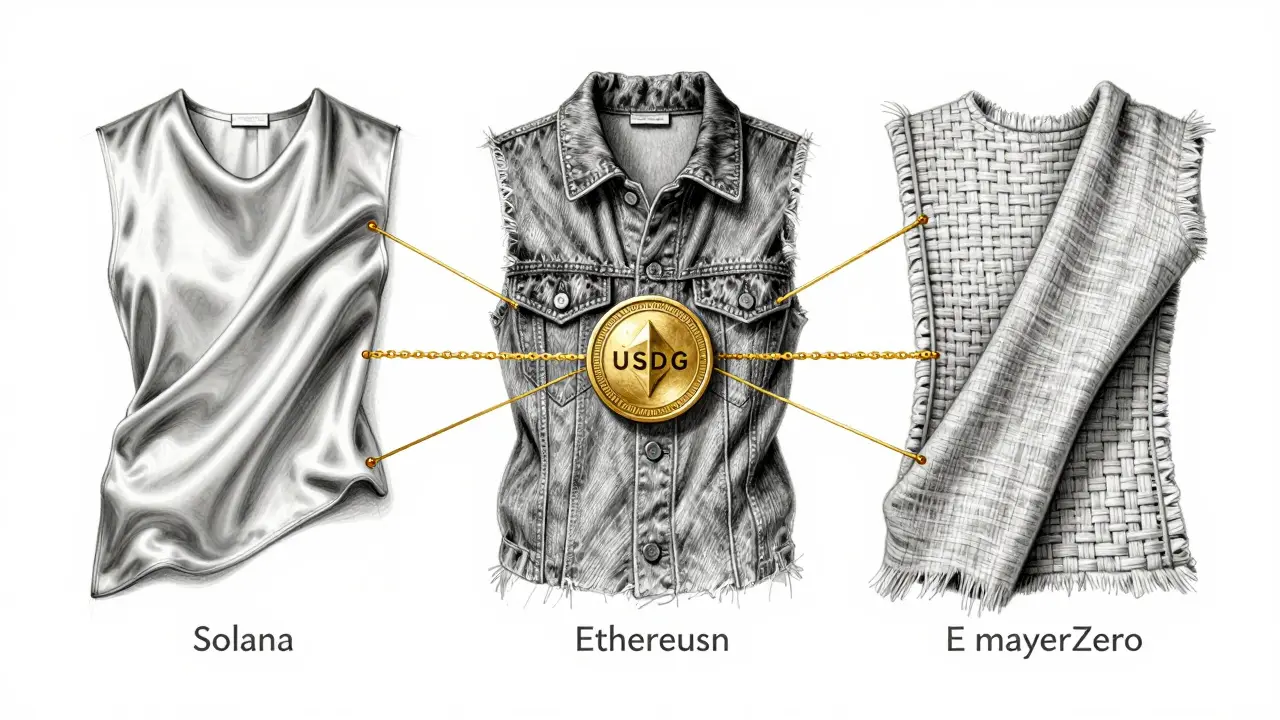
A stablecoin is only useful if it can move quickly and cheaply. USDG is built for interoperability, meaning it exists on multiple blockchain networks simultaneously. This allows users to choose the chain that best fits their needs for speed or cost.
| Blockchain Network | Token Standard | Supply Share | Key Feature |
|---|---|---|---|
| Solana | SPL Token | 57.2% | High speed, low fees |
| Ethereum | ERC-20 | 19.6% | DeFi compatibility, security |
| Ink & X Layer | Native Deployments | Growing | Emerging ecosystems |
Notice that Solana holds the majority of the supply. This makes sense because Solana offers near-instant settlement times, which is perfect for payments. However, Ethereum remains critical for decentralized finance (DeFi) applications where deep liquidity and smart contract maturity matter more than raw speed.
To bridge these chains, USDG uses LayerZero’s OFT (Omnichain Fungible Token) standard. When you send USDG from Ethereum to Solana, the original tokens are locked in a secure contract on Ethereum, and equivalent tokens (called USDG0) are minted on Solana. This ensures the total supply never exceeds the reserved cash, maintaining the 1:1 peg across all networks.
Regulatory Moat: MAS and MiCA Compliance
One of the strongest advantages USDG has over competitors is its dual-regulatory status. In a world where governments are cracking down on unregulated crypto assets, compliance is a feature, not a bug.
First, as mentioned, it is supervised by the Monetary Authority of Singapore (MAS). Second, in July 2025, USDG expanded into the European Union under the Markets in Crypto-Assets Regulation (MiCA). It is regulated by the Finnish Financial Supervisory Authority (FIN-FSA).
Why does this matter to you? If you are a business in Europe or Asia, using USDG reduces legal risk. Exchanges and payment processors in the EU are required to handle MiCA-compliant assets. This opens doors for USDG that remain closed to non-compliant stablecoins. It creates a "defensible moat"-competitors cannot easily replicate this level of regulatory approval overnight.
The Global Dollar Network (GDN): Sharing the Yield
Here is where USDG gets interesting economically. Traditional stablecoin issuers like Tether (USDT) or Coinbase (USDC) keep almost all the interest earned from their reserve investments. With USDG, the model is different.
Through the Global Dollar Network (GDN), approximately 97% of the network economics are shared with participating partners. These partners include major industry players like Robinhood, Kraken, Galaxy Digital, and recently, Mastercard.
This yield-sharing model incentivizes these companies to promote and integrate USDG. Instead of fighting against each other, they benefit when USDG grows. Mastercard’s involvement, for instance, signals intent to enable USDG transactions across its global payment network. This ecosystem approach accelerates adoption because the incentives are aligned: everyone wins when the network expands.
Market Position: How Does It Compare?
As of March 2026, USDG has a market capitalization of roughly $1.786 billion. While this sounds large, it is tiny compared to the incumbents. Tether (USDT) dominates with over $183 billion, and USDC follows with $76 billion. Even PayPal’s PYUSD sits at $4.2 billion.
So, why use USDG if it’s smaller? Liquidity and trust trade-offs. USDT has massive liquidity but has faced years of scrutiny regarding its reserve transparency. USDC is highly trusted but lacks the multi-jurisdictional regulatory depth of USDG in certain regions. USDG positions itself as the "institutional-grade" choice for those who prioritize regulatory certainty and transparent yield sharing over sheer market dominance.

Real-World Use Cases
You might be wondering, "What do I actually do with USDG?" Here are the primary scenarios where it shines:
- Cross-Border Remittances: Sending money to family overseas usually involves high fees and slow processing. With USDG, you can transfer value in minutes at a fraction of the cost, leveraging the speed of Solana or the reach of Ethereum.
- Trading Pair Stability: Traders use USDG to park funds between trades. Because it maintains a tight peg, you avoid the volatility of Bitcoin or Ethereum while keeping your capital in the crypto ecosystem.
- Enterprise Payments: Businesses can use USDG for international supplier payments. The regulatory compliance makes it easier for corporate treasury departments to approve its use compared to unregulated alternatives.
- DeFi Integration: Developers build lending and borrowing protocols on top of USDG. Users can earn yield by providing liquidity, knowing the underlying asset is securely backed.
Risks and Considerations
No financial instrument is without risk. While USDG is heavily regulated, you should still consider a few factors:
- Counterparty Risk: You are trusting Paxos and DBS Bank to manage the reserves correctly. While audits are frequent, no system is immune to failure.
- Adoption Scale: Smaller market cap means less liquidity on some exchanges. If you try to swap a very large amount of USDG quickly, you might experience slippage compared to USDT.
- Regulatory Changes: Laws change. If MAS or EU regulators alter their stance on stablecoins, USDG’s operations could face new hurdles, though its current compliance puts it in a strong position to adapt.
Conclusion: Is USDG Right for You?
Global Dollar (USDG) represents a shift toward mature, regulated cryptocurrency infrastructure. It is not designed for gamblers looking for 100x returns. It is built for users who want the efficiency of blockchain with the safety of traditional banking oversight.
If you value transparency, regulatory compliance, and a fair economic model that rewards network participants, USDG is a compelling option. It may not replace USDT or USDC entirely anytime soon, but it carves out a vital niche for institutions and individuals who demand proof of reserves and legal clarity. As the GDN expands and more chains support USDG, its utility will likely grow, making it a staple in the regulated stablecoin landscape.
Is Global Dollar (USDG) safe to hold?
USDG is considered highly safe due to its regulatory oversight by the Monetary Authority of Singapore (MAS) and the Finnish Financial Supervisory Authority (FIN-FSA). Each token is backed 1:1 by cash and short-term US Treasuries held in segregated accounts at DBS Bank. Monthly third-party audits verify these reserves, reducing the risk of de-pegging compared to less transparent stablecoins.
Can I use USDG in the European Union?
Yes. Since July 2025, USDG has been compliant with the EU’s Markets in Crypto-Assets Regulation (MiCA). This makes it one of the few stablecoins legally recognized for widespread use in European exchanges and payment systems, offering significant advantages for EU-based businesses and traders.
How does USDG differ from USDC?
While both are regulated stablecoins, USDG offers a unique yield-sharing model through the Global Dollar Network (GDN), distributing ~97% of reserve yields to partners. Additionally, USDG has dual-regulatory approval (Singapore and EU MiCA), whereas USDC is primarily regulated in the US. USDG also prioritizes multi-chain interoperability via LayerZero, allowing seamless movement between Solana, Ethereum, and other networks.
Which blockchains support USDG?
USDG is natively deployed on Ethereum (ERC-20) and Solana (SPL). It also has deployments on Ink and X Layer. Through LayerZero’s bridging technology, it is accessible on additional chains like Hyperliquid, Aptos, and Plume via the USDG0 bridged token standard.
Who issues Global Dollar (USDG)?
USDG is issued by Paxos Digital Singapore Pte. Ltd. (PDS), a Major Payments Institution supervised by the Monetary Authority of Singapore. Paxos is a well-established name in the fintech space, known for issuing other regulated digital assets.
Does USDG earn interest for holders?
Holding USDG in a standard wallet does not automatically generate interest. However, the Global Dollar Network (GDN) shares ~97% of network economics with partners like Robinhood, Kraken, and Mastercard. Retail users can earn yield by providing liquidity on supported DeFi platforms or exchanges that participate in the GDN ecosystem.
What happens if I lose my private keys for USDG?
Like all cryptocurrencies, USDG is non-custodial when held in a personal wallet. If you lose your private keys, access to your funds is permanently lost. Paxos does not have a "reset password" function for self-custodied wallets. Always store your seed phrase securely. If you hold USDG on an exchange, the exchange manages custody, but you are subject to their platform risks.
Is USDG available on Binance or Coinbase?
Availability varies by region and time. As of early 2026, USDG is actively traded on major exchanges like OKX and Bitpanda. Always check your local exchange’s listing page for the most current availability, as regulatory requirements may restrict access in certain jurisdictions.

Eric Grosso
27 May, 2026 . 06:17 AM
so is this basically just usdc but with more lawyers watching it? i mean the mas thing sounds cool but does it actually matter for a guy like me sending money to my cousin in ph?
Edith Mair
28 May, 2026 . 21:25 PM
Eric you are missing the point entirely. The regulatory moat is huge. If you think USDT or USDC are safe without strict oversight, you are living in a fantasy world. USDG has actual audits and segregated accounts at DBS. That is not just marketing fluff, that is structural integrity. Stop asking if it matters for small transfers and start understanding why institutional adoption requires this level of compliance.
Sam Dashti
29 May, 2026 . 22:02 PM
I’m digging into the Solana angle here because honestly, Ethereum fees are a joke for payments. Seeing 57% of supply on Solana makes total sense. It’s fast, it’s cheap, and it doesn’t make you feel like you’re paying rent every time you move a dollar. Plus, the LayerZero bridging means you aren’t stuck on one chain. It’s like having a universal remote for your stablecoins instead of hunting for adapters. I’ve been testing small amounts on SPL and the settlement speed is genuinely impressive compared to the sluggish ERC-20 experience.
Bill Gunn
31 May, 2026 . 09:33 AM
Great points Sam! 🚀 The interoperability via LayerZero is definitely the killer feature here. Many people overlook how much friction exists when moving assets between chains manually. By using the OFT standard, USDG solves the liquidity fragmentation problem. You can earn yield on Ethereum DeFi protocols but settle payments on Solana without losing value or waiting hours for bridges. It’s a seamless ecosystem rather than isolated silos. Don’t forget to check the monthly attestation reports though, transparency is key! 🔍
Miss Masquer
31 May, 2026 . 14:34 PM
It is fascinating to observe how the regulatory landscape is shifting towards entities that prioritize clarity over obscurity, especially when we consider the historical context of financial instruments that have failed due to lack of transparency. In Canada, we are very accustomed to rigorous banking standards, so seeing a crypto asset backed by cash equivalents in segregated accounts at a major institution like DBS Bank provides a sense of security that is often absent in the wild west of decentralized finance. The fact that they publish monthly attestations allows users to verify the reserves independently, which fosters trust in a way that algorithmic models simply cannot replicate.
Joshua Alcover
2 June, 2026 . 00:56 AM
The epistemological framework of USDG relies heavily on centralized custodial mechanisms which inherently contradict the foundational ethos of cryptographic decentralization. While the Monetary Authority of Singapore provides a veneer of legitimacy, one must question the ontological status of 'trust' in a system where third-party intermediaries hold the keys to liquidity. This is not innovation; it is merely traditional fiat banking dressed in blockchain aesthetics to appease the technocratic elite. The true sovereign individual rejects such regulated constructs.
Diana Morris
2 June, 2026 . 03:53 AM
stop overthinking it joshua. it works. fast. cheap. regulated. thats all you need. why do people always complicate simple things. just use it and move on.
Dianne Wright
2 June, 2026 . 15:26 PM
i mean everyone says they are transparent but who really checks these audits? probably just another shell game. i bet the reserves are tied up in some obscure treasury bonds that will crash next week. typical. nothing changes in finance except the names on the boxes.
trisya hazriyana
5 June, 2026 . 20:40 PM
oh sure lets pretend the audit firms are saints lol. they get paid by the issuer too. its a cozy little club. but hey if you want to play house with your money go ahead. i prefer keeping my capital in assets that dont rely on a central bank's good mood. sarcasm aside the yield sharing model is interesting though. 97% back to partners? sounds too good to be true or just smart marketing.
Debbie Lewis
7 June, 2026 . 15:48 PM
I’ve been watching the market cap growth. It’s small compared to Tether, but steady. I like that it’s not trying to be everything to everyone right now. Just solid, regulated, and useful. No hype, just utility.
Rosie Morris
8 June, 2026 . 08:07 AM
im worried about the slippage though. if i need to sell a big chunk quickly will i get screwed? the liquidity isnt there yet compared to usdt. feels risky for large amounts.
lorna erni
9 June, 2026 . 14:03 PM
Rosie you are absolutely right to be cautious about liquidity depth for large orders. However, for most retail and even mid-sized enterprise transactions, the current liquidity is sufficient. The real advantage isn't just selling speed but the ability to integrate into payment rails like Mastercard eventually. Think long term. Also, don't ignore the cross-border remittance use case where fees matter more than instant deep liquidity dumps. Let's support projects that bring real utility rather than just trading volume.
stalin brian
11 June, 2026 . 09:47 AM
hey guys i was reading about the miCA compliance in eu. is that a big deal? i live in germany and always had trouble finding stablecoins that were legal to use for business. this could change things for local traders.
kamal ifrani
13 June, 2026 . 04:18 AM
Oh wow, look at you Stalin Brian, acting like MiCA is some holy grail. It’s just another bureaucratic hurdle designed to stifle innovation and protect legacy banking interests. But sure, clap your hands because a stablecoin got a stamp of approval from Brussels. Meanwhile, the rest of the world is moving forward with actual decentralization. Typical western obsession with regulation over freedom.
saradee dee
14 June, 2026 . 22:10 PM
Kamal please stop being so negative. For many businesses in Europe, compliance is not a burden but a necessity. Being able to use a stablecoin without fearing legal repercussions is huge. It brings stability and trust to the digital economy. We should appreciate efforts to bridge the gap between crypto and traditional finance, not mock them.
Craig Swanson
15 June, 2026 . 11:18 AM
Saradee is correct. Look, I know some of you hate regulation, but if you want mass adoption, you need legal clarity. Companies won’t touch unregulated tokens for payroll or supplier payments. USDG gives them a safe harbor. If you think that’s bad, you’re fighting a losing battle. Adapt or get left behind.
Dana Rapoport
17 June, 2026 . 08:06 AM
The philosophical underpinning of regulated stablecoins suggests a convergence of state power and digital efficiency. While purists may decry this as a betrayal of crypto ideals, one must consider the pragmatic reality: safety enables scale. Without the guardrails provided by MAS and MiCA, the average user remains exposed to predatory practices and opaque reserve structures. This is not capitulation; it is evolution.
Hadleigh Edwards
18 June, 2026 . 04:12 AM
I truly believe that we are witnessing the dawn of a new era in global finance where the boundaries between traditional banking and blockchain technology begin to blur in a harmonious and beneficial manner for all participants involved in this exciting journey towards a more inclusive and efficient economic system that empowers individuals and businesses alike to transact with confidence and ease across borders without the usual delays and exorbitant fees that have plagued international payments for decades.
mark valmart
19 June, 2026 . 11:58 AM
Hadleigh man you gotta take a breath lol. But yeah, the point stands. It’s easier to send money now. That’s what matters to me.
Crystal Davis
20 June, 2026 . 13:19 PM
The yield-sharing model is fundamentally flawed because it incentivizes partners to promote the token regardless of its underlying health. It creates a conflict of interest where Robinhood and Kraken benefit from network growth rather than user protection. This is classic corporate capture disguised as community empowerment. Be wary of who holds the keys to the yield distribution.
Christina Pearce
20 June, 2026 . 21:16 PM
Crystal, while conflicts of interest are always a concern in finance, the transparency of the GDN structure allows users to see exactly how yields are distributed. It’s not hidden. And frankly, having major players like Mastercard interested is a strong signal of viability. I’d rather have regulated competition than a monopoly held by opaque entities. What alternatives do you propose that offer both safety and yield?
Barclay Chantel
22 June, 2026 . 06:09 AM
A charming attempt to sanitize the banality of modern finance with buzzwords like 'interoperability' and 'regulatory moats'. In truth, USDG is merely another cog in the machine of neoliberal control, offering the illusion of choice while reinforcing the dominance of the US dollar hegemony. One might expect more intellectual rigor from those discussing the future of money, but alas, we are left with this pedestrian exposition of compliant mediocrity.