You’ve heard the name WAGMI is a decentralized cryptocurrency exchange built on the Metis Layer 2 network, offering non-custodial trading with low gas fees but limited liquidity. Also known as WAGMI Metis DEX, it operates without fiat on-ramps and serves niche users seeking fast, cheap swaps within the Metis ecosystem., maybe because of the catchy acronym or the growing buzz around Layer 2 solutions. But here’s the hard truth: WAGMI isn’t your typical crypto exchange. It doesn’t hold your money. It doesn’t offer credit card deposits. And if you try to move a large amount of capital through it, you might lose more to slippage than you save on fees.
So, who is this platform actually for? If you’re looking to trade Bitcoin or Ethereum with high volume, you’re likely in the wrong place. But if you’re deep into the Metis ecosystem, trying to swap small amounts of native tokens like METIS for stablecoins like USDC, WAGMI might just be the most cost-effective tool in your belt. This review cuts through the hype to tell you exactly what works, what breaks, and whether WAGMI deserves a spot in your digital wallet in 2026.
The Core Identity: What Exactly Is WAGMI?
First things first: let’s clear up the confusion. There is MetisDAO is the governance protocol behind the Metis Network, issuing the METIS token used for staking and voting. and there is WAGMI Exchange is a separate decentralized trading platform that utilizes Metis infrastructure but operates independently from the DAO.. They are not the same thing. WAGMI is a decentralized exchange (DEX) launched in 2023, incorporated in the United Arab Emirates. It sits on top of the Metis Layer 2 blockchain, which is designed to scale Ethereum by processing transactions faster and cheaper.
Unlike centralized giants like Binance or Coinbase, WAGMI is non-custodial. That means you never give up control of your funds. You connect your wallet-like MetaMask or WalletConnect-and trade directly from it. The platform currently supports only four cryptocurrencies and eight trading pairs. Yes, you read that right. Four coins. In a market with thousands of assets, this sounds limiting. But for specific use cases, particularly those involving Metis-native assets, it fills a gap that larger, more generalist exchanges often ignore.
Fees, Speed, and the Cost of Doing Business
Let’s talk numbers, because that’s usually why people look at Layer 2 DEXs. WAGMI boasts a tiered fee structure ranging from 0.05% to 1%, depending on your trading volume and status. For the average user, the standard fee hovers around 0.3%. On paper, this looks competitive, especially when compared to Uniswap’s standard 0.3% fee on Ethereum mainnet.
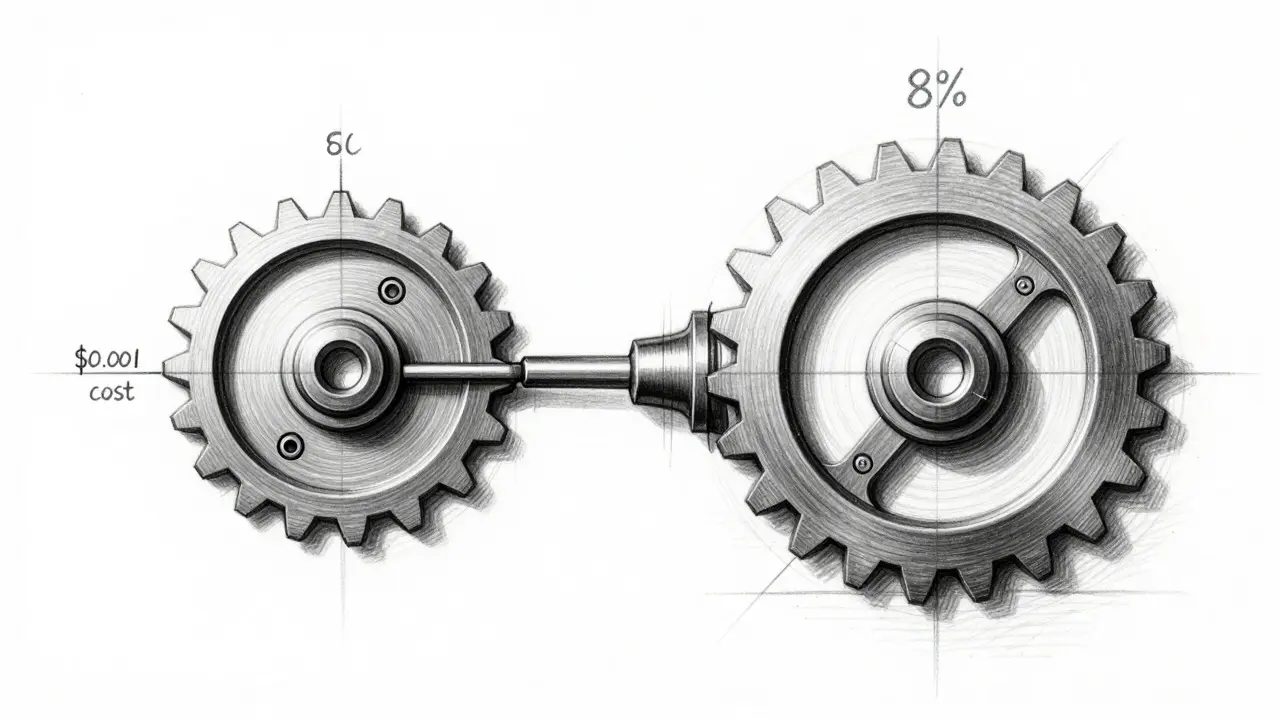
But the real magic happens with gas fees. Because WAGMI runs on Metis, an optimistic rollup solution, transaction costs are negligible. We’re talking about an average of $0.001 per transaction. Compare that to Ethereum mainnet, where gas can spike to $5, $10, or even $50 during peak times. If you’re making frequent small trades, these savings add up quickly.
Speed is another major advantage. Metis offers transaction finality in 1-2 minutes, whereas Ethereum can take 15 minutes or more. For active traders, waiting half an hour for a confirmation is unacceptable. WAGMI delivers near-instant settlement, making it feel responsive and modern. However, don’t mistake speed for capacity. While the platform handles 12-15 transactions per second (TPS) during peak hours, this is significantly lower than Arbitrum-based DEXs that process 50-75 TPS. So, while it’s fast for individual users, it may struggle under massive network-wide congestion.
| Feature | WAGMI (Metis) | Uniswap v3 | PancakeSwap |
|---|---|---|---|
| Standard Fee | 0.3% | 0.3% | 0.25% |
| Avg. Gas Fee | $0.001 | $2 - $50+ (Ethereum) | $0.10 - $0.50 (BNB Chain) |
| Transaction Finality | 1-2 Minutes | 15+ Minutes (L1) | ~3 Seconds |
| Coin Selection | 4 Cryptocurrencies | 10,000+ | 8,000+ |
| Daily Volume | $1.2 Million | $1.2 Billion | $850 Million |
The Liquidity Trap: Why Big Trades Fail
Here is the catch that trips up most new users: liquidity. WAGMI ranks in the 29th percentile for orderbook depth among decentralized exchanges. What does that mean for you? It means there aren’t enough buyers and sellers waiting on the other side of your trade.
If you try to swap $100 of METIS for USDC, you’ll likely get a great rate with minimal slippage. But if you try to move $10,000, you might experience slippage of 8% or more. Slippage is the difference between the expected price of a trade and the executed price. High slippage means you’re getting fewer tokens than you anticipated because you’ve exhausted the available orders at good prices.
User 'MetisTrader88' on Reddit reported losing significant value due to 8.2% slippage on a $10,000 trade. Expert analysis from the Blockchain Research Institute confirms this, noting that trades exceeding $5,000 face an average slippage of 2.3%, compared to the industry standard of 0.5% on deeper platforms. If you are a whale or even a moderate trader, WAGMI is currently too shallow for your needs. Stick to trades under $2,000 to stay safe.
Security and Trust: Who Watches the Watchers?
In the world of DeFi, security isn’t just a feature; it’s the product. WAGMI has had its smart contracts audited by CertiK, a reputable security firm. The audit report (#METIS-WAGMI-2024-087) passed, which is a good sign. It means the code itself doesn’t have obvious backdoors or critical bugs.
However, passing an audit doesn’t guarantee safety against all threats. More importantly, WAGMI lacks an insurance fund. Protocols like Aave have millions of dollars in safety coverage to protect users in case of exploits. WAGMI has nothing. If a hacker finds a way to drain the pools, your funds are gone. There is no customer service hotline to call, no CEO to sue. You are on your own.
Regulatory-wise, WAGMI operates under the Dubai Virtual Assets Regulatory Authority (VARA). As of July 2025, VARA requires KYC (Know Your Customer) verification for transactions over $1,000. Interestingly, WAGMI’s October 2025 transparency report states they currently operate without KYC. This puts them in a gray area. While it appeals to privacy advocates, it could pose compliance risks in the future if regulators crack down harder on anonymous DEXs.
User Experience: Easy Setup, Hard Support
Getting started with WAGMI is straightforward. If you already use MetaMask, you’re halfway there. The learning curve is rated 'easy' by CryptoSlate, with setup taking about 8-12 minutes. You simply connect your wallet, select the token pair, and approve the transaction. The interface is clean, responsive, and works well on both desktop and mobile devices.
But what happens when things go wrong? Support is virtually non-existent. There is no live chat, no ticket system. You have two options: a Telegram group with 1,247 members or an email address. User reports indicate an average response time of 32 hours via email. During network congestion, which causes failed transactions in 17% of user experiences, you’re largely left to troubleshoot yourself. The common fix? Increase your gas fee to 1.2-1.5x the standard rate. The documentation helps with basic swaps but offers little guidance on troubleshooting complex issues.
Is WAGMI Worth Using in 2026?
WAGMI occupies a very specific niche. It is not a replacement for Binance, Uniswap, or PancakeSwap. It is a specialized tool for participants in the Metis ecosystem. If you are holding METIS tokens and want to swap them for stablecoins quickly and cheaply, WAGMI is excellent. The low fees and fast finality make it superior to bridging back to Ethereum mainnet just to use a larger DEX.
However, if you are looking for diversity, advanced features like limit orders, or deep liquidity for large trades, look elsewhere. The platform’s TVL has dropped 22% since Q2 2025, and analysts predict further consolidation in the Metis DEX space. With competitors like Netswap and mSwap holding the majority of the ecosystem’s volume, WAGMI faces an uphill battle.
That said, their roadmap includes integration with Chainlink’s CCIP for cross-chain transfers and the addition of concentrated liquidity pools by early 2026. These updates could improve liquidity and utility. Until then, treat WAGMI as a lightweight, low-cost bridge for small Metis-native trades, not a primary trading hub.
Is WAGMI (Metis) a centralized or decentralized exchange?
WAGMI is a fully decentralized exchange (DEX). It is non-custodial, meaning you retain control of your private keys and funds at all times. Trades occur directly on the Metis blockchain via smart contracts, without intermediaries holding your assets.
What are the trading fees on WAGMI?
WAGMI uses a tiered fee structure ranging from 0.05% to 1%. The standard fee for most users is 0.3%. Additionally, gas fees on the Metis network are extremely low, averaging around $0.001 per transaction.
Can I deposit fiat currency (USD, EUR) on WAGMI?
No, WAGMI does not support fiat on-ramps. You must already possess cryptocurrency in a compatible wallet (like MetaMask) and bridge it to the Metis network before you can trade on the platform.
How much slippage should I expect on WAGMI?
For small trades (under $2,000), slippage is typically minimal. However, for larger trades exceeding $5,000, slippage can reach 2.3% or higher, with some users reporting up to 8% on $10,000 trades due to low liquidity depth.
Is WAGMI secure and audited?
Yes, WAGMI’s smart contracts have been audited by CertiK. However, unlike some larger protocols, it does not have an insurance fund to cover losses in the event of a hack or exploit. Users trade at their own risk.
Which wallets are compatible with WAGMI?
WAGMI supports any Ethereum-compatible wallet that can interact with the Metis Layer 2 network. Popular options include MetaMask, WalletConnect, and Trust Wallet. You will need to configure your wallet to use the Metis RPC settings (Chain ID 1088).
Why is the coin selection so limited on WAGMI?
As a niche DEX focused on the Metis ecosystem, WAGMI prioritizes depth over breadth. It currently lists only 4 cryptocurrencies and 8 trading pairs to maintain manageable liquidity pools. Expanding too quickly without sufficient capital can lead to severe slippage issues.