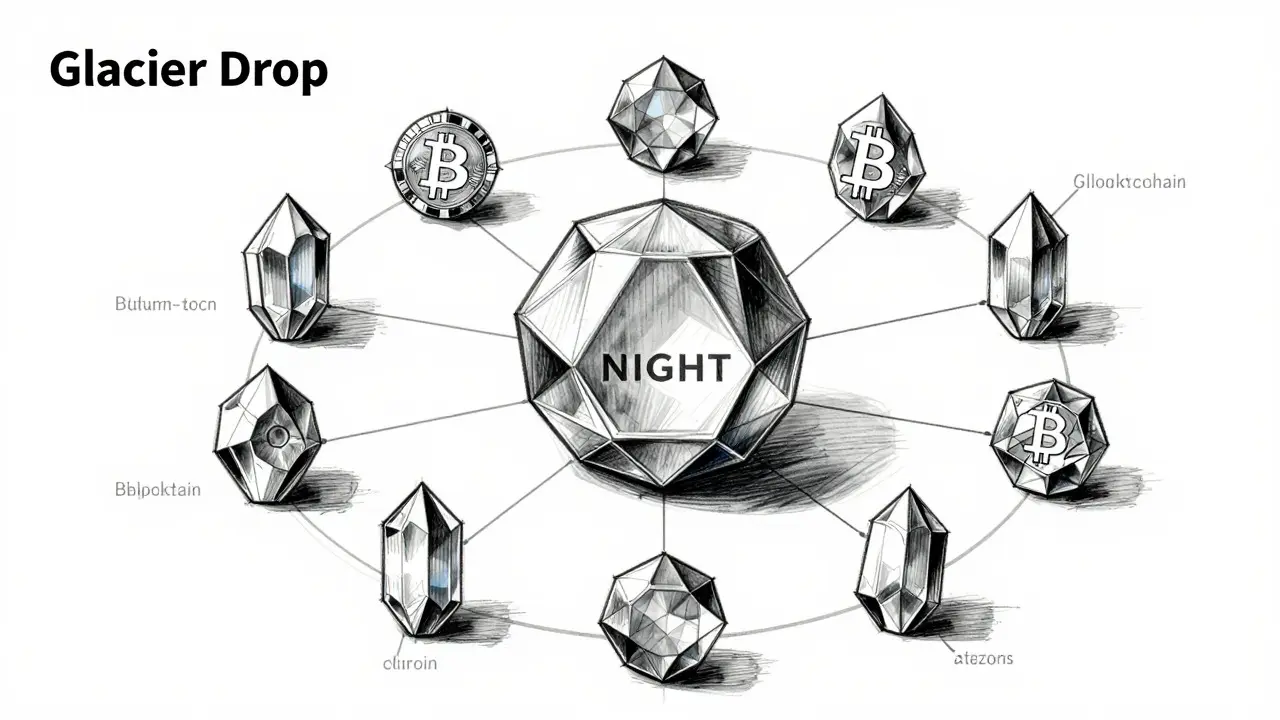
Imagine holding crypto on eight different blockchains and getting paid for it. That is exactly what the Midnight Network did with its NIGHT token distribution. Known as the "Glacier Drop," this initiative launched in August 2025 and represents one of the largest airdrops in recent history. It distributed 24 billion tokens to nearly 34 million eligible addresses. If you are looking for details on how it worked, who qualified, and what happens next, this guide breaks down the mechanics without the fluff.
What Is Midnight and Why Does It Matter?
Midnight Network is a privacy-centric sidechain built within the Cardano ecosystem. Unlike main chains that prioritize total transparency, Midnight focuses on "rational privacy." This means users can choose when to disclose data, balancing utility with protection. The project was championed by Charles Hoskinson, the founder of Cardano, aiming to solve the tension between public verification and user privacy.
The network uses two key assets. First, there is NIGHT, the native utility token used for governance and staking. Second, there is DUST, a resource token used to pay transaction fees. This dual-token model creates a specific economic structure where NIGHT holders engage in long-term network activities, while DUST handles daily operational costs.
Eligibility: Who Could Claim the Tokens?
The Glacier Drop wasn't open to everyone. Eligibility was determined by a snapshot taken on June 11, 2025. To qualify, your wallet needed to hold at least $100 worth of cryptocurrency in the native asset of any supported chain at that exact moment. This threshold filtered out bot accounts and dust wallets while keeping the door open for genuine retail investors.
The supported ecosystems included eight major networks:
- Bitcoin (BTC)
- Ethereum (ETH)
- Ripple (XRP)
- Solana (SOL)
- Avalanche (AVAX)
- BNB Chain (BNB)
- Brave (BAT)
- Cardano (ADA)
If you held crypto on multiple chains, you could potentially claim from each one. However, the allocation wasn't equal. Cardano holders got the biggest slice. Specifically, 50% of the total supply (12 billion NIGHT tokens) was reserved exclusively for ADA holders. Bitcoin holders received 20%, and the remaining 30% was split proportionally among the other six chains based on their dollar value at the snapshot time.
The Claiming Process: Steps and Requirements
Claiming NIGHT tokens required a bit more effort than just clicking a button. The process ran through a 60-day window that closed on October 4, 2025. Here is how it worked:
- Connect Your Wallet: Users connected their existing wallet (like MetaMask or Eternl) to the official portal at midnight.gd.
- Prove Custody: You had to sign a message to prove you controlled the private keys. This step excluded most centralized exchange accounts unless the exchange acted on your behalf.
- Provide a Cardano Address: Even if you were an Ethereum holder, you had to provide a fresh, unused Cardano wallet address to receive the tokens. This ensured all NIGHT tokens landed on the Cardano network.
This two-step cryptographic proof prevented Sybil attacks and ensured only legitimate holders claimed their rewards. For many users, the friction came from needing to set up a Cardano wallet if they didn't already have one. Despite this, the system successfully verified millions of participants across different blockchain ecosystems.
Vesting Schedule: When Can You Sell?
Unlike typical airdrops that give you immediate liquidity, NIGHT tokens follow a strict vesting schedule. This design aims to prevent speculative dumping and encourage long-term participation. Once you claimed your tokens, they were locked in a smart contract.
| Phase | Unlock Percentage | Timing |
|---|---|---|
| Initial Lock | 0% | From Mainnet Launch |
| First Unlock | 25% | 90 Days Post-Launch |
| Second Unlock | 25% | 180 Days Post-Launch |
| Third Unlock | 25% | 270 Days Post-Launch |
| Final Unlock | 25% | 360 Days Post-Launch |
Note that the clock starts ticking only after the Midnight mainnet launches, not from the date you claimed the tokens. Each unlock event is randomized within its 90-day window to avoid coordinated selling pressure. This "gradual thawing" approach signals that the project values sustained network health over short-term price spikes.
What Happened to Unclaimed Tokens?
Since the claiming window closed on October 4, 2025, any NIGHT tokens left unclaimed did not vanish. Instead, they moved into a cascading recovery mechanism. Phase two is called the "Scavenger Mine." In this phase, participants solve computational puzzles to earn a share of the remaining allocation. This serves a dual purpose: distributing leftover tokens and bootstrapping essential network infrastructure through useful computation.
If tokens survive the Scavenger Mine, they move to phase three, known as "Lost-and-Found." This acts as a final safety net after mainnet launch for users who missed earlier phases. This three-phase structure ensures that the entire 24 billion token supply eventually enters circulation through community participation, rather than staying locked in a central treasury.

Why This Airdrop Stands Out
The Midnight Glacier Drop differs from standard crypto distributions in several key ways. First, its cross-chain scope is rare. Most airdrops target a single community, but Midnight reached out to holders across eight major ecosystems. Second, the eligibility criteria were purely algorithmic. There were no social media tasks or point systems; it was strictly about holding value at a specific time. Third, the extended vesting period shows a commitment to long-term development. By locking tokens for a year, the project reduces the risk of a massive sell-off immediately after launch, which has plagued many previous token releases.
Frequently Asked Questions
Is the Midnight NIGHT airdrop still open?
No, the primary claiming window for the Glacier Drop closed on October 4, 2025. However, unclaimed tokens are now part of the Scavenger Mine phase, offering new opportunities for participants to earn allocations through computational puzzles.
Do I need a Cardano wallet to claim NIGHT tokens?
Yes. Even if you qualified via Bitcoin or Ethereum holdings, you were required to provide a fresh, unused Cardano wallet address to receive your NIGHT tokens. All NIGHT tokens reside on the Cardano network.
When do NIGHT tokens become tradable?
Tokens begin unlocking 90 days after the Midnight mainnet launch. They unlock in four equal tranches every 90 days until full liquidity is reached at 360 days post-launch.
Who was eligible for the Glacier Drop?
Holders of at least $100 worth of BTC, ETH, XRP, SOL, AVAX, BNB, BAT, or ADA in self-custody wallets as of the June 11, 2025 snapshot were eligible. Addresses on the OFAC SDN list were excluded.
What is the difference between NIGHT and DUST tokens?
NIGHT is the native utility token used for governance and staking on the Midnight Network. DUST is a separate resource token used specifically to pay for transaction fees, creating a dual-token economic model.