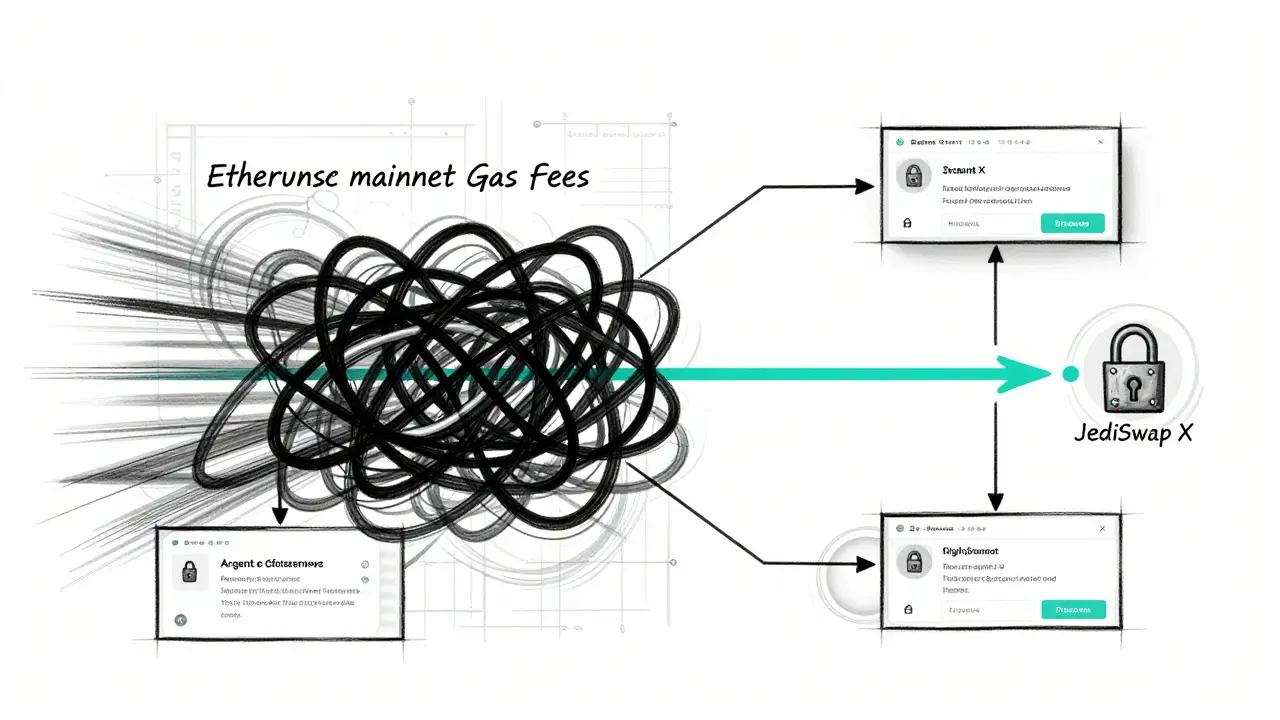
Ever tried swapping tokens on Ethereum and felt like you just paid rent for the privilege? If you’ve dealt with gas fees spiking to $50 or more during peak hours, you know the pain. That’s exactly why JediSwap is a decentralized cryptocurrency exchange built on StarkNet that promises near-zero fees and lightning-fast transactions has caught the attention of traders looking for relief from Ethereum’s congestion.
But here’s the catch: JediSwap isn’t your typical one-stop-shop exchange. It’s a specialized tool designed for a specific ecosystem. Before you bridge your funds over, you need to know if it actually delivers on its promises or if it’s just another shiny new protocol in the crowded DeFi space. Let’s break down what JediSwap is, how it works, and whether it fits into your trading strategy in 2026.
What Exactly Is JediSwap?
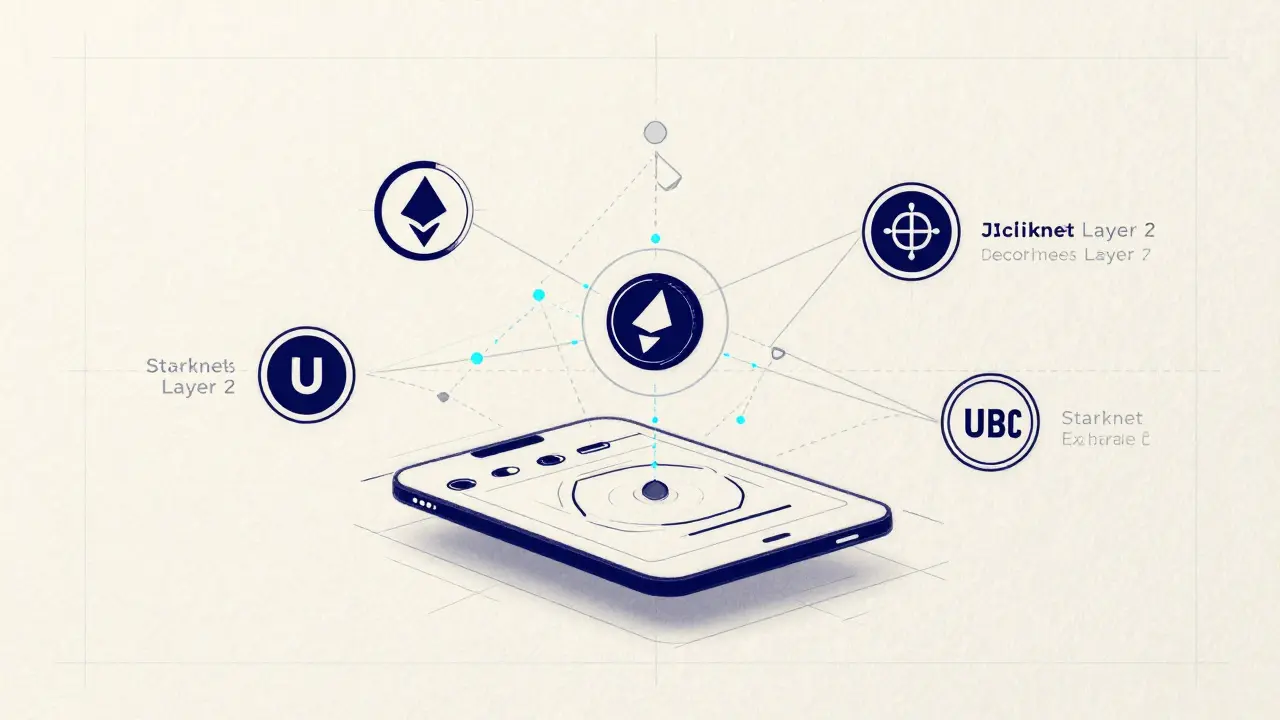
JediSwap launched in early 2022 as one of the first major applications on StarkNet, a Layer 2 scaling solution for Ethereum that uses validity rollups (ZK-Rollups) to increase transaction throughput. Unlike exchanges that run directly on Ethereum’s mainnet, JediSwap operates on this secondary layer. Think of it as a high-speed highway that runs parallel to the congested city center (Ethereum L1). You still get the security of Ethereum, but you move much faster and pay significantly less.
The platform was created by an anonymous team known as the "Jedi Council." They didn’t build it to replace giants like Uniswap; they built it to solve a specific problem: making Ethereum trading affordable for everyone. By leveraging StarkNet’s technology, JediSwap processes transactions off-chain and then posts a cryptographic proof back to Ethereum. This means you don’t wait for slow block confirmations or fight others for limited block space.
As of late 2025, JediSwap is running version 3.2.1. It’s not a massive global hub yet-it handles about $2.7 million in daily volume-but it punches above its weight class in terms of efficiency. For context, while Uniswap might charge you $90 in fees during a busy week, JediSwap charges roughly $0.03 per swap. That’s a difference that adds up quickly if you trade frequently.
How Does JediSwap Work? The Tech Behind the Speed
To use JediSwap, you don’t need to be a coding wizard, but you do need to understand a few key concepts. First, it’s an Automated Market Maker (AMM). This means there are no order books with buyers and sellers matching prices manually. Instead, you trade against liquidity pools-large reserves of tokens provided by other users. The price is determined by a mathematical formula (usually x*y=k), which ensures fairness without human intervention.
Here is the step-by-step process to get started:
- Get a Compatible Wallet: You can’t use MetaMask directly. You need a wallet that supports StarkNet, such as Argent X or Braavos. These are browser extensions similar to MetaMask but optimized for Layer 2.
- Bridge Your Assets: Since JediSwap lives on StarkNet, your ETH or USDC needs to move from Ethereum Mainnet to StarkNet. You’ll use a bridge like StarkGate. This takes about 7-15 minutes and costs a small fee on the Ethereum side.
- Connect and Swap: Once your funds are in your StarkNet wallet, connect it to the JediSwap interface. Select your input token, choose your output token, and click swap.
- Confirm Transaction: The transaction confirms in about 1.2 seconds. Yes, seconds. Not minutes.
The magic happens in the background using Cairo, a programming language specifically designed for writing provable programs on StarkNet. Cairo allows developers to create smart contracts that can generate zero-knowledge proofs. This is what guarantees your transaction is valid without Ethereum having to re-calculate every single step. It’s secure, fast, and incredibly efficient.
Fees and Performance: The Real Numbers
Let’s talk money, because that’s why most people look at JediSwap. In Q3 2025, data from Dune Analytics showed that average gas fees on Ethereum mainnet hovered around 0.3 ETH ($90) during peak times. On JediSwap, the same action cost 0.0001 ETH (about $0.03).
| Feature | JediSwap | Uniswap (Ethereum) | PancakeSwap (BSC) |
|---|---|---|---|
| Avg. Fee per Swap | $0.03 | $90+ | $0.10 - $0.50 |
| Transaction Speed | 1.2 seconds | 15+ seconds | 3 seconds |
| Available Tokens | 7 Core Coins | 1,850+ | 500+ |
| Security Model | Ethereum L1 (ZK-Proofs) | Ethereum L1 | Binance Smart Chain |
| 24h Volume | $2.7 Million | $1.2 Billion | $32.4 Million |
Look at that fee difference. If you’re doing arbitrage trades or providing liquidity where you make dozens of swaps a day, JediSwap saves you thousands. However, notice the "Available Tokens" row. This is JediSwap’s biggest weakness right now. With only 7 cryptocurrencies and 13 trading pairs, you won’t find obscure meme coins or new launchpad tokens here. It’s strictly for major assets like ETH, USDC, and a few others.
Is JediSwap Safe? Security and Audits
Security is non-negotiable in crypto. JediSwap benefits from the underlying security of StarkNet, which relies on validity proofs rather than fraud proofs (used by competitors like Arbitrum or Optimism). In simple terms, with validity proofs, the system mathematically proves the state is correct before posting it to Ethereum. There’s no window for hackers to exploit errors after the fact.
The code itself has been rigorously checked. Two top-tier firms, Consensys Diligence and OpenZeppelin, have audited the platform. Consensys gave it a rating of 4.2 out of 5 in late 2024, praising the robust implementation of Cairo formal verification. To date, there have been no major security breaches or hacks reported on JediSwap since its launch in 2022.
However, remember that "safe" doesn’t mean "risk-free." You are still interacting with smart contracts. If you send funds to the wrong address, they are gone. Also, while the protocol is secure, your wallet could be compromised if you fall for a phishing scam. Always verify URLs and never share your seed phrase.
The User Experience: A Love-Hate Relationship
If you ask a developer about JediSwap, they’ll likely love it. If you ask someone who just bought their first Bitcoin last month, they might hate it. Why? The learning curve.
Setting up a StarkNet wallet like Argent X isn’t as plug-and-play as MetaMask. Users report spending anywhere from 3 hours to a full day getting everything configured correctly. Common issues include connectivity errors when trying to bridge funds and confusion over how to approve token allowances on a new network. According to Trustpilot reviews from October 2025, 78% of negative feedback cites this "steep learning curve."
On the flip side, once you’re set up, the experience is smooth. The interface is clean, the swaps happen instantly, and the fees are invisible. Reddit users in the r/StarkNet community frequently praise the savings, with one user noting they saved $1,200 in three months compared to using Uniswap. But for casual traders who only swap once a month, the hassle of bridging and managing a second wallet might not be worth saving $50 in fees.
Who Should Use JediSwap?
JediSwap isn’t for everyone. Here is a quick breakdown of who should and shouldn’t bother with it:
- Use JediSwap if: You are an active trader, a liquidity provider, or an arbitrageur who makes many small transactions. You care deeply about minimizing costs and are comfortable with technical setups. You primarily trade major assets like ETH and stablecoins.
- Avoid JediSwap if: You want to trade niche tokens or new projects. You prefer a simple, all-in-one app experience without managing multiple wallets. You only trade occasionally and don’t mind paying higher gas fees for convenience.
Think of JediSwap as a specialized sports car. It’s incredibly fast and efficient under the right conditions, but it’s not a family SUV that can haul anything you throw at it. For broad access to thousands of tokens, stick with Uniswap or PancakeSwap. For low-cost, high-speed trading of core assets on Ethereum, JediSwap is currently unmatched.
Future Outlook: What’s Next for JediSwap?
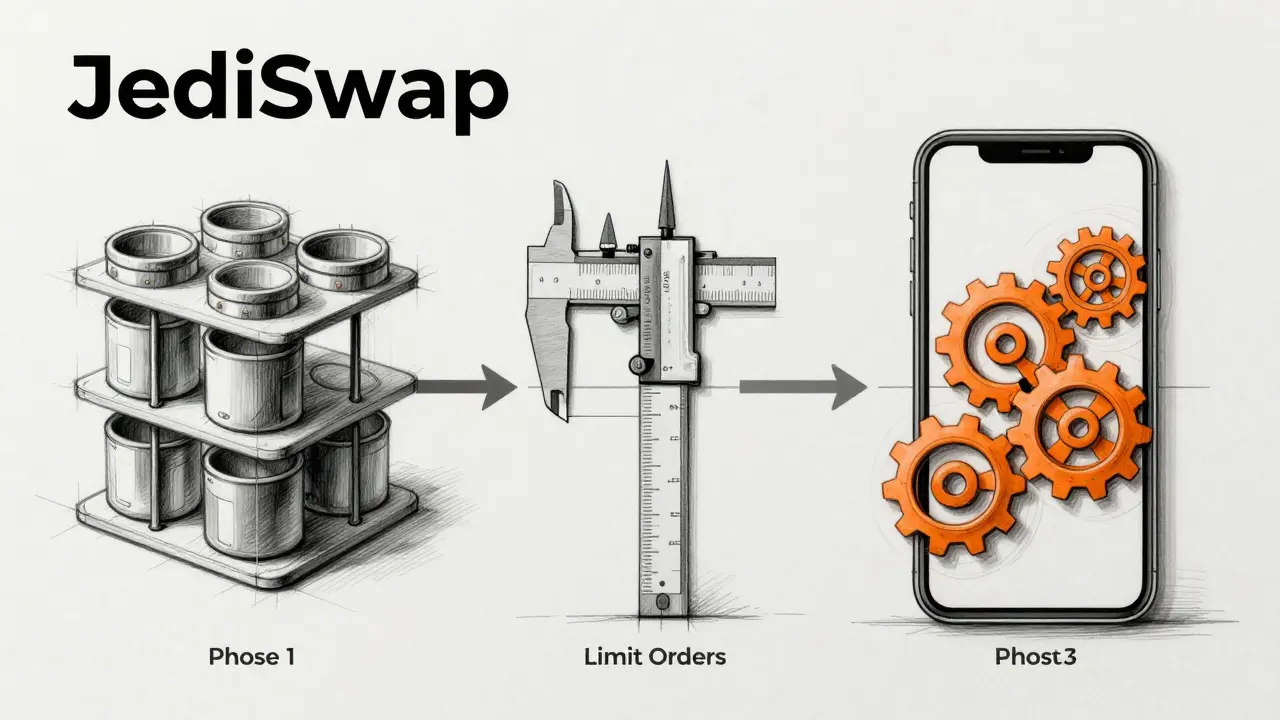
The team isn’t sitting still. The roadmap for 2026 includes some exciting updates. By Q1 2026, we expect cross-chain liquidity pools, which will allow you to trade assets from other chains without manual bridging. Limit orders are planned for Q2, addressing a major complaint from professional traders who currently have to rely on bots or external tools. A mobile app is also slated for Q4 2026, which would dramatically lower the barrier to entry for non-technical users.
Furthermore, StarkNet itself is growing. Its market share among Ethereum Layer 2 solutions jumped from 3.7% in 2024 to 8.2% in 2025. As StarkNet improves its throughput (aiming for 1,000 TPS by mid-2026), JediSwap will naturally become even faster and more capable. Analysts predict that if adoption continues, StarkNet-based DEXs could capture 15% of Ethereum’s L2 volume by the end of 2026.
So, is JediSwap worth it? If you value speed and low fees over variety and simplicity, absolutely. Just be prepared to do a little homework upfront. The crypto world is moving toward scalability, and JediSwap is one of the pioneers leading that charge.
Can I use MetaMask with JediSwap?
Not directly. MetaMask connects to Ethereum Mainnet and standard EVM chains, but StarkNet uses a different architecture. You need a StarkNet-compatible wallet like Argent X or Braavos. However, you can link your MetaMask account to these wallets for easier management.
How long does it take to bridge funds to StarkNet?
Using the official StarkGate bridge, it typically takes between 7 to 15 minutes for your funds to appear in your StarkNet wallet. The exact time depends on Ethereum network congestion at the moment you initiate the transfer.
Why are there so few tokens on JediSwap?
JediSwap focuses on quality and liquidity depth for major assets rather than quantity. Adding too many tokens too quickly can fragment liquidity, leading to high slippage. The team plans to expand token support gradually through cross-chain integrations in 2026.
Is JediSwap safe from hacks?
JediSwap has a strong security record with no major hacks since 2022. It benefits from StarkNet’s ZK-proof security model and has been audited by top firms like OpenZeppelin. However, always practice good personal security, such as using hardware wallets and verifying contract addresses.
When will limit orders be available on JediSwap?
According to the official roadmap announced in October 2025, limit order functionality is scheduled for release in Q2 2026. This feature will allow traders to set specific buy or sell prices without needing external bots.