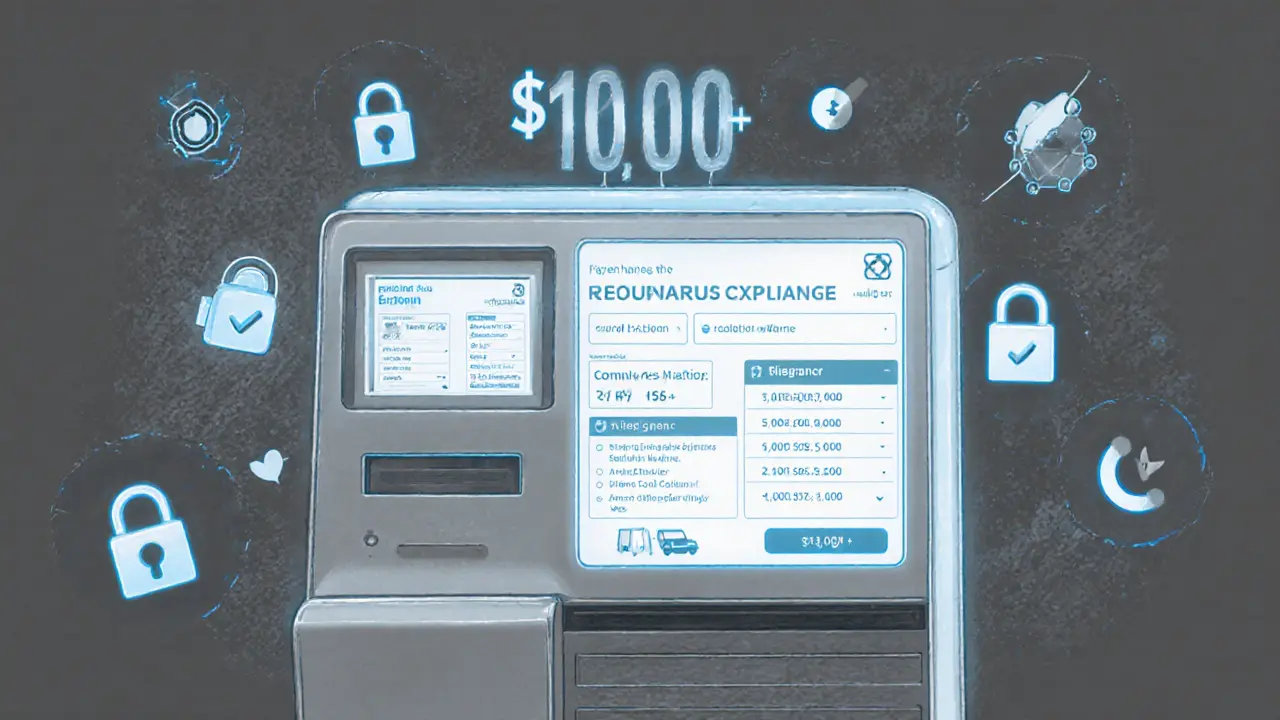
Travel Rule Compliance Cost Calculator
How It Works
This calculator estimates your compliance costs based on transaction volume and region-specific requirements. The FATF Travel Rule requires sharing sender/receiver information for transactions over $1,000. Costs vary by region due to different thresholds and regulations.
By 2025, if you're running a crypto exchange, wallet service, or even trading large amounts of Bitcoin or Ethereum, you're already operating under strict international AML rules. These aren't suggestions. They're legally binding requirements enforced across 189 countries. The crypto AML standards you're dealing with today were shaped by the Financial Action Task Force (FATF) in 2019, and since then, they've become harder, faster, and more technical than most people realize.
What the FATF Actually Requires
The FATF didn't just make up rules out of thin air. They took the same anti-money laundering laws that banks have followed for decades and forced them to work for crypto. The centerpiece? The Travel Rule. This rule says that any time you send more than $1,000 in crypto, you must share the sender's and receiver's names, account numbers, and addresses with the receiving platform. It sounds simple, but it breaks the myth that crypto is anonymous. If you're sending Bitcoin from Coinbase to Binance and it's over $1,000, both platforms are legally required to exchange this data through secure channels.Before 2019, most crypto platforms didn't collect this info. Now, they have to. And they're not doing it manually. Companies like Notabene and Chainalysis built entire software systems just to handle this data transfer. If you're a small exchange trying to comply, you're looking at $150,000 to $500,000 in setup costs, plus ongoing maintenance. That's why many smaller players either shut down or got bought by bigger firms.
How Different Regions Handle It
The FATF sets the global baseline, but countries add their own twists. The U.S. requires information sharing for transactions over $3,000 - higher than the FATF’s $1,000 threshold. That means if you're sending $2,500 from the U.S. to Europe, your U.S. exchange might not send your data, but the European exchange will still demand it. This mismatch causes delays, failed transfers, and frustrated users.The European Union went further with MiCA - Markets in Crypto-Assets regulation - which fully took effect in December 2024. Under MiCA, any company offering crypto services in the EU must get official authorization before operating. That means submitting detailed risk assessments, internal control systems, and proof they can monitor transactions in real time. The European Banking Authority handed over AML oversight to a new EU AML Authority on December 31, 2025. So now, there's one central body watching crypto firms across all 27 EU countries.
Japan takes a different approach. Their Financial Services Agency requires exchanges to register, but allows domestic transfers under ¥1 million (about $6,500) without full identity checks. This creates a loophole where users can move smaller amounts without KYC, but anything bigger triggers full compliance. It's a compromise between privacy and control.
The Real Cost of Compliance
Most people think AML compliance is just about asking users for ID. It's not. It's about building systems that watch every transaction, flag suspicious patterns, and report them automatically. According to ACAMS, the average crypto firm spends €287,000 just to implement the Travel Rule. That includes hiring compliance officers, buying software, training staff, and running audits.One exchange in Australia told me they hired seven full-time compliance staff after hitting 1 million monthly transactions. Their AI system scans 15,000 transactions per second, checking against global sanctions lists, known darknet addresses, and suspicious behavior patterns. A single misstep - like missing a flagged wallet - could cost them their license.
And the learning curve is steep. To become a certified AML specialist in crypto, you need 120 to 150 hours of study and pass a 120-question exam with at least a 70% score. Most compliance officers start with traditional banking backgrounds and retrain. There's no shortcut.

Who’s Getting It Right - And Who’s Not
The data shows a clear divide. Regulated exchanges like Kraken and Coinbase, which invest heavily in compliance, see fewer user complaints and attract more institutional investors. Coinbase’s 2023 Transparency Report showed a 73% drop in illicit transactions after upgrading their AML tools. Their Trustpilot rating stayed at 4.1 stars, with only 12% of negative reviews mentioning verification issues.Meanwhile, Binance - which didn’t fully comply in many jurisdictions - saw 41% of its 14,382 Trustpilot reviews complain about slow or excessive verification. Their 2.8-star rating reflects user frustration, not just bad service. Users don’t hate KYC. They hate when it’s slow, confusing, or inconsistent.
Smaller platforms are getting crushed. A CoinDesk survey found that 78% of crypto businesses listed compliance costs as their third-highest expense, right after staffing and security. Many couldn’t afford the upgrade and left the market. The number of crypto exchanges implementing Travel Rule tech jumped from 29 in 2021 to 73 of the top 100 by 2023. That’s not growth - that’s consolidation.
What’s Coming Next
The FATF updated its guidance in February 2024 to include DeFi platforms and NFT marketplaces - but only if they have centralized control. That means if a DeFi protocol lets users trade tokens without any company behind it, it’s not a VASP. But if a company runs a DeFi app that holds user funds or sets trading rules, it’s now subject to the same rules as Coinbase.Central banks are experimenting with something called "compliance-by-design." Imagine a stablecoin like USDC built so that every transaction automatically checks AML rules at the protocol level. No software needed. No manual checks. The blockchain itself enforces the rules. The Bank for International Settlements is testing this with digital euro and digital yen pilots.
By 2026, the IMF predicts 95% of all crypto transactions will happen on fully compliant platforms. That’s up from 68% in 2023. The market for crypto compliance tools is expected to grow from $1.2 billion in 2023 to $4.7 billion by 2027. Big players like LexisNexis and Oracle are buying up smaller compliance firms to get in.

The Big Problems Still Left Unsolved
Despite all the progress, two huge gaps remain. First, peer-to-peer (P2P) trades. If you send crypto directly from your wallet to someone else’s wallet - no exchange involved - there’s no one to collect or share data. The FATF’s 2024 report admitted only 27% of countries even try to monitor these transactions. That’s where most illicit activity still hides.Second, the lack of global tech standards. Right now, every compliance vendor uses a different data format. One exchange uses Notabene’s system, another uses Chainalysis, and a third uses a custom-built tool. They don’t talk to each other well. That’s why transfers sometimes fail even when both sides are compliant. The International Organization for Standardization is working on ISO 24165 - a universal protocol for Travel Rule data exchange - expected to be finalized in mid-2025. If it works, it’ll fix most interoperability issues.
Then there’s the privacy debate. Harvard professor Cynthia Dwork argues that current AML tools give a false sense of security. They collect tons of personal data, but don’t stop the most sophisticated criminals - who use mixers, privacy coins, or cross-chain bridges. She says the system punishes regular users while leaving bad actors a few steps ahead.
What This Means for You
If you're a regular crypto user: expect longer verification times, stricter limits on transfers, and more platforms asking for ID. It’s not going away. But you’ll also see fewer scams, fewer exchange collapses, and more institutional money coming in.If you're running a crypto business: compliance isn't optional anymore. The cost is high, but the cost of non-compliance is higher - fines, shutdowns, jail time for executives. Start early. Don’t wait until regulators come knocking.
If you're an investor: look for platforms with clear AML certifications. They’re safer, more stable, and more likely to survive the next market cycle. The days of anonymous, unregulated crypto are over. The new era is transparent, regulated, and messy - but far more sustainable.
What is the FATF Travel Rule for crypto?
The FATF Travel Rule requires Virtual Asset Service Providers (VASPs) like crypto exchanges and wallet services to share sender and receiver information - including names, account numbers, and addresses - for transactions over $1,000. This rule, adopted in 2019, treats crypto transfers like traditional bank wire transfers, closing a major loophole that allowed anonymous movement of funds.
Which countries have the strictest crypto AML rules?
The European Union has the most comprehensive system through MiCA, which requires all Crypto-Asset Service Providers (CASPs) to get official authorization before operating. The U.S. enforces strict rules through FinCEN and the Bank Secrecy Act, with a higher $3,000 threshold for the Travel Rule. Japan requires exchange registration but allows smaller domestic transfers without full KYC. All three are considered top-tier in enforcement.
Do I need to verify my identity to send crypto?
Yes - if you're using a regulated exchange or wallet service and sending over $1,000. Most platforms now require full KYC (Know Your Customer) verification before allowing any significant transactions. Even if you're sending to another person’s wallet, if the platform you're using is regulated, they’ll still need your details. The only way to avoid this is using truly decentralized, non-custodial wallets - but even then, you can’t cash out to banks without compliance.
Why do some crypto exchanges have bad reviews about verification?
Many users complain about slow document checks, unclear requirements, or repeated requests for the same info. This happens because compliance systems are still being refined. Some platforms use outdated software, others have understaffed teams, and many struggle with cross-border regulations. Regulated exchanges like Kraken and Coinbase have invested in better automation and support, which is why their user ratings are higher.
Can I still use crypto without complying with AML rules?
Technically yes - if you use non-custodial wallets and stick to peer-to-peer trades. But practically, no. To buy crypto with fiat (USD, EUR, NZD), you need a regulated exchange, which requires KYC. To cash out to your bank, you need compliance. To use major services like PayPal or Stripe with crypto, you need compliance. Avoiding AML rules means locking yourself out of the mainstream financial system.
What’s the difference between MiCA and FATF rules?
FATF sets global guidelines that countries adopt. MiCA is the EU’s binding law that turns those guidelines into enforceable regulations. MiCA goes further by requiring formal authorization, ongoing risk assessments, and specific data security rules. It also creates a single regulator (the EU AML Authority) to oversee all crypto firms in the EU, making enforcement much stronger than FATF’s patchwork approach.
Are privacy coins like Monero banned under AML rules?
They’re not banned everywhere, but they’re heavily restricted. Most regulated exchanges in the EU, U.S., and Australia don’t support Monero or Zcash because their privacy features make it impossible to trace transactions or comply with the Travel Rule. Some platforms allow them only for internal trading, not fiat on-ramps. In practice, using privacy coins limits your ability to move money into or out of the regulated financial system.
How are DeFi platforms affected by AML rules?
Only DeFi platforms with centralized control are regulated. If a company runs a DeFi app that holds user funds, sets trading rules, or controls smart contracts, it’s considered a VASP and must comply. Truly decentralized protocols - where no single entity has control - are currently exempt. But regulators are watching closely, and future updates may target governance tokens or protocol developers.
The future of crypto isn’t about breaking rules - it’s about playing by them. The systems are imperfect, the costs are high, and the tech is still evolving. But the direction is clear: transparency is now the price of entry. Those who adapt will thrive. Those who resist will be left behind.





Bhoomika Agarwal
1 December, 2025 . 09:14 AM
So now my Bitcoin is just another wire transfer with extra steps? Great. India’s been doing this since the 90s with hawala-except we didn’t need a $500k software stack to do it. FATF thinks they invented transparency. We invented survival.
And now you want me to pay $287k so some American compliance bot can flag my uncle’s chai money? LOL.
Next they’ll make me file a Form 8949 just to send ETH to my mom for Diwali.
They’re not regulating crypto. They’re killing it with bureaucracy.
And the worst part? The criminals are already using Monero. The rest of us? We’re just paying for the privilege of being watched.
My country’s got 1.4 billion people. You think you can track them all with KYC? Bring your AI. Bring your blockchain. Bring your ISO 24165. We’ll still find a way.
Because freedom doesn’t need permission. It just needs a wallet.
And a little bit of chaos.
That’s the real crypto.
Not your compliance dashboard.
Not your $150k software.
Just you. Your keys. Your rules.
Until they ban that too.
Katherine Alva
2 December, 2025 . 12:22 PM
It’s wild how we’ve turned something so revolutionary into a compliance checklist 🤔
I get the need for safety, but… are we trading our autonomy for a false sense of security? 🤷♀️
Like, if the system is designed to catch criminals, why are the law-abiding folks bearing 90% of the burden? 💔
And what happens when the ‘trusted’ platforms get hacked? All that personal data-names, addresses, wallet links-just sitting in one place. 😬
It feels like we’re building a gilded cage… and calling it progress.
Maybe the real innovation isn’t in the tech… but in reimagining trust itself?
Just a thought. 🌱
Nelia Mcquiston
2 December, 2025 . 21:01 PM
I’ve spent the last six months working with a small DeFi startup trying to navigate this mess. The regulatory landscape isn’t just fragmented-it’s actively contradictory. One jurisdiction says you need KYC for $1,000, another says $3,000, and a third says ‘we don’t care if it’s decentralized.’
And yet, we’re supposed to build one system that works everywhere? That’s not innovation. That’s institutionalized chaos.
What’s missing isn’t more rules-it’s interoperability. A single data format. A common language. Something that doesn’t require five different APIs to send $1,200 from New York to Berlin.
ISO 24165 could be it. But only if the big players stop treating compliance like a moat and start treating it like infrastructure.
Otherwise, we’re just rearranging deck chairs on the Titanic.
And the Titanic is full of people who just want to send crypto to their cousin without getting audited.
Mark Stoehr
4 December, 2025 . 17:55 PM
they made crypto boring now like banks lmao who even wants to use this shit anymore everyone just uses binance and ignores the rules anyway its all fake compliance
Shari Heglin
6 December, 2025 . 15:07 PM
The assertion that compliance costs are the primary driver of market consolidation is empirically supported by the data presented, yet it omits the counterfactual: had these regulations been implemented earlier, the industry might have avoided the proliferation of unregulated entities that ultimately eroded public trust.
Moreover, the characterization of AML as a ‘price of entry’ implies a normative judgment that is not substantiated by regulatory philosophy, which is predicated on systemic risk mitigation rather than market efficiency.
It is worth noting that the FATF’s guidance is non-binding; enforcement is a sovereign function. The EU’s MiCA framework, therefore, represents not an evolution of global standards, but a jurisdictional overreach that may set a precedent for regulatory fragmentation.
One must ask: if the goal is to eliminate illicit finance, why are peer-to-peer transactions-the very vectors of anonymity-being left unaddressed by 73% of signatory nations?
The answer is not technological. It is political.
Reggie Herbert
7 December, 2025 . 19:34 PM
Let’s cut the fluff. This isn’t about AML. It’s about control. The banks didn’t want crypto. So they got their lobbyists to turn it into a regulated utility. Now every startup needs a compliance officer before they can even deploy a smart contract.
And don’t get me started on the Travel Rule. You think someone sending $1,100 in ETH to their friend in Portugal gives a damn about name and address? Nah. They just use a mixer or a P2P app.
Meanwhile, the legit players? They’re getting crushed under paperwork. The real criminals? They’re laughing all the way to the Monero vault.
This isn’t regulation. It’s a tax on innovation. And the tax collector? It’s the same old Wall Street gang in new suits.
Murray Dejarnette
8 December, 2025 . 18:01 PM
Bro. I just sent $800 to my buddy in Colombia for his son’s meds. Got flagged. Got locked out. Had to call support for 47 minutes. They asked me for a notarized letter explaining why I was sending crypto to a family member.
That’s not compliance. That’s harassment.
And now they want me to pay $500k to ‘solve’ this? For what? So some AI can flag my aunt’s birthday gift as ‘suspicious behavior’?
I’m not mad. I’m just… tired.
They turned crypto into a bureaucratic nightmare. And they call it progress?
Y’all are the reason people still use Telegram bots to trade.
And you know what? They’re faster. And they don’t ask for my birth certificate.
Sarah Locke
10 December, 2025 . 06:27 AM
Listen. I know this feels overwhelming. I’ve seen it firsthand-small teams working 80-hour weeks just to keep their licenses. But here’s the truth: this isn’t the end of crypto. It’s the beginning of its maturity.
Think of it like this: the internet didn’t die because of spam filters. It grew because people realized security made it more usable.
Yes, KYC is annoying. Yes, the software is expensive. But imagine a world where you don’t have to worry about your exchange getting shut down because it didn’t report a $2 million wash trade.
That’s the future we’re building.
It’s messy. It’s slow. It’s expensive.
But it’s real.
And it’s worth it.
Because the alternative? Chaotic collapse.
We don’t have to like it. But we can choose to build through it.
And if you’re reading this and feeling defeated?
Take a breath.
Then keep going.
You’re not alone.
Mani Kumar
11 December, 2025 . 21:40 PM
The FATF’s framework is fundamentally flawed. It applies banking paradigms to a decentralized architecture. This is not regulation-it is misalignment.
Furthermore, the cost structure disproportionately burdens non-US entities. A startup in Delhi cannot compete with Kraken’s $2M compliance budget.
Thus, the ‘global standard’ is merely an American export masquerading as international consensus.
And the ISO 24165 initiative? A PR exercise. No Chinese, Russian, or Indian entity will adopt it without sovereign override.
Compliance is not innovation. It is colonization.
Tatiana Rodriguez
13 December, 2025 . 07:05 AM
I remember when crypto was just a wild west experiment-people trading Bitcoin for pizza, no one asking for ID, just pure digital barter. Now? We’ve got compliance officers, audit trails, risk assessments, and software that scans 15,000 transactions per second. It’s like we took the soul out of it.
I get why we need it. I really do. Scams destroyed lives. Exchanges vanished overnight. People lost everything. I’ve cried over those stories.
But now it feels like we’re building a museum to protect a dead thing.
Every time I send ETH, I feel like I’m handing over my passport to a robot.
And the worst part? The people who actually need privacy-victims of abuse, dissidents, whistleblowers-they’re the ones being locked out.
So we protect the system… but at what cost to the human beings inside it?
I don’t have an answer.
But I’m asking the question.
And I think we all should.
Philip Mirchin
13 December, 2025 . 14:21 PM
As someone who’s helped folks in Nigeria and Indonesia get access to crypto, I’ve seen the good and the ugly.
On one hand, this compliance stuff keeps people from getting scammed. On the other, it shuts out the very people it’s supposed to protect.
My friend in Lagos uses P2P to send money home. No exchange. No KYC. Just WhatsApp and a wallet. He’s not a criminal. He’s a father.
Now we’re telling him he can’t do that unless he pays $500 to a compliance vendor he’s never heard of?
That’s not inclusion. That’s exclusion with a fancy name.
Real innovation isn’t about building better software.
It’s about building better systems for real people.
And right now? We’re failing.
Britney Power
15 December, 2025 . 01:39 AM
Let’s be brutally honest: the entire AML framework for crypto is a performative farce. The data collection is excessive, the enforcement is inconsistent, and the outcomes are negligible.
According to Chainalysis’s own 2023 report, illicit activity on-chain remains under 0.3% of total volume-yet we’re spending billions to combat it.
Meanwhile, the most sophisticated laundering operations occur through traditional finance: shell companies, real estate, art auctions-none of which are subject to anything resembling the Travel Rule.
So we’re targeting the weakest link in the chain while ignoring the entire pipeline.
This isn’t regulation. It’s virtue signaling disguised as policy.
And the victims? Not the criminals.
It’s the honest users who now need a PhD in compliance just to send a dollar.
Maggie Harrison
16 December, 2025 . 23:26 PM
It’s okay to feel frustrated. I do too.
But here’s what I’ve learned: the people who built this system? They didn’t wake up one day and say ‘let’s ruin crypto.’ They saw people lose life savings. They saw scams. They saw exchanges vanish.
And they thought: ‘We can’t let this keep happening.’
So they built tools. They wrote rules. They fought lobbyists.
It’s messy. It’s slow. It’s not perfect.
But it’s progress.
And if you’re reading this and thinking ‘this isn’t what I signed up for’?
You’re right.
But the future isn’t about going back.
It’s about building something better.
And you? You’re part of that.
Keep showing up.
Even when it hurts.
❤️
Lawal Ayomide
18 December, 2025 . 18:09 PM
They think they can control crypto with rules? In Nigeria, we’ve been trading crypto for years without banks. We use WhatsApp, Telegram, even radio ads. They can’t stop us.
They can make it expensive. They can make it slow.
But they can’t make it disappear.
Because crypto isn’t software.
It’s survival.
justin allen
20 December, 2025 . 07:03 AM
Oh wow. Another ‘regulation is good’ lecture. How original.
Let me guess-you also think Bitcoin should be taxed like stocks and regulated like a bank?
Newsflash: crypto is not a bank. It’s not a stock. It’s not your dad’s 401(k).
And if you’re celebrating this compliance circus like it’s a victory?
You’re the reason crypto will never go mainstream.
Because people don’t want to be monitored.
They want freedom.
And you just handed the government the keys.
ashi chopra
20 December, 2025 . 16:07 PM
I just want to say… I see you.
All of you.
The devs burning out trying to comply.
The users frustrated with the 3-day verification.
The small exchanges shutting down because they can’t afford the software.
And the ones who just want to send money to family without being treated like suspects.
This isn’t about right or wrong.
It’s about balance.
And I hope we find it.
Not because regulators demand it.
But because we care enough to build it together.
Darlene Johnson
21 December, 2025 . 16:49 PM
They’re not regulating crypto.
They’re preparing for the surveillance state.
Every wallet address. Every transaction. Every IP. Every device fingerprint.
They’re building a database of every crypto user on Earth.
And when the next ‘crisis’ comes?
They’ll freeze accounts. They’ll block transfers. They’ll say ‘it’s for your safety.’
But it’s not.
It’s control.
And they’re using AML as the Trojan horse.
Don’t be fooled.
They don’t care about crime.
They care about power.
Ivanna Faith
23 December, 2025 . 02:55 AM
Why do we even need to share names for crypto transfers? 🤷♀️
It’s digital cash. Not a bank wire.
And now we’re all just… data points?
Feels like we traded freedom for a credit score.
And the worst part? It didn’t even stop the scams.
Just made everyone slower.
Love the irony.
Love the hypocrisy.
Love the fact that they call this progress.
It’s not.
It’s surrender.
Akash Kumar Yadav
24 December, 2025 . 15:37 PM
India’s compliance laws are already draconian. Now they want to export American AML to us?
We have 1.4 billion people. 800 million unbanked.
You think a $500k software system will work here?
It won’t.
It’ll just kill innovation.
And the real criminals? They’ll keep using hawala.
Because they always do.
And we? We’ll be stuck paying for your compliance theater.
samuel goodge
25 December, 2025 . 12:32 PM
There is a fundamental tension here: between the ideal of decentralization and the practical necessity of accountability.
The FATF’s Travel Rule attempts to bridge this gap-but it does so by imposing a centralized, identity-based model onto a permissionless, pseudonymous system.
Is this a technical failure? Or a philosophical one?
Perhaps both.
And yet, the absence of regulation has led to catastrophic failures: Terra, FTX, Celsius-each a monument to unchecked greed.
So we are caught between two evils.
One: chaos.
Two: control.
Neither is perfect.
But one is survivable.
And perhaps, in time, we can evolve a third path.
One that preserves anonymity without enabling impunity.
But that path has not yet been charted.
And it will require more than software.
It will require wisdom.
alex bolduin
27 December, 2025 . 07:18 AM
Look I get it compliance is annoying but if you want to use crypto without getting scammed you gotta do it
Im not saying its perfect but its better than losing your life savings to a rug pull
Also who even uses P2P anymore its just a mess
Just use kraken or coinbase and move on
Vidyut Arcot
29 December, 2025 . 04:14 AM
Hey, if you’re reading this and feeling overwhelmed-you’re not alone.
I’ve been there. Built a small exchange. Spent 18 months just trying to get compliant.
It cost me everything.
But I kept going.
Why?
Because I believe in crypto.
Not the hype.
Not the moon.
But the idea that money can be open. Fair. Accessible.
And yes, that means doing the hard work.
Yes, it’s expensive.
Yes, it’s slow.
But we’re building something that lasts.
Not a flash in the pan.
A real system.
For everyone.
Even if it hurts right now.
Keep going.
You’re making it better.
Jay Weldy
30 December, 2025 . 13:01 PM
It’s funny how we all act like this is new.
Remember when banks had to start reporting cash deposits over $10k?
People screamed then too.
Now? No one even thinks about it.
Maybe in 10 years, KYC for crypto will feel just as normal.
Not because we like it.
But because we got used to it.
And the world kept moving.
And we moved with it.
Nelia Mcquiston
1 January, 2026 . 11:31 AM
Actually, Jay, you’re right to point out the normalization angle. But here’s the catch: banking compliance evolved over decades. We had time to adapt. We had public discourse. We had legal precedent.
Crypto got slapped with the same rules overnight-with no transition, no education, no grace period.
That’s not evolution. That’s imposition.
And that’s why it feels so violent.
It’s not the rules we’re resisting.
It’s the speed.
And the lack of voice.
Philip Mirchin
1 January, 2026 . 17:54 PM
Exactly. And it’s not just speed. It’s who gets to decide.
Why should a U.S. regulator set the standard for a Nigerian farmer sending money home?
Why should a European law override India’s financial inclusion goals?
Compliance shouldn’t be a one-size-fits-all export.
It should be a conversation.
And right now? We’re not talking.
We’re just enforcing.
Sarah Locke
2 January, 2026 . 12:18 PM
And that’s why we need more voices like yours.
Not just regulators. Not just CEOs.
But farmers. Parents. Students. People who just want to send money without a 3-page form.
They’re not noise.
They’re the future.
And if we don’t listen to them?
Then we’re not building crypto.
We’re building a monument to bureaucracy.
Bhoomika Agarwal
3 January, 2026 . 10:01 AM
Finally. Someone gets it.
India doesn’t need your compliance software.
We need your humility.
And your silence.
Let us build our own way.
Not your way.
Not FATF’s way.
Our way.
And when we’re done?
You’ll be the ones begging to join us.
ashi chopra
4 January, 2026 . 20:20 PM
Thank you for saying that.
Because this isn’t about rules.
It’s about respect.
And right now? We’re not showing enough of it.
Mani Kumar
5 January, 2026 . 09:38 AM
Respect? You mean the kind that comes after you’ve already seized our assets, frozen our accounts, and shut down our businesses?
No.
Respect is not given after the fact.
It is granted before the first rule is written.
And it has not been granted.