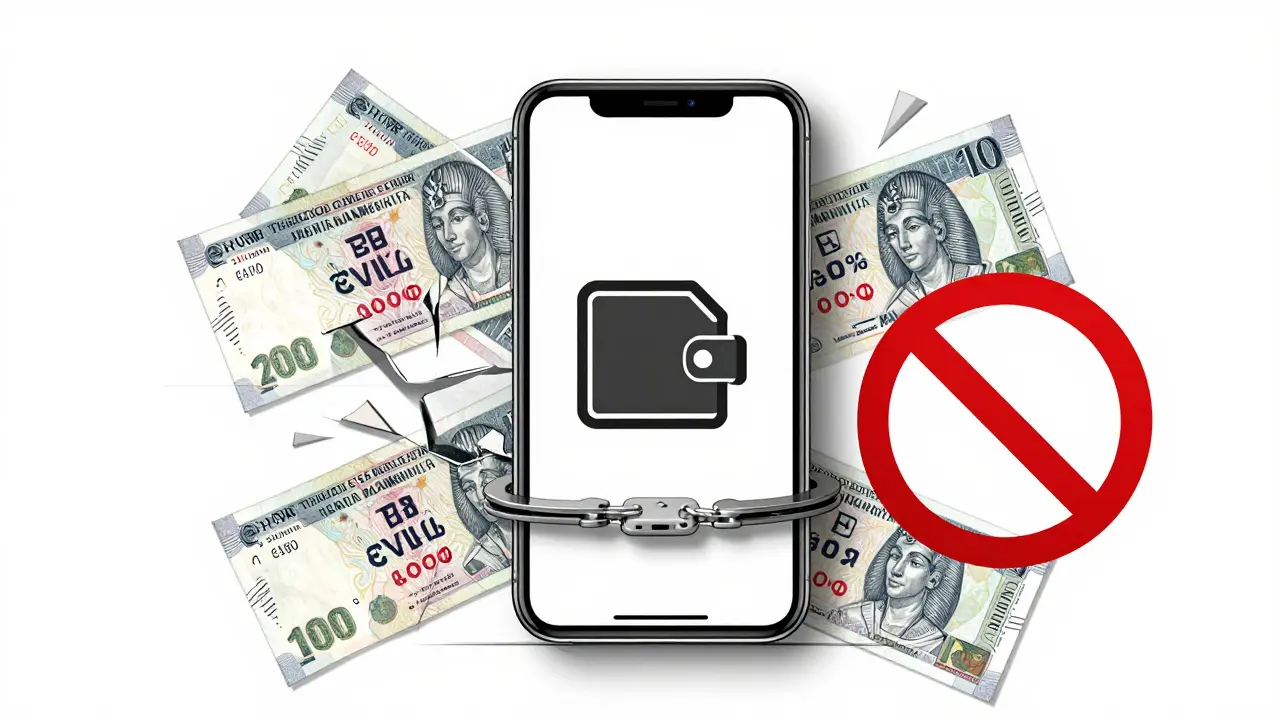
If you’re promoting cryptocurrency in Egypt, you’re risking more than just a fine. You could end up in prison. That’s not a rumor - it’s the law. Under Law No. 194 of 2020, anyone who promotes, trades, or operates platforms for cryptocurrencies without government approval faces serious consequences: jail time, heavy fines, or both. There’s no gray area. The Egyptian Central Bank (CBE) and the Financial Regulatory Authority (FRA) have made it clear: crypto promotion is illegal, and enforcement is real.
What Exactly Is Illegal?
The law doesn’t just ban Bitcoin or Ethereum trading. It targets every form of crypto promotion. That includes social media influencers posting about crypto gains, websites advertising crypto investment platforms, Telegram groups recruiting users for staking, or even YouTube videos explaining how to buy crypto. If you’re encouraging people to use digital assets without a license from the CBE or FRA, you’re breaking the law.
The scope is broad. It covers everything from NFTs sold as financial investments to DeFi platforms promising returns. Even staking - where users lock up crypto to earn interest - is considered a prohibited financial activity unless you have official approval. The CBE explicitly states that staking is "inherently linked to cryptocurrency activities" and falls under the same ban. There’s no exception for educational content, community building, or "just sharing info." If it’s promoting adoption or use of crypto in Egypt, it’s illegal.
The Penalties Are Harsh
The punishment isn’t light. Violators face imprisonment and/or a fine between one million and ten million Egyptian pounds (roughly $516,000 USD). That’s not a small penalty - it’s more than the average Egyptian earns in 20 years. Courts can choose to impose jail time alone, a fine alone, or both. There’s no minimum sentence, so judges have wide discretion, which means even first-time offenders could be locked up.
The law ties these penalties to older financial regulations, especially Capital Market Law No. 95 of 1992. That law requires any public investment offer - including crypto - to have a licensed prospectus approved by the FRA. Since no crypto-related prospectus has ever been approved, any promotion automatically violates this rule. This creates a legal trap: even if you’re not directly selling crypto, if your content makes people think they should invest, you’re liable.
Why Is Egypt So Strict?
Egypt’s stance isn’t random. The CBE has been warning about crypto since January 2018, calling it a threat to "national security and financial stability." Their main argument? Cryptocurrencies aren’t backed by any government, aren’t regulated globally, and have no intrinsic value. To them, crypto is like gambling - risky, uncontrolled, and dangerous to ordinary people.
The FRA adds that crypto platforms often involve fraud, cybercrime, and money laundering. They point to cases where users lost life savings to fake exchanges or Ponzi schemes disguised as crypto investments. The government fears that widespread crypto use could undermine the Egyptian pound, disrupt banking systems, and allow illicit funds to flow undetected. That’s why they treat promotion like a financial crime - not just a regulatory violation.
The Paradox: Everyone’s Using It Anyway
Here’s the twist: despite the ban, Egypt has one of the highest crypto adoption rates in Africa and the Middle East. A 2022 report by TripleA found that over 1.75 million Egyptians - about 1.7% of the population - owned cryptocurrency. More recent estimates suggest that number has grown to nearly 3 million. That’s more than the entire population of some European countries.
Why? Because crypto solves real problems. With inflation rising, currency controls tightening, and remittance fees high, many Egyptians use Bitcoin and USDT to protect savings, send money abroad, or buy goods online. Peer-to-peer trading on platforms like Paxful and LocalBitcoins is common. Crypto ATMs and local OTC traders operate quietly. The law doesn’t stop usage - it just criminalizes talking about it.
This creates a massive enforcement gap. How do you jail 3 million people? You don’t. So authorities focus on high-profile cases: influencers with large followings, website owners running crypto ads, or companies offering "crypto investment plans" without licenses. Regular users? They’re ignored - unless they get caught promoting.
How Enforcement Works
The FRA keeps a public "negative list" of unlicensed crypto entities. If you’re on that list, your website can be blocked, your social media accounts reported, and your assets frozen. The authorities actively monitor platforms like Instagram, TikTok, and YouTube for crypto promotions. They rely on citizen reports too - anyone can file a complaint against a promoter.
Recent crackdowns have targeted Telegram channels and TikTok creators who post "earn crypto daily" schemes. In 2024, a popular influencer with 800,000 followers was arrested after promoting a crypto staking platform. He was charged under Law No. 194 and sentenced to two years in prison. His case made headlines - not because he was the first, but because it showed the government was serious.

What About Legitimate Blockchain Projects?
Even businesses trying to do the right thing are stuck. If you want to build a blockchain-based payment system, a supply chain tracker, or a digital ID platform using crypto tech, you still need CBE approval. But the CBE doesn’t issue licenses for blockchain innovation - only for financial services that mimic traditional banking. So if your project uses crypto, even if it’s not a currency, you’re still at risk.
There’s no clear path to compliance. No application portal. No guidelines. No public examples of approved projects. This means any legitimate developer or startup in Egypt has to choose: stay quiet and risk legal trouble, or abandon crypto entirely. Many choose the latter.
The Bigger Picture
Egypt’s approach isn’t unique - countries like Nigeria and Vietnam have also cracked down. But Egypt’s penalties are among the harshest. Other nations regulate crypto. Egypt bans it. Other nations tax it. Egypt imprisons people for talking about it.
This isn’t just about money. It’s about control. The government sees decentralized finance as a challenge to its authority over the economy. By criminalizing promotion, they’re not just stopping transactions - they’re stopping conversations. They want people to forget crypto even exists.
But history shows that banning technology doesn’t kill it - it just drives it underground. In Egypt, crypto isn’t dying. It’s evolving. People use it in private, through encrypted apps, cash trades, and word-of-mouth. The law may stop influencers, but it can’t stop demand.
What Should You Do?
If you’re in Egypt and you’re involved in crypto - even just sharing knowledge - you need to understand the risk. Promoting it publicly, even as a joke or a tutorial, can lead to arrest. Avoid social media posts, YouTube videos, or public events about crypto. Don’t run ads. Don’t host Telegram groups. Don’t offer investment advice.
If you’re using crypto for personal reasons - sending remittances, saving money, buying online - you’re likely safe. The law targets promotion, not possession. But if you’re helping others get involved? That’s where the danger lies.
There’s no sign the government will soften its stance. In fact, recent statements from the CBE and FRA call for "extreme caution" and warn that enforcement will intensify. The message is clear: if you promote crypto in Egypt, you’re playing with fire. And fire doesn’t care if you meant well.
Can I be jailed just for talking about crypto on social media in Egypt?
Yes. If your social media post encourages others to buy, trade, or invest in cryptocurrency - even if you’re not running an exchange - you can be charged under Law No. 194 of 2020. Authorities consider any public promotion without a license as a violation. Influencers have been arrested for posting "earn crypto daily" content or sharing wallet addresses.
Is owning cryptocurrency illegal in Egypt?
No. Owning cryptocurrency is not illegal. The law targets promotion, trading, and operating platforms - not personal possession. Many Egyptians hold Bitcoin or USDT for savings or remittances without issue. But if you start selling it, promoting it, or using it to run a business, you cross into illegal territory.
Are NFTs also banned under this law?
Yes - if they’re used for financial purposes. The CBE explicitly states that NFTs fall under the same restrictions as cryptocurrencies when sold as investments, traded for profit, or used to raise funds. Promoting NFT marketplaces or staking NFTs for returns is illegal. However, using NFTs for art, collectibles, or non-financial digital ownership isn’t targeted - but proving intent is hard, so most avoid the gray zone entirely.
Has anyone actually gone to jail for crypto promotion in Egypt?
Yes. In 2024, a social media influencer with over 800,000 followers was sentenced to two years in prison for promoting a crypto staking platform. Other cases involve website operators and Telegram admins who ran crypto investment groups. While most enforcement targets high-profile promoters, the legal precedent is set: jail time is a real possibility.
Can I get a license to promote crypto in Egypt?
No. The Central Bank of Egypt has not issued a single license for crypto promotion, trading, or exchange services. There is no official application process. The government’s position remains firm: all crypto-related financial activities are prohibited unless explicitly authorized - and no authorization has ever been granted.
What happens if I’m caught promoting crypto?
You’ll likely be investigated by the Financial Regulatory Authority. Your digital assets may be frozen, your social media accounts reported, and your device seized. You could be arrested and charged under Law No. 194 of 2020. Penalties include imprisonment, a fine of 1-10 million EGP ($516,000), or both. Legal defense is difficult since there’s no legal framework for compliance - the law is designed to make defense nearly impossible.






Elana Vorspan
25 February, 2026 . 19:43 PM
Honestly? I'm not surprised. Egypt's trying to protect its people from get-rich-quick scams, and honestly, a lot of crypto content online is pure snake oil. 🙃 I get why they're cracking down - but jeez, jail time? That's wild. Maybe they should focus on education instead of prison cells.
Kenneth Genodiala
26 February, 2026 . 08:07 AM
This is precisely why fiat remains the superior monetary system. Cryptocurrencies are speculative instruments with no intrinsic value, and permitting their promotion is tantamount to endorsing financial anarchy. The Egyptian state is exercising prudent governance.
Michael Rozputniy
28 February, 2026 . 03:01 AM
theyre using this as a cover to control the population. the cbe is in bed with the imf and the world bank. they dont want people to escape the dollar trap. its all a psyop. i read a thread on 4chan that said the egyptian military owns the gold reserves that back the pound. if you dont believe me, check the un reports from 2019. its all connected.
Sriharsha Majety
1 March, 2026 . 04:14 AM
people in egypt use crypto because the economy is a mess and the government cant help. banning talk about it doesnt fix inflation or remittance fees. its like banning water because some people drink too much. the real issue is corruption not crypto
Tabitha Davis
2 March, 2026 . 07:08 AM
OMG this is the most dramatic thing i've seen all week. Imagine getting jailed for posting a meme about Bitcoin. This is like 1984 but with TikTok. Someone call the UN. Someone call Elon. Someone call my mom. I need to share this immediately.
Nadia Shalaby
3 March, 2026 . 03:44 AM
I don't get the panic. People use crypto because it works for them. The government's fear seems more about losing control than protecting citizens. It's like banning bicycles because some people ride them too fast.
Daisy Boliaan
3 March, 2026 . 11:24 AM
Okay but can we talk about how ridiculous it is that you can get arrested for saying "buy BTC" on Instagram? I posted a crypto meme last week and my friend screamed at me to delete it. I didn't. I just laughed. The fact that this is even a thing is insane. Someone needs to make a documentary.
Robert Conmy
4 March, 2026 . 18:57 PM
This is exactly what happens when you let moral panic override reason. People are using crypto to survive. Jail for promoting it? That's not law - that's tyranny. If you care about financial freedom, you should be outraged. Not confused. Outraged.
Lilly Markou
6 March, 2026 . 00:05 AM
The institutionalized suppression of decentralized financial mechanisms represents a profound regression in the evolution of sovereign economic autonomy. The Egyptian state, in its current configuration, appears to prioritize centralized control over individual economic agency - a posture historically associated with authoritarian regimes.
McKenna Becker
6 March, 2026 . 02:14 AM
The law targets speech, not action. That’s the problem.
precious Ncube
7 March, 2026 . 02:38 AM
If you’re dumb enough to believe crypto isn’t a pyramid scheme, you deserve to lose everything. This law is the only thing keeping people from being ruined. Stop romanticizing financial suicide.
Amita Pandey
8 March, 2026 . 08:43 AM
The Egyptian government’s stance is both legally coherent and ethically defensible. The absence of regulatory infrastructure renders cryptocurrency promotion inherently destabilizing. To permit such activity without a robust framework is to invite systemic vulnerability.
Jan Czuchaj
8 March, 2026 . 11:08 AM
I’ve been thinking about this for a while. People don’t realize that when you ban something like this, you don’t eliminate the behavior - you just make it more dangerous. Imagine being in Egypt, trying to send money to your sister in Germany, and you have to use a black-market crypto broker because the banks are too slow and expensive. You’re not a criminal. You’re a parent. The law doesn’t see that. It just sees a "promoter." And that’s tragic.
Tracy Peterson
9 March, 2026 . 12:49 PM
This is why we need global crypto rights. If you can be jailed for talking about Bitcoin in one country, then no one’s safe. This isn’t about Egypt - it’s about the precedent. Once speech is criminalized, what’s next? Talking about inflation? Discussing currency devaluation? We’re sliding down a slope and no one’s even looking.
George Suggs
10 March, 2026 . 02:36 AM
The real story here is how many people are still using crypto despite the risk. That says more than any law ever could.
Felicia Eriksson
12 March, 2026 . 01:09 AM
I just want to say thank you to everyone who’s quietly using crypto to help their families. You’re not breaking the law - you’re surviving it. I hope one day the world sees you as the heroes you are.
aaron marp
12 March, 2026 . 21:34 PM
I’ve lived in three countries where crypto was banned. Each time, the ban didn’t stop usage - it just made it more expensive, more dangerous, and more invisible. Egypt’s law is a symptom of a deeper fear: that people might realize they don’t need the system to survive. And that’s why they’re scared.
Patrick Streeb
13 March, 2026 . 20:13 PM
The regulatory framework underpinning Law No. 194 of 2020 is, in principle, aligned with international standards concerning the prevention of illicit financial flows. However, the absence of a transparent licensing mechanism renders compliance unattainable - a condition which may, in legal terms, constitute a de facto prohibition.
Phillip Marson
15 March, 2026 . 11:38 AM
they think they can outsmart the internet? nah. people in egypt are out here turning p2p trades into a full-on underground economy. theyre not just buying crypto - theyre building a parallel financial system. and the government? theyre still trying to arrest influencers. bro its 2025. the game changed.
Tracy Whetsel
15 March, 2026 . 19:24 PM
I know someone who got arrested for posting a YouTube video about how to set up a crypto wallet. He was 19. He just wanted to help his mom send money to her sister. He’s in jail now. I don’t know what’s worse - the law, or the fact that no one’s talking about it. We need to speak up.
Alyssa Herndon
17 March, 2026 . 10:21 AM
I don’t judge people who use crypto. I just hope they’re careful. The law isn’t about money - it’s about silence. And silence is the real prison.
Ifeanyi Uche
19 March, 2026 . 06:28 AM
this is why africa needs to stop being scared of innovation. egypt is scared of its own people. they dont want them to get smart. they want them to stay poor and dependent. crypto is freedom. and freedom scares them