Imagine you want to bet on Bitcoin’s price rising over the next three months. You don’t want to buy the coin itself; you just want exposure to its movement. In the world of cryptocurrency derivatives, you have two main paths: Perpetual Futures, which never expire, and Quarters, which end on a set date. Choosing the wrong one can quietly drain your wallet through hidden costs or force you into unwanted trades.
The difference isn't just about dates. It's about how much you pay to hold a position, how you manage risk, and whether you're day-trading or investing for the long haul. Let's break down exactly how these contracts work so you can pick the right tool for your strategy.
What Are Perpetual Futures?
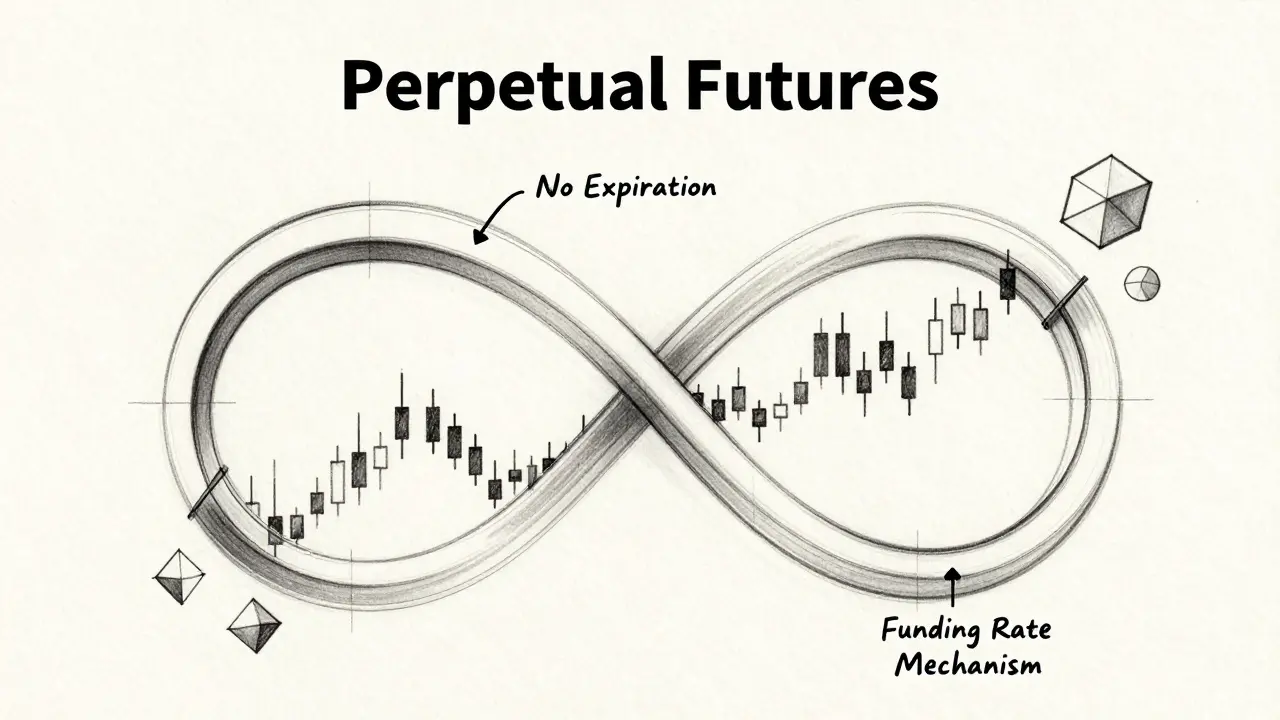
Perpetual Futures are derivative contracts with no expiration date. Think of them as a standard futures contract that has been stripped of the "end game." You can open a position and keep it open for days, weeks, or even years, provided you maintain enough margin in your account to cover potential losses.
This structure was born out of necessity in the crypto market. Traditional financial markets close on weekends and holidays, but crypto trades 24/7/365. A traditional futures contract would expire while traders were asleep or on vacation, creating gaps in liquidity. Perpetuals solve this by allowing continuous trading without the hassle of rolling over contracts every month.
However, there is a catch. Without an expiration date, the price of the perpetual contract could drift far away from the actual spot price of Bitcoin or Ethereum. To prevent this, exchanges use a mechanism called the Funding Rate. This is a periodic payment exchanged between traders holding long positions and those holding short positions. If the funding rate is positive, longs pay shorts. If it's negative, shorts pay longs. These payments usually happen every 8 hours.
What Are Quarterly Futures?
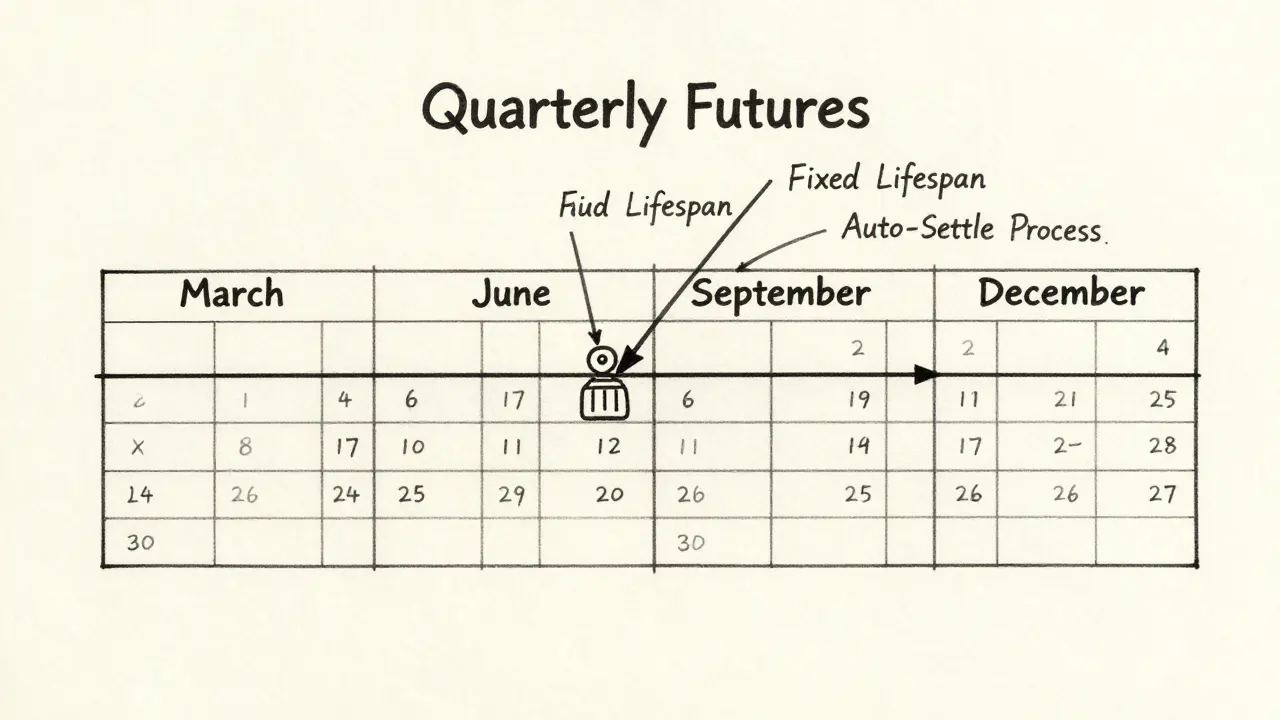
Quarterly Futures, also known as dated futures, operate like traditional commodity futures. They have a fixed lifespan-typically three months-and expire on a specific date. In the crypto world, these usually expire on the last Friday of March, June, September, and December.
When a quarterly contract expires, it settles. This means the position is closed automatically at the prevailing market price, and any profit or loss is realized. You cannot hold a quarterly contract past its expiration date. If you still want exposure after the current quarter ends, you must manually close your old position and open a new one in the next quarter's contract. This process is called "rolling over."
The biggest advantage of quarterly futures is simplicity in cost structure. There are no funding rates. You pay an entry fee (maker/taker fees) when you open the trade, and potentially another when you close it. But between opening and closing, you owe nothing extra to the exchange or other traders. This makes them predictable for budgeting.
The Critical Difference: Funding Fees vs. Expiration
If you only remember one thing from this guide, let it be this: Funding fees kill long-term holds in perpetuals, while expiration forces action in quarters.
In perpetual futures, the funding rate acts as an anchor to keep the contract price close to the spot price. During bull markets, when everyone is buying, the funding rate often turns positive. Long traders pay short traders. If you hold a large long position for a month during a hot rally, you might pay 0.1% every 8 hours. That adds up quickly. Over 30 days, that’s roughly 90 payments. A 0.1% fee repeated 90 times eats into your capital significantly, even if the asset price goes up.
Quarterly futures avoid this entirely. You might pay slightly higher initial fees due to lower liquidity in some cases, but you won't face recurring hourly charges. However, you face the "expiration wall." As the contract nears its end, liquidity can dry up, and the spread between bid and ask prices might widen. You must decide: do I close now? Do I roll to the next quarter? Or do I let it settle?
| Feature | Perpetual Futures | Quarterly Futures |
|---|---|---|
| Expiration Date | None (Open-ended) | Fixed (Every 3 months) |
| Ongoing Costs | Funding Rates (every 8 hours) | None (except entry/exit fees) |
| Liquidity | Very High (Deep order books) | Moderate (Varies by proximity to expiry) |
| Best For | Day Trading, Scalping, Short-term speculation | Swing Trading, Hedging, Long-term positioning |
| Settlement | Manual Close or Liquidation | Auto-settle or Manual Roll |
Leverage and Margin Requirements
Both contract types offer leverage, allowing you to control a larger position with a smaller amount of capital. For example, with 10x leverage, $1,000 lets you control a $10,000 position. But the way margin works differs slightly.
In perpetual futures, exchanges often allow higher maximum leverage (up to 100x or more on some platforms). Because the contract never expires, you need to monitor your margin balance constantly. If the market moves against you, you may receive a margin call or get liquidated instantly. The funding rate also affects your effective margin; paying high funding fees reduces your available equity over time.
Quarterly futures typically offer lower maximum leverage limits, often capped around 20x-50x depending on the exchange. This is partly because the finite nature of the contract reduces certain systemic risks. Since you know exactly when the contract ends, you can plan your exit strategy better. Some institutional traders prefer quarters because they don't have to worry about sudden spikes in funding rates draining their margin unexpectedly.
Who Should Use Which Contract?
Your choice should depend entirely on your trading horizon and style.
- Choose Perpetual Futures if: You are a day trader or scalper who opens and closes positions within hours or days. You benefit from the deep liquidity and tight spreads found in perpetual markets. You don't want to deal with contract rollovers. You understand how to calculate funding costs and factor them into your break-even point.
- Choose Quarterly Futures if: You are a swing trader or investor holding positions for weeks or months. You want to hedge a spot portfolio without paying daily funding fees. You prefer predictable costs and want to avoid the psychological pressure of watching funding rates tick up every 8 hours. You are comfortable managing expiration dates and rolling contracts if needed.
Risk Management Tips for Both Types
Regardless of which contract you choose, derivatives carry significant risk. Here are practical steps to protect your capital.
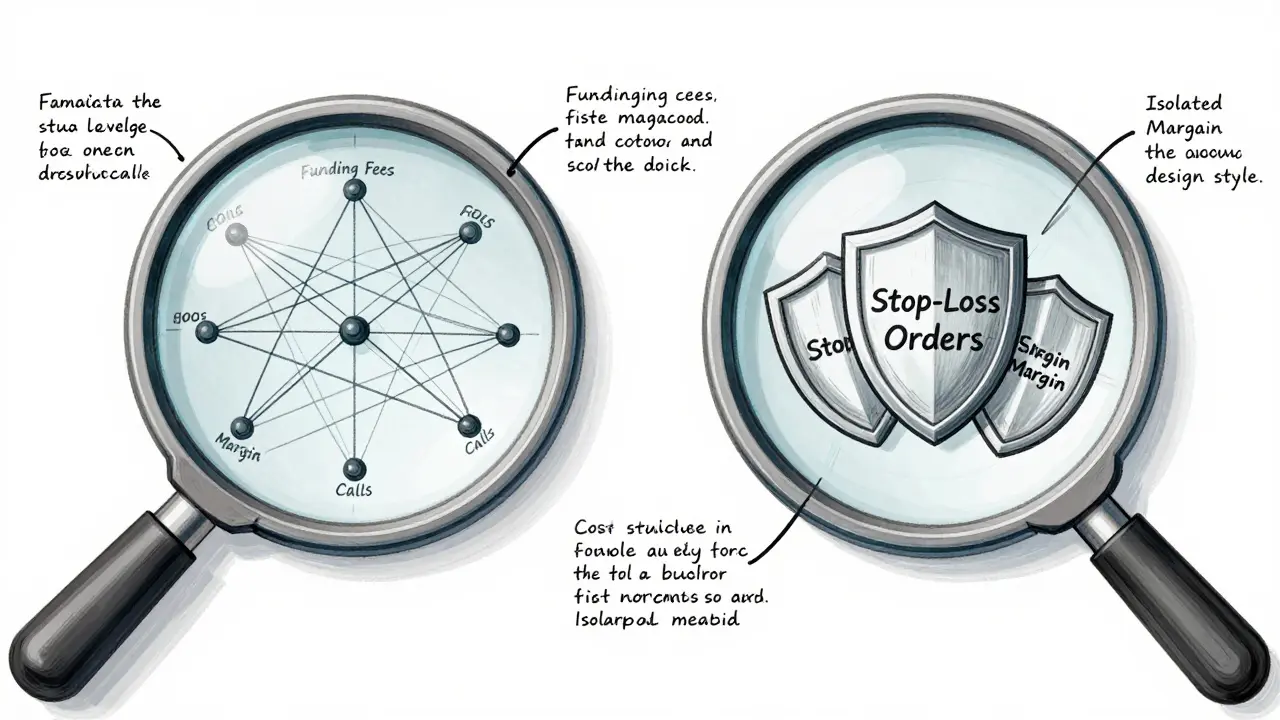
- Calculate Total Cost of Carry: For perpetuals, check the current funding rate before entering a large position. If it's extremely high (e.g., >0.1% per interval), the cost of holding will eat your profits. Use a calculator to estimate total fees over your expected holding period.
- Set Stop-Losses: Never trade without a stop-loss. In volatile crypto markets, a small move can wipe out leveraged positions. Set stops based on technical levels, not arbitrary percentages.
- Monitor Liquidity: In quarterly futures, liquidity drops as the expiration date approaches. Avoid placing large market orders in the final few days of a quarter. Use limit orders instead to avoid slippage.
- Beware of Auto-Rollover Traps: Some exchanges offer auto-roll features for quarters. Ensure you understand the terms. Sometimes, auto-rolling happens at unfavorable prices during low-liquidity periods.
- Use Isolated Margin: Especially for beginners, use isolated margin rather than cross-margin. This ensures that if a trade goes bad, only the allocated margin for that specific position is lost, protecting your entire account balance.
Market Dynamics: Contango and Backwardation
Understanding market sentiment helps you choose the right contract. In traditional finance, the relationship between futures and spot prices is described as contango or backwardation.
In crypto perpetuals, this shows up in the funding rate. When the funding rate is consistently positive, the market is in "contango"-traders expect prices to rise, so longs pay shorts. This is common in bull markets. When the funding rate is negative, the market is in "backwardation"-shorts pay longs, indicating bearish sentiment or heavy hedging.
Quarterly futures reflect this through the price difference between the current quarter and the next quarter. If the next quarter's contract is priced higher than the current one, it's contango. If lower, it's backwardation. Savvy traders can exploit these differences. For instance, in strong contango, you might prefer shorts in perpetuals to collect funding payments, or buy the cheaper spot asset and sell the expensive future.
Can I convert a perpetual future to a quarterly future?
No, you cannot directly convert one type of contract to another. They are separate products with different underlying mechanics. To switch, you must close your existing perpetual position and then open a new position in the quarterly contract. Be aware that this involves two sets of transaction fees and potential price slippage.
Which contract has better liquidity?
Perpetual futures generally have significantly higher liquidity. Most retail traders prefer perpetuals because they don't expire, leading to deeper order books and tighter spreads. Quarterly futures liquidity tends to concentrate in the most active quarter (the nearest expiration) and dries up in distant quarters.
Do I have to pay funding fees if I hold a quarterly future?
No. Quarterly futures do not charge funding fees. You only pay maker/taker fees when you open and close the position. This is why they are often preferred for longer-term holdings where funding costs would otherwise accumulate.
What happens if I forget to close my quarterly future before expiration?
If you hold a position until the expiration time, the exchange will automatically settle it. Your position is closed at the settlement price (usually the average spot price over a short window around expiration). Any profit or loss is credited or debited to your account. You do not own the underlying asset unless it's a delivery-based contract, but most crypto quarters are cash-settled.
Are perpetual futures safer than quarterly futures?
Safety depends on your strategy. Perpetuals are "safer" for traders who want to avoid the complexity of expiration dates and rollovers. However, they carry the risk of unpredictable funding fees. Quarterlies are "safer" for cost predictability but require active management to avoid unintended settlements or liquidity issues near expiry. Neither is inherently safer; they just present different risks.