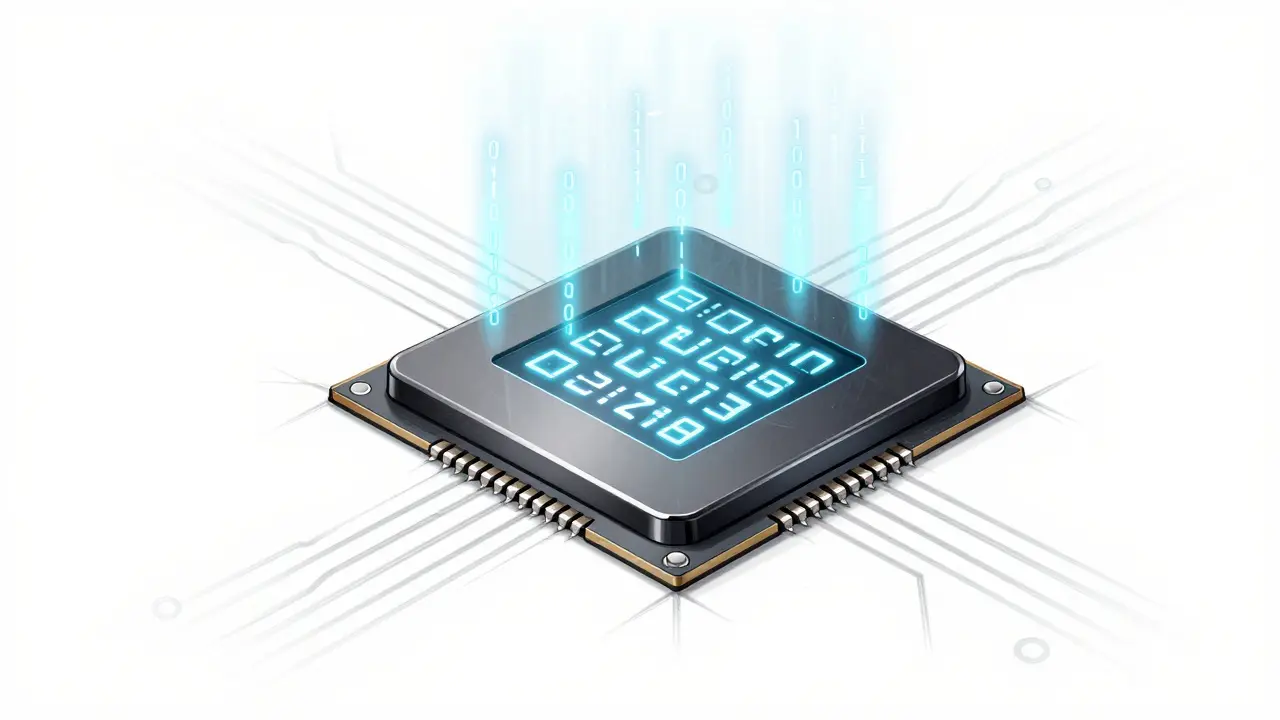
When you hear someone talk about Bitcoin mining, they usually say it’s all about solving hard math problems. But what’s the real variable that makes the difference between winning and losing? It’s not the block size, not the transaction fees, not even the timestamp. It’s the nonce. And understanding why it’s the core of mining is the key to knowing how Bitcoin actually works.
What Is the Nonce, Really?
The nonce is a 32-bit number - meaning it can be any whole number from 0 to 4,294,967,295. That’s over 4 billion possible values. Miners don’t pick it. They don’t guess it smartly. They just try every single one, one after another, billions of times per second. This isn’t a strategy. It’s brute force. And it’s the only part of the mining process where miners have total control.
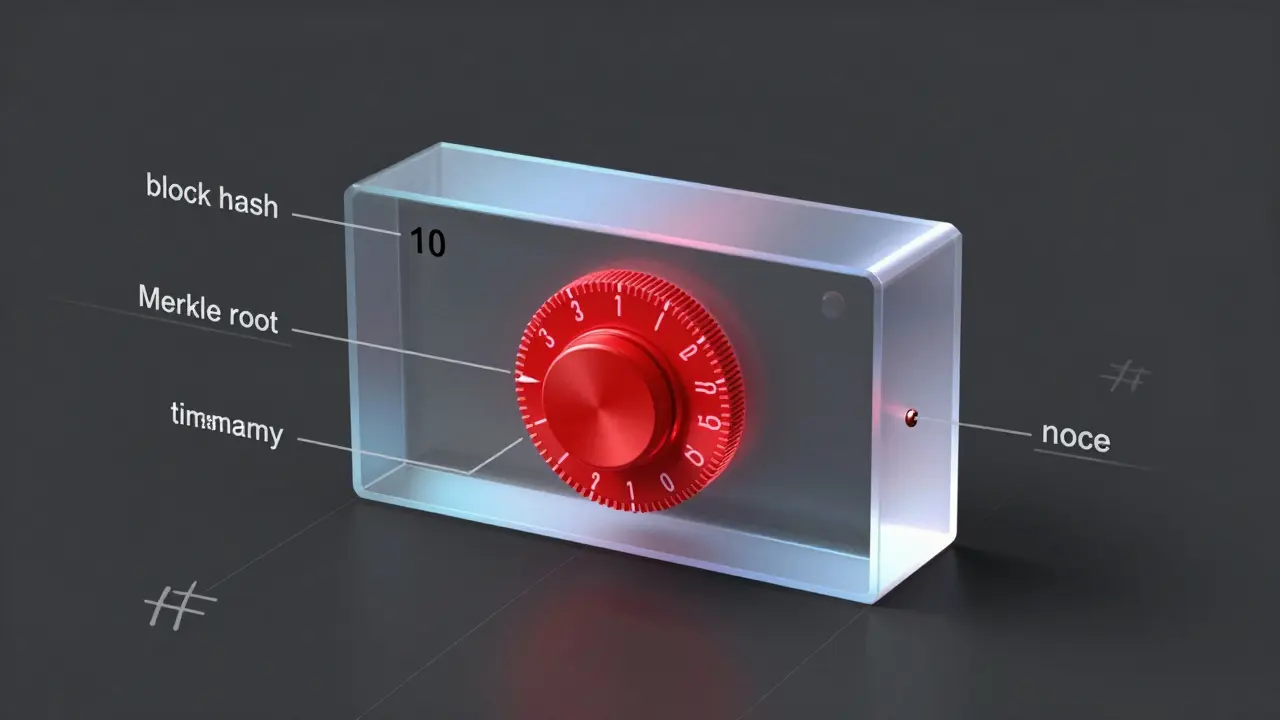
Every Bitcoin block has a header. That header includes a few fixed pieces: the hash of the previous block, the Merkle root of all transactions in the block, the version number, the timestamp, and the difficulty target. All of these are either set by the network or locked in by the transactions themselves. The only thing left to change? The nonce. It’s the one knob miners can turn. Every time they change it, they run the whole block header through SHA-256 again. They keep doing this until the output hash is lower than the network’s target. That’s the win condition.
Why the Nonce Is Different from Everything Else
Let’s compare it to other variables miners deal with.
- Difficulty target: This is set by the entire Bitcoin network. Every 2,016 blocks (about every two weeks), the network checks how fast blocks were mined. If it took less than 10 minutes on average, it gets harder. If it took longer, it gets easier. Miners can’t touch this. They can only react to it.
- Transaction fees: Miners can choose which transactions to include. They usually pick the ones with the highest fees to maximize earnings. But that doesn’t help them find the block. It only affects how much they earn after they win. The nonce is what gets them the win in the first place.
- Merkle root: This is a digital fingerprint of all transactions in the block. If you change even one transaction, the Merkle root changes. Miners can pick which transactions to include, so they have some control here. But they still need to find the right nonce to make the hash work. The Merkle root doesn’t solve the puzzle - the nonce does.
- Timestamp: This has to be within 2 hours of the network time. It’s not a free variable. It’s a constraint.
None of these other variables are designed to be brute-forced. They’re either fixed, constrained, or selected for economic reasons. The nonce is the only one built for trial-and-error. It’s the only variable that exists purely to be tested.
How Miners Actually Use the Nonce
Modern ASIC miners don’t think. They don’t strategize. They just spin. Each chip tests hundreds of billions of nonces every second. There’s no logic. No AI. No prediction. It’s pure speed. The more hashes you can do per second, the more nonces you can try. And the more nonces you try, the higher your chance of hitting the right one.
Think of it like a lottery with 4.3 billion tickets. You don’t pick the winning number. You just buy as many tickets as you can afford. Your ASIC is your ticket printer. The nonce is the number on each ticket. The network is the lottery machine. And the prize? 6.25 BTC plus whatever fees are in the block.
Miners don’t optimize the nonce. They optimize the machine that tests it. That’s why ASIC manufacturers compete on hash rate - not on transaction selection algorithms or fee analyzers. A miner with a 100 TH/s machine has 10 times more chances than one with 10 TH/s. That’s it. No other variable comes close to having that kind of impact.
The Hidden Role of the Nonce in Security
The nonce isn’t just a tool for mining. It’s the foundation of Bitcoin’s security. The whole idea of proof-of-work is that it’s expensive to produce but easy to verify. The nonce makes that possible. Because finding it requires massive computation, it’s hard to fake. But checking that a hash meets the target? That takes a fraction of a second.
Without the nonce, there’s no way to prove someone spent real energy to create a block. Other variables like transaction fees or timestamps can be manipulated or faked. But a valid hash with a correct nonce? That’s proof someone did the work. That’s why blockchain experts call the nonce the “proof-of-work engine.” It’s the only part of the system that enforces scarcity and order.
It also prevents replay attacks. If someone tried to reuse an old block, the nonce wouldn’t match the new difficulty target. The system would reject it. The nonce ties each block to its exact moment in time and network state. No other variable does that.
What Happens When the Block Reward Drops?
The next Bitcoin halving is expected in 2024. The block reward will drop from 6.25 BTC to 3.125 BTC. That means miners will earn less from new coins. Transaction fees will become more important. So, will miners start focusing more on optimizing fees instead of nonces?
Not really. Why? Because even if fees go up, you still need to mine the block to collect them. If you can’t find the nonce, you get nothing. Zero. Not even a fee. That’s why the nonce still dominates. Miners will still spend billions on hardware to increase hash rate. They’ll still race to build faster chips. The fee optimization side? That’s just icing on the cake. The cake is still the nonce.
In fact, as block rewards shrink, the pressure to mine efficiently increases. That means the competition over nonce speed will get even fiercer. The mining arms race isn’t slowing down - it’s accelerating.
Why Other Variables Don’t Matter as Much
You might think, “What if I pick the right transactions? What if I time my block perfectly?” Those things matter for profit. But they don’t matter for success. You can have the perfect block with the highest fees and the best timestamp. But if your nonce is wrong, the whole block is invalid. The network won’t accept it. Your hardware will be useless. Your electricity bill? Still due.
There’s no such thing as a “smart nonce.” You can’t predict it. You can’t optimize it. You can only test it. That’s why mining pools exist - to combine hash power. Because no single miner can rely on anything else. The nonce is the gate. Everything else happens after you pass through it.
Bottom Line: The Nonce Is King
Bitcoin mining isn’t about being clever. It’s about being fast. The nonce is the only variable that turns speed into success. Everything else - fees, transaction selection, timing - only matters if you’ve already found the nonce. And that’s why ASICs cost tens of thousands of dollars. That’s why mining farms use megawatts of power. That’s why the entire industry exists: to test nonces faster than anyone else.
So if you’re trying to understand Bitcoin mining, forget the fancy terms. Stop worrying about transaction fees. Stop reading about mempool dynamics. Focus on one thing: how fast can your hardware test nonces? That’s the only number that matters.
Is the nonce the only thing that changes in a Bitcoin block?
No, but it’s the only one miners can freely change. Other parts of the block header - like the Merkle root, timestamp, and previous block hash - also change, but they’re determined by transaction data or network rules. Only the nonce is under the miner’s direct control. That’s why it’s the core of the mining process.
Can miners choose any nonce value they want?
Yes, within the 32-bit range (0 to 4,294,967,295). Mining software automatically cycles through all possible values, starting from 0 or a random point. Miners don’t pick specific numbers - they let their hardware test them all. There’s no strategy, just speed.
Do mining pools manipulate the nonce?
No. Mining pools assign different nonce ranges to each miner to avoid duplicate work. But the nonce itself is still tested the same way: by brute force. The pool just coordinates who tries which values so no one wastes effort on the same numbers.
Why can’t we just increase the nonce size to make mining harder?
The nonce size isn’t what makes mining hard. The difficulty target is. Even with a 32-bit nonce, miners test trillions of combinations because the target hash is extremely low. Increasing the nonce size wouldn’t help - it would just mean more values to test, but the network already adjusts difficulty to keep block times at 10 minutes. The nonce’s size is enough.
What happens if two miners find the same nonce at the same time?
They both broadcast their blocks. The network temporarily splits into two chains. Miners then build on whichever block they receive first. The chain with the most cumulative proof-of-work becomes the main one. The other block becomes orphaned. The nonce isn’t the issue - it’s network propagation and consensus rules that decide the winner.

Steven Lefebvre
5 March, 2026 . 14:39 PM
The nonce is literally the only thing that matters in mining. All the other stuff? Just noise. You can have the fanciest transaction set, the perfect timestamp, the highest fees - but if your hash doesn’t hit the target, you’re out. It’s not about being smart. It’s about being loud. And your ASIC is your voice.
Every second, billions of numbers are being cranked through SHA-256 like a slot machine with no payout odds. That’s Bitcoin. Raw, ugly, beautiful computation.
Stop overthinking it. Just mine faster.
nalini jeyapalan
6 March, 2026 . 21:32 PM
Ugh. This whole post is so basic. Everyone who’s been in this space for more than two minutes knows the nonce is the key. But you’re acting like this is some groundbreaking revelation.
Meanwhile, real miners are already moving to custom ASICs with dynamic nonce allocation and parallelized hashing pipelines. You’re still talking about 32-bit ranges like it’s 2013.
Get with the program.
Christina Young
8 March, 2026 . 03:40 AM
Nonce? Please. You’re missing the point entirely. The real bottleneck isn’t the nonce - it’s the power supply. Without stable 24/7 grid access and cooling infrastructure, your ASIC is a paperweight.
And don’t even get me started on how most ‘miners’ are just renters in data centers who have no idea what a nonce even is.
This whole narrative is a fantasy for hobbyists with too much time and too little electricity.
Drago Fila
10 March, 2026 . 00:15 AM
Love this breakdown. Seriously. So many people think mining is about guessing or luck or some secret algorithm.
But no - it’s pure physics. Electricity → Heat → Hashes → Nonces → Block.
It’s beautiful in its simplicity.
Keep pushing the limits. Keep building faster. Keep grinding. The network needs you.
And hey - if you’re just starting out? Don’t sweat it. Just learn. One hash at a time.
Issack Vaid
11 March, 2026 . 21:09 PM
How quaint. A 32-bit nonce? In 2024? The entire premise of this post is charmingly archaic.
Modern mining doesn’t operate on single nonces - it operates on work units distributed across millions of chips, each iterating through trillions of candidate nonces in overlapping, dynamically assigned ranges.
The nonce is not the variable. The nonce is the *unit of measurement* for the variable: computational throughput.
Also, the timestamp constraint is far more relevant than you imply - it’s the only variable that prevents chain reorganizations under network latency.
Shawn Warren
13 March, 2026 . 20:02 PM
Nonce is king period
ASICs are the throne
Electricity is the crown
Profit is the illusion
Keep grinding
Keep hashing
Keep believing
The blockchain doesn't care about your feelings
Jeffrey Dean
15 March, 2026 . 02:54 AM
Is the nonce really the core? Or is it just the only variable we can observe?
What if the real magic is in the *unseen* - the quantum fluctuations in the silicon lattice that cause slight timing variations in hash computation?
What if the nonce is just a proxy for something deeper - a cosmic entropy signature encoded in the fabric of spacetime itself?
Or maybe… we’re all just playing a game designed by entities that don’t even use binary.
Think deeper. The nonce is a distraction. The real mining happens in the silence between the clock cycles.
Brian T
16 March, 2026 . 15:34 PM
I read this whole thing and I’m still not convinced the nonce matters more than the Merkle root.
What if the real bottleneck is transaction selection? What if the network is actually bottlenecked by how fast nodes can validate the Merkle tree?
You’re ignoring the fact that 70% of mining time is spent waiting for new transactions to arrive.
Maybe the nonce is just the last step in a long chain of dependencies.
Why are we pretending it’s the only one?
Nancy Jewer
17 March, 2026 . 16:45 PM
From a consensus protocol standpoint, the nonce is the critical enabler of the PoW mechanism’s verifiability property. It introduces a computationally asymmetric challenge-response structure where the prover must expend non-trivial resources to generate a valid solution, while the verifier can validate it in constant time - a foundational construct for decentralized trust.
Without the nonce’s deterministic iteration, the entire security model collapses into a game of prediction rather than proof.
Leah Dallaire
18 March, 2026 . 10:37 AM
Who says the nonce is the only thing? What if the real mining happens in the shadows - in the backdoors of ASIC firmware? What if the nonce is just a decoy to distract us from the fact that the NSA and China are precomputing hashes using quantum algorithms we don’t even know about?
They’ve been doing it since 2017. They just let us think we’re playing a fair game.
Nonce? Ha. It’s all rigged.
Bill Pommier
20 March, 2026 . 01:53 AM
Let me be clear: the notion that the nonce is the 'only' variable under miner control is not merely incorrect - it is dangerously misleading.
Miners control the coinbase transaction, which includes the extra nonce field - a 256-bit variable that extends the nonce space beyond 32 bits.
They control the order of transactions, which alters the Merkle root - a variable that changes with every transaction swap.
They control the timestamp within a 2-hour window - which affects difficulty recalibration.
And yet you reduce this entire system to a 32-bit counter? This is not insight. This is ignorance masquerading as education.
Olivia Parsons
20 March, 2026 . 03:24 AM
Simple truth: you can’t mine without finding the nonce. Everything else is bonus.
It’s like trying to win a race when your car has no gas. Doesn’t matter how fancy the wheels are.
Just keep hashing. Keep plugging in. Keep showing up.
That’s all there is.
Austin King
20 March, 2026 . 04:07 AM
100% this. I started mining with a used GPU and thought I needed to optimize my mempool strategy.
Turns out? I just needed more watts.
Once I upgraded my PSU and added another rig? My hash rate jumped 4x.
Nothing else changed.
Just more nonces per second.
That’s all it takes.
Bryanna Barnett
21 March, 2026 . 05:13 AM
nonce is king but like… what if the real game is who can get the cheapest electricity?
like honestly
if you’re paying 15 cents/kwh you’re already losing
just saying
also why do people still talk about asics like they’re magic?
they’re just hot dumb boxes
Josh Moorcroft-Jones
22 March, 2026 . 11:53 AM
While the post correctly identifies the nonce as the primary variable under miner control, it fundamentally misunderstands the broader computational ecology of Bitcoin mining. The nonce, while necessary, is not sufficient. The mining process is a multi-layered optimization problem involving not only the nonce but also the coinbase transaction’s extra nonce field, the Merkle tree’s leaf node ordering, the block header’s version field, and the dynamic adjustment of transaction inclusion based on fee-rate density. Furthermore, the assumption that the nonce is brute-forced sequentially is outdated - modern mining rigs use parallelized nonce spaces, precomputed hash chains, and nonce reordering algorithms that exploit the non-uniform distribution of hash outputs under SHA-256. The nonce is not the sole variable - it is one component within a high-dimensional solution space. To reduce it to a single knob is to misunderstand the complexity of the system at the level of a child playing with a Rubik’s cube while claiming to understand quantum mechanics.
Rachel Rowland
24 March, 2026 . 01:12 AM
Hey newbies - don’t get overwhelmed.
You don’t need to know all the math.
You don’t need the fanciest ASIC.
You just need to start.
One rig.
One power bill.
One nonce at a time.
You got this.
We’ve all been there.
Keep going.