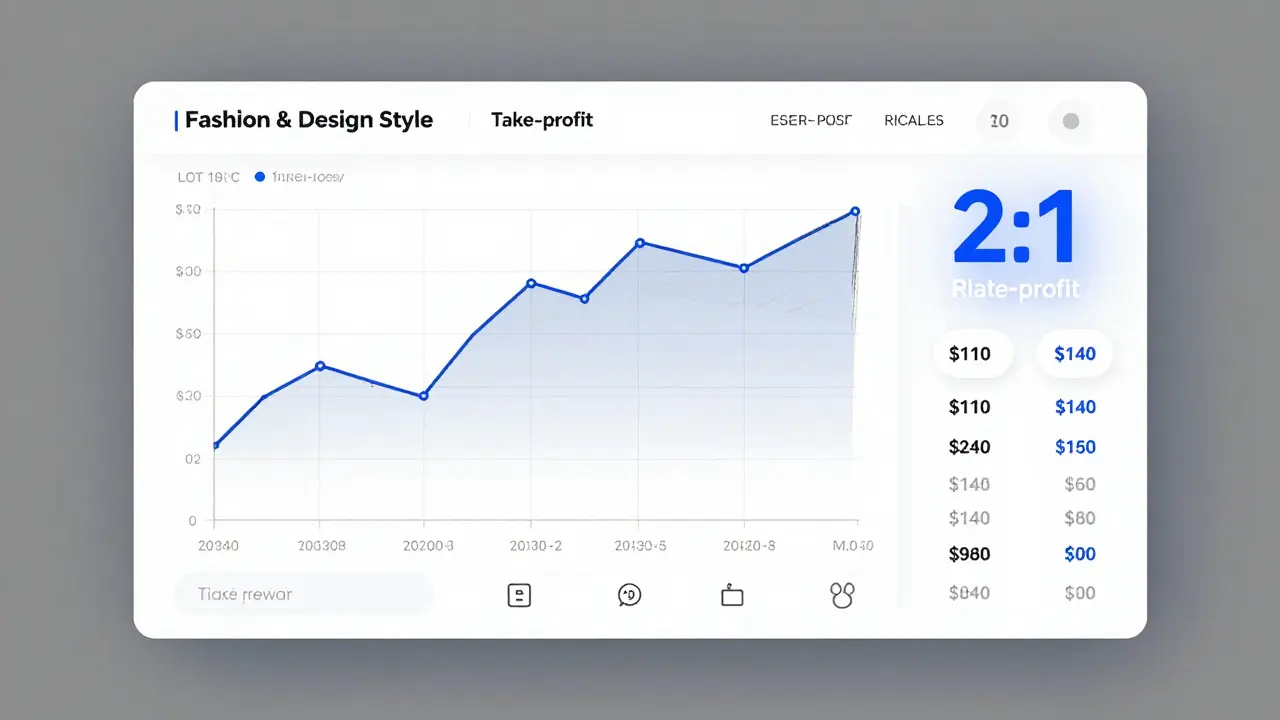
When you’re trading Bitcoin, Ethereum, or any other cryptocurrency, it’s not enough to just hope the price goes up. You need a clear plan - one that tells you when to get in, when to get out, and most importantly, whether the risk is worth the reward. That’s where the risk-reward ratio comes in.
Think of it like betting on a sports game. If you’re risking $10 to win $20, that’s a 1:2 ratio. You’re putting up $10 to make $20 - so for every dollar you risk, you stand to gain two. In crypto trading, this same logic applies. A good risk-reward ratio helps you avoid emotional trades and stick to a system that works over time.
What Is the Risk-Reward Ratio?
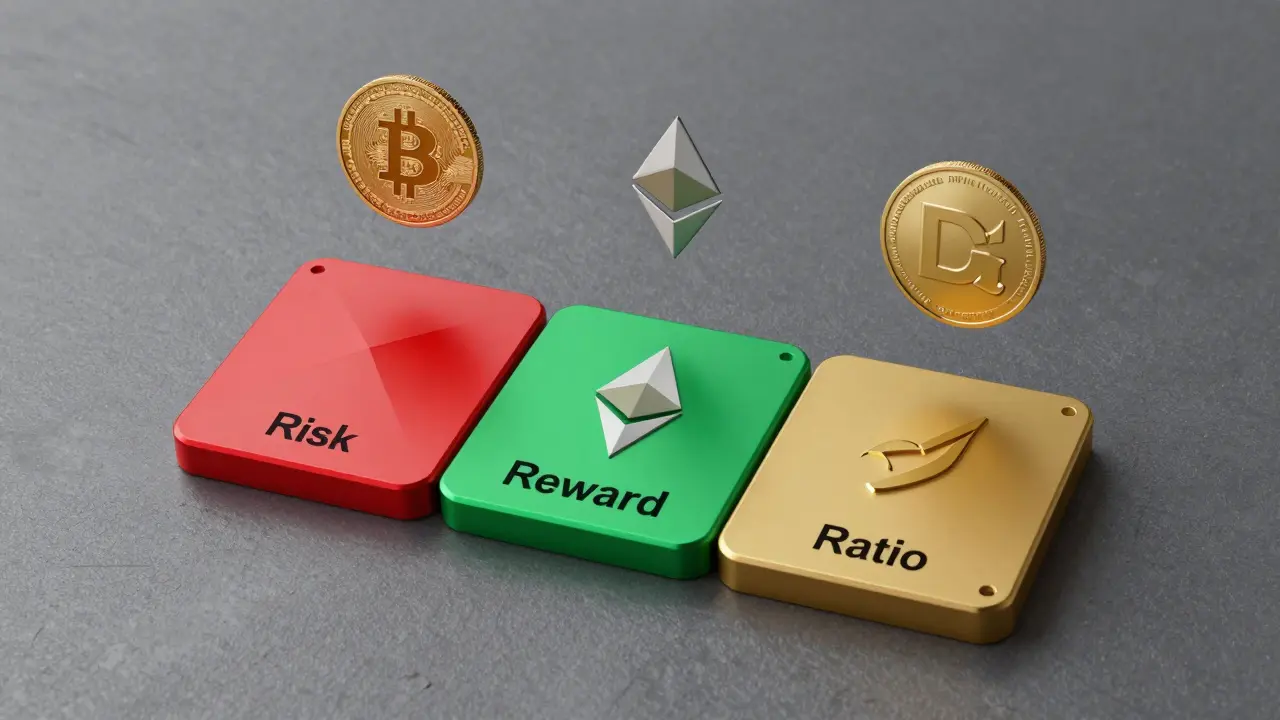
The risk-reward ratio (RRR) is a simple number that compares how much you stand to lose versus how much you stand to gain in a single trade. You calculate it by dividing your potential profit by your potential loss.
For example:
- You buy Solana at $120
- You set a stop-loss at $110 (you lose $10 if the trade goes wrong)
- You set a take-profit at $140 (you gain $20 if it goes right)
Your risk is $10. Your reward is $20. So your ratio is 2:1 - meaning you’re aiming to make $2 for every $1 you risk.
This isn’t about guessing. It’s about planning. You decide your risk before you even place the trade. That’s the difference between a gambler and a trader.
Why It Matters in Crypto
Crypto markets move fast. Prices can swing 20% in an hour. One minute you’re up, the next you’re down. Without a clear risk-reward rule, you’ll get shaken out by noise. You’ll chase pumps, panic-sell dips, and end up trading on emotion - not logic.
Here’s the truth: you don’t need to win every trade to make money. You just need to win enough of the right ones.
Let’s say you have a 40% win rate. Sounds bad, right? But if you’re using a 3:1 risk-reward ratio, here’s what happens:
- You lose 60 trades: $10 loss each = -$600
- You win 40 trades: $30 profit each = +$1,200
- Net profit: +$600
Even with fewer wins than losses, you’re still profitable. That’s the power of a good ratio.
How to Calculate It Step-by-Step
Here’s how to do it in real time, no math degree needed:
- Find your entry point - where you’re buying. Write it down.
- Set your stop-loss - the price where you bail if things go south. This is your risk.
- Set your take-profit - where you cash out. This is your reward.
- Subtract your stop-loss from your entry to get your risk amount.
- Subtract your entry from your take-profit to get your reward amount.
- Divide reward by risk. That’s your ratio.
Example: You buy Dogecoin at $0.08. Stop-loss at $0.075. Take-profit at $0.10.
- Risk: $0.08 - $0.075 = $0.005
- Reward: $0.10 - $0.08 = $0.02
- Ratio: $0.02 ÷ $0.005 = 4:1
That’s a strong setup. You’re risking 5 cents to make 20 cents.
What’s a Good Ratio?
There’s no magic number. But most professional traders aim for at least 2:1. Why? Because crypto is unpredictable. You’ll get hit by bad news, whale dumps, or just random volatility. If your ratio is too low - say 1:1 - you’ll need to win over 50% of your trades just to break even. That’s hard.
Here’s what works for different styles:
| Trading Style | Typical Ratio | Why It Works |
|---|---|---|
| Swing Trading | 3:1 to 5:1 | Hold for days or weeks. Let trends play out. Higher ratios match slower moves. |
| Day Trading | 2:1 to 3:1 | Quick entries/exits. Need solid wins to cover fees and slippage. |
| Scalping | 1.5:1 to 2:1 | Small profits, high volume. Tight stops. Must win often. |
| Long-Term Investing | 5:1+ | Hold for months. Big moves. Stop-losses are wide. Risk is low relative to potential. |
Some traders go for 1:5 - risking $1 to make $5. That sounds insane, but it’s common in high-conviction setups. Think Bitcoin breaking a major resistance level. If you’re right, you win big. If you’re wrong, you lose small. That’s smart risk.
How to Use It in Real Trading
Here’s how to make this work in practice:
- Plan before you enter - Never open a trade without knowing your stop and target. If you can’t define them, don’t trade.
- Use limit orders - Set your take-profit and stop-loss as limit orders when you enter. Don’t rely on manual execution.
- Track your ratios - Keep a simple spreadsheet. Note each trade’s ratio. After 20 trades, look at your average. Are you consistently hitting 2:1 or better?
- Adjust based on market - In a choppy market, avoid 5:1 ratios. You’ll get stopped out too often. In a strong trend, go for higher ratios.
- Don’t chase low ratios - If you see a coin pumping and the risk-reward is 1:1.2, walk away. That’s not a trade - that’s a gamble.
One trader I know in Wellington uses a simple rule: "No trade under 2:1." He’s had losing streaks, but over 18 months, he’s up 74%. Why? Because he only takes trades that make sense mathematically.
Common Mistakes to Avoid
Even smart traders mess this up. Here’s what goes wrong:
- Moving stop-losses - You let a trade go negative and keep pushing your stop further out. That turns a 2:1 trade into a 1:3 disaster.
- Ignoring volume - A 4:1 ratio on a low-liquidity coin? Risky. You might not get filled at your target.
- Overleveraging - Using 10x leverage on a 1:1 ratio? That’s suicide. Leverage multiplies risk. Always factor it in.
- Chasing “sure things” - If everyone’s talking about a coin, the setup is usually already priced in. The best opportunities are quiet.
One trader I follow lost $12,000 in two weeks because he kept adjusting his stop-loss on a meme coin. He thought he was "giving it room." In reality, he was just losing more.
Pair It With Technical Analysis
The risk-reward ratio doesn’t work alone. It needs context.
Use support and resistance levels to set your stop and target. If you’re buying near a strong support level, your stop-loss can be placed just below it. Your target? Place it at the next resistance zone.
Tools like RSI or MACD help confirm momentum. But they don’t tell you how much to risk. That’s where the ratio comes in.
Example: Bitcoin is bouncing off $60,000 support. RSI is oversold. You enter at $60,200. You set stop-loss at $59,400 (risk = $800). Target? $62,000 (reward = $1,800). Ratio = 2.25:1. Clean setup. High probability. Good risk-reward.
Final Rule: Protect Your Capital
The goal isn’t to make a killing on one trade. It’s to survive long enough to make many good trades.
Never risk more than 1-2% of your total capital on a single trade. If you have $10,000, don’t risk more than $200 per trade. That way, even 10 losses in a row won’t wipe you out.
Combine that with a solid risk-reward ratio - say 3:1 - and you’re building a system that works whether the market is up, down, or sideways.
Crypto doesn’t care if you’re right emotionally. It only cares if you’re right mathematically. The risk-reward ratio is your compass. Use it.
What’s the best risk-reward ratio for crypto trading?
There’s no single "best" ratio - it depends on your strategy. Most professional traders aim for at least 2:1. Swing traders often use 3:1 to 5:1, while scalpers may use 1.5:1. The key is consistency. Pick a ratio that fits your style and stick to it.
Can I make money with a 1:1 risk-reward ratio?
Yes - but only if you win more than half your trades. A 1:1 ratio means you need a win rate above 50% just to break even after fees. That’s tough in crypto, where markets are noisy and unpredictable. Most traders find it easier to win with higher ratios (like 2:1 or 3:1) and accept lower win rates.
Should I adjust my stop-loss if the trade moves in my favor?
Only if you’re trailing your stop to lock in profits - never to give the trade more room to fail. Moving your stop-loss away from your original plan to avoid a loss turns a disciplined trade into a gamble. Always stick to your original risk-reward setup unless you’re actively managing a winning position.
How do I set a realistic take-profit target?
Look at historical price levels. Where has the asset reversed before? Use support/resistance zones, Fibonacci levels, or previous highs/lows. Don’t guess. Don’t aim for "double or nothing." Set your target based on where the market has acted in the past.
Does risk-reward ratio work for long-term holders?
Yes - even if you’re holding for months. You still need to define your exit point. If you bought Bitcoin at $50,000 and plan to sell at $100,000, your reward is $50,000. If your stop-loss is at $40,000, your risk is $10,000. That’s a 5:1 ratio. It’s still a trade - just a long-term one.




sai nikhil
14 March, 2026 . 23:05 PM
Been using 3:1 ratios for swing trades on SOL and ADA lately. Game changer. No more emotional exits. Just let the math do the work. Even when I get stopped out twice in a row, I know I'm ahead long-term. No panic, no FOMO. Just discipline.
Diane Overwise
16 March, 2026 . 17:38 PM
OMG I LOVE THIS SO MUCH LIKE OMG I’M CRYING RN 🥹😭 I JUST LOST MY ENTIRE ETH PORTFOLIO BECAUSE I DIDN’T KNOW ABOUT THIS 😭😭😭
Dionne van Diepenbeek
18 March, 2026 . 03:29 AM
Why do people overcomplicate this you just set your stop and your target and if the ratio isnt at least 21 you dont trade
Graham Smith
18 March, 2026 . 10:56 AM
While the 2:1 heuristic is statistically sound, it's fundamentally flawed in non-ergodic environments like crypto. The Kelly Criterion, when applied with log utility maximization under volatile fat-tailed distributions, suggests optimal leverage is inversely proportional to variance. Most retail traders fail because they conflate expected value with expected utility. A 3:1 ratio on a low-liquidity altcoin with 80% bid-ask spread is not a trade-it's a liquidity trap masquerading as an edge.
Jerry Panson
19 March, 2026 . 22:17 PM
I appreciate the structure of this guide. It's rare to see such a methodical approach in crypto discourse. However, I must emphasize that risk-reward ratios are only one component of a broader risk management framework. Position sizing, correlation matrices, and macroeconomic regime shifts must also be integrated. Without this context, even a 5:1 ratio can lead to ruin.
Katrina Smith
21 March, 2026 . 16:13 PM
oh wow a 21 ratio? that sounds sooo professional like i bet you also wear socks with sandals and drink matcha lattes
Anastasia Danavath
22 March, 2026 . 07:50 AM
bro i just use my gut and it works 90% of the time 🤷♀️✨
anshika garg
23 March, 2026 . 03:38 AM
There's something beautiful about trading with a ratio… it’s like whispering to the market: I see you, I respect you, and I won’t let fear or greed speak for me. It’s not about winning. It’s about showing up, consistently, with a quiet mind. The market doesn’t care if you’re right emotionally. But it bows to the disciplined. And in that silence between the candles… that’s where wisdom lives.
Bruce Doucette
23 March, 2026 . 20:19 PM
Anyone who uses less than 3:1 is just gambling with their kids' college fund. I’ve seen this movie before. You think you're being 'pragmatic'-you're just scared of real risk. Stop pretending you're a trader. You're a tourist with a MetaMask wallet.
Marie Vernon
25 March, 2026 . 03:06 AM
I love how this post breaks it down so clearly. I’ve been teaching this to my niece who just started trading. She’s 19 and thought crypto was a lottery. Now she’s tracking ratios in a Notion doc. It’s so rewarding to see someone build real skills instead of chasing moon shots. Keep sharing this kind of stuff.
Ross McLeod
27 March, 2026 . 02:58 AM
It's worth noting that the majority of retail traders who attempt to apply risk-reward ratios without incorporating volatility-adjusted position sizing, or without accounting for the time decay of liquidity in altcoins, are essentially optimizing for a theoretical model that does not reflect real market microstructure. The assumption of discrete, cleanly filled orders at exact price levels ignores slippage, order book depth, and the fact that most stop-losses are clustered at round numbers-making them predictable targets for manipulation. A 2:1 ratio on BTC might be viable, but on a meme coin with 12-hour trading volume under $2 million? That's not a trade. It's a target.
rajan gupta
28 March, 2026 . 06:57 AM
when i first started trading i thought i was a god… then i lost 80k in 3 days… now i just sit in silence… the market speaks… and it says: you are not the center of this universe… the ratio… the ratio is the truth… 💔🌙
Billy Karna
29 March, 2026 . 22:43 PM
One thing the post doesn’t mention enough is the importance of backtesting your ratio across different market regimes. A 3:1 ratio that worked during a bull run might fail miserably in a sideways or bear market due to increased whipsawing. I track my ratio performance by quarter-bull, bear, choppy-and adjust my minimum threshold accordingly. In choppy markets, I’ll drop to 1.8:1 but tighten my stop by 30%. It’s not rigid-it’s adaptive. Also, always factor in gas fees and exchange taker fees. That 4:1 ratio on a small-cap alt? Might be 2.7:1 after fees. Don’t ignore that.
Cheri Farnsworth
30 March, 2026 . 19:18 PM
Excellent framework. I would only add that risk-reward ratios must be documented in real time, not retrospectively. Many traders rationalize losses by recalibrating their original targets. This introduces confirmation bias. Use a pre-trade checklist. Entry, stop, target, ratio. Initials. Timestamp. No exceptions. Discipline is not a virtue-it’s a procedure.