You see a meme coin skyrocketing on your feed. It’s up 500% in an hour. Your friends are posting screenshots of massive gains. The FOMO hits hard. But before you click 'buy,' stop. That green candle might be the last thing you see before your portfolio turns red. In the world of memecoins, which are cryptocurrencies based on internet memes with little to no intrinsic utility, price spikes are often engineered traps rather than organic growth.
These traps are known as pump and dump schemes, which are market manipulation tactics where coordinated groups artificially inflate asset prices before selling off their holdings. They are sophisticated, fast-moving, and designed specifically to exploit human psychology. By August 2026, these schemes have evolved beyond simple Telegram spam into complex operations involving automated bots, influencer networks, and cross-chain coordination. Understanding how they work is the only way to protect your capital.
The Anatomy of a Trap: How the Scheme Unfolds
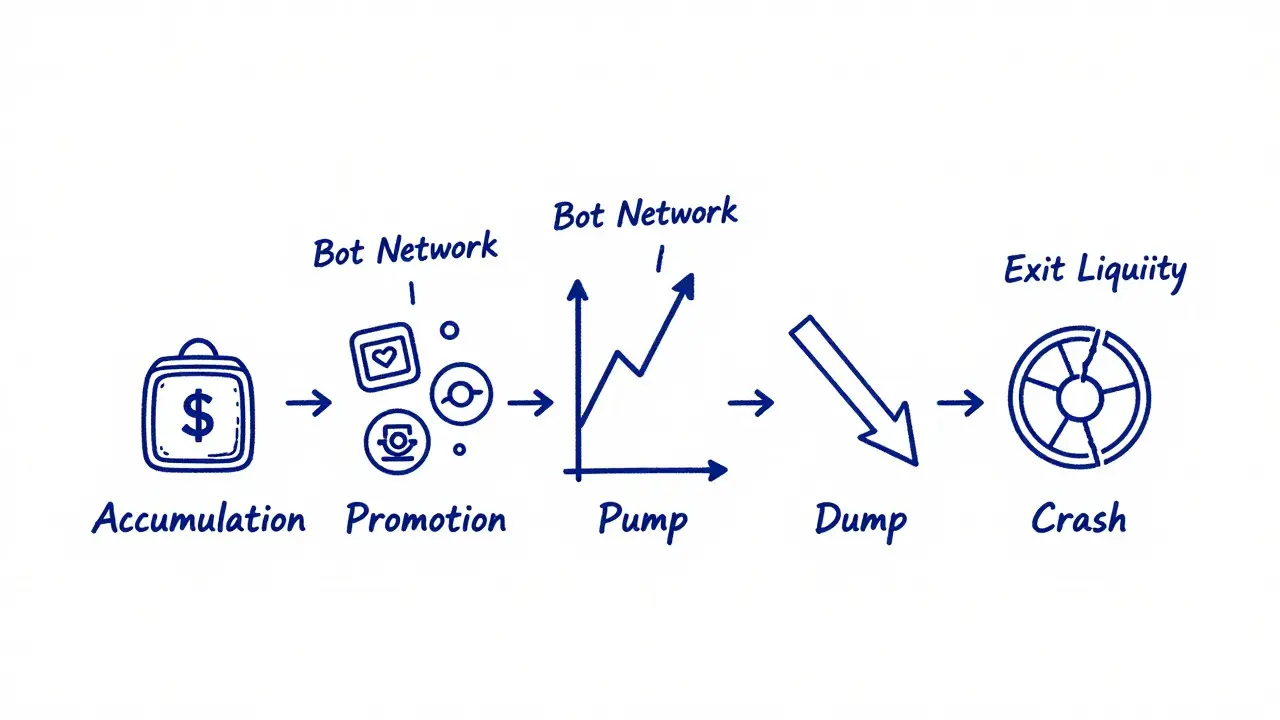
To spot a scam, you first need to understand its lifecycle. These schemes don't happen by accident; they follow a rigid script. Security analysts and researchers from institutions like the University of Chicago have mapped this process into distinct phases. Recognizing which phase a token is in can save you thousands of dollars.
- Accumulation (The Quiet Phase): Perpetrators, often including the token creators themselves, quietly buy large quantities of cheap tokens. They use multiple wallets to hide their ownership concentration. At this stage, the token looks dead or obscure. Trading volume is low, and there is little social media presence.
- Promotion (The Hype Machine): This is where the noise starts. Coordinated groups post across Twitter, Discord, and Telegram. They use paid influencers who may not even disclose their sponsorship. You’ll see generic phrases like "next 100x gem" or "community takeover." The goal isn't to inform you; it's to create urgency.
- Pump (The FOMO Spike): As more retail investors jump in due to fear of missing out, the price skyrockets. Charts go vertical. Media outlets might pick up the story, adding legitimacy. This is the most dangerous phase because the price action looks real, but it’s driven by buying pressure from victims, not value.
- Dump (The Exit Liquidity): Once the orchestrators have sold enough of their accumulated supply at peak prices, the support vanishes. They sell en masse, causing a liquidity crisis. New buyers find no one left to sell to, and the price crashes 80-99% within minutes or hours.
- Crash (The Aftermath): The token becomes illiquid or worthless. Developers might abandon the project entirely. Victims are left holding bags that cannot be sold without taking massive losses.
Notice the timing? Academic research indicates that organized pump groups often announce targets 24 to 48 hours before execution. If you’re seeing the announcement now, you’re likely already late to the party.
Red Flags That Scream "Scam"
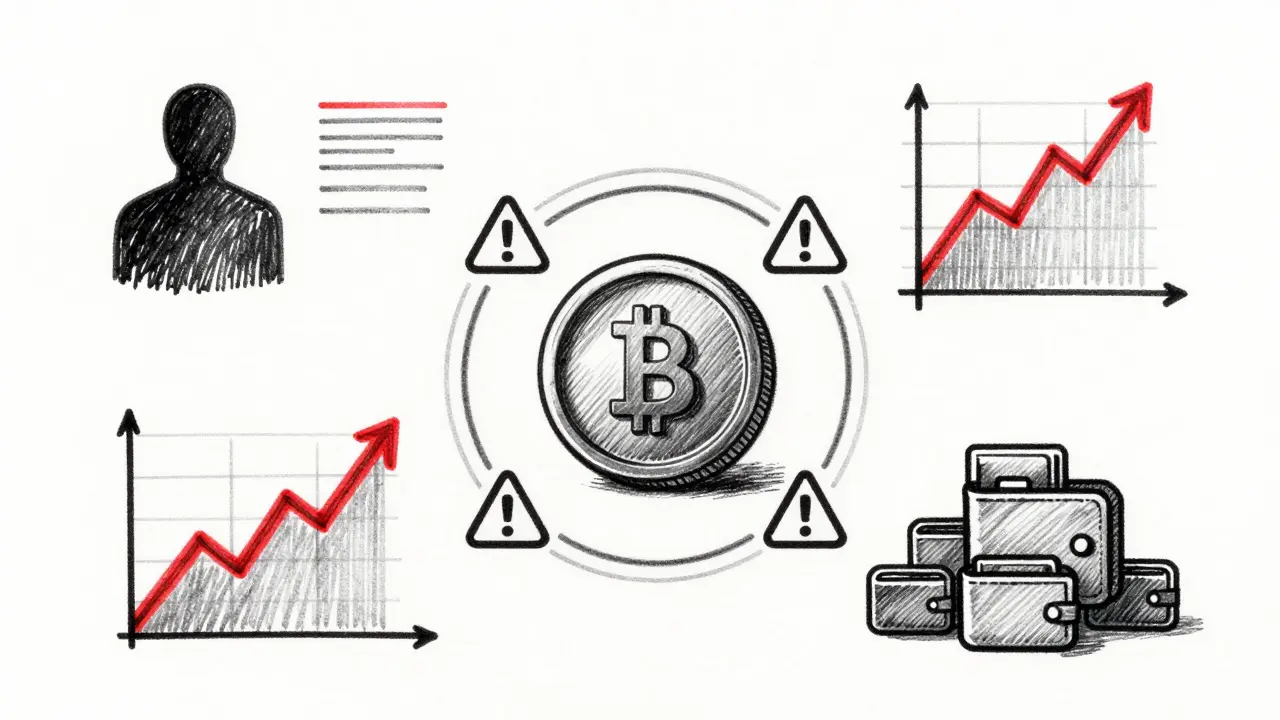
Not every volatile memecoin is a scam, but certain patterns appear repeatedly in fraudulent projects. If you see three or more of these signs, walk away.
- Anonymous Teams with No Track Record: While pseudonymity is common in crypto, complete anonymity combined with zero prior successful projects is risky. Legitimate teams usually have public GitHub repositories or verifiable identities.
- Unrealistic Promises: Guarantees of fixed returns, partnerships with major brands (like Coca-Cola or Tesla) that haven’t been officially confirmed, or claims of "revolutionary technology" buried under meme culture are classic lies.
- Sudden Volume Spikes Without News: If a token’s trading volume increases tenfold overnight without any corresponding development update, partnership announcement, or market-wide trend, someone is pumping it.
- Concentrated Holdings: Check the holder distribution. If the top 10 wallets hold more than 30-40% of the supply (excluding liquidity pools), a few people control the price. They can dump on you anytime.
- Locked Liquidity Lies: Many scammers claim their liquidity is locked. Verify this on platforms like Uniswap or Raydium. If the lock expires soon or doesn’t exist, developers can pull the rug instantly.
- Aggressive Social Media Marketing: Spammy comments, bot-like accounts praising the token, and excessive use of emojis and caps lock are indicators of coordinated promotion rather than organic community growth.
Tools and Techniques for Verification
Relying on gut feeling isn’t enough in 2026. You need data. Fortunately, blockchain transparency allows us to verify almost everything. Here’s how to dig deeper.
| Tool Type | Examples | What to Look For |
|---|---|---|
| Blockchain Explorers | Etherscan, Solscan, BscScan | Check contract age, number of holders, and transaction history. Look for unusual transfers between developer wallets. |
| Token Snipers & Analytics | DexScreener, Dextools, Birdeye | Analyze price charts for unnatural spikes. Check if the token has been flagged for honeypot behavior (can’t sell). |
| Wallet Trackers | Nansen, Arkham Intelligence | Identify if smart money is buying or if known scammer wallets are involved. Track cluster activity. |
| Contract Auditors | Honeypot.is, TokenSniffer | Run the contract address through these tools to check for malicious code that prevents selling or taxes transactions excessively. |
For example, if you’re looking at a new token on Solana, which is a high-performance blockchain platform known for low fees and fast transactions, use Solscan to view the top holders. If you see five wallets created on the same day holding 20% of the supply each, that’s a huge red flag. Real communities distribute tokens widely over time.
Also, check the contract code. On Ethereum-based chains, you can verify if the contract is open-source. If the code is obfuscated or hasn’t been verified on Etherscan, assume it contains hidden functions that allow the creator to mint infinite tokens or blacklist your wallet.
Pump and Dump vs. Rug Pull: Knowing the Difference
People often confuse pump and dumps with rug pulls, which are scams where developers withdraw all liquidity from a token's pool, leaving investors with worthless assets. While both result in losses, the mechanics differ.
In a pump and dump, the token remains tradable, but the price collapses because sellers overwhelm buyers. The liquidity pool still exists, but the value is gone. In a rug pull, the developers literally steal the funds from the liquidity pool. You can’t sell at all because there’s no counterparty. Both are devastating, but rug pulls are technically easier to execute on decentralized exchanges without proper locks. Always check if liquidity is locked and for how long. A short lock period (e.g., 7 days) is a warning sign; legitimate projects often lock for months or years.
The Role of Social Engineering
Technology matters, but psychology is the real weapon. Scammers exploit cognitive biases. The most powerful is social proof. When you see hundreds of people buying, you assume they know something you don’t. But those "people" might be bots. Automated scripts can generate thousands of fake tweets, Discord messages, and Telegram reactions in seconds.
Another tactic is scarcity. Phrases like "presale ending soon" or "limited supply" trigger panic buying. In reality, memecoin supplies are often infinite or easily expandable by the creator. There is no scarcity unless the contract explicitly burns tokens and verifies the burn on-chain.
Influencer marketing is also a key driver. In 2026, many influencers use "shill" channels where they promote tokens for free allocation. They rarely do due diligence. If an influencer with a following of 100k suddenly shills a micro-cap token, ask yourself: Why are they telling me? Usually, it’s because they’ve already bought in and need exit liquidity.
Protecting Yourself: A Practical Checklist
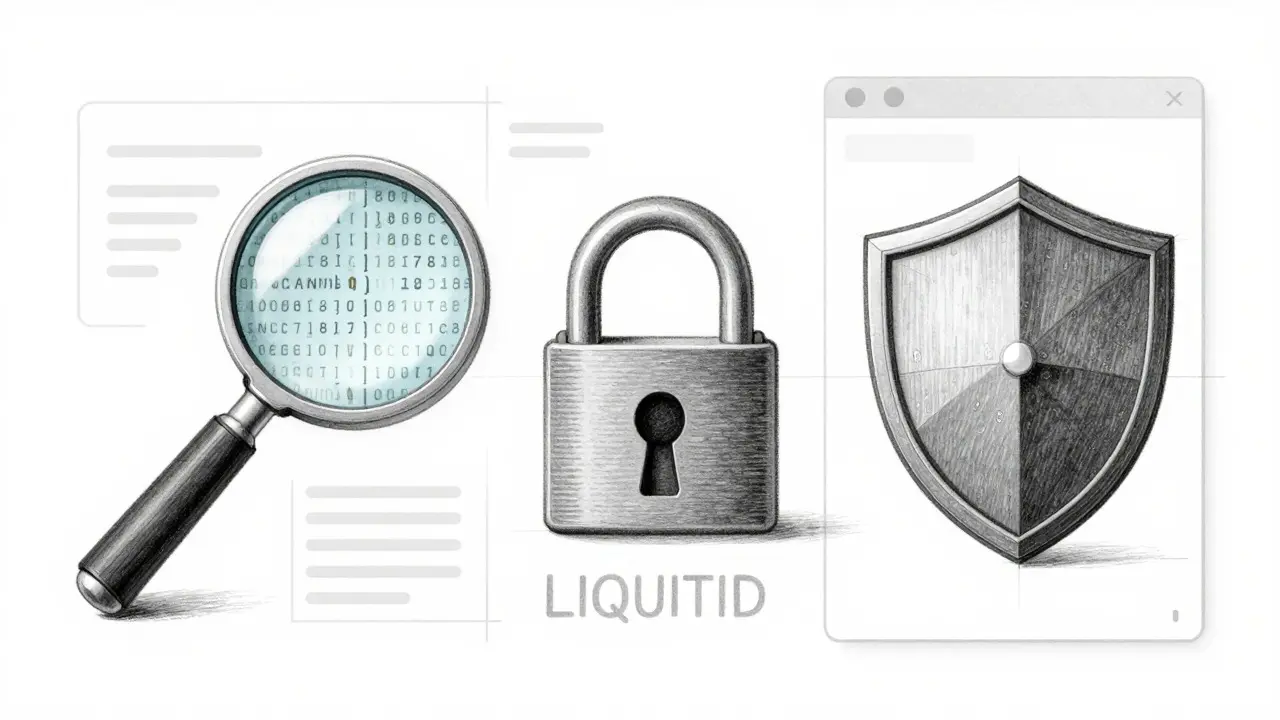
You don’t need to be a coder to stay safe. Follow this checklist before investing in any memecoin:
- Verify the Contract: Ensure it’s verified on the block explorer. Run it through a honeypot checker.
- Check Holder Distribution: Top 10 holders should not exceed 30% of supply (excluding LP). Use tools like Bubblemaps to visualize connections between wallets.
- Assess Liquidity: Is it locked? Where? For how long? If it’s unlocked, treat it as high risk.
- Research the Team: Are they anonymous? Do they have a history? If yes, proceed with extreme caution.
- Ignore Hype: If everyone is talking about it, you’re probably too late. Early adopters profit; latecomers pay the price.
- Use Limit Orders: Avoid market orders during pumps. Slippage can eat 20-50% of your investment in volatile conditions.
- Take Profits Early: If you double your money, sell half. Play with house money. Greed is what keeps people trapped.
Regulatory Landscape in 2026
The regulatory environment has tightened since the early days of crypto. Agencies like the Commodity Futures Trading Commission (CFTC), which is a U.S. government agency responsible for regulating derivatives markets, including cryptocurrency futures and the Securities and Exchange Commission (SEC) have increased scrutiny on digital asset promotions. In 2025 and 2026, several high-profile cases resulted in fines and bans against influencers and platforms facilitating pump and dumps.
However, enforcement lags behind innovation. Most memecoins launch on decentralized exchanges (DEXs) like Uniswap or Raydium, which operate without intermediaries. This makes direct prosecution difficult. Regulators are focusing on centralized exchanges (CEXs) and social media platforms, requiring them to label sponsored content and remove fraudulent listings. Still, the burden of verification largely falls on the investor.
Blockchain analytics firms like Chainalysis and Elliptic are helping authorities trace illicit flows. Wallet clustering techniques can identify when multiple addresses belong to the same entity. If you’re involved in a pump group, your digital footprint is permanent. Be aware that anonymity online is an illusion.
Conclusion: Stay Skeptical, Stay Safe
Memecoins offer excitement and potential rewards, but they come with extreme risk. The majority fail. A significant portion are outright scams. By understanding the mechanics of pump and dump schemes, using analytical tools, and maintaining emotional discipline, you can navigate this space more safely. Remember: if it sounds too good to be true, it almost certainly is. Protect your capital, verify everything, and never invest more than you can afford to lose.
What is the biggest red flag for a memecoin pump and dump?
The biggest red flag is a sudden, unexplained spike in price and volume accompanied by aggressive social media promotion. If the token has no clear utility, an anonymous team, and concentrated holdings among a few wallets, it is highly likely being manipulated.
How can I check if a memecoin's liquidity is locked?
You can check liquidity locks on platforms like Unicrypt, Team.Finance, or directly on the DEX interface. Look for a "Lock" status and verify the expiration date. If no lock information is available, assume the liquidity is unlocked and at risk of being pulled by developers.
Are pump and dump schemes illegal?
Yes, pump and dump schemes are considered market manipulation and are illegal in many jurisdictions, including the United States. Regulatory bodies like the CFTC and SEC actively pursue offenders, though enforcement in decentralized spaces remains challenging.
What is the difference between a pump and dump and a rug pull?
In a pump and dump, manipulators inflate the price and then sell their holdings, crashing the price. The liquidity pool remains intact. In a rug pull, developers withdraw all liquidity from the pool, making the token unsellable and stealing the funds directly.
How do scammers coordinate pump and dump schemes?
Scammers use private Telegram groups, Discord servers, and encrypted messaging apps to coordinate. They often employ bots to amplify messages on public platforms and hire influencers to spread hype. Timing is critical, with announcements made just before the pump phase begins.


Ed Wallace
9 August, 2026 . 10:10 AM
It is fascinating to observe how the digital marketplace has become a theater of human psychology, where greed and fear dance in a chaotic waltz. The article outlines the mechanics with precision, yet one must wonder if the true trap lies not in the code but in our own susceptibility to narrative. We are creatures of story, after all, and a compelling tale of wealth can override even the most rational caution. Perhaps the survival guide should also include a section on emotional discipline, for that is the ultimate firewall against such schemes.
Joshua Hofford
10 August, 2026 . 19:27 PM
I think there is still hope for the community if we just keep educating each other! It’s great to see people sharing these insights because knowledge is power. Let’s keep the vibe positive and help newcomers avoid these pitfalls together.
Marcia Albert
10 August, 2026 . 21:04 PM
Just watching from the sidelines with a cup of coffee. The whole scene feels like a circus, doesn't it? All the flashing lights and loud noises, but the ringmaster is always empty-handed at the end. I prefer to let the chips fall where they may rather than chase the green candles.
Emma Smith
11 August, 2026 . 17:17 PM
look deep into the abyss and the abyss will dump on you basically its all about the liquidity pools and the smart money moving before the retail clowns show up so if you dont have the tools you are just food for the wolves
Michael Mostyn
13 August, 2026 . 06:31 AM
The structural integrity of these schemes relies heavily on the asymmetry of information available to different market participants. While the average investor relies on public sentiment, the orchestrators utilize private channels and advanced analytics to execute their strategies. This disparity creates an inherent unfairness that regulation struggles to address effectively due to the decentralized nature of the platforms involved.
Erica Johnson
14 August, 2026 . 02:12 AM
You really need to check the contract yourself instead of trusting some random post online :/ Most people here are too lazy to verify anything which is why they lose their shirts every single time
Ken G
14 August, 2026 . 20:13 PM
they want you to believe it is free market but it is rigged by the elites who control the narratives and the bots are everywhere watching your every move so stay woke and protect your energy because the system is designed to fail you
Lorraine Surringer
15 August, 2026 . 17:01 PM
Oh honey, you have no idea how painful it is to watch people walk into these traps again and again. It breaks my heart honestly. You just have to listen to your gut feeling when something seems off because your intuition knows better than any chart ever could.
Alex Di Mango
16 August, 2026 . 13:43 PM
Let's try to keep the discussion respectful and helpful for everyone involved. It's easy to get cynical, but sharing accurate information is the best way forward. We can learn from these mistakes without tearing each other down.
Amor Jordan
18 August, 2026 . 03:22 AM
I feel like we often forget the human element behind these transactions. It is not just numbers on a screen; it is real people losing savings and trust. Being empathetic to those who have fallen victim is crucial, rather than just blaming them for being gullible.
Nick Darring
19 August, 2026 . 17:18 PM
Actually, I think the problem is that everyone is trying to be too careful and missing out on the actual opportunities that exist if you are brave enough to take risks. The ones who make money are the ones who jump in early and don't overthink it. Sure, you might lose some, but the winners win big. It is all about the thrill of the chase and the adrenaline rush of the pump. Why let a little thing like fraud stop you from potentially changing your life?
Eden Tadesse
20 August, 2026 . 20:04 PM
thats a good point about the risk taking i guess sometimes you have to roll the dice to win big right
Eric Zehr
21 August, 2026 . 14:05 PM
While risk-taking is part of investing, reckless speculation is a different matter entirely. There is a distinct difference between calculated risk based on research and gambling on hype. We should encourage diligence, not impulsivity.
Namrata Mapgaonkar
23 August, 2026 . 04:54 AM
In India we see similar patterns with penny stocks so it is not just crypto but human nature everywhere :) Maybe we can share more cross border experiences to help each other stay safe
Rita Dutta
23 August, 2026 . 16:29 PM
The cosmic dance of supply and demand is often disrupted by these artificial manipulations which shows a lack of spiritual alignment in the market forces at play
Paul Smith
24 August, 2026 . 13:28 PM
Hey guys! 👋 Just wanted to say thanks for this info. 🙏 It's super helpful to know what to look out for. Stay safe out there! 🚀💸
Rodmun Tarnowski
25 August, 2026 . 22:14 PM
Indeed! The importance of verification cannot be overstated. One must always ensure that the liquidity is locked and the team is transparent. These steps are essential for maintaining confidence in the asset.
Matthew Smith
26 August, 2026 . 13:40 PM
morality is dead in crypto anyway so why bother checking just buy the dip and pray to the blockchain gods
Prudence Flemming
26 August, 2026 . 21:08 PM
the jargon is thick but the truth is simple if you cant explain it simply you dont understand it and these scammers know that so they hide behind complex contracts and buzzwords
Carl Michaud
27 August, 2026 . 01:57 AM
The entire ecosystem is built on a foundation of lies and deception orchestrated by shadowy figures who manipulate the data streams to create false signals of strength. Trust nothing. Verify everything. The mainstream media will never tell you the real story behind these coordinated attacks on your financial freedom.
Matt Kay
29 August, 2026 . 01:32 AM
boring read tbh
Dave Kjendal
30 August, 2026 . 06:44 AM
most people dont have the brains to spot these scams anyway so might as well just give up and buy gold or something stable
Kat Bennett
31 August, 2026 . 01:40 AM
I have been following the trends closely and it seems like the regulatory pressure is finally starting to bite into these operations. It is interesting to see how the landscape shifts over time and whether these measures will actually deter the bad actors or just push them further underground. We will have to wait and see how the next year unfolds in this space.