
Back in November 2021, BitOrbit (BITORB) launched its token on BSCPad with a promise: a structured, multi-phase IDO and airdrop designed to reward early supporters. But today, the project sits at a market cap of just $2.83K - a far cry from the $290K it raised. So what really went down? And why did an IDO that looked solid on paper end up as a cautionary tale?
How the BitOrbit Airdrop Actually Worked
The BitOrbit token sale wasn’t a wild, free-for-all giveaway. It was methodical. Six separate fundraising rounds ran over weeks, each with specific rules. The airdrop component wasn’t just for random Twitter followers - it was tied to participation in earlier stages like private sales and whitelist registrations. To qualify, users had to complete KYC, connect their wallets, and hold a minimum amount of BSCPad’s native token. This wasn’t a spammy “join our Telegram” scam. It was a real, vetted process - the kind that was considered standard back then.At launch on November 4, 2021, at 21:25 UTC+3, 10% of the total BITORB supply was released to participants. The rest? Locked up. A one-month cliff period followed, meaning no one could sell anything for 30 days. After that, the remaining 90% was released linearly over four months - about 22.5% per month. This wasn’t meant to pump prices. It was meant to keep people invested in the long term.
Why BSCPad Was the Right Choice (At the Time)
BitOrbit didn’t pick a random platform. It chose BSCPad, one of the top 10 IDO launchpads on Binance Smart Chain in 2021. Why does that matter? Because BSCPad had a reputation for filtering out outright scams. Projects had to pass basic checks: team transparency, whitepaper clarity, and a working prototype. For users, that meant less risk than jumping into a random CoinMarketCap listing.But even the best launchpad can’t save a weak project. BSCPad’s system worked as designed - it distributed tokens fairly, locked them properly, and ensured smart contract security. The problem wasn’t the platform. It was what happened after.
The Hidden Flaw: No Real Use Case
Here’s where BitOrbit fell apart. The tokenomics were smart. The distribution was fair. The launchpad was reputable. But what was BITORB actually for?No one could answer that clearly. There was no dApp. No game. No DeFi protocol. No utility beyond trading. Investors weren’t buying into a product - they were betting on hype. And when the initial excitement faded, so did the price. Compare that to successful 2021 IDOs like those on Polkastarter or DAO Maker. Those projects had working products, active communities, and real roadmaps. BitOrbit had a whitepaper and a token contract.
That’s why the market cap collapsed. $290K raised. $2.83K left. That’s a 99% drop. Not because the market crashed - because the project had no reason to exist.
What’s Changed Since 2021?
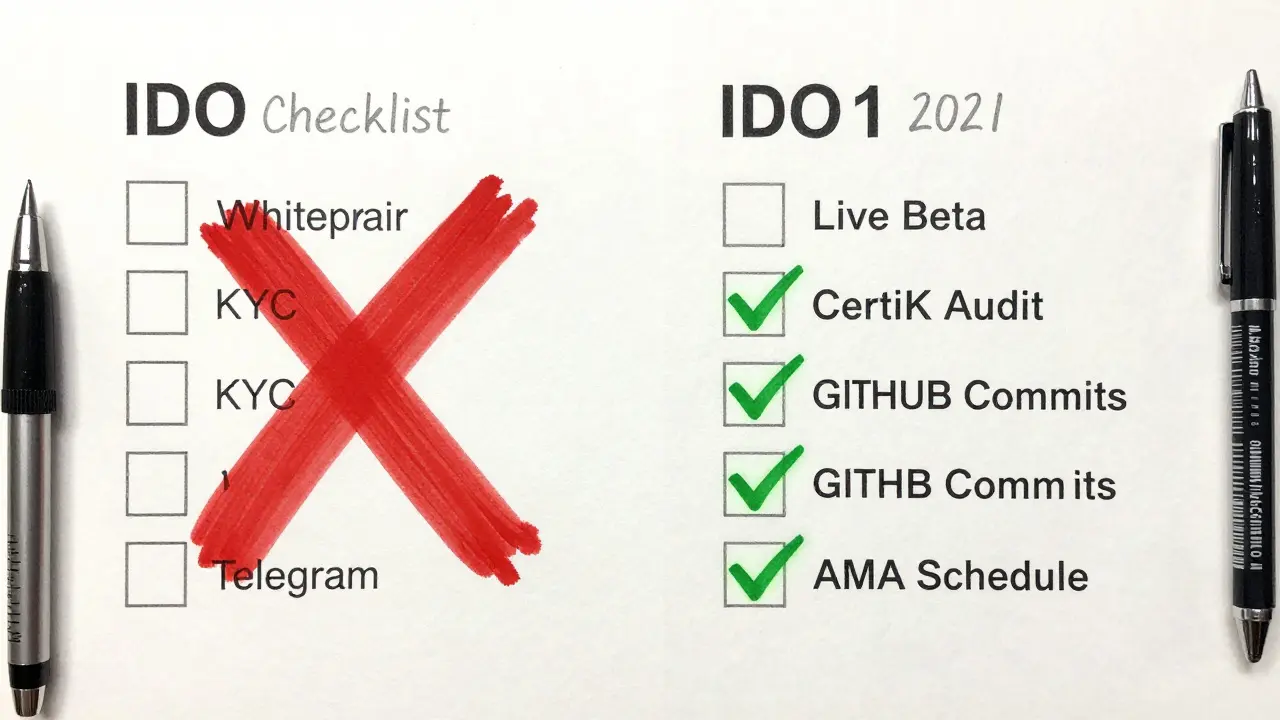
If BitOrbit launched today, it wouldn’t have made it past the first gate.Modern IDO launchpads like DAO Maker, GameFi, or Bybit Launchpad don’t just check KYC - they demand proof of product. They require:
- Live beta versions of the platform
- Third-party audits from firms like CertiK or Hacken
- Clear token utility (e.g., staking rewards, governance voting, fee discounts)
- Active social media with real engagement, not just bots
And the financial bar is higher too. Entry fees for top launchpads now average $72.29. You’re not just paying to join - you’re paying to prove you’re serious. BitOrbit’s 2021 model would never pass today’s standards.
Also, investors aren’t playing guessing games anymore. They check GitHub commits. They look at team LinkedIn profiles. They track on-chain activity. A token with no code updates, no community calls, and zero development activity? It’s dead on arrival.
Lessons from BitOrbit’s Failure
BitOrbit’s story isn’t about bad luck. It’s about a classic mistake: confusing fundraising success with product success.Here’s what you can learn from it:
- Token distribution ≠ value creation. Locking tokens sounds smart, but if no one uses the product, the lock-up is meaningless.
- Launchpad reputation doesn’t guarantee success. Even BSCPad couldn’t save a project with no purpose.
- Airdrops need utility. If your airdrop doesn’t lead to real usage, it’s just a giveaway that burns your credibility.
- Post-launch execution is everything. The moment the token goes live, the real work begins. No updates? No community? No future.
Projects that thrive today aren’t the ones with the flashiest marketing. They’re the ones with daily code commits, weekly AMAs, and transparent roadmaps. BitOrbit had none of that.
Is BITORB Still Active?
As of early 2026, there’s no evidence of ongoing development. The official website is down. The GitHub repo hasn’t been updated since 2022. Social channels are silent. The token trades on a few low-volume DEXs, but daily volume is under $50. It’s effectively a ghost project.Some holders still cling to it, hoping for a revival. But without a team, a roadmap, or any activity, that’s just wishful thinking.
What Should You Do If You Still Hold BITORB?
If you’re sitting on BITORB tokens:- Don’t wait for a miracle. The odds are near zero.
- Check if you can swap it for any other token on decentralized exchanges - even if it’s worth pennies.
- Learn from the mistake. Next time, ask: What does this token actually do? If you can’t answer in one sentence, walk away.
The crypto space moves fast. Projects that don’t evolve die. BitOrbit didn’t fail because of bad luck. It failed because it was never built to last.
Was the BitOrbit airdrop real?
Yes, the BitOrbit airdrop was real and part of its official IDO process on BSCPad. Participants who completed KYC, held the required BSCPad tokens, and joined whitelist rounds received BITORB tokens at launch. However, the airdrop was not a free giveaway - it was tied to active participation in the fundraising rounds. Tokens were distributed via smart contract and subject to vesting schedules.
Why did BitOrbit’s price crash so hard?
BitOrbit’s price crashed because it had no real utility. The token had no use case - no dApp, no staking, no governance, no product. Investors bought in hoping for quick gains, but once the initial hype faded, there was nothing to hold value. The $290K raised didn’t translate into development, marketing, or community growth. Without ongoing work, the token became worthless.
Could BitOrbit have succeeded if it launched today?
No. Today’s launchpads require far more than just a whitepaper. Projects must show live beta versions, third-party audits, active GitHub commits, and clear token utility. BitOrbit had none of that. Even if it had raised the same amount, modern platforms would have rejected it before listing. The bar for legitimacy has risen dramatically since 2021.
Is BitOrbit still trading?
BitOrbit (BITORB) still trades on a few low-volume decentralized exchanges, but daily volume is under $50. The official website is offline, the GitHub repo is inactive since 2022, and social media channels are abandoned. It’s not listed on any major exchanges. For all practical purposes, it’s a dead project.
What’s the difference between an IDO and an airdrop?
An IDO (Initial DEX Offering) is when a new token is sold directly to the public via a decentralized exchange, usually through a launchpad like BSCPad. Participants pay to buy tokens, often with crypto like BNB or USDT. An airdrop is when tokens are given for free - usually to users who complete tasks like joining Telegram, holding a specific token, or referring friends. BitOrbit’s airdrop was part of its IDO process - not a separate free giveaway.
How do you avoid projects like BitOrbit in the future?
Always check three things before investing: 1) Is there a working product? Look at GitHub commits and beta access. 2) Is the team real? Search LinkedIn profiles and past projects. 3) Is there ongoing community activity? Look for weekly updates, AMAs, and honest Q&As - not just hype posts. If you can’t answer these clearly, it’s not worth your money.

Anandaraj Br
18 February, 2026 . 08:57 AM
lol this is why i stopped trusting idos after 2021
they all look like legit projects on paper until you realize they have zero code commits and a team that vanished after the airdrop
bitorbit was just another crypto meme with a whitepaper and a discord server full of bots
Andrew Edmark
19 February, 2026 . 07:25 AM
I feel you... I lost a decent chunk on this one too 😔
But honestly? It’s a lesson. Not everyone gets scammed on purpose. Some of us just believed in the dream.
Still, I’m glad I walked away before the next one. 🙏
yogesh negi
21 February, 2026 . 05:09 AM
You know what really kills me? The fact that BitOrbit had a solid structure, a reputable launchpad, proper vesting... everything except the one thing that matters: a real product.
It’s like building a Ferrari with no engine.
Everyone was so focused on the wheels and the paint job, no one checked under the hood.
And now? The whole thing’s rusting in a junkyard.
We need to stop romanticizing tokenomics and start demanding utility.
Every single project that survived 2022 had daily GitHub updates.
BitOrbit had a press release and a Telegram bot that said 'HODL'.
That’s not a community. That’s a graveyard with a banner.
And the worst part? People still hold it.
Hope is the most expensive crypto asset out there.
AJITH AERO
21 February, 2026 . 14:37 PM
so they raised 290k and now its worth 2.83k
congrats you just invented a new way to burn money
Lauren Brookes
22 February, 2026 . 16:25 PM
It’s wild how much we used to believe in the mechanics alone.
Lock-ups, vesting, KYC - we thought those were magic shields.
But none of it matters if the project doesn’t actually do anything.
I think we all forgot that crypto isn’t about finance - it’s about building things people want to use.
BitOrbit didn’t build anything.
It just took money and disappeared.
Chris Thomas
24 February, 2026 . 13:33 PM
The failure of BitOrbit isn't a case study - it's a diagnostic of the entire 2021 IDO ecosystem.
Tokenomics without product-market fit is financial theater.
Lock-up schedules are not a substitute for development velocity.
Launchpad reputation is not a proxy for due diligence.
And airdrops are not community-building - they're vanity metrics dressed as incentives.
What we're seeing here is the death rattle of speculative capitalism masquerading as innovation.
Real projects don't need to explain why their token matters - their code does.
BitOrbit's GitHub was a ghost town.
That's the real red flag - not the price drop.
Sarah Shergold
25 February, 2026 . 14:09 PM
bitorbit lol
they had a whitepaper and a discord
thats it
no code no updates no nothing
classic
Dominica Anderson
26 February, 2026 . 14:05 PM
America had the right idea - we moved on.
These Indian and东南亚 projects think they can just throw a token out there and call it a day.
It’s embarrassing.
You don’t get to play in crypto with a PowerPoint and a dream.
Real innovation doesn’t need hype - it needs code.
Nova Meristiana
27 February, 2026 . 21:02 PM
Wait - you’re telling me a project with no utility failed?
Shocking.
I mean, who could’ve seen that coming?
Maybe if they’d added a meme coin mascot…
or a TikTok dance…
oh wait - they didn’t even have that.
lol
Nicole Stewart
1 March, 2026 . 20:59 PM
No utility no future.
Done.
Tarun Krishnakumar
3 March, 2026 . 08:21 AM
I knew this was coming.
Everyone talks about the airdrop like it was some grand scheme.
But here’s the truth - BSCPad didn’t vet the project.
They vetted the wallet addresses.
And the team? Two guys with LinkedIn profiles made in 2018.
One of them was a former Uber driver.
And the whitepaper? Copied from a 2017 Ethereum blog post.
And you think the market cap collapse was random?
It wasn’t.
It was a silent alarm.
Everyone who knew crypto saw it.
But the retail crowd? They were too busy reposting '1000x' memes.
The whole thing was a honeypot.
And now? The devs are on Telegram selling NFTs of their old roadmap.
They never even coded the product.
They just wanted to cash out before the next pump.
It’s not a failure.
It’s a feature.
Jenn Estes
4 March, 2026 . 21:10 PM
I’m not surprised.
They didn’t even have a Discord admin who replied.
And the website? Looked like it was built in 2014.
Anyone who invested after reading the FAQ deserves what they got.
Jeremy Fisher
6 March, 2026 . 05:27 AM
You know, I’ve been in crypto since 2017, and I’ve seen a lot of projects come and go.
But BitOrbit? It’s one of the few that made me feel sad.
Not because I lost money - I didn’t invest - but because I saw the potential.
It had the structure. The team looked legit. The timing was perfect.
But then... nothing.
No updates.
No blog posts.
No AMAs.
Just silence.
It’s like they took the money and went fishing.
And now the whole thing’s just a ghost story we tell newbies.
'Remember BitOrbit? Yeah... that’s how you don’t do it.'
JJ White
6 March, 2026 . 11:42 AM
This isn’t a failure - it’s a betrayal.
People trusted the system.
They did KYC.
They locked their tokens.
They waited.
And what did they get?
A silent GitHub.
A dead website.
A team that ghosted.
That’s not bad luck.
That’s malice wrapped in a whitepaper.
And the worst part?
They’re still trading on DEXs.
Like zombies.
Like ghosts.
Like hope.
And people are still buying.
Because they’re not smart.
They’re desperate.
Alan Enfield
7 March, 2026 . 04:13 AM
Honestly, I think the whole thing was a lesson in humility.
We all thought we were smart for picking a 'reputable' launchpad.
But reputation doesn’t mean accountability.
It just means they didn’t outright steal your money.
BitOrbit didn’t need to be evil.
They just needed to be lazy.
And that’s scarier.
Jennifer Riddalls
9 March, 2026 . 03:20 AM
I still have a few BITORB tokens tucked away
Not because I think it’ll bounce
But because I want to remember what not to do next time
And honestly? It worked
I haven’t invested in a single IDO since
Kyle Tully
10 March, 2026 . 23:30 PM
You know what’s funny? People still ask me if I have BITORB.
I say yes.
They say 'oh cool, you still believe in it?'
I say 'no, I keep it as a trophy'
Like a medal from a battle I didn’t win
It’s not worth anything
But it reminds me
That I used to be naive
And now I’m not
Anandaraj Br
12 March, 2026 . 20:42 PM
I saw the same thing happen with another project last week.
Same structure.
Same launchpad.
Same silence after launch.
It’s not luck.
It’s a pattern.
And they’re still doing it.
Because the next guy is always dumber than the last one.